Showing posts with label 1976. Show all posts

Friday, December 31, 2010

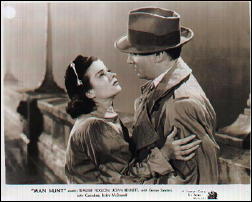
Man Hunt/Rogue Male

If, when talking about movies, someone at this year's New Year party (or at a film blog) pontificates the blanket statement "there's never been a remake of a film better than the original," here's a rebuttal (besides, say, True Grit) you can have at the ready:


Man Hunt (Fritz Lang, 1941) Dudley Nichols' adaptation of the 1939 Geoffrey Household novel that begins with a sure-fire set-up: a big game hunter, Captain Alan Thorndike (Walter Pidgeon), travels to Berchtesgaden to shoot Adolf Hitler right in the Berghof with a long-range rifle.  He "takes the shot," but then, on second thought loads a bullet into the chamber...too late.  He's discovered, taken prisoner and tortured for information by Major Quive-Smith (George Sanders, at his most impenetrably cold).  The Major wants the Captain to admit that his intent was to kill Der Fuhrer (something he understands being an avid sportsman himself) and sign a confession to that effect, saying that he was doing it for the British government.  Thorndike refuses, is beaten, then dumped over a cliff to make his death appear an accident.

But Thorndike survives, and makes his way back to England, barely ahead of his Nazi pursuers.  With the aid of a cockney lass, Jerry Stokes (Joan Bennett), he manages to elude his pursuers, going, literally, underground by living in a makeshift cave and living off the land.  But a cave has one drawback—it only has one exit, and this proves to be a weakness in Thorndike's cat-and-mouse with the Nazis.

It's a corker of a story, told with the visual paranoia that Lang excelled at.  It's one long chase that finally goes elementally one-on-one.  Where Nichols diverges from Household (aside from actually naming the dictator the author's anonymous hunter aims for, no doubt with the approval of the director, a German exile*) is in a neat insertion of a "woman's part," through the extended English city section, which becomes a deus ex machina for the final confrontations.  "Jerry Stokes" was a Nichols creation, it being thought that giving Thorndike a visible love interest for the audience to identify with, would more humanize Thorndike and his quest.  "Jerry" has her origins in the book, but was only suggested.  Nichols, Lang, and Bennett made flesh what Household only used as a back-story.   


Rogue Male (Clive Donner, 1976) BBC film of the Household novel that keeps the original more in its sights.  Where Man Hunt is urban, has a love interest, and is quite light-hearted at times, Rogue Male is more to the point, quite brutal (the shots of Peter O'Toole's Thordyke after being beaten to a bloody pulp are tough to watch) and extends the cave scenes, making them much more a part of the story (Pidgeon spends barely 20 minutes in the cave in Man Hunt) as they are in the book.

But it is the character of Thorndyke where the two most diverge—Pidgeon's captain does what he does to survive.  That's certainly true of O'Toole's characterization (it has to be!), but one also gets the sense that this hunter prefers life in a cave to one in the aristocracy.  Any hint of romance is purely prologue, giving an ethereal quality to the unnamed woman, that O'Toole merely suggests with a melancholy cast of his eyes.  Written with 20/20 hindsight by Frederic Raphael, the film is far more political than either the book or first film could ever hope to be at the time they were written, given the historical perspective nearly forty years can bring.  Smart, intelligent, unwavering, the BBC version of Household's novel is an adaptation worthy of the anonymous Hunter.

The Lang version is more stylish and romantic, but Donner's TV-version has the novel down cold.  O'Toole has stated that it is the favorite of all films.


* This supposedly worried 20th Century Fox exec Darryl F. Zanuck, as well as The Breen Office, as America, at the time, was neutral in the European War, not entering the fray until the attack on Pearl Harbor.

Saturday, September 6, 2008

Olde Review: The Shootist

Written August 11, 1976

"The Shootist" (Don Siegel, 1976) I was briefing through the movie reviews of various magazines in the grocery store a year or so ago, when I came across Richard Schickel's review of "McQ" or "Brannigan" (probably "Brannigan"), in which he remarked that a proper bicentennial project would be to come up with a decent script for John Wayne.

I was hoping
'Rooster Cogburn" might be it, but that was a waste..of time...and talent. And besides, as much as I like "Rooster" Cogburn as a character, the acceptance of Wayne's acting that suddenly sprang up smacked a bit too much of "Well, we'll like him as long as the old galoot knows he's a joke." Well, there were times in "True Grit" when Wayne--the Wayne as the screen force--came through. I didn't want to see Wayne made fun of or exploited. I wanted to see him triumph, as of old, in his now twilight years, and as John Wayne, the very fine actor.

So, I am delighted at "The Shootist" and delighted with it. It is about Wayne, as about Books (instant cliché time). Why else would Siegel in his opening use shots of old Wayne movies (and mostly Howard Hawks Wayne films, where Wayne played a character built out of his own persona, rather than playing "honest-to-God" characters ala John Ford) and with young boys---in 'Red River" and "Rio Bravo"--as Wayne the mentor, as he is, in an odd way, in this film.

Siegel is still a little obvious in his handling of things, but the ideas are so good, who cares? He literally numbers Wayne's days. And what a nice idea for a living legend and soon-to-be-immortal legend to have his birthday and the day of his death on the same day, on a gravestone that doesn't mark its day.

Death hangs over this film, in conversation, in song, in thought, in way of life. But this is nothing new. Death has walked with Wayne through many a picture. For a long time. Both were winners in the end, and, as in real life, Death must have his due.


"The Shootist" is the film John Wayne went out on, and as a summation of his career, and a the last ring of the bell, it's nearly perfect, even though the film is a bit flawed. Still, director Siegel did a masterful job of keeping the stars corraled--there was a lot of people wrangling to be in it--and Wayne healthy, although there were times when he was too weak to be on-set (although he was, at that time, cancer-free). And even though Wayne and Siegel got on like a house afire (the two couldn't have been more different, politically) there were still dust-up's about the way Siegel, the most economical and least fancy of directors, would line up shots. Lauren Bacall, who was no doubt reliving her own time of dealing with cancer with husband Humphrey Bogart, braved up through the movie, and provided a steely shoulder for Wayne to lean on. Stewart signed on for a cameo, comprising the most jarring scene; it's Stewart who provides the cancer diagnosis. And Richard Boone, John Carradine and Hugh O'Brian did the same out of respect and love for their old co-star, and Ron Howard, eyes set on a directing career instead of acting, still pursued the juvenile lead one last time. The budget was tiny, but top-heavy with stars...and history.

All those guest stars work against the film and make it lose focus a bit. You can tell that Siegel might not have gotten all the coverage he might have wanted--sequences seem stretched a might' thin. But overall, the film works well.

With time, perspective...and maybe a slight blurring of facts...one can look at "The Shootist" as the death of the Western--a sturdy movie genre for decades. The 60's had slowed it down, made them seem irrelevant, but one could still count on a number of Westerns being shot every year...until John Wayne died. And then...nothing.

A few things crop up here and there. "
Tombstone" and its cousin "Wyatt Earp," Eastwood's classic (and Oscar-winning) "Unforgiven," and "Silverado," which reminded how good a time an intelligent Western could be. "Deadwood" is a wickedly nifty updating of the "Gunsmoke" stories of a frontier town, and "3:10 to Yuma" this year briefly revived interest in the Old West and its ways. But a case can be made that without Wayne in the saddle, green-lighting a Western became a difficult proposition.

Why bother? Wayne kept the genre alive for so long, but with his passing, they became less viable.

They might still come back. Turner will do a period piece, a
Zane Grey adaptation, once in awhile, "Lonesome Dove" certainly proved popular, and even "Brokeback Mountain" made a contribution. But that "3:10 to Yuma" popularity was certainly encouraging.

Then there's the curious phenomenon of the Western morphing into another genre--Science Fiction, precisely. The "
Back to the Future" series capped off with an Old West yarn, and it was easy to see the gun-slinger in Han Solo in "Star Wars," the fight in the bar, etc. and, Joss Whedon created a future Western in the "Firefly" series, and its movie-spin-off, "Serenity." It's funny. Just as the western was a broad enough genre to encompass all sorts of morality plays that would reflect today's society, so, too does the Science Fiction story. The two overlap, and share much the same elasticity, that frequently it turns into a case of "You got Science Fiction in my Western/You got Western in my Science Fiction."

Maybe the Western hasn't rode into the sunset just yet.

Maybe it's just waiting for a new dawn.

Or a new star to guide her.


Monday, June 23, 2008

Olde Review: The Outlaw Josey Wales

written on September 10, 1976

"The Outlaw Josey Wales" (Clint Eastwood, 1976) It's a little hard to pin down Clint Eastwood as a director. In "Play Misty for Me," he tried to be technically expert at suspense after Don Siegel (and I guess Hitchcock--no one tries to be technically expert at suspense without calling on him), but (in "Misty") he tended to pad things out with diverting passages that didn't fit. Although the jazz concert segment of the film was fine in a verité sense, and although the other sequence made a recording star out of Roberta Flack, they were needless to the story and drew one away from the suspense (why make a suspense film, then?). It wasn't bad. But it wasn't good.

"High Plains Drifter" was a failure, for Clint tried to be arty and trashy in the same breath; it was an odd combination of vinegar and water, and although he stuck with the story, the film still didn't come together as a whole. "Breezy" was his best film, although if he could have worked on the script a bit more, and cut a few scenes it would have been better. It certainly revealed a pleasanter side to his character. If only he could work that into a script. "The Eiger Sanction" was a failure--it, too, was padded out to a numbing length and any crude charm that was in the book (it was an amusing day's read) was missing in the film; good score by John Williams, though)

Let me amend all this by saying that "The Outlaw Josey Wales" is definitely Clint Eastwood's best film as a director. This does not mean that it isn't flawed by no means. By no reason should this film be 145 minutes long. It needs to be cut (what is exasperating is that so much of it is good, I couldn't decide what to cut)* Also when Eastwood shifts his gears--and, well, he shifts gears like I drive a truck with a standard--interrupting the whole flow of the travelling. Just as "Josey Wales" is going full-speed into a quirky, fun adventure story, an upsetting bit of savagery by Commancheros is inserted, and for too long are we subjected to the raping and pillaging of a plucky Kansas family.

A lot of things stick in the memory. The first sequence--Wales plowing, his son playing at help, a single indelible image of wales' wife, pastorally lit, her form reflected in the water, an image both beautiful and too frail to last. Josey learning to shoot: a shot focused on a piece of wood, Josey firing out of focus, his attention on that target; cut to Josey and the target in focus, he's now concentrating both on the wood and himself (Eastwood spoils it by inserting another Wales unfocused shot). Some inspired casting--Sam Bottoms, John Vernon, Chief Dan George, that plucky Kansas woman,** nicely hewn portraits all. Nicely staged quirky gun battles--Josey sitting in front of a fire by George: "You never forget," the fire reflected on his face, but not this fire, another more life-changing one.

It contains the ruggedness we've come to expect on an "Eastwood picture." but also a humor and a good-heartedness that has never been mixed in with the ingredients.

This was Eastwood's best picture--up to that time. He was still self-indulgent, with his camera-work drawing attention to itself. A bit unsure of his compositions. A little too quick to use hand-held to generate frisson. He was learning the technical craft, but wasn't sure enough of himself and his actors to not meddle with it. And he had enough power in Hollywood to do what he wanted, without having to take a lot of guff from producers, although I'll bet he was consulting with Siegel. But his ability with actors was getting better, and the stolidness of the direction was starting to loosen up. But more importantly, he became more disciplined with his editing, more discerning of what he needed to tell the story, not show off how much he could experiment. Over the next few years he'd take a stab at directing lighter material, and set up challenges for himself on every picture, large and small. He'd get out of the western genre, and become a fine, disciplined director. "Bird" "Unforgiven" "The Bridges of Madison County" "Absolute Power" "Mystic River" "Million Dollar Baby" the Iwo Jima films. They're spare, powerful works by a director sure of his material and his actors.


But you started to see the artist Eastwood might become in the overall feel of "The Outlaw Josey Wales"--though he was still tied to the past and influenced by his work with Siegel and Leone (and torn between their two disparate styles) but starting to learn a new path--his own. It was fun to watch Eastwood become a great director. And no one could deny him that title with "Unforgiven." Of all the vanity projects directed by actors over the years that have won the Best Picture Oscar, that is the one film no one can argue with.

* Eastwood dwells on the attack on the wagon train and especially the rape too much, and I'd cut the "learning to shoot" sequence that I extol in the next 'graph.


**Paula Trueman.

Saturday, June 21, 2008

Olde Review: Logan's Run

written September 5, 1976

"Logan's Run" (Michael Anderson, 1976) "Logan" is a movie I'd like to have been a part of. There are so many steps where someone should have taken Saul David, Michael Anderson, or David Zelag Goodman by the hand with a warm glass of milk and a cookie and explain to them that what they wanted to do wouldn't work, and that the slip-shod way they were planning to realize it wasn't going to help it, either.

Mind you, there are some things I like. The
Jerry Goldsmith score (what, I'm going to desert Goldsmith now? Herrmann's dead and Barry's comatose!)* Jenny Agutter is in it, and provides some moments of acting that actually seem natural in this spectacle of the unnatural (unnatural matte shots, etc.) (Why, in God's name has it taken Jenny Agutter five years since her last movie to appear in another one? The insight and wisdom displayed in her performances in "The Railway Children," and in Roeg's "Walkabout" should have made her much more in demand, since she is undoubtedly the best young actress since Pamela Franklin--and have you seen what's she's been in lately?)** Peter Ustinov comes in and says his lines like he just thought them up, and makes Michael York et al. look like The Reader's Theater.

The film brightens up a bit once
York and Agutter reach outside, not only because we, the audience, are on familiar ground, but also because we're out of those God-awful sets.

A friend of mine who's read the book says that book and movie have only the title in common. It's too bad that this should be such a turkey. I remember
Bruce Dern's plaintive cry in "Silent Running"--"What happened to the flowers?" Walking out (of "Logan's Run"), echoed in my mind "What happened to the $8 million?" Sleazy matte shots. Cruddy model shots. And from the company that put "2001" together.*** It has been said that we are about to be engulfed by a resurgence of sci-fi movies, their popularity expanding in the fifties, and then dwindling out to be revived when someone came out with a new special effect technique. Now, unfortunately, it looks like "Logan" predicts a resurgence of '50's technique. What happened to Magicam that was supposed to be so revolutionary? Is everything being used on the "Star Trek" film?****

But, lest it be mistaken that I am concerned only with special effects, let me say that "Special effects are worthless unless the ideas presented are special, as well!"***** Or else we get things like "
Space: 1999" which looks gorgeous, but its scripts have the consistency (and intelligence) of tapioca pudding.****** (I'm writing this in a camper-pickup truck bouncing over Wyoming's dirt roads). We must have intelligent writing! (and I'm not helping!)


Ah, youth. Pretty bad and squirrely writing here, even for the back of a pick-up truck, but my sentiments about "Logan's Run" haven't changed a jot. The sets are cheesey (although setting the city in a mall was a particularly good idea--we'll probably all live in hermetically-sealed malls in the future), the effects are bad--the city-scape miniatures wouldn't pass Gerry Anderson muster--and the story is fairly trashed.

However, the stupidest decision by the producers to make the central theme of the book-- the lottery for "renewal" (that is, not killing everyone who turns 30--it's 21 in the book)--
a spectator sport. You'd think that after weekly events that destroy every participant that one of these young people would come to the conclusion that NOBODY ever got renewed. I don't care how self-absorbed or de-sensitized or drugged-out they are, someone would notice.

They're working on a remake now, which is perfect for a youth-dominated market of kids barely out of their teens, while, in the meantime, the film had an unofficial distillation of themes in
Michael Bay's "The Island."

* I've written about Goldsmith here. Bernard Herrmann had recently died (his last released score--for DePalma's "Obsession" would be released a scant two weeks away. John Barry was not comatose--I was being facetious--but he had relaxed his style to a slow dirge pace orchestrated for a massive number of strings.

**I wrote this when I was 21. All I can say in my defense is I had the "hots" for Jenny Agutter, so I was partial. I think it was because she didn't mind doing nude scenes. There wasn't five years between movies--I just hadn't seen them--and she continues to act occassionally--she played the mother in a remake of "The Railway Children," and had a role in the excellent "Mi-5" series (aka "Spooks"). Pamela Franklin had just appeared in "The Legend of Hell House."

*** The distributor has nothing to do with it, kid. It's the producer and the director and the design team.

**** The plight of the science-fiction film would be resolved (or made worse, depending on your view) the next year with the release of "Star Wars" and "Close Encounters of the Third Kind." The success of these films kick-started the on-again/off-again "Star Trek" film and its reultant film series. It is now being re-vamped, with a new cast, and a new version of "Logan's Run" is being prepped.

***** This was bolded in big block letters. The sentiment is still good (if obvious anywhere except Hollywood), but, really, there's no need to shout!

******What's wrong with tapioca pudding?!


Sunday, February 3, 2008

Missed It By That Much: Robin and Marian

Missed It By That MuchA series of analyses of treasured film that are not classics,
though they could have been if only a few elements were changed.


"Robin and Marian" (Columbia/Tri-Star) 1976
Director: Richard Lester
Screenplay: James Goldman

On paper, it looks perfect. The author of "The Lion In Winter" jumping a few years ahead in the story to tell of the end of Richard the Lionheart's bloody Crusades, and the return of Robin Hood and the loyal Little John to Sherwood Forest, where they find a lot has changed. Directing would be Richard Lester, who had returned to A-list prominence with his extraordinary staging of "The Three Musketeers"/"The Four Musketeers." He was becoming the "go-to" guy for period dramas, finding ways to bring a mature light-heartedness to any dreary point in history (or more appropriately, he would ignore Hollywood sound-stage pretense and show historical periods a bit more accurately--for example, his fly-filled Rome in the otherwise schtick-filled "A Funny Thing Happened On the Way to the Forum"). In the years since, his successes had been spotty: "Juggernaut," his all-star take on the disaster film, sank at the box-office (never mind--watch it!), as did his dream-project "Royal Flash" bringing his "Musketeers" adaptor George MacDonald Fraser's character to the big screen.
But "Robin and Marian" had that Goldman script (unfortunately, Goldman's other produced screenplay "They Might Be Giants," although good for naming rock bands, also failed at the box-office despite the star-power of a post-"Patton" George C. Scott and Joanne Woodward) and a dream-cast. Goldman wanted Nicol Williamson as Robin and maybe Sean Connery as Little John. Lester got them, but reversed the roles, which Goldman had to admit, worked. Robert Shaw would re-unite with his "From Russia With Love" co-star (and golfing partner) as the Sheriff of Nottingham. Richard Harris would play King Richard, Denholm Elliott and Ronnie Barker (of "The Two Ronnies") would be Merry Men. Ian Holm would appear as the weasley King John. But, with the role of Maid Marian, they hit the mother-lode: after nearly a decade off the screen, producer Ray Stark coaxed Audrey Hepburn to play the older, wiser lost love of Robin Hood.

Filming was done in Spain (Lester's old haunt from "Musketeers" and "A Funny Thing Happened On the Way to the Forum") and completed quickly--Lester's a "one-take" kind of director which always appealed to Connery.


Then things started to go wrong.
The script by Goldman is charming, but often relies, as did "The Lion in Winter" on piquant anachronisms--the kind of "Isn't that funny? They talk like we do!" approach to historical drama that can be a bit cloying. "You never wrote!" complains Maid Marian at one point in the script about Robin Hood's many years away. "I don't know how!" says Robin in perplexed reply.
But there are some nice things--the over-all theme of living past your prime or need, combined with Robin's nostalgia for the old days and his childish belief that he can make things right again on all fronts. There are some nice little cliche-bashings. I remember a couple of cut-away shots of Nicol Williamson's Little John looking pained at Robin and Marian expressing affection for each other, and thinking, "Oh Lord, they're going to make Little John gay!" which I thought was a pretty cheap way to bring in relevance to the story. But it proves to be a clever gambit. Later in the film when Marian goes to John and begs him to keep Robin out of battle, she makes the same assumption. "You've always been jealous of me! But you had him all those years!" Williamson beautifully underplays this scene "Yer Rob's lady," he mumbles. "What?" she cries. "If ye'd been mine, I'd never've left." and Williamson chucks the apple he was eating into the night where it arcs and disappears. Nice set-up. Nice turn. As is the ending, recreating the myth of Robin firing one last arrow through the window, telling John to bury Marian and he where it lands. In Lester's last shot, it never falls to earth.

The charm of the script no doubt appealed to Hepburn--she has a speech at the end that most actresses would kill for, though, practically. it slows the film to a crawl at a critical time. There are publicity pictures of Lester and Connery showing her around the set, but Hepburn, given Lester's directorial approach of "You act, I'll shoot" might have been a bit put off by his quick approach and lack of hand-holding.

She made complaints about some of the gristlier aspects to Lester's cut, particularly to his opening the film with a shot of ripe fruit, and ending it, with the fruit rotting in the sun. This is a brilliant way to express an aspect of the story--that Robin, and Marian too, have overstayed their usefulness. And the film is gritty. The staging of an opening scene in a burned-out desert fortress feels more like everybody's waiting for Godot rather than King Richard. And Lester keeps his own anachronisms well-chosen, for example Robin Hood's morning routine--waking up in the forest, stretching, brushing his teeth with a fir branch, and reaching for a good ball-scratch until he sees Marian waking up--Connery's hopping attempt to be nonchalant is priceless.

And the violence is rough stuff. People die very badly in the film despite the chain-mail and armor, and the wounds they suffer are played up. Lester seemed determined to counter-act any chirpiness in the film by bringing it down to Earth. Maybe this upset Hepburn.

But for whatever reason, producer Ray Stark chose to take control. Initially, Lester employed Michel Legrand, his composer for the "Musketeers" films, to write a period-appropriate score, which was met with much approval, though it wasn't tuneful or romantic in any way. Stark, hearing the score, and not having control over much else, replaced it with a quickly put-together score by John Barry, who'd worked with Lester before and whose James Bond scores for Connery were well-known. He also won an Oscar for the music for Goldman's "The Lion in Winter." Barry's a wonderful composer, but the main-stay of his score is a bucolic love theme that frequently bounces over the scenes and makes them too sweet for a film about the passing of youth and the end of days. It's sounds like it would be more appropriate for a film about otters frolicing than "Robin and Marian." Perhaps Stark thought would be enough to soothe the blue-haired ladies going to see Audrey Hepburn's first film in a decade. Given her rather cute performance, maybe it would have been a good idea to re-cast her, too. Perhaps she took the role as a chance to get another Oscar (she won in 1954 for "Roman Holiday"--Katherine Hepburn won for her starring role in "The Lion in Winter"). She didn't get it. Nor did the blue-hairs show up. The film was not a major hit at the box office.

I've never heard the Legrand score, but considering the amazing job that he did scoring "The Three Musketeers" for Lester, the two might have done something very interesting for this film. But we'll never know. "Robin and Marian" is locked in a bizarre nether-world where it's at once too sweet, but also stark and unsentimental. Lester could make misconcieved films, but his approach to counter-point Goldman's sentimentality in a world of hardship was a good one. One would have liked to have seen that version of the film.