Showing posts with label Peter O'Toole. Show all posts

Friday, December 31, 2010

Man Hunt/Rogue Male

If, when talking about movies, someone at this year's New Year party (or at a film blog) pontificates the blanket statement "there's never been a remake of a film better than the original," here's a rebuttal (besides, say, True Grit) you can have at the ready:


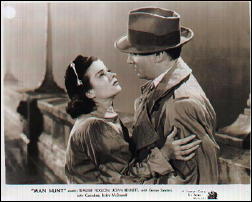
Man Hunt (Fritz Lang, 1941) Dudley Nichols' adaptation of the 1939 Geoffrey Household novel that begins with a sure-fire set-up: a big game hunter, Captain Alan Thorndike (Walter Pidgeon), travels to Berchtesgaden to shoot Adolf Hitler right in the Berghof with a long-range rifle.  He "takes the shot," but then, on second thought loads a bullet into the chamber...too late.  He's discovered, taken prisoner and tortured for information by Major Quive-Smith (George Sanders, at his most impenetrably cold).  The Major wants the Captain to admit that his intent was to kill Der Fuhrer (something he understands being an avid sportsman himself) and sign a confession to that effect, saying that he was doing it for the British government.  Thorndike refuses, is beaten, then dumped over a cliff to make his death appear an accident.

But Thorndike survives, and makes his way back to England, barely ahead of his Nazi pursuers.  With the aid of a cockney lass, Jerry Stokes (Joan Bennett), he manages to elude his pursuers, going, literally, underground by living in a makeshift cave and living off the land.  But a cave has one drawback—it only has one exit, and this proves to be a weakness in Thorndike's cat-and-mouse with the Nazis.

It's a corker of a story, told with the visual paranoia that Lang excelled at.  It's one long chase that finally goes elementally one-on-one.  Where Nichols diverges from Household (aside from actually naming the dictator the author's anonymous hunter aims for, no doubt with the approval of the director, a German exile*) is in a neat insertion of a "woman's part," through the extended English city section, which becomes a deus ex machina for the final confrontations.  "Jerry Stokes" was a Nichols creation, it being thought that giving Thorndike a visible love interest for the audience to identify with, would more humanize Thorndike and his quest.  "Jerry" has her origins in the book, but was only suggested.  Nichols, Lang, and Bennett made flesh what Household only used as a back-story.   


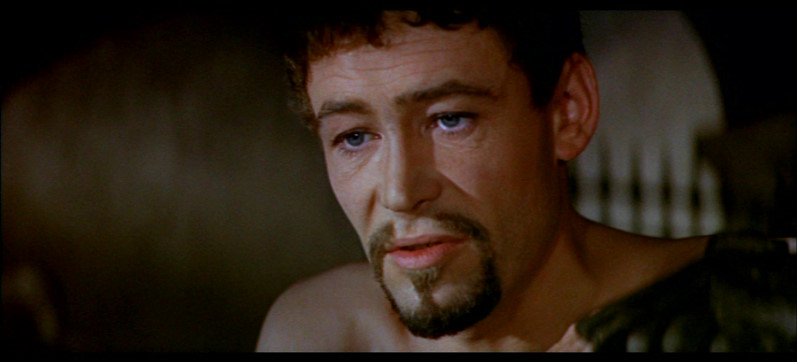
Rogue Male (Clive Donner, 1976) BBC film of the Household novel that keeps the original more in its sights.  Where Man Hunt is urban, has a love interest, and is quite light-hearted at times, Rogue Male is more to the point, quite brutal (the shots of Peter O'Toole's Thordyke after being beaten to a bloody pulp are tough to watch) and extends the cave scenes, making them much more a part of the story (Pidgeon spends barely 20 minutes in the cave in Man Hunt) as they are in the book.

But it is the character of Thorndyke where the two most diverge—Pidgeon's captain does what he does to survive.  That's certainly true of O'Toole's characterization (it has to be!), but one also gets the sense that this hunter prefers life in a cave to one in the aristocracy.  Any hint of romance is purely prologue, giving an ethereal quality to the unnamed woman, that O'Toole merely suggests with a melancholy cast of his eyes.  Written with 20/20 hindsight by Frederic Raphael, the film is far more political than either the book or first film could ever hope to be at the time they were written, given the historical perspective nearly forty years can bring.  Smart, intelligent, unwavering, the BBC version of Household's novel is an adaptation worthy of the anonymous Hunter.

The Lang version is more stylish and romantic, but Donner's TV-version has the novel down cold.  O'Toole has stated that it is the favorite of all films.


* This supposedly worried 20th Century Fox exec Darryl F. Zanuck, as well as The Breen Office, as America, at the time, was neutral in the European War, not entering the fray until the attack on Pearl Harbor.

Friday, October 17, 2008

My Favorite Year

"My Favorite Year" (Richard Benjamin, 1982) Surely one of the best jobs during the early 1950's was being a writer for "Your Show of Shows,"* broadcast live Saturday nights on NBC. Starring Sid Caesar, Imogene Coca, Carl Reiner and Howard Morris, the writing staff contained such wits as Reiner, Mel Tolkin, Larry Gelbart, Danny Simon, his odd couple brother Neil Simon, Lucille Kallen, and Mel Brooks.** The work environment was so fondly remembered it has consistently been used as comedic inspiration. First, Reiner used it as the work environment for "The Dick Van Dyke Show." Neil Simon wrote the stage-play "Laughter on the 23rd Floor."*** And Brooks took the kernel of a script by Dennis Palumbo about a going-to-seed celebrity and his "minder" and morphed it into his remembrance of "Your Show of Shows," "My Favorite Year."**** Brooks served as neither writer, nor director, but as Executive Producer, he completely re-imagined the film as this sunny, hilarious remembrance, dripping with nostalgia, of being a cocky kid in New York in the '50's working for a hit comedy show. 

"King" Kaiser (Joseph Bologna) is the high-strung, neurotic star of a network variety show, and one week it falls to writer's assistant Benjy Stone (Mark Linn-Baker) to "manage" movie star Alan Swann (Peter O'Toole) through the rehearsals and broadcast. Two problems: Swann's a perennial lush, and he's never acted before a "live" audience. Fortunately, Benjy is Swann's biggest fan and forgives a lot of bad behavior, but Swann's "bad boy" behavior, insecurities and inebriation keep throwing up barriers.

O'Toole was initially hesitant to take on the role of the Errol Flynn-like Swann (he was convinced by an odd coincidence--the date of Swann's death inscribed on a tombstone--in a scene cut from the film--was also O'Toole's birthday. He was, again, nominated for a Best Actor Oscar for his performance. Richard Benjamin solidified his transition from actor to director with this film, which also featured Jessica Harper as the apple of Benjy's eye, Bill Macy, Anne De Salvo and Basil Hoffman as the show's writers, legendary composer Adolph Green as a producer, Lainie Kazan as Benjy's mother, Cameron Mitchell as a mobster unhappy with his portrayal on the show, and even former "Show of Shows" performer Selma Diamond in a small role. 

But the highlight is O'Toole's swashbuckling star. Looking gaunt and rheumy-eyed even when he's not plowed, Swann benefits from O'Toole's charm, crack timing and physical comedy--O'Toole can do a prat-fall and make it look deadly--but the actor makes the drama work as well. Swann's freak-out at being told he's performing "live" ("I'm not an actor! I'm a movie star!!") is both comic and tragic. And he plays off well with a sharp cluster of East Coast character actors. 

The all-pervasive air of nostalgia begins immediately with the opening of Nat King Cole's "Stardust" over animated credits, and continues to the last frame with a joyous semi-sadness. "My Favorite Year" works on so many levels--as a drama as well as a comedy, as a fond remembrance as well as a fond farewell. And any movie that has a decent role for O'Toole to show how good he is, dramatically or comedically deserves a place on any list of 'favorites." 

* To give you a glimpse of "Your Show of Shows" here's Carl Reiner, Sid Caesar, Howie Morris and Louis Nye performing a sketch called "This Is Your Story." It's in two parts.

** And Woody Allen became a writer for the 60 minute version of the show, "Ceasar's Hour." 
*** Coincidentally, when "Laughter on the 23rd Floor" was video-taped for PBS, it was directed by "My Favorite Year" director Richard Benjamin, and featured its star, Mark-Linn Baker. 
**** The original screenplay took place in the early 1900's, and Wyatt Earp was the personage to be "minded."

Tuesday, April 8, 2008

How to Steal a Million

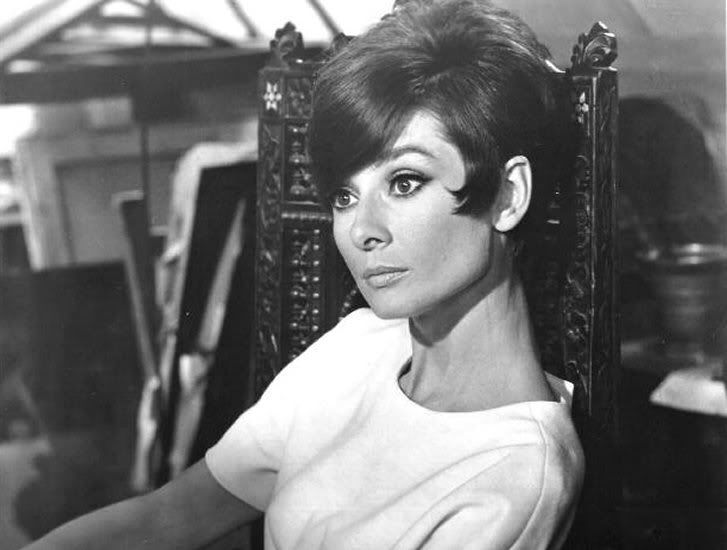
"How to Steal a Million" (William Wyler, 1966) Audrey Hepburn, all Givenchy'd up and no place to go, with her "Roman Holiday" director, William Wyler. Now the locale is Paris--the exteriors, at least--and the slim plot revolves around Hepburn securing the services of an art thief (Peter O'Toole--committed, but aloof) to break into a National Gallery to nab a statue (created by her forger-father) before the insurance company can examine it and expose it as a fraud. It takes about an hour of cute dialogue, spry encounters, several costume changes and an incident of "meet-cute" before we get there. The rest of the movie documents the long, drawn-out robbery which relies on false alarms--and we see all of them. There is magnetism involved, but not among the principal actors--Hepburn pirouettes in her own spotlight, and O'Toole observes, amused. Wyler, on the other hand, is content to make sure we see how expansive the sets are, like he was still filming "Ben-Hur." Those sets, however, never seem more than nattily-dressed cavernous soundstages (his next film would be the equally leaden "Funny Girl"). It's a trifle, with all the consistency of just-applied meringue, and with as much confectioner's sugar.

Monday, March 17, 2008

Venus

"Venus" (Roger Michell, 2006) Peter O'Toole, in an interview in the special features section of the "Venus" DVD sums it up as a story between "a dirty old man and a slutty young woman." Exactly, and if it had been sold like that it would have made much more money at the box-office. As it is, the film has to stand on its own merits, which are considerable. Hanif Kureishi's script is literate but low-down, full of humanity in all its frailties, both young and old, well-played by a stellar cast. And that's where the elements of specialness occur:

1) O'Toole--he plays an elderly thespian who, these days, "specializies in corpses," who has lived an impulsive romantic life, and in the winter of his discontent, still does. O'Toole makes the most of the words, but, more than any other actor, knows what to do between the lines. O'Toole is frail, but not THIS frail, and his tremulousness is a stunning act of craft over pride. He's not alone.


2) Playing the ex-wife he abandoned with three kids ("under six," she reminds him) is Vanessa Redgrave, the greatest actress extant, who does the part sans make-up, unglamourously and brilliantly. To see O'Toole and Redgrave play a scene together for the first time is a great event, and should be required viewing for all aspiring actors. These two actors, once coltish and prancing, now old and playing broken down is heart-breaking, but exciting (I'm starting to sound like bloody James Lipton!)


3) Jamie Alexander, in a seemingly artless way, matches them. That is not an insignificant thing. Picked, no doubt, because she resembles the young Vanessa Redgrave, one waits for the scene where the two meet. the viewer is not disappointed.

4) A scene where O'Toole, humiliated, goes for a walk and finds himself at a small, humble proscenium--the benches covered and strewn with leaves and garbage, as the soundtrack becomes awash with O'Toole's voice from past performances of different eras and different fidelities that's as fine as any piece of film I've ever seen

5) A waitess at the old actor's favorite eating hole sees a picture of the young actor in the paper. "Gawd, he was GO-geous, wasn't he?" Someone should make another starrer for O'Toole and call it "Give The Man The Friggin' Oscar He So Richly Deserves, Already" and be done with it.

Thursday, March 13, 2008

Becket

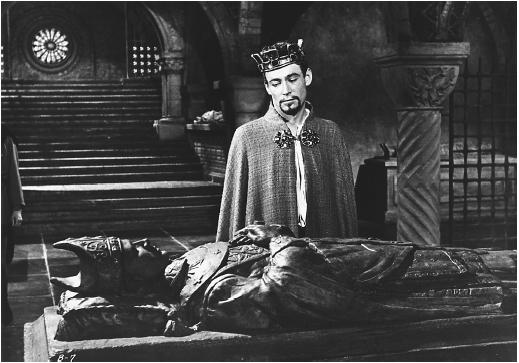
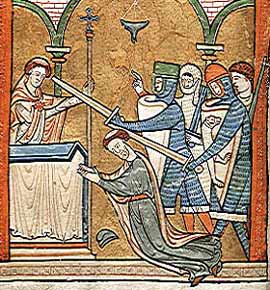
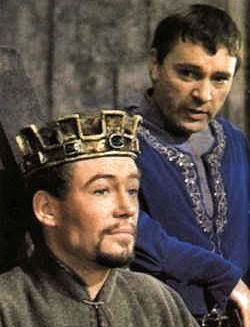
"Becket" (Peter Glenville, 1964) Why bother about religion when there's so much wenching to do? Wenching and bellowing at the TOP of your lungs while you're at it! King Henry II (Peter O'Toole, who would play the role again in "The Lion In Winter") is having trouble with the Archbishop of Canterbury, so when the elderly Archbishop dies he appoints as his replacement his old friend and advisor Thomas Becket (Richard Burton). Becket, being a Saxon--actually, he was Norman like Henry, the original playwright Jean Anoulih got it wrong--causes grief to Henry's Court. And then Becket finds religion as archbishop and gets all self-righteous on Henry, taking the Church's side on conflicts with the King. That does not sit well with the "perennially adolescent" first Plantagenet King, and in a drunken rage shouts, "Can no one rid me of this meddlesome priest?" and he has barons who are perfectly willing to take on the job. Becket, in death, becomes a folk-hero to the Saxons, and Henry, in remorse, has himself flogged and petitions for Becket's sainthood. Am I giving anything away? The story's only 800 years old! O'Toole and Burton have a fine time playing "Can you top this?" with each other in scene after scene, Burton controlled and stentorian and O'Toole indulgent and capering. Add John Gielgud as the King of France and you have some of the best British actors doing top-notch work in one film. Yes, it's talky, but with this cast, it sure is entertaining conversation.

Sunday, March 9, 2008

Don't Make a Scene: The Stunt Man

The Set-up: Cameron (Steve Railsback) is a fugitive on the run. In his flight he is nearly run down by Bert--a stuntman on a movie--performing a reckless stunt that kills him. Cameron is taken under the wing of the film's director, Eli Cross (Peter O'Toole), who, when the authorities make inquiries about the accident, insists that the new-comer, Cameron, is actually Bert, the late stuntman. Cameron, fearing arrest, plays along. Action!


Eli Cross: [Referring to his performance] You did that very well.

Cameron: Hey, I just listened.

Cross: There are a few actors only in the entire world who have mastered that art. Anyway, it was a very good audition. And the part is yours. Cameron: What? What are you talking about? What part?

Cross: Stuntman. [The two climb into the set's crane which rises]
Cameron: What about the people who work for you? They gonna look at me and go, "Hi, Bert?"


Cross: Prefer "Hi, Alice?" Don't worry about the people who work for me, my crew. They'll call you anything I wish them to. And I'm not being callous merely. Bert is a bloody tragedy, but there's nothing we can do about it. Nothing. I must have this location for three days and you need a place to hide.


Assistant Director: [Over megaphone] Eli, the crew is waiting. We need the next set-up.


Cross: [Down to the A.D.] The hand! Close-up of the hand! With you in a minute!
Assistant Director: An Eli minute or a real minute?


Cameron: By tomorrow the cops are gonna know exactly what I look like.


Cross: Oh, Bert, do stop this worrying. You must have heard of "movie magic?"


Cross: You shall be a stuntman. Who is an actor. Who is a character in a movie. Who is an enemy soldier.


Cross: Who'll look for you amongst all those? People like to believe in things and policemen are just people. Or so I'm told.


Cross: Frankly, our problem is so simple it's almost beneath us. Now, listen to me.


Cross: [Indicating the door of the hotel where the cast and crew are staying] That door is the looking glass. And inside it is Wonderland.


Cross: Have faith, Alice. Close your eyes, and enjoy.


Words by Lawrence B. Marcus and Richard Rush


Pictures by Mario Tosi, A.S.C and Richard Rush

"The Stunt Man" is available on DVD through Anchor Bay Entertainment