Showing posts with label 1982. Show all posts

Saturday, October 29, 2011

Now I've Seen Every "Thing" Department

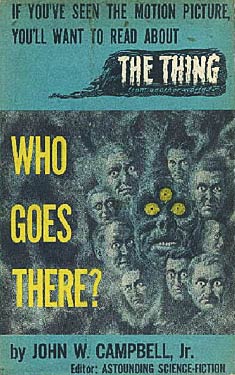
"Who Goes There?" by Don Stuart (a pseudonym for sci-fi pioneer John W. Campbell) is one of the acknowledged great stories in speculative fiction.  Part science-fiction, part horror and part psychological thriller, it tells of an isolated Antarctic research facility that discovers a flying saucer long buried in the ice.  Investigation leads to finding the saucer's sole inhabitant not too far away and taking the BEM-sicle back to the Ice Station for analysis.  Of course, it escapes and this particular ET has a special talent—it can "pretend" to be anyone it has killed and "absorbed."  Hiding in plain sight, the "Thing" starts picking off the scientists one by one, while the humans among them start to worry which of their (dwindling) number could be the wolf in sheep's clothing.  Paranoia strikes deep, but "The Thing" strikes deeper, able to replicate the men down to their blood-cells, which provides them with a nifty test to see who's genuine and who's a "Thing"-a-ma-job—take a blood-sample and dip a hot wire into it, and the alien-cells react and start to metamorphose, while the human hemoglobin merely sizzles.


Eventually, the alien is trapped by the scientists, while it is constructing an anti-grav ship to escape, forcing it outside into the cold, where it is torched by the scientists.  Humanity triumphs that the alien has been thwarted from fleeing or spreading itself to another outpost.  All's right with the world, especially considering that no other visit has occurred since the first ship crashed twenty million years before.  No other invasion is expected anytime soon.  The end.

From its origins in the August 1938 issue of "Astounding Stories," the tight, compact story was first adapted for the screen by Charles Lederer (with assists from Ben Hecht) and the film's producer, one of the great directors of American film, who put such a personal stamp on the film that, to this day, there is debate about just how much work on it the listed director of record actually did.  And that man's influence has taken over the DNA of his film's clones, so powerful is his influence and legacy.


The researchers take a measurement of the saucer.
Hawksian team-work in The Thing (from Another World)


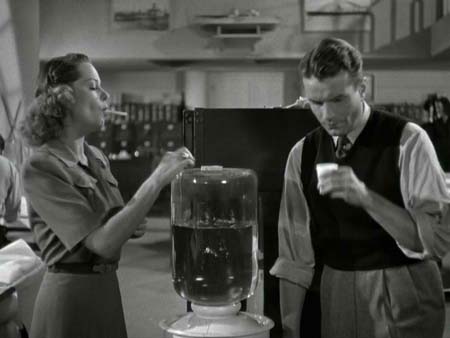
The Thing (From Another World) (Christian Nyby, 1951).  Yes, it says "Christian Nyby" in the credits, but the film is such a prime example of Executive Producer Howard Hawks' style that folks just assume he had a hand in directing it, as well.  He almost certainly re-wrote the script, as it crackles with wit, banter, and includes the requisite "Hawks woman" who's tough enough to play with "the boys."  In fact, the dialogue and human interplay are better than the film deserves and is more entertaining than the "monster movie" that is at its frozen core. 

Hawks puts it in the arctic, then tossed out Campbell's psychological element—his military/scientific crew are Hawksian professionals and suspicions about each other would drive a wedge into that mix (it's enough that one scientist want to emphasize research over self-preservation to cause some heated exchanges*), fraying the team-spirit necessary for to get through the crisis and the simple goal of staying alive.  Nope.  It's simple.  The "Thing" is bad.  "It" wants to kill us.  We kill "it" before "it" kills us.  Research?  That's what autopsies are for!

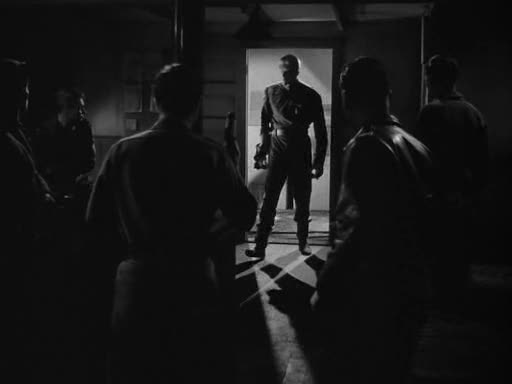
So, The Thing (From Another World) is much more of a monster movie than the study of paranoia the story is.  Teamwork towards a common goal is emphasized—you can say that a lot of Hawks' films are analogies to the disparate gypsy-camp of film-makers working together to create a single film—and it boils down to survival.  Besides the interplay of the characters, the film also boasts some iconic scenes: the Air Force officers and scientists spreading out on the ice to determine the size of the saucer; the sight of "the creature" (explained in simple unscientific jargon by one of the researchers as "an intellectual carrot") silhouetted in light as it kinetically bursts open the door of the room hiding the crew; the truly eerie scene of growing blood-sucking creature-clones like they were lethal daisies.

The Thing (From Another World) is a tough, no-nonsense monster movie with sides clearly drawn: us against them.  But the only hint of the original tale's paranoia comes from the film's final line: "Watch the skies!"


Braised carrots are on the menu at the arctic station tonight.
James Arness (in a role he hated) gets fried in The Thing (From Another World)


The Thing (John Carpenter, 1982) Carpenter has long been a disciple of Howard Hawks (his Assault on Precinct 13 is an urban remake of Rio Bravo, and Halloween is merely The Thing in costume), so it was only natural that he would take on the sole horror movie in Hawks' CV.  Bill Lancaster's script hews a little closer to Campbell's story, re-introducing the character conflicts and the assimilating alien (and eliminating Hawks' lone female character, making the station very much a "boys' club," comprised of Carpenter's "go-to" top-liner Kurt Russell—as chopper pilot McReady—and a "who's who" of veteran '80's character actors, Wilford Brimley, T.K. Carter, David Clennon, Richard Dysart, Charles Hallahan, Donald Moffat, Keith David, and Richard Masur).  In the Hawks version it was "us against them;" with Carpenter, it's back to "we have met the enemy, and he could be one of us."


Kurt Russell as MacReady in Carpenter's version


The tone is decidedly different, too.  Carpenter's film is dark and brooding and creepy, punctuated by sequences of crazily unnerving violence concocted by make-up wizard Rob Bottin's creative realizations of the creature's ability to turn any part of a human's anatomy into a potential source of weapon or defense.  It's icky and gooey and strangely goofy to see heads sprouting spider legs and skittering through the facility, or to see the detached head of one of the researchers pull itself along by whipping its tongue around a table leg and pulling itself out of harm's way.


Rob Bottin's creature creations for The Thing (1982) emphasize
a strange versatility when utilizing its human hosts.

Ultimately, though, for all the anarchic lunacy of the monster sequences, the movie boils down to a claustrophobic, paranoid fight between the men amongst themselves in their search for who is the monster among them, and Carpenter ends the film on a decidedly down note as the survivors of the carnage eye each other, each suspecting the other of being a creature, while they await certain death from the freezing elements, their previously secure station decimated by the events of the previous hours, providing no safety, no sanctuary or any warmth.  There are no winners in the decidedly small intergalactic battle zone.   And, though we're left with no ending and only a stalemate, we can be assured there will be no survivors, either.  Any victory is hollow, and one is left pondering if any "thing" human came out of it.


The Thing (Matthijs van Heijningen Jr., 2011) A direct prequel to Carpenter's film,** but basically the same plot.  Spaceship found.  Creature in the ice.  Thaws out.  Starts absorbing people.  What's interesting is that van Heijningen also pays tribute to Hawks, by turning the sex-tables on the story, making paleontologist Kate Lloyd (Mary Elizabeth Winstead from Scott Pilgrim, who looks unnervingly like Zooey Deschanel and can rock a flame-thrower) the "guy-in-charge" after the official authority structure breaks down.  Just as Hawks up-ended The Front Page by casting Rosalind Russell in one of the men's roles for His Girl Friday, van Heijningen provides an interesting dynamic by putting a woman in control of a station full of panicking men.

One doesn't have to have seen the Carpenter version to appreciate what is going on in the film, but if one has there are touchstones that one can appreciate (and check off if one is a "completist" or continuity-obsessive) along the way—especially at the end once the credits have started rolling—there's the merged double-creature that is briefly seen in the earlier film, the axe in the door, the suicide, the fleeing dog pursued by snipers.  But, the giddy, manic quality of the creature-creations has been muted for straight-out horror effects—van Heijningen even has a cheap-shot "Boo" effect early on that still makes one jump—but Carpenter's (and Campbell's) blood-test sequence is neatly sabotaged for a simpler, more organic, and slightly creepier, test that anticipates a potential attack every time someone opens their mouth.

It does its job well, but one is left feeling it really wasn't necessary to make this entry, as it its only function seems to be to ride the coat-tails of its predecessor and fill in some blanks of an already competent version that left some audience-members behind (in the same way that 2010 did for 2001).


Kate Lloyd (Mary Elizabeth Winstead) rocks a flame-thrower.

* And we all know how disastrous heated exchanges can be at an ice-station!

** The film literally ends where Carpenter's begins, with a Norwegian helicopter  and gunman chasing a dog over the Antarctic wastes.


Friday, June 12, 2009

The Three Lives of the Cat People

"Cat People" (Jacques Tourneur, 1942) The year after "Citizen Kane," RKO Studios declared war on Orson Welles by pressuring the ouster of President George J. Schaefer (whose motto was "Quality Pictures at a Premium Price") and installing Charles Koerner who trumpeted the studio's new philosophy "entertainment, not genius." In its zeal to create entertainment without genius, the Studio gave a freer reign to one of their house producers, Val Lewton, who created a series of sophisticated horror films on the cheap, among which was "Cat People."

The result was entertainment and genius of another kind.

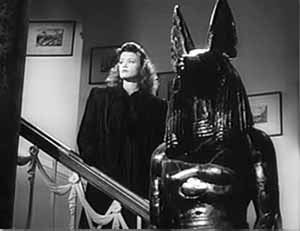
Strictly B-movie material, the film nevertheless struck a nerve and did well at the box-office, despite some lackluster dialogue, sub-par performances (particularly by star Simone Simon, whose tortured English was left without extensive dubbing) and overall cheapness (transformed by brilliant cinematography); entering Irena Dubrovna's brownstone, the grand staircase from Welles' "The Magnificent Ambersons" is there, recycled somewhat inexplicably for the movie. A grandiose stair-way like that sticks out as not belonging, in the same way that Irena (Simon) is odd—foreign, exotic, petite, and nearly incomprehensible—in the generic studio-city the film takes place in.

But it's the ideas and execution behind "Cat People" that twisted nerves. In as obvious a metaphor as you can have, Irena is a creature that, when sexually aroused, turns into a vicious panther that attacks and kills her partner, the result of her village being invaded and damned by devil worshippers in the distant past. The movie's a strange push-pull of ambiguity and obviousness. The delay of the creature's "appearance" makes Irena suspect, as all we have is her belief in a barbaric folk-tale. When it becomes clear that Irena is what she says she is, the image of her transformed is always suggested by shadow and sound, an off-screen presence that is unmistakable, but not to be seen directly.
The entire movie is a clever delaying tactic that entices and teases with our innate desire to "see the monster."
Man (the awkward Kent Smith)-meets-feline. Despite Irena's fears and protestations, they marry, but consumed with her past, Irena refuses to consummate the marriage. This leads to turmoil (and concern in the movie's principals that Irena is..."strange," but not in the way they think). The husband seeks counselling for her, but Irena's shrink becomes attracted to her instead. Ultimately, the husband files for divorce (irreconcilable differences?) Irena's fears proving too much for him. It isn't until near the end, when the rakish psychiatrist tries to have his way with her that the claws come out, and the rogue male is dispatched. Mee-ow.

It just sounds awful and, indeed, some of the acting is. But the story is provocative, setting up a situation where **warning, warning** sex is dangerous, even while the turning away from the act is considered unnatural and...well, as strange as thinking you're going to turn into a panther. Director Tourneur's handling of it by suggestion is awesome. One memorable segment has
Irena's rival for her husband's affections (Jane Randolph) trapped in a gym-pool while around her, guttural growls echo, and slinking shadows force her to the middle of the pool. And the director's low-budget suggestion of Irena turning into a cat, is also suggestive of her sinking to the floor to satisfy that randy psychiatrist. Many of those ideas would be recycled with the next life of "Cat People," but the sexuality and cat-transformations would be a lot more explicit. Did that make it better?

Wellllllll.....


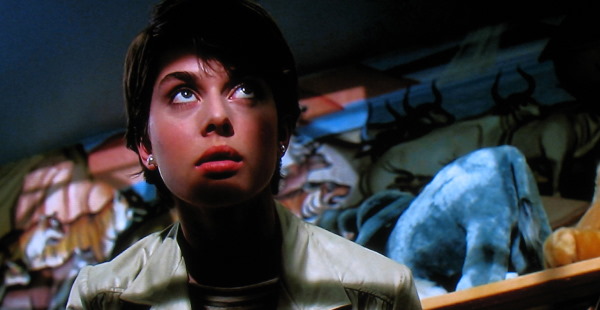
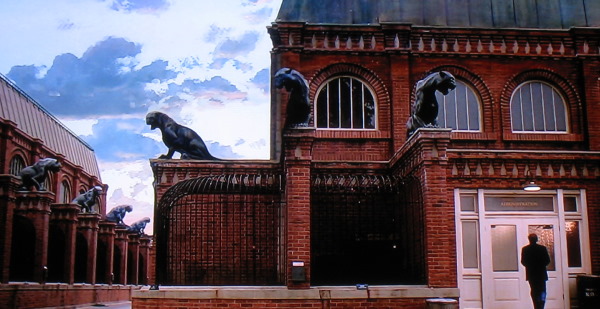
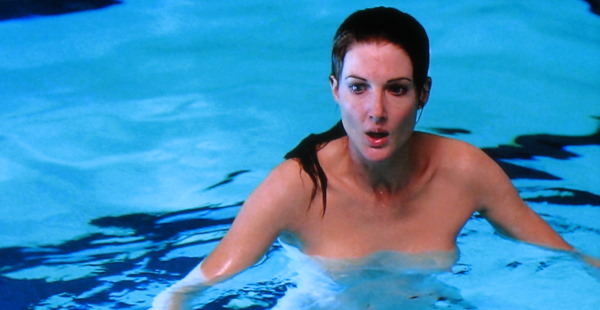
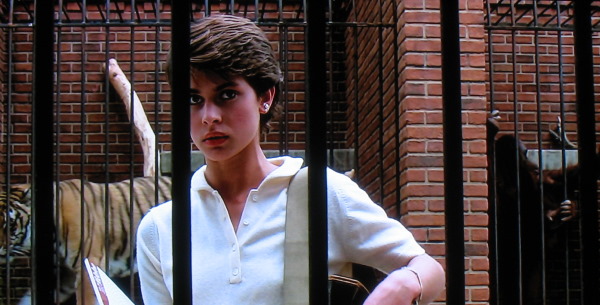
"Cat People" (Paul Schrader, 1982) A strict remake, but not an austere one, writer-director Paul Schrader took the original "Cat People" and updated it for the up-tight STD'd 80's. The performances are better, but the characters all seem a bit under-written and played. If you've seen the first, you'll see the same idea of a stark concrete zoo set. The same basic plot. The trick jump-shock of the bus is recreated in stereophonic sound and color. You'll even see what looks like a shot-for-shot recreation of the pool sequence, but as an indication of the puerile nature of the update, the figure trapped in the pool by the suggestive growls (Annette O'Toole) is topless this time.

Sure we might appreciate it, but it comes off as crass and cheap, compared to the original. In the same way, Schrader
adds some mythological hokum as a prelude and deepened the "cat-curse" to include an incestuous way to break it involving cat-brother and cat-sister (Malcolm McDowell, Nastassja Kinski) getting it on—something alluded to, but isn't seen. Like Schrader's other attempts to make "Cat People" more kinkified, it ends up feeling clawless. What's the point of having the "curse" if you can't use it for the story? And so it's alluded to, but never presented. Schrader also makes more explicit the cat-transformation making it a were-wolfish change that seems somehow less convincing than the suggestive original. And forgive me, but is it an improvement to have Kinski's cat-person spending the rest of her life in a zoo? Are we meant to be cheered by her apparent captivity, or is it merely the excuse to entertain a sequel?

For all its attempts to "
sex it up," the film actually comes across as more conventional than the 40's original. Hard to believe, but the more "sophisticated" 80's remake has less going for it as a thriller, horror film
, a Gothic love story, a romance, or even a cautionary tale.


"The Curse of the Cat People" (Gunther von Fritsch/Robert Wise, 1944) An odd sequel that is better than the original, "Curse" features the cast from the first but turns it on its tail. Oliver (Kent Smith) and Alice (Jane Randolph) are married and their daughter, Amy (the melancholy little Ann Carter) is troubled—attacking other children viciously and living in a fantasy world with an imaginary friend—who just happens to be Irena Dubrovna (Simone Simon)! Is "cat-scratch fever" communicable?

Despite the characters from the first film appearing here, "Curse" has little to do with "Cat People"—all the "cat people" are dead and
Amy might be haunted by the reminders of her father's first wife (who is never mentioned in the house), so that she imagines Irena. Given the family history, Dad discourages her little flights of fantasy, thinking it could lead to the tragedy of the first film, a tactic that confuses Amy and distrustful of her own family. Then, she is glommed onto by a grasping older actress who lives down the street (Julia Dean). You know those older actresses, they can be pretty dramatic and this one favors Amy over her own daughter (Elizabeth Russell). Not a movie about monsters in the shadows, but the ones in our minds. Although one could make a case for for it being about possession, it's not a horror film, but instead an atmospheric fantasia about the dark side of childhood imagination and alienation, as potent and strange as "The Innocents" or "Night of the Hunter."

It also marked the directing debut of
Robert Wise, who had edited "Citizen Kane" for RKO and would become one of Hollywood's master craftsmen, working in a number of genres and winning Best Picture and Directing Oscars for "West Side Story" and "The Sound of Music
."

Friday, October 17, 2008

My Favorite Year

"My Favorite Year" (Richard Benjamin, 1982) Surely one of the best jobs during the early 1950's was being a writer for "Your Show of Shows,"* broadcast live Saturday nights on NBC. Starring Sid Caesar, Imogene Coca, Carl Reiner and Howard Morris, the writing staff contained such wits as Reiner, Mel Tolkin, Larry Gelbart, Danny Simon, his odd couple brother Neil Simon, Lucille Kallen, and Mel Brooks.** The work environment was so fondly remembered it has consistently been used as comedic inspiration. First, Reiner used it as the work environment for "The Dick Van Dyke Show." Neil Simon wrote the stage-play "Laughter on the 23rd Floor."*** And Brooks took the kernel of a script by Dennis Palumbo about a going-to-seed celebrity and his "minder" and morphed it into his remembrance of "Your Show of Shows," "My Favorite Year."**** Brooks served as neither writer, nor director, but as Executive Producer, he completely re-imagined the film as this sunny, hilarious remembrance, dripping with nostalgia, of being a cocky kid in New York in the '50's working for a hit comedy show. 

"King" Kaiser (Joseph Bologna) is the high-strung, neurotic star of a network variety show, and one week it falls to writer's assistant Benjy Stone (Mark Linn-Baker) to "manage" movie star Alan Swann (Peter O'Toole) through the rehearsals and broadcast. Two problems: Swann's a perennial lush, and he's never acted before a "live" audience. Fortunately, Benjy is Swann's biggest fan and forgives a lot of bad behavior, but Swann's "bad boy" behavior, insecurities and inebriation keep throwing up barriers.

O'Toole was initially hesitant to take on the role of the Errol Flynn-like Swann (he was convinced by an odd coincidence--the date of Swann's death inscribed on a tombstone--in a scene cut from the film--was also O'Toole's birthday. He was, again, nominated for a Best Actor Oscar for his performance. Richard Benjamin solidified his transition from actor to director with this film, which also featured Jessica Harper as the apple of Benjy's eye, Bill Macy, Anne De Salvo and Basil Hoffman as the show's writers, legendary composer Adolph Green as a producer, Lainie Kazan as Benjy's mother, Cameron Mitchell as a mobster unhappy with his portrayal on the show, and even former "Show of Shows" performer Selma Diamond in a small role. 

But the highlight is O'Toole's swashbuckling star. Looking gaunt and rheumy-eyed even when he's not plowed, Swann benefits from O'Toole's charm, crack timing and physical comedy--O'Toole can do a prat-fall and make it look deadly--but the actor makes the drama work as well. Swann's freak-out at being told he's performing "live" ("I'm not an actor! I'm a movie star!!") is both comic and tragic. And he plays off well with a sharp cluster of East Coast character actors. 

The all-pervasive air of nostalgia begins immediately with the opening of Nat King Cole's "Stardust" over animated credits, and continues to the last frame with a joyous semi-sadness. "My Favorite Year" works on so many levels--as a drama as well as a comedy, as a fond remembrance as well as a fond farewell. And any movie that has a decent role for O'Toole to show how good he is, dramatically or comedically deserves a place on any list of 'favorites." 

* To give you a glimpse of "Your Show of Shows" here's Carl Reiner, Sid Caesar, Howie Morris and Louis Nye performing a sketch called "This Is Your Story." It's in two parts.

** And Woody Allen became a writer for the 60 minute version of the show, "Ceasar's Hour." 
*** Coincidentally, when "Laughter on the 23rd Floor" was video-taped for PBS, it was directed by "My Favorite Year" director Richard Benjamin, and featured its star, Mark-Linn Baker. 
**** The original screenplay took place in the early 1900's, and Wyatt Earp was the personage to be "minded."

Monday, August 18, 2008

Cannery Row

"Cannery Row" (David S. Ward, 1982) Quirky adaptation of John Steinbeck's sublime tales of the Monterey Dock District* that didn't do well at the box-office despite one of Nick Nolte's best performances, and an early starring performance by Debra Winger.

"Doc" (
Nolte) is a marine biologist living a spartan existence on the row, but he's still the king in a society of wharf-bums and hookers. Like any good eco-system, there is a harmony amongst the denizens with a loose-knit economic system of favors performed and the occassional get-rich-quick scheme.

But the introduction of a new critter can upset any established ecology, and so the arrival of Suzy DeSoto (
Winger) causes havoc within the community. She's a good kid down on her luck who catches "Doc's" eye, though he's afraid to commit, content to merely observe and annotate. She fails miserably at hooking, though, inspiring the madam, Fauna (Audra Lindley), to crass attempts at match-making. Comfortable nowhere, but with no ability to leave, she makes a home in a large, abandoned storage-tank and settles for a kind of independence.

It's a ruefully funny semi-tall tale sublimely told with an ironic narration by the honey-magnolia tones of
John Huston. The cast is full of slovenly cherubic character actors who would fir well into a John Ford stock company--Frank McRae, M. Emmett Walsh, Tom Mahoney and John Malloy. "Cannery Row" is a bit like a Ford film as it deals with community and the integration of a new-comer into the fold, and how the community reacts to them and also how that community reacts to crisis.

"Cannery Row" is one of those films I love. Every viewing of it is like seeing an old friend.


* They comprise the novels "Cannery Row" and its sequel "Sweet Thursday"