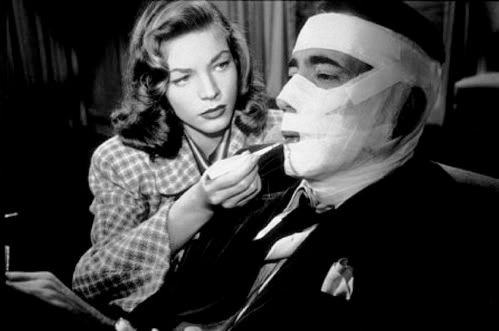
"Dark Passage"(Delmer Daves, 1947) Soapish film noir with "Bogey and Baby" that manages to have a few interesting things to recommend it, amidst some howler material.
Irene gives Parry a place to crash, and a change of clothes. Then, making his way to Frisco to meet an old buddy, his cab-driver gives him a line on a disgraced plastic surgeon, who's not adverse to doing last-minute surgeries at 3 a.m. It takes Parry a week to heal, which he does at Irene's—something he didn't want to do, but seeing as his buddy was murdered and all...
Grave's-eye view of a post-op Bogart finding his musician-buddy dead.
Wait a minute! If you hadn't said that yet, what kept you? It would appear that San Francisco (nice location work, by the way) is the smallest town in America, as everybody knows everybody else and their business, besides. While convalescing at Irene's, Parry becomes aware that the place is being watched by a couple people, a potential blackmailer (Clifton Young) and Madge (Agnes Moorehead), the buttinsky friend of Irene's who used to go out with Bob (Bruce Bennett), Irene's current beau, but was also old friends with the Parry's back in the day. As Bogart would say, "Everything's starting to look nice and cosy..."
When the bandages come off, we get to see The Man with Bogart's Face, but before then, all we're allowed to see of Parry was his picture in the paper, or his face in shadow. Daves employed a technique not much used in movies—the first-person subjective camera, so we see everything from Parry's point-of-view; there's a lot of people speaking right at usthroughout the first part of the movie and answered back by Bogart's disembodied voice. Daves pulls off some miraculous inter-cutting between location-work and studio set-ups (in a moving car, yet!), and it's interesting to see how he gets himself out of jams of timing and transitions. He also employs an interesting angle every now and again, like the vantage point of a murder scene...from below the floor!
There's a lot to quibble about (did I mention the plastic surgery only takes an hour?), but any excuse to see Bogart-Bacall together again, and to see another of Agnes Moorehead's unabashedly demonstrative performances. Those are enough reasons to give "Dark Passage" a watch.
Here's looking at you looking at me, kid. Subjective POV of Lauren Bacall in "Dark Passage"
"Written On the Wind"(Douglas Sirk, 1956) Consummate trash is still something to be celebrated, and "Written on the Wind" is consummate trash; so soap-opera it squeaks, it has pretensions towards Tennessee Williams but with dialogue straight out of Indiana Jones, and sophisticated airs that smell a little fetid, like last night's twelve course meal left in the sink.
But it's directed like a dream (with the occasional diversion into night-sweats) by Douglas Sirk, who may be the most manipulative film director since Hitchcock, steering an audience's sight-lines like a Dutch master, by means both sly and obvious.
There's been a bit of a kerfluffle on the cin-terwebs recently over Sirk's worth as a director. Well, it's one thing to design the sets and wardrobe and choose the colors and decor, but it's quite another to orchestrate all those things and design a course through it to make an image that complements, makes explicit or counters the words on the script-page (that, at the time Sirk was working, had to be approved by a censor, mind you). Call it "Dancing through the Hays Code" and Sirk's direction cuts quite a path of stylish elegance while presenting the mire of the "comfortably well-off." It's a bit like trying to keep your dignity running through a cow-field.
The story is about the Hadley family, thick—almost gooey—with the oil business, and something of a gusher when it comes to spilling their muck in all directions, soiling those in their vicinity. Take Mitch Wayne (Rock Hudson), son of a farmer who worked the Hadley property and school-chum to the Hadley scum of a scion, Kyle (Robert Stack), an intense guy who always comes on a little strong to the ladies. Mitch, on the other hand, is hard-working, poor, and a perfect gentleman. Even when Kyle sweeps Lucy, the girl Mitch has his eye on (Lauren Bacall), off her feet and out of Mitch's grasp with a dazzling display of Hadley life-style. Simple enough. Then toss in Kyle's sister Marylee (as in "...we roll along")(Dorothy Malone*), who's been in love with Mitch since they were kids, and things get real complicated. In fact, they get as wild as the wind, which blows and batters the Hadley Estate in a show of Nature's distaste—a protest as violent as Akira Kurosawa's dust-devils.
Not too worry, though. Sirk is the tour guide through this E-ticket sexual Disneyland. Enjoy the ride (and keep your hands in the vehicle at all times).
Let's start off with something safe. Women's heads as a proscenium arch—their curiosity points us to and frames the principals.
Sirk used a moving camera sparingly and with a great deal of control. He let you see what he wanted you to see when he wanted you to see it. In this set-up, the eye would wander to what's around the corner (the garish red on the wall attracts your eye)—patience, Sirk will take you there in a minute. In the meantime, there is a large mirror, incongruously in front of the check-in desk, that allows you to see the characters coming out of an elevator before they approach the lady at check-in. Your eyes move to that. Sirk likes to make entrances interesting by having them reflected in mirrors.
After a bar fight that leaves Kyle defeated and humiliated, everybody's showing him the door without saying anything, the beaded curtain forming a light-weight barrier. When he violently goes through it, the body of Dorothy Malone's character Marylee will follow the sway of the beads before she turns and follows her brother.
Where do your eyes go? The camera has followed Bacall and Hudson into the bar, where they stop, looking for Stack. If their body positions didn't point you in the right direction, Sirk has put Stack between the two brightest things in the room—the white-shirted bartenders.
Lucy and Mitch bring the drunken Kyle home to recover—that's Mitch climbing the stairs in the background, Kyle's the limp sack over his shoulder—while a mortified Lucy explains to father Jasper...well, *sigh* it's probably a story's he's heard before.
And if you think the director's taking this florid stuff too seriously, brothers and sisters, you aren't looking close enough. Get out your de-coder rings. There'll be a quiz.
Doesn't get more obvious than this...you couldn't show sex on the screen in the 50's (without pan-aways to roaring fires and crashing ocean waves)—but you can show this and it isn't any surprise when Marylee is revealed to be having an affair with the pump-jockey (who for a perverse bit of trivia is played by Grant Williams, "The Incredible Shrinking Man").
This is an insert shot. It was deliberate and could have been edited out without hurting anything, and yet it remains. It occurs when Lucy tours the hotel suite Kyle Hadley has arranged for her and opens a drawer...of clutch-purses. How many purses have been snapped in anger (and in men's faces) over the cinematic war between men and women during the Hays Code? Lots, because purses with those snapping openings were a metaphor for a woman's genitalia. And when a woman got mad at a man--SNAP!--she would loudly shut the purse...thereby showing her disdain for the man by metaphorically denying him sex (Things were that complicated in the Hays Code days). Lucy should have inferred how much Kyle played around by this little collection and ran like hell. *
Kyle Hadley starts this conversation on the right side of the frame in front of the bed, then as he becomes more ardent, the bed is uncovered. And oh, by the way, rival-for-Lucy's-affections Mitch is seen in the mirror between them, but because he's on a different plane from Lucy and Kyle, he could be on another planet. So, although he comes between them, he's little (diminutive, in fact) threat. There's a lot of triangulation in this family.
Some friend. Now here's Kyle's sister Marylee (Dorothy Malone) a hyperbolic hyphenate of dipso- and nympho-manias.* She's been in love with Mitch since they were kids, and despises her brother with a passion that practically pops the buttons off her blouse. Sirk makes sure we see her pouring the booze in the Cinemascope frame. Or she's so drunk, she has to hold it that close to avoid spillage.
Marylee in her well-ordered, yet cluttered room. The room is orderly, tidy—everything in its place, including her intended in a thick, wrought-iron frame—with the occasional wild errant splash of color...that being red—including her phone. Looking at this angle from above, the angles of things would look crazy and at odd angles--they're directing your attention to her, but she's small and trapped by her surroundings. Of course she is. Her room is a reflection of her own roiling mind, shadowed and complicated and morbid like a funeral hall.
Speaking of reflections, Sirk does a lot with this shot. Marylee plunks herself down, inserting herself into Lucy's mirror (she likes the attention), and adjusts her hair as Lucy brushes. Marylee thinks they're just alike, with their attachments to Mitch and Kyle linking them...but she's alone, posing in that mirror. She is the storm to Lauren Bacall's calm, seemingly incapable of remaining still, where Bacall is all stillness. They're counter-points, not reflections.
Dysfunctional family portrait. Father Jasper Hadley (Robert Keith), old and frail and ineffectual, has put all his strength into his oil business—check out his portrait—and his kids have run out of control (Their mother's dead—they probably ate her after they were born, like the spiders they are).
Your turn! Now what (oh, what) could Sirk be saying with this shot?
Nothing. I just like this shot. Thanks for playing. Exits by the mirror on the wall. Mind the gap.
* Malone won an Oscar for her role. It's easy to see why—she put a lot of work and jitter-bugging energy into this performance (see the video). Even at 24 frames per second it's hard to keep up with her. Both Malone and Bacall had worked with Bogart in "The Big Sleep" (Bogart, by the way, hated this movie and told Bacall she should stay clear of this sort of material).
** If you think my theories are a bit far-fetched, I can only remind you of the story of the woman who went to a psychiatrist who gave her a rorshach test. "Now, what does this remind you of?" he asks her, and she says, "That's a vagina." "How about this one?" "That's two people making love." "Interesting, what do you see in this picture?" "That's another picture of making love." "And what's this one?" "Well, that's a penis." "Well, it's obvious," says the shrink. "You're obsessed with sex." "I am!" says the woman. "You're the one with the dirty pictures!"
"The Shootist"(Don Siegel, 1976) I was briefing through the movie reviews of various magazines in the grocery store a year or so ago, when I came across Richard Schickel's review of "McQ" or "Brannigan" (probably "Brannigan"), in which he remarked that a proper bicentennial project would be to come up with a decent script for John Wayne.
I was hoping 'Rooster Cogburn" might be it, but that was a waste..of time...and talent. And besides, as much as I like "Rooster" Cogburn as a character, the acceptance of Wayne's acting that suddenly sprang up smacked a bit too much of "Well, we'll like him as long as the old galoot knows he's a joke." Well, there were times in "True Grit" when Wayne--the Wayne as the screen force--came through. I didn't want to see Wayne made fun of or exploited. I wanted to see him triumph, as of old, in his now twilight years, and as John Wayne, the very fine actor.
So, I am delighted at "The Shootist" and delighted with it. It is about Wayne, as about Books (instant cliché time). Why else would Siegel in his opening use shots of old Wayne movies (and mostly Howard Hawks Wayne films, where Wayne played a character built out of his own persona, rather than playing "honest-to-God" characters ala John Ford) and with young boys---in 'Red River" and "Rio Bravo"--as Wayne the mentor, as he is, in an odd way, in this film.
Siegel is still a little obvious in his handling of things, but the ideas are so good, who cares? He literally numbers Wayne's days. And what a nice idea for a living legend and soon-to-be-immortal legend to have his birthday and the day of his death on the same day, on a gravestone that doesn't mark its day.
Death hangs over this film, in conversation, in song, in thought, in way of life. But this is nothing new. Death has walked with Wayne through many a picture. For a long time. Both were winners in the end, and, as in real life, Death must have his due.
"The Shootist" is the film John Wayne went out on, and as a summation of his career, and a the last ring of the bell, it's nearly perfect, even though the film is a bit flawed. Still, director Siegel did a masterful job of keeping the stars corraled--there was a lot of people wrangling to be in it--and Wayne healthy, although there were times when he was too weak to be on-set (although he was, at that time, cancer-free). And even though Wayne and Siegel got on like a house afire (the two couldn't have been more different, politically) there were still dust-up's about the way Siegel, the most economical and least fancy of directors, would line up shots. Lauren Bacall, who was no doubt reliving her own time of dealing with cancer with husband Humphrey Bogart, braved up through the movie, and provided a steely shoulder for Wayne to lean on. Stewart signed on for a cameo, comprising the most jarring scene; it's Stewart who provides the cancer diagnosis. And Richard Boone, John Carradine and Hugh O'Brian did the same out of respect and love for their old co-star, and Ron Howard, eyes set on a directing career instead of acting, still pursued the juvenile lead one last time. The budget was tiny, but top-heavy with stars...and history.
All those guest stars work against the film and make it lose focus a bit. You can tell that Siegel might not have gotten all the coverage he might have wanted--sequences seem stretched a might' thin. But overall, the film works well.
With time, perspective...and maybe a slight blurring of facts...one can look at "The Shootist" as the death of the Western--a sturdy movie genre for decades. The 60's had slowed it down, made them seem irrelevant, but one could still count on a number of Westerns being shot every year...until John Wayne died. And then...nothing.
A few things crop up here and there. "Tombstone" and its cousin "Wyatt Earp," Eastwood's classic (and Oscar-winning) "Unforgiven," and "Silverado," which reminded how good a time an intelligent Western could be. "Deadwood" is a wickedly nifty updating of the "Gunsmoke" stories of a frontier town, and "3:10 to Yuma" this year briefly revived interest in the Old West and its ways. But a case can be made that without Wayne in the saddle, green-lighting a Western became a difficult proposition.
Why bother? Wayne kept the genre alive for so long, but with his passing, they became less viable.
They might still come back. Turner will do a period piece, a Zane Grey adaptation, once in awhile, "Lonesome Dove" certainly proved popular, and even "Brokeback Mountain" made a contribution. But that "3:10 to Yuma" popularity was certainly encouraging.
Then there's the curious phenomenon of the Western morphing into another genre--Science Fiction, precisely. The "Back to the Future" series capped off with an Old West yarn, and it was easy to see the gun-slinger in Han Solo in "Star Wars," the fight in the bar, etc. and, Joss Whedon created a future Western in the "Firefly" series, and its movie-spin-off, "Serenity." It's funny. Just as the western was a broad enough genre to encompass all sorts of morality plays that would reflect today's society, so, too does the Science Fiction story. The two overlap, and share much the same elasticity, that frequently it turns into a case of "You got Science Fiction in my Western/You got Western in my Science Fiction."
Maybe the Western hasn't rode into the sunset just yet.
 "Dark Passage" (Delmer Daves, 1947) Soapish film noir with "Bogey and Baby" that manages to have a few interesting things to recommend it, amidst some howler material.


 Sirk used a moving camera sparingly and with a great deal of control. He let you see what he wanted you to see when he wanted you to see it. In this set-up, the eye would wander to what's around the corner (the garish red on the wall attracts your eye)—patience, Sirk will take you there in a minute. In the meantime, there is a large mirror, incongruously in front of the check-in desk, that allows you to see the characters coming out of an elevator before they approach the lady at check-in. Your eyes move to that. Sirk likes to make entrances interesting by having them reflected in mirrors.
 After a bar fight that leaves Kyle defeated and humiliated, everybody's showing him the door without saying anything, the beaded curtain forming a light-weight barrier. When he violently goes through it, the body of Dorothy Malone's character Marylee will follow the sway of the beads before she turns and follows her brother.
 Where do your eyes go? The camera has followed Bacall and Hudson into the bar, where they stop, looking for Stack. If their body positions didn't point you in the right direction, Sirk has put Stack between the two brightest things in the room—the white-shirted bartenders.
 Lucy and Mitch bring the drunken Kyle home to recover—that's Mitch climbing the stairs in the background, Kyle's the limp sack over his shoulder—while a mortified Lucy explains to father Jasper...well, *sigh* it's probably a story's he's heard before.
 And if you think the director's taking this florid stuff too seriously, brothers and sisters, you aren't looking close enough. Get out your de-coder rings. There'll be a quiz.
 Doesn't get more obvious than this...you couldn't show sex on the screen in the 50's (without pan-aways to roaring fires and crashing ocean waves)—but you can show this and it isn't any surprise when Marylee is revealed to be having an affair with the pump-jockey (who for a perverse bit of trivia is played by
  This is an insert shot. It was deliberate and could have been edited out without hurting anything, and yet it remains. It occurs when Lucy tours the hotel suite Kyle Hadley has arranged for her and opens a drawer...of clutch-purses. How many purses have been snapped in anger (and in men's faces) over the cinematic war between men and women during the Hays Code? Lots, because purses with those snapping openings were a metaphor for a woman's genitalia. And when a woman got mad at a man--SNAP!--she would loudly shut the purse...thereby showing her disdain for the man by metaphorically denying him sex (Things were that complicated in the Hays Code days). Lucy should have inferred how much Kyle played around by this little collection and ran like hell.
  Kyle Hadley starts this conversation on the right side of the frame in front of the bed, then as he becomes more ardent, the bed is uncovered. And oh, by the way, rival-for-Lucy's-affections Mitch is seen in the mirror between them, but because he's on a different plane from Lucy and Kyle, he could be on another planet. So, although he comes between them, he's little (diminutive, in fact) threat. There's a lot of triangulation in this family.
 Some friend. Now here's Kyle's sister Marylee (
 Marylee in her well-ordered, yet cluttered room. The room is orderly, tidy—everything in its place, including her intended in a thick, wrought-iron frame—with the occasional wild errant splash of color...that being red—including her phone. Looking at this angle from above, the angles of things would look crazy and at odd angles--they're directing your attention to her, but she's small and trapped by her surroundings. Of course she is. Her room is a reflection of her own roiling mind, shadowed and complicated and morbid like a funeral hall.
 Speaking of reflections, Sirk does a lot with this shot. Marylee plunks herself down, inserting herself into Lucy's mirror (she likes the attention), and adjusts her hair as Lucy brushes. Marylee thinks they're just alike, with their attachments to Mitch and Kyle linking them...but she's alone, posing in that mirror. She is the storm to Lauren Bacall's calm, seemingly incapable of remaining still, where Bacall is all stillness. They're counter-points, not reflections.
 Dysfunctional family portrait.
 Your turn! Now what (oh, what) could Sirk be saying with this shot?
 Nothing. I just like this shot. Thanks for playing. Exits by the mirror on the wall. Mind the gap.


_01.jpg)