Showing posts with label John Carradine. Show all posts

Thursday, April 12, 2012

Drums Along the Mohawk

When Orson Welles was asked what movies he studied before embarking on directing Citizen Kane he replied, "I studied the Old Masters, by which I mean John Ford, John Ford, and John Ford." For the next three days we'll be looking at little-seen films from The Old Master, each different in tone, temperament and subject matter, but all unmistakably the work of America's storied film-maker, the irascible, painterly, domineering, sentimental puzzle that was John Ford, John Ford, and John Ford.

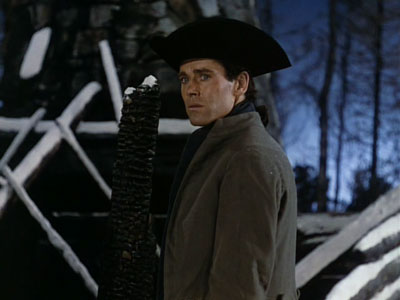
Drums Along the Mohawk (John Ford, 1939) "Every generation must make its own way—in one place or another"—so director Ford caps the start of his career-long history of the United States...with a wedding, for this earliest episode in that timeline.  The year is 1776, but instead of the politicians haggling over language in Philadelphia meeting rooms, he's—again—on the frontier, a couple day's ride from Albany, New York. Gil Martin (Henry Fonda) and his new wife Lana (Claudette Colbert) are embarking on a mission, just as the newly formed states are, "to form a more perfect union."  

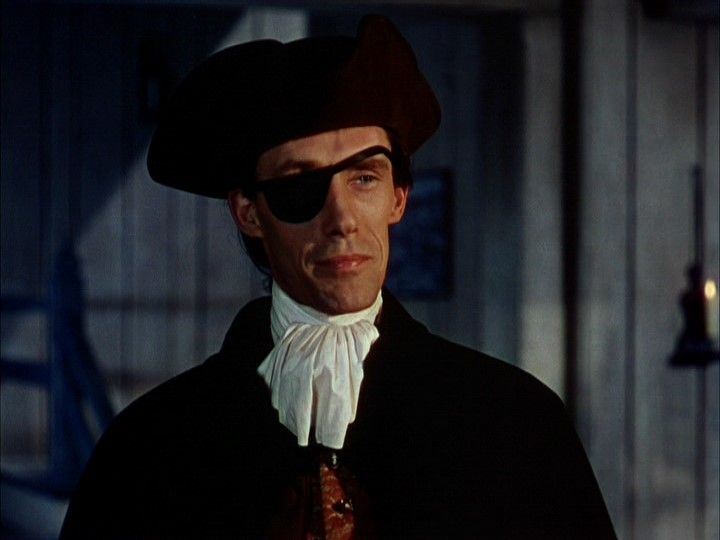
It won't be easy for either organization, with threats, both internal and external.  There are attacks by Natives against the encroaching settlers (but, even here, Ford has them blameless—if brutally opportunistic—as the Iroquois are taking their orders from a Tory agent, played by an eye-patched John Carradine, who is paying the tribe for their berserker destruction of the homesteads, burning everything—buildings, crops and possessions—down to the bare Earth, leaving nothing, not even anything the tribe could steal or profit by), internal strife among the villagers, and the hard-scrabble existence that tests the fiber of the town-folk.

Before long, the citizens are driven to the local fort housing the militia, always at the ready for a call to arms from General Washington.  In the meantime are the struggles to maintain a family, order, and petty grievances that threaten to disrupt the community from within.  But, a shared sense of purpose—community-building reflecting the larger picture of nation-building, pulls the majority of them through.

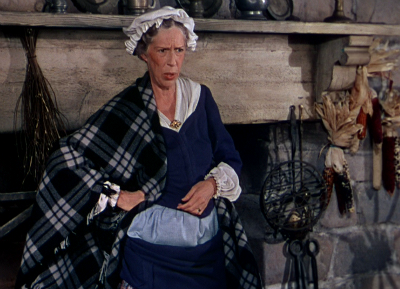
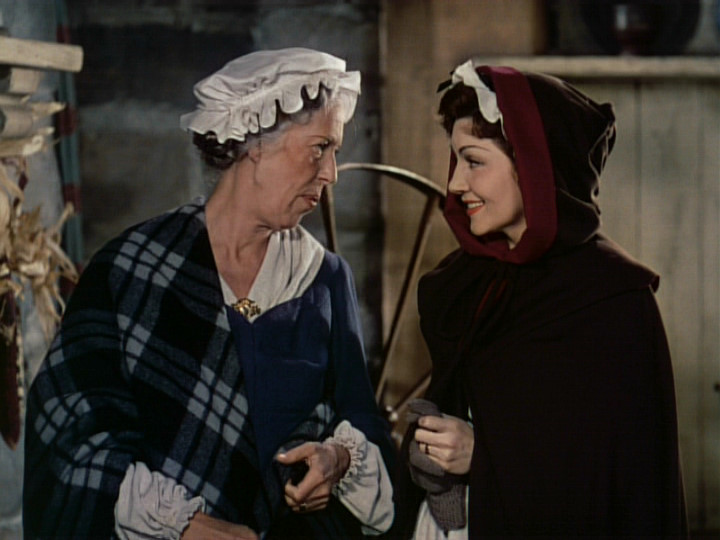
Early on, Gil and Lana are burned out of their humble cabin-home, built by Gil. They take up lodgings with the widow McKlennar (Edna May Oliver) as workers and soon, are back on their feet, on a par with everyone who has suffered hardships.

This is Ford's first film in color, and it's eye-popping Technicolor, and the director, who was discriminating in his choice of which format to use—his last two were in monochrome—fills the screen with detailed color; the very first shot, after the needle-pointed credits, is a pull-out from the bouquet that Lana is holding at her wedding, and there are fiery sunsets and sunrises framed in the same Ford-fashion, with just the right amount of horizon for contrast.  The greens are the most verdant, and fire seems to play an important part of the scheme of things, the flaming colors unnatural against a pastoral backdrop.

Fire figures in a violent double-whammy that strikes one unexpectedly towards the end of the film, as a scout (played by Francis Ford, the director's brother) is wheeled out in front of the fort in a wagon of straw, which is then set alight by torches and flaming arrows.*  Just when that scene is set in the mind, one of the settlers (played by Ford stock-player Ward Bond) is shot in the shoulder with a flaming arrow.  A flaming arrow.  Okay, sure, the arrow is a special effect on a wire, but the fire is real and Bond and his clothing are just as flammable as the next guy and his clothing.  The level of violence is turned up just a notch from what one might expect, and one is taken aback by it.  

Ford could do that—make you feel all-complacent and tear the Navajo-rug out from under you.

But it's a great movie.  Action-oriented, with the only difference being that the significant events—the bigger picture—is all happening off-screen, rather than being part of the tapestry of events.  Ford would be doing that in the future (both in his career and the events that shaped the country), but this is a very fine beginning.


Ford's first film in color—and Technicolor, at that—does not disappoint.


* It works just as dramatically here as it did in 1987, when Kubrick used something similar in Full Metal Jacket.

Saturday, September 6, 2008

Olde Review: The Shootist

Written August 11, 1976

"The Shootist" (Don Siegel, 1976) I was briefing through the movie reviews of various magazines in the grocery store a year or so ago, when I came across Richard Schickel's review of "McQ" or "Brannigan" (probably "Brannigan"), in which he remarked that a proper bicentennial project would be to come up with a decent script for John Wayne.

I was hoping
'Rooster Cogburn" might be it, but that was a waste..of time...and talent. And besides, as much as I like "Rooster" Cogburn as a character, the acceptance of Wayne's acting that suddenly sprang up smacked a bit too much of "Well, we'll like him as long as the old galoot knows he's a joke." Well, there were times in "True Grit" when Wayne--the Wayne as the screen force--came through. I didn't want to see Wayne made fun of or exploited. I wanted to see him triumph, as of old, in his now twilight years, and as John Wayne, the very fine actor.

So, I am delighted at "The Shootist" and delighted with it. It is about Wayne, as about Books (instant cliché time). Why else would Siegel in his opening use shots of old Wayne movies (and mostly Howard Hawks Wayne films, where Wayne played a character built out of his own persona, rather than playing "honest-to-God" characters ala John Ford) and with young boys---in 'Red River" and "Rio Bravo"--as Wayne the mentor, as he is, in an odd way, in this film.

Siegel is still a little obvious in his handling of things, but the ideas are so good, who cares? He literally numbers Wayne's days. And what a nice idea for a living legend and soon-to-be-immortal legend to have his birthday and the day of his death on the same day, on a gravestone that doesn't mark its day.

Death hangs over this film, in conversation, in song, in thought, in way of life. But this is nothing new. Death has walked with Wayne through many a picture. For a long time. Both were winners in the end, and, as in real life, Death must have his due.


"The Shootist" is the film John Wayne went out on, and as a summation of his career, and a the last ring of the bell, it's nearly perfect, even though the film is a bit flawed. Still, director Siegel did a masterful job of keeping the stars corraled--there was a lot of people wrangling to be in it--and Wayne healthy, although there were times when he was too weak to be on-set (although he was, at that time, cancer-free). And even though Wayne and Siegel got on like a house afire (the two couldn't have been more different, politically) there were still dust-up's about the way Siegel, the most economical and least fancy of directors, would line up shots. Lauren Bacall, who was no doubt reliving her own time of dealing with cancer with husband Humphrey Bogart, braved up through the movie, and provided a steely shoulder for Wayne to lean on. Stewart signed on for a cameo, comprising the most jarring scene; it's Stewart who provides the cancer diagnosis. And Richard Boone, John Carradine and Hugh O'Brian did the same out of respect and love for their old co-star, and Ron Howard, eyes set on a directing career instead of acting, still pursued the juvenile lead one last time. The budget was tiny, but top-heavy with stars...and history.

All those guest stars work against the film and make it lose focus a bit. You can tell that Siegel might not have gotten all the coverage he might have wanted--sequences seem stretched a might' thin. But overall, the film works well.

With time, perspective...and maybe a slight blurring of facts...one can look at "The Shootist" as the death of the Western--a sturdy movie genre for decades. The 60's had slowed it down, made them seem irrelevant, but one could still count on a number of Westerns being shot every year...until John Wayne died. And then...nothing.

A few things crop up here and there. "
Tombstone" and its cousin "Wyatt Earp," Eastwood's classic (and Oscar-winning) "Unforgiven," and "Silverado," which reminded how good a time an intelligent Western could be. "Deadwood" is a wickedly nifty updating of the "Gunsmoke" stories of a frontier town, and "3:10 to Yuma" this year briefly revived interest in the Old West and its ways. But a case can be made that without Wayne in the saddle, green-lighting a Western became a difficult proposition.

Why bother? Wayne kept the genre alive for so long, but with his passing, they became less viable.

They might still come back. Turner will do a period piece, a
Zane Grey adaptation, once in awhile, "Lonesome Dove" certainly proved popular, and even "Brokeback Mountain" made a contribution. But that "3:10 to Yuma" popularity was certainly encouraging.

Then there's the curious phenomenon of the Western morphing into another genre--Science Fiction, precisely. The "
Back to the Future" series capped off with an Old West yarn, and it was easy to see the gun-slinger in Han Solo in "Star Wars," the fight in the bar, etc. and, Joss Whedon created a future Western in the "Firefly" series, and its movie-spin-off, "Serenity." It's funny. Just as the western was a broad enough genre to encompass all sorts of morality plays that would reflect today's society, so, too does the Science Fiction story. The two overlap, and share much the same elasticity, that frequently it turns into a case of "You got Science Fiction in my Western/You got Western in my Science Fiction."

Maybe the Western hasn't rode into the sunset just yet.

Maybe it's just waiting for a new dawn.

Or a new star to guide her.