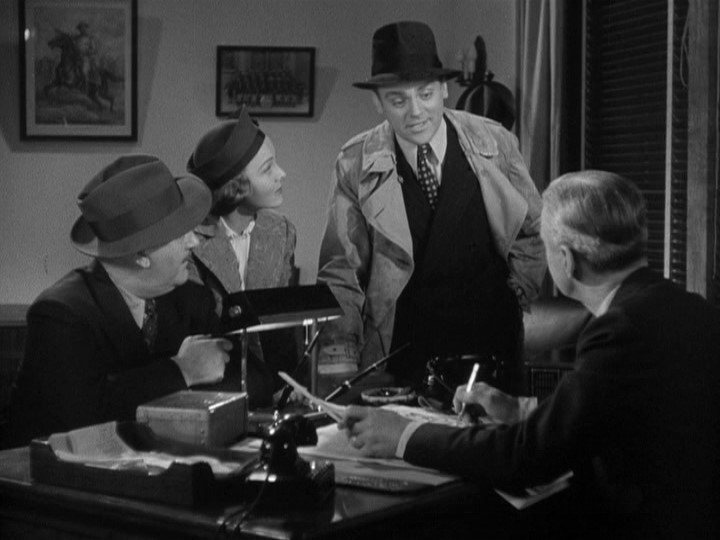
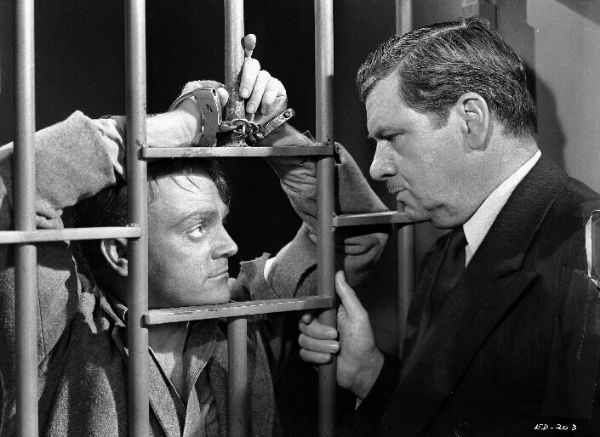
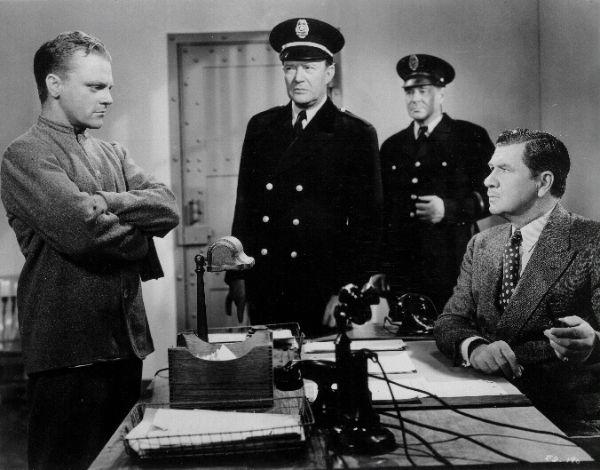
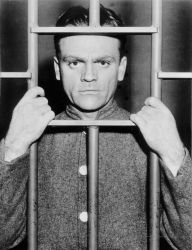
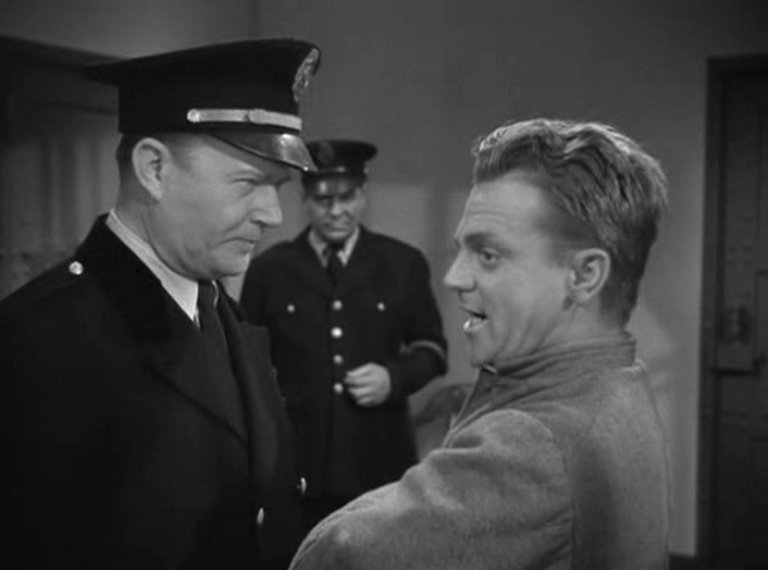
Each Dawn I Die(William Keighley, 1939) Edgy newspaper reporter Frank Ross (James Cagney) has a hot news lead, but it gets buried when the crooked assistant D.A. he's trying to get the goods on, knocks him cold, douses him in whiskey, and puts him behind the wheel of a car and sends it caroming down a city street, ultimately killing three innocents. Ross is convicted of vehicular manslaughter and thrown in jail, his campaign against the crooked DA (who is trying to run for governor) quashed. On the outside the folks in the newsroom his reporting partner (Jane Bryan) and his editor are trying to dig deep to find out how to get around the lawyers, and inside Frank tries to stay alive, getting information from fellow prisoners in the sweat-shops, and even saving the life of "Hood" Stacey (George Raft), who, to repay the debt, cooks up a hair-brain scheme to find who framed Ross. When another inmate is killed, Ross names Stacey, in order for the gangster to be tried, and make it easier for him to escape. Not very likely. Stacey does escape, however, but reneges on his plan, making one more set-back for Ross, who is slowly going crazy with his prison-term, and the impossibility of finding out who's responsible while stuck behind bars. No, it's not very credible, but the points of interest in the story are Cagney, who pushes the boundaries of what "good guy" behavior can entail and Raft, who's smooth, wry, likable, and utterly corrupt. This makes him completely different from the crooked DA who isn't witty, isn't smooth, and is dully cruel, but is also utterly corrupt. So, the difference between good and evil (in its shades of gray) in the audience's affection is that "bad" must also be personally bad, and incapable of entertaining us. If you can entertain us, obviously you can't be that bad a guy, even capable of reforming. But, what separates this from other Warner Bros. efforts of the period is that the authorities, although personifications of fear and threat, are also completely fallible and downright evil. The "good guys" are the "bad guys" and that's something a little different in a post-"Code" gangster movie.
It's Election day 2012. If you haven't already, go out and vote, dammit. And in that spirit, time for some truths to be self-evident.
Anytime Movies are the movies I can watch anytime, anywhere. If I see a second of it, I can identify it. If it shows up on television, my attention is focused on it until the conclusion. Sometimes it’s the direction, sometimes it’s the writing, sometimes it’s the acting, sometimes it’s just the idea behind it, but these are the movies I can watch again and again (and again!) and never tire of them.
I’m very suspicious of patriotism (I always recall the "last resort of a scoundrel" remark), yet nothing moves me so much like a movie extolling the virtues of America.
It wasn’t until I was voting on the Emmy’s that I sat down and watched “The West Wing.” I figured it was going to be a vapid “America-Love It or Leave It” tract (starring Rob Lowe), even if it did have Martin Sheen playing the President, in which case, I could leave it. But TWW was a serious look at government work—its glories and disappointments, the combination of ego and sacrifice. It could criticize individuals and “ideology for ideology’s sake,” but one thing it never ever criticized was the idea of Public Service, no matter what side of the aisle it was on. At the same time the country is being run by crooks specializing in an institutionalized form of bribery and graft, there is an infrastructure of people for whom government service is a sacred trust (well, there’s gotta be ONE!) “The West Wing” paid tribute to that corps of people wherever they might be, week after week, and it made for refreshingly positive TV. It also made for a refreshing look at our nation as it stands.
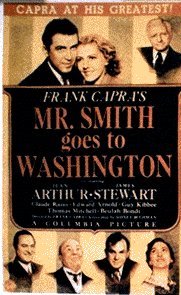
And so, too, does “ Mr. Smith Goes to Washington.” Made in 1939, it plays like it was written yesterday. When I saw it for the first time—right after “Watergate”—I found it amazingly prescient. But no, it was talking about its own times. The problems just keep re-occurring again and again. And again. Whoever doesn’t know history is doomed to repeat it, and with every fresh crop of people governing, they’ll keep making the same mistakes. Maybe they think they’re unique. Maybe they don’t know history. They say that if you keep making the same mistake over and over, it’s a sign of insanity. Well, psychology never factored in term limits. “Mr. Smith…” is the story of a youth leader who is appointed to the Senate after the incumbent dies. This runs afoul of the state’s political machine that ran that senator as well as the senior Senator, Paine (Claude Rains)—who just happens to be an idol of the new senator’s.
It wouldn’t work if director Frank Capra didn’t have tall awkward Jimmy Stewart—not James, Jimmy—whose every stammered syllable bespoke humility. But get him talking about America or Liberty of The Capitol Dome and the stutter disappears in a fervent stage whisper that trails off in awe. Mr. Smith isn’t sure of himself, but he’s sure sure of the Country.
And Washington, D.C. is just the place to shake him up with a few lashes of the Beltway. Stewart could be frustratingly folksy, but for Capra (and for Hitchcock and Anthony Mann) he could be unnervingly vulnerable and, at the other end of the bi-pole, dramatically unhinged. The last act of “Mr. Smith…”—the filibuster against false charges of graft—features Stewart in both phases. At one point, he's knee-deep in political hate-mail, clutching it in his hands and looking skyward like Jesus at Gethsemane. Then a few short paragraphs about “lost causes” later, he’s at his most defiant. “You think I’m licked! You ALL think I’m licked!!” That was his Oscar-winning performance, not the next year’s “The Philadelphia Story” where the “cynical reporter” bit just didn’t wash with someone who looked so homespun. The filibuster scene always brings a lump to my throat, and it’s not sympathy pains for Stewart’s frayed larynx.
Now, I’ve read the screenplay to “Mr. Smith Goes to Washington.” It ends with a big parade honoring the completely vindicated Smith, surrounded by his boy-rangers, supported by the woman-he-loves (Jean Arthur, again, who manages to make her extraordinarily jaded Senate Aide adorable, even when she’s at her worst—and she has a great drunk scene with Thomas Mitchell. Hmmm, Thomas Mitchell, again). Why, even the disgraced Senator Paine is being lionized. Oh, it’s just so sweet, your eyes could roll back in their sockets and jam and stick that way. As Arthur’s Miss Saunders tipsily says in the film, “Nah, I can’t think of anything more shappy!” “Capra-corn” is what the very self-aware director called it.
So, he cut it. Orson Welles has said: "If you want a happy ending that depends, of course, on where you stop your story." Capra leaves his story’s ending ambiguous. Oh, you could call the riotous goings-on at the end a Happy Ending—but all of Paine’s Senate pals are trying to calm him down, telling him it’s okay…everything’s all right, we're still on your side. The only solace Jefferson Smith is granted is in the sympathetic smile from the Vice-President (played by John Ford’s silent cowboy film-star Harry Carey) before he collapses in a heap of his enemy’s mass-generated letters. The movie "celebration" has all the weight of an Al Gore victory celebration on Election Day 2000--a case of premature exaltation. But nothing's been solved. No one's been cleared. Nothing has been decided. There is just misunderstanding and confusion. Carey leans back and has a chaw while the chaos of Democracy continues unabated. It may not be a "happy" ending, considering the sequence that was shelved. It may not even be a dramatically satisfying ending. But it is representative of the loud, messy process that turns the gears of Democracy. However slow-moving, however off-course, they still turn.
Jeferson Smith (Jimmy Stewart) looks for guidance.
Mr. Smith Goes to Washington American Graffiti To Kill a Mockingbird Goldfinger Bonus: Edge of Darkness
Sunday's Scene: For Dads and Grads Tuesday: Fuggedaboutit...
When Orson Welles was asked what movies he studied before embarking on directing Citizen Kane he replied, "I studied the Old Masters, by which I mean John Ford, John Ford, and John Ford." For the next three days we'll be looking at little-seen films from The Old Master, each different in tone, temperament and subject matter, but all unmistakably the work of America's storied film-maker, the irascible, painterly, domineering, sentimental puzzle that was John Ford, John Ford, and John Ford.
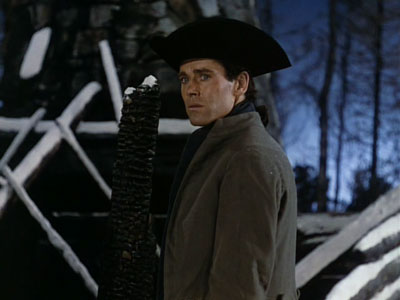
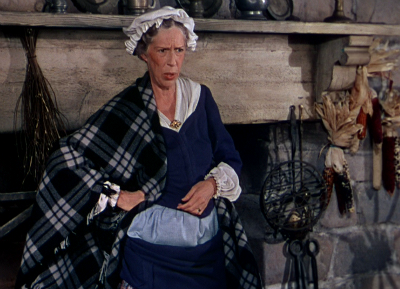
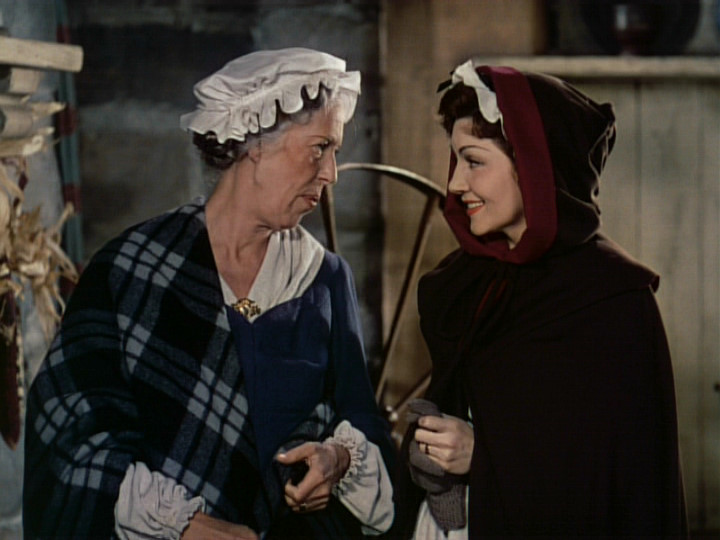
Drums Along the Mohawk(John Ford, 1939) "Every generation must make its own way—in one place or another"—so director Ford caps the start of his career-long history of the United States...with a wedding, for this earliest episode in that timeline. The year is 1776, but instead of the politicians haggling over language in Philadelphia meeting rooms, he's—again—on the frontier, a couple day's ride from Albany, New York. Gil Martin (Henry Fonda) and his new wife Lana (Claudette Colbert) are embarking on a mission, just as the newly formed states are, "to form a more perfect union."
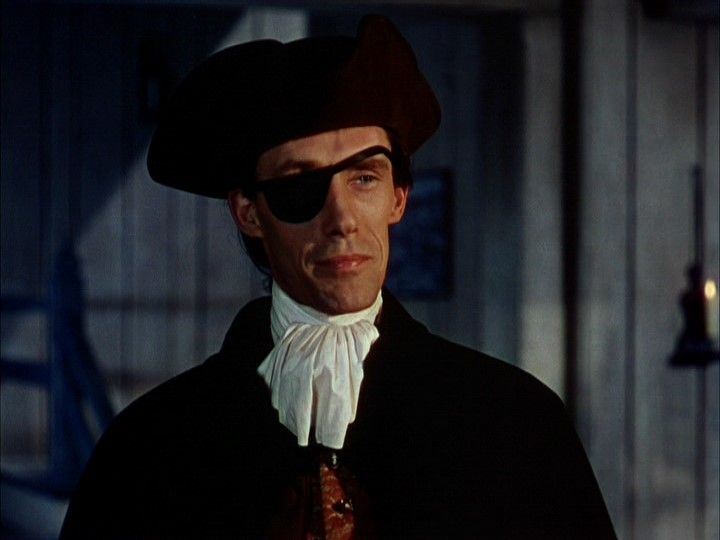
It won't be easy for either organization, with threats, both internal and external. There are attacks by Natives against the encroaching settlers (but, even here, Ford has them blameless—if brutally opportunistic—as the Iroquois are taking their orders from a Tory agent, played by an eye-patched John Carradine, who is paying the tribe for their berserker destruction of the homesteads, burning everything—buildings, crops and possessions—down to the bare Earth, leaving nothing, not even anything the tribe could steal or profit by), internal strife among the villagers, and the hard-scrabble existence that tests the fiber of the town-folk.
Before long, the citizens are driven to the local fort housing the militia, always at the ready for a call to arms from General Washington. In the meantime are the struggles to maintain a family, order, and petty grievances that threaten to disrupt the community from within. But, a shared sense of purpose—community-building reflecting the larger picture of nation-building, pulls the majority of them through.
Fire figures in a violent double-whammy that strikes one unexpectedly towards the end of the film, as a scout (played by Francis Ford, the director's brother) is wheeled out in front of the fort in a wagon of straw, which is then set alight by torches and flaming arrows.*Just when that scene is set in the mind, one of the settlers (played by Ford stock-player Ward Bond) is shot in the shoulder with a flaming arrow. A flaming arrow. Okay, sure, the arrow is a special effect on a wire, but the fire is real and Bond and his clothing are just as flammable as the next guy and his clothing. The level of violence is turned up just a notch from what one might expect, and one is taken aback by it.
Ford could do that—make you feel all-complacent and tear the Navajo-rug out from under you.
But it's a great movie. Action-oriented, with the only difference being that the significant events—the bigger picture—is all happening off-screen, rather than being part of the tapestry of events. Ford would be doing that in the future (both in his career and the events that shaped the country), but this is a very fine beginning.
Ford's first film in color—and Technicolor, at that—does not disappoint.
* It works just as dramatically here as it did in 1987, when Kubrick used something similar in Full Metal Jacket.
It's Spring-Break for me. Times are busy. The Summer Movie Season is already begun (and I'll be writing about the new ones) and the Film Festivals are grinding away like creaky mills separating wheat from chaff. It's as good a time as any to re-boot a feature I started years ago, when it was suggested I do a "Top Ten" List.
I don't like those: they're rather arbitrary; they pit films against each other, and there's always one or two that should be on the list that aren't because something better shoved it down the trash-bin.
So, I came up with this: "Anytime" Movies.
Anytime Movies are the movies I can watch anytime, anywhere. If I see a second of it, I can identify it. If it shows up on television, my attention is focused on it until the conclusion. Sometimes it’s the direction, sometimes it’s the writing, sometimes it’s the acting, sometimes it’s just the idea behind it, but these are the movies I can watch again and again (and again!) and never tire of them. There are ten (kinda). They're not in any particular order, but the #1 movie IS the #1 movie.
I’m very suspicious of patriotism (I always recall the "last resort of a scoundrel" remark), yet nothing moves me so much like a movie extolling the virtues of America.
It wasn’t until I was voting on the Emmy’s that I sat down and watched “The West Wing.” I figured it was going to be a vapid “America-Love It or Leave It” tract (starring Rob Lowe), even if it did have Martin Sheen playing the President, in which case, I could leave it. But TWW was a serious look at government work—its glories and disappointments, the combination of ego and sacrifice. It could criticize individuals and “ideology for ideology’s sake,” but one thing it never ever criticized was the idea of Public Service, no matter what side of the aisle it was on. At the same time the country is being run by crooks specializing in an institutionalized form of bribery and graft, there is an infrastructure of people for whom government service is a sacred trust (well, there’s gotta be ONE!) “The West Wing” paid tribute to that corps of people wherever they might be, week after week, and it made for refreshingly positive TV. It also made for a refreshing look at our nation as it stands.
And so, too, does “Mr. Smith Goes to Washington.” Made in 1939, it plays like it was written yesterday. When I saw it for the first time—right after “Watergate”—I found it amazingly prescient. But no, it was talking about its own times. The problems just keep re-occurring again and again. And again. Whoever doesn’t know history is doomed to repeat it, and with every fresh crop of people governing, they’ll keep making the same mistakes. Maybe they think they’re unique. Maybe they don’t know history. They say that if you keep making the same mistake over and over, it’s a sign of insanity. Well, psychology never factored in term limits.
“Mr. Smith…” is the story of a youth leader who is appointed to the Senate after the incumbent dies. This runs afoul of the state’s political machine that ran that senator as well as the senior Senator, Paine (Claude Rains)—who just happens to be an idol of the new senator’s.
It wouldn’t work if director Frank Capra didn’t have tall awkward Jimmy Stewart—not James, Jimmy—whose every stammered syllable bespoke humility. But get him talking about America or Liberty of The Capitol Dome and the stutter disappears in a fervent stage whisper that trails off in awe. Mr. Smith isn’t sure of himself, but he’s sure sure of the Country.
And Washington, D.C. is just the place to shake him up with a few lashes of the Beltway. Stewart could be frustratingly folksy, but for Capra (and for Hitchcock and Anthony Mann) he could be unnervingly vulnerable and, at the other end of the bi-pole, dramatically unhinged. The last act of “Mr. Smith…”—the filibuster against false charges of graft—features Stewart in both phases. At one point, he's knee-deep in political hate-mail, clutching it in his hands and looking skyward like Jesus at Gethsemane. Then a few short paragraphs about “lost causes” later, he’s at his most defiant. “You think I’m licked! You ALL think I’m licked!!” That was his Oscar-winning performance, not the next year’s “The Philadelphia Story” where the “cynical reporter” bit just didn’t wash with someone who looked so homespun. The filibuster scene always brings a lump to my throat, and it’s not sympathy pains for Stewart’s frayed larynx.
Now, I’ve read the screenplay to “Mr. Smith Goes to Washington.” It ends with a big parade honoring the completely vindicated Smith, surrounded by his boy-rangers, supported by the woman-he-loves (Jean Arthur, again, who manages to make her extraordinarily jaded Senate Aide adorable, even when she’s at her worst—and she has a great drunk scene with Thomas Mitchell. Hmmm, Thomas Mitchell, again). Why, even the disgraced Senator Paine is being lionized. Oh, it’s just so sweet, your eyes could roll back in their sockets and jam and stick that way. As Arthur’s Miss Saunders tipsily says in the film, “Nah, I can’t think of anything more shappy!” “Capra-corn” is what the very self-aware director called it.
So, he cut it. Orson Welles has said: "If you want a happy ending that depends, of course, on where you stop your story." Capra leaves his story’s ending ambiguous. Oh, you could call the riotous goings-on at the end a Happy Ending—but all of Paine’s Senate pals are trying to calm him down, telling him it’s okay…everything’s all right, we're still on your side. The only solace Jefferson Smith is granted is in the sympathetic smile from the Vice-President (played by John Ford’s silent cowboy film-star Harry Carey) before he collapses in a heap of his enemy’s mass-generated letters. The movie "celebration" has all the weight of an Al Gore victory celebration on Election Day 2000--a case of premature exaltation. But nothing's been solved. No one's been cleared. Nothing has been decided. There is just misunderstanding and confusion. Carey leans back and has a chaw while the chaos of Democracy continues unabated. It may not be a "happy" ending, considering the sequence that was shelved. It may not even be a dramatically satisfying ending. But it is representative of the loud, messy process that turns the gears of Democracy. However slow-moving, however off-course, they still turn.
Jeferson Smith (Jimmy Stewart) looks for guidance.
Mr. Smith Goes to Washington American Graffiti To Kill a Mockingbird Goldfinger Bonus: Edge of Darkness
Sunday's Scene: For Dads and Grads Tuesday: Fuggedaboutit...
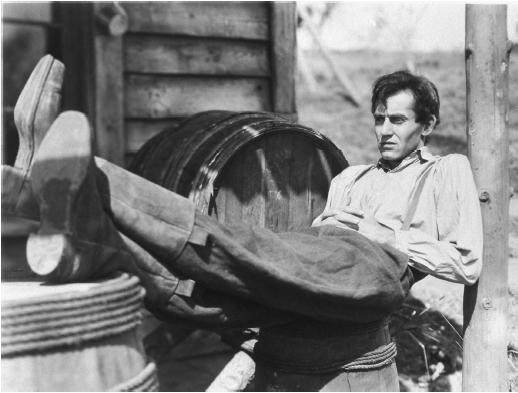
"Young Mr. Lincoln"(John Ford, 1939)Essential "John Ford at Fox" movie about the "jack-legged country lawyer" who would become the 16th President at the time of the nation's sundering. The film is filled to the bursting with fore-shadowing, from Abe playing "Dixie" on a jew's harp to encountering Stephen Douglas and Mary Todd to the penultimate shot of him striding up a storm-tossed hill lit by lightning (more on that later). Henry Fonda, heel-lifted, stiff-gated and nose-puttied plays Abe with a slow "drawrl" and far-away look, the film concentrating on the young Lincoln's learning and early practice of the law in Springfield, Illinois. Along the way he's haunted by the loss of his first love, Anne Rutledge and takes part in a murder case involving an angelic country family that stirs up feelings of home. Ford has a fine time skewering the pomposity of trial proceedings and the airs of high society.
The film is a prime example of the emotional mood swings that energized Ford's films.
But it also showcases the director's eye for composition and use of Nature to re-inforce story points. For example, there's this early scene where Abe and Anne tentatively express feelings. Anne is friendly with Abe, while he is tragically smitten. Ford frames them by a river where a great tree forms an arch extending from Anne and branches out to barely graze Abe.
The scene will end with Lincoln walking under that arch, alone, and throwing a rock into that swiftly-flowing river, its ripples starting a transition in time that will show the river clogged with ice, and a graveyard containing Anne's grave. In the background, a yearning violin piece serves as "her" theme, but also, generally, of memory and loss, as it keeps coming back throughout the film (23 years later, Ford would use it again in the same context in "The Man Who Shot Liberty Valance.")
And there's no denying the power of that almost-final shot (a more obvious studio shot serves as the last one, followed by Lincoln Memorial views) of Lincoln's film-ending hill-climb "goin' on a-piece." The bordering fence forming a barricade and the huge sky rumbling with thunder. It's one of the most beautiful representations of Destiny ever committed to film, from the film-laureate of History and nostalgia with a painter's eye and a poet's command of metaphor.
"The Rules of the Game"(Jean Renoir, 1939) Disillusioned by what he saw as a soft, indulgent society, Jean Renoir made a film to warn his fellow French of their lassitude (which always goes over big!) when Europe was facing a horrible threat, and found his film hated and ridiculed from all corners (Renoir relates a story of watching horrified at the premiere as a man in the audience set fire to a newspaper and threw it at the screen). Attempting to salvage his film, Renoir cut and cut and cut, but no one warmed to it...and during the war the only existing intact copy had been destroyed. Then, it became acknowledged as one of the Great Films of All Time. One can see why. Renoir is never subtle about his Grand Hotel of mis-fits, who are fiddling about while Rome burns, jumping in and out of each other's pants and business. Cruel but polite, they possess charm but no morals, they occupy their time, but not their lives, and Renoir plays no favorites, being as tough on the staff as theboor-geoisee. Supposedly, much of the film was ad-libbed, with Renoir providing a specific skeleton of the story for the actors to follow. This brings a great deal of freshness to the film, but also some of the cast can't help but go a bit over-board. The final irony is saved for last as a plucky rebound from tragedy is just another example of a selfish shallowness. Prescient, uncompromising (but also very entertaining!), "The Rules of the Game" is an open invitation to laugh at those horrible rich people, and has the audacity to hold up a mirror.
I’m very suspicious of patriotism (I always recall the "last resort of a scoundrel" remark), yet nothing moves me so much like a movie extolling the virtues of America.
It wasn’t until I was voting on the Emmy’s that I sat down and watched “The West Wing.” I figured it was going to be a vapid “America-Love It or Leave It” tract (starring Rob Lowe), even if it did have Martin Sheen playing the President, in which case, I could leave it. But TWW was a serious look at government work—its glories and disappointments, the combination of ego and sacrifice. It could criticize individuals and “ideology for ideology’s sake,” but one thing it never ever criticized was the idea of Public Service, no matter what side of the aisle it was on. At the same time the country is being run by crooks specializing in an institutionalized form of bribery and graft, there is an infrastructure of people for whom government service is a sacred trust (well, there’s gotta be ONE!) “The West Wing” paid tribute to that corps of people wherever they might be, week after week, and it made for refreshingly positive TV. It also made for a refreshing look at our nation as it stands.
And so, too, does “Mr. Smith Goes to Washington.” Made in 1939, it plays like it was written yesterday. When I saw it for the first time—right after “Watergate”—I found it amazingly prescient. But no, it was talking about its own times. The problems just keep re-occurring again and again. And again. Whoever doesn’t know history is doomed to repeat it, and with every fresh crop of people governing, they’ll keep making the same mistakes. Maybe they think they’re unique. Maybe they don’t know history. They say that if you keep making the same mistake over and over, it’s a sign of insanity. Well, psychology never factored in term limits.
“Mr. Smith…” is the story of a youth leader who is appointed to the Senate after the incumbent dies. This runs afoul of the state’s political machine that ran that senator as well as the senior Senator, Paine (Claude Rains)—who just happens to be an idol of the new senator’s.
It wouldn’t work if director Frank Capra didn’t have tall awkward Jimmy Stewart—not James, Jimmy—whose every stammered syllable bespoke humility. But get him talking about America or Liberty of The Capitol Dome and the stutter disappears in a fervent stage whisper that trails off in awe. Mr. Smith isn’t sure of himself, but he’s sure sure of the Country.
And Washington, D.C. is just the place to shake him up with a few lashes of the Beltway. Stewart could be frustratingly folksy, but for Capra (and for Hitchcock and Anthony Mann) he could be unnervingly vulnerable and, at the other end of the bi-pole, dramatically unhinged. The last act of “Mr. Smith…”—the filibuster against false charges of graft—features Stewart in both phases. At one point, he's knee-deep in political hate-mail, clutching it in his hands and looking skyward like Jesus at Gethsemane. Then a few short paragraphs about “lost causes” later, he’s at his most defiant. “You think I’m licked! You ALL think I’m licked!!” That was his Oscar-winning performance, not the next year’s “The Philadelphia Story” where the “cynical reporter” bit just didn’t wash with someone who looked so homespun. The filibuster scene always brings a lump to my throat, and it’s not sympathy pains for Stewart’s frayed larynx.
Now, I’ve read the screenplay to “Mr. Smith Goes to Washington.” It ends with a big parade honoring the completely vindicated Smith, surrounded by his boy-rangers, supported by the woman-he-loves (Jean Arthur, again, who manages to make her extraordinarily jaded Senate Aide adorable, even when she’s at her worst—and she has a great drunk scene with Thomas Mitchell. Hmmm, Thomas Mitchell, again). Why, even the disgraced Senator Paine is being lionized. Oh, it’s just so sweet, your eyes could roll back in their sockets and jam and stick that way. As Arthur’s Miss Saunders tipsily says in the film, “Nah, I can’t think of anything more shappy!” “Capra-corn” is what the very self-aware director called it.
So, he cut it. Orson Welles has said: "If you want a happy ending that depends, of course, on where you stop your story." Capra leaves his story’s ending ambiguous. Oh, you could call the riotous goings-on at the end a Happy Ending—but all of Paine’s Senate pals are trying to calm him down, telling him it’s okay…everything’s all right, we're still on your side. The only solace Jefferson Smith is granted is in the sympathetic smile from the Vice-President (played by John Ford’s silent cowboy film-star Harry Carey) before he collapses in a heap of his enemy’s mass-generated letters. The movie "celebration" has all the weight of an Al Gore victory celebration on Election Day 2000--a case of premature exaltation. But nothing's been solved. No one's been cleared. Nothing has been decided. There is just misunderstanding and confusion. Carey leans back and has a chaw while the chaos of Democracy continues unabated. It may not be a "happy" ending, considering the sequence that was shelved. It may not even be a dramatically satisfying ending. But it is representative of the loud, messy process that turns the gears of Democracy. However slow-moving, however off-course, they still turn.
Jeferson Smith (Jimmy Stewart) looks for guidance.
Anytime Movies are movies I can watch anytime, anywhere. If I see a second of it, I can identify it. If it shows up on television, my attention is focused on it until the conclusion. Sometimes it's the direction, sometimes it's the writing, sometimes it's the acting, sometimes it's just the idea behind it, but these are the movies I can watch again and again and never tire of them. There are ten. This is Number 6.

_02.jpg)