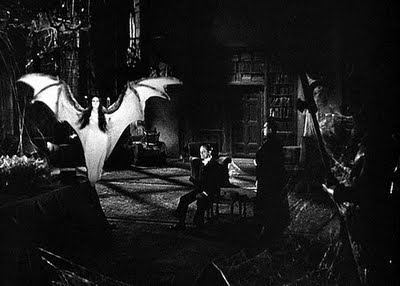
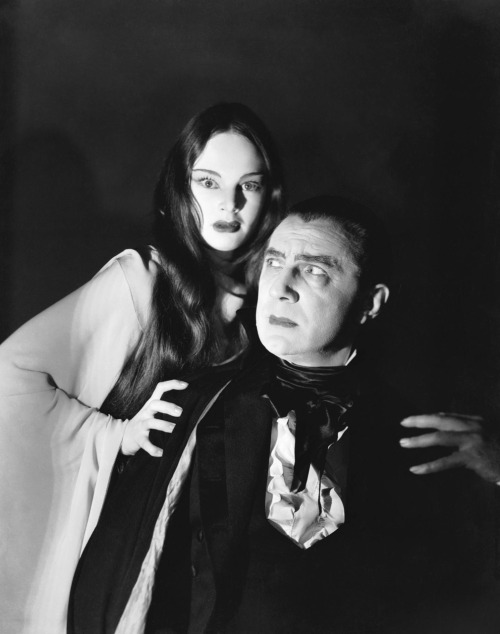
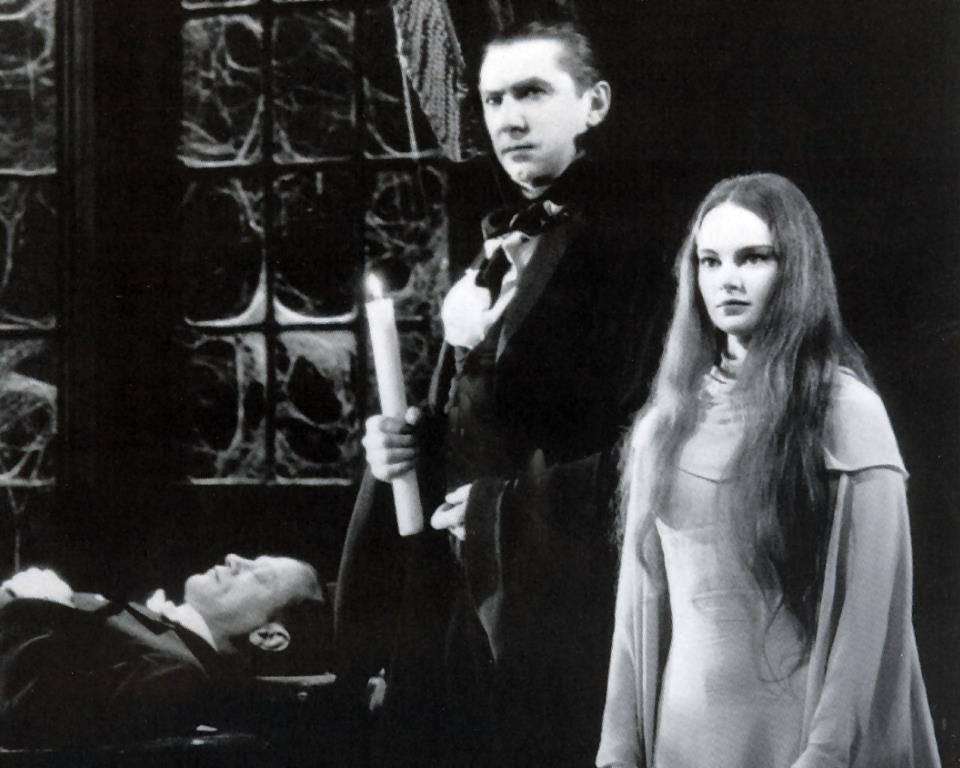
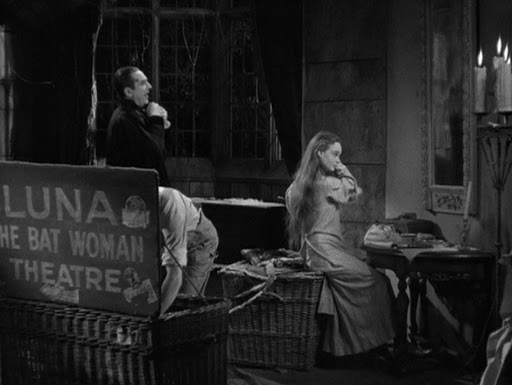
Mark of the Vampire (Tod Browning, 1935) Oooh! Here's a Hallowe'en nugget! Bela Lugosi as a vampire in a film directed by the original director of Dracula, Tod Browning? What could be better than that?
Well, just about anything, but all is not lost. The film is full of Browning's atmospheric touches—which made Dracula so creepy—and he does himself better here with extensive fog effects, a "real" flying vampire, and a hot she-vampire that's creepier than Lugosi, himself.
A remake of Browning's London After Midnight (a Lon Chaney silent film classic considered lost), this version is re-set in Prague. Plans for the wedding of Irena Borotyn (Elizabeth Allan) and Fedor Vincenti (Henry Wadsworth) are dampened when her father, Sir Karell Borotin (Holmes Herbert) is found murdered, two holes in his neck and his body drained of blood. The police are baffled, but not the townspeople, who blame it all on Count Mora and his daughter Luna (Bela Lugosi and Carol Borland), who the locals think reside in the Borotyn castle near town, despite being dead for many, many years.
The marriage is postponed, the case, being investigated by Inspector Neumann (Lionel Atwell), goes cold and Irena goes to live with her guardian, the Baron Otto van Zinden (Jean Hersholt). And, wouldn't you know it? Right before the wedding can occur again, another attack occurs—this time Fedor turns up double punctured after walking by the Borotyn castle. Then, Irena is attacked. Things are getting to be a real pain in the neck, so the inspector brings in noted vampire specialist Professor Zellen (Lionel Barrymore), who suggests a two pronged attack (naturally), they'll dig up the body of Sir Karell to see if he in thrall to the vampire, and they'll search the Borotyn castle for Mora and Luna.
There's more to this than meets the eye, and far less with a twist ending that makes horror fans see red.
Still, before they stake these vampires, Browning's atmospherics are fun, effective and slightly risible and although it disappoints for toying with the audience (and for the many 20/20 hindsight "but if..." questions after), it's genuinely creepy.
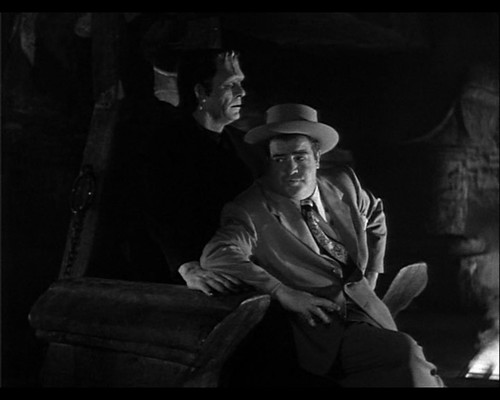
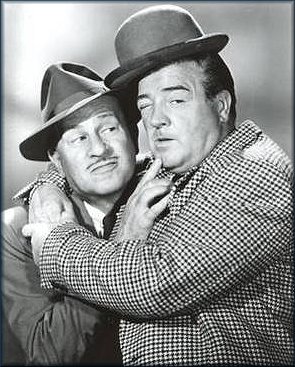
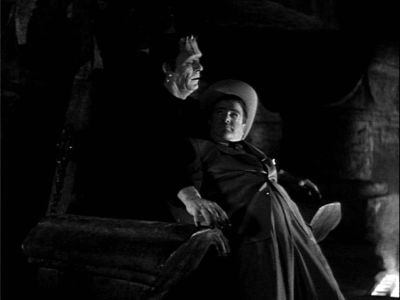
 "Abbott and Costello Meet Frankenstein" (Charles Barton, 1948) The full title is "Bud Abbott and Lou Costello Meet Frankenstein" (as they all had the same production studio, Universal Pictures). But even that mouthful leaves out two major characters in the film: Bela Lugosi re-stakes his claim as Count Dracula, and Lon Chaney, Jr. plays poor S.O.B. Larry Talbot, aka "The Wolfman,"* who turns lycanthropic whenever the moon is full (sort of an eternal frat-boy)** The unholy trio of Universal met long-time companions Bud and Lou for some hi-jinks and low horror. The boys are warehouse workers who have the bad fortune to be dealing with two crates of European antiquities bound for the local museum--Dracula's coffin (with an "occupado" sign on it) and the inanimate Frankenstein Monster (victim of a dead battery). Talbot's in the neighborhood, as he's tracking the shipments for some reason.The plot revolves around Dracula's ambition to re-animate the Monster, but replace its criminal brain with a more compliant, simpler brain, and Lou's character, Wilbur Grey, is the perfect candidate. This film was a favorite of the kids in my neighborhood, and when it aired (around Hallowe'en, after "The Brakeman Bill Show"), it was the sole topic of conversation for two weeks, and endlessly recreated on the streets and playgrounds. All the Great monsters--in one movie!! Of course, it'd be great!
And it was: giddy fun with enough strangeness, horrible deeds, and the slapstick and repartee that Bud and Lou were good for. Maybe it's "Mom's Apple Pie Syndrome,"*** where the tastes of childhood circumvent our better instincts later in life, but a re-appraisal of "A + B = F" in adulthood found me admiring its competence, humor and basic story-telling construction (circuitous, though it is). It's good stuff--strictly "B" material, but when did that ever get in the way of Big "E" Entertainment?
And it had Monsters. The Bestest Monsters. The ones that represented our Id's and haunted our dreams. Given the content of my previously sex-obsessed reviews of "Frankenstein" and "Dracula," what, then, can we glean from "A + B = F?" well, despite my "longtime companion" crack, Bud and Lou were room-mates who were 'into" dames. In fact, as if to counteract the threats of homosexuality (Frankenstein) and rapacious heterosexuality (Dracula) the Monsters represent, they are SO hetero, that Lou's Wilbur has two women vying for his attentions, though "bad girl" scientist Dr. Sandra Mornay only wants him for his mind. Bud and Lou are "safe" examples of "normal" sexuality--ya know, dancing and going to parties and dressing up and nothing further than "First Base."
"Who?"
Now, don't get me started....
Wait a minute....Bud Abbott's character's name is "Chick." Hmmm. * Chaney, son and heir-apparent to the make-up master of the Silent Era, claimed that he also stood in for Glenn Strange as The titular Monster, when the latter actor suffered an ankle injury.
** Vincent Price also makes a cameo non-appearance as "The Invisible Man!"
*** "Mom's Apple Pie" Syndrome usually rears its ugly head when dealing with "fanboy favorites," like the Star Wars films, or the Indiana Jones series, (ie. "You think the serial-mugging/teddy-bear warfare of "Return of the Jedi" was better than the recent Trilogy?" or "You seriously think the thuggish, racist and puppetoon "Temple of Doom" and slap-dash "Last Crusade" were "classics" compared to "Kingdom of the Crystal Skull?")
 "Dracula" (Tod Browning, 1931) Filmed version of the stage-play* featuring its matinee-idol, Bela Lugosi. As with "Frankenstein," there had been other versions of Count Dracula's British Invasion, including one ("Nosferatu" by F.W. Murnau) that got around copyright issues by calling its "vampyre" "Count Orlok."** As with Universal Picture's earlier productions of "The Phantom of the Opera," "The Hunchback of Notre Dame" and "The Man Who Laughs," the film is heavy on theatrics, but, this time, is a bit lean in the make-up department, although Lugosi did wear painful silvered contact lenses to enhance his seductive glare. Lugosi's elegant monster, with his slash of a mouth, and eyes wide open while balefully squinting with a laser-like intensity manages to still evoke "the creeps" to this day.
Tod Browning's direction is full of subtle touches--the sudden appearance of the Count's "brides," for example--and not-so-subtle--a shot of Jonathan Harker on Dracula's staircase is shot through a spider web, and Dwight Frye's performance as Renfield is babblingly over-the-top, as is required of so many actors in the horror genre.
As we wrote of the primal homosexual aspects of "Frankenstein," "Dracula" is the straighter blood-brother--the heterosexual aspect of humanity gone hysterical. Dracula's attacks start as seductions, but his acts are akin to rape--animalistic and savage--and linked to sexuality--penetrative, taking blood and passing on the disease of vampirism to his victims. sapping life-strength and energy. And it's all under the guise of civility and position, of manners and societal restraint. But underneath throbs the bestial urges--hidden by day, and only alive at night. Sure, it's nice to bask in the glow of celebrity, but make sure the smile isn't hiding fangs.
Count Dracula, then, is one big hard-on, that by light of day, crumbles to dust. That his bane are religious icons and his own lack of reflection (self-knowledge) only reinforces the metaphor. He's never gone out of style, no matter how straight-laced or free-loving the times. Dracula is one popular "playa."
With the times, the incarnations of "Dracula" have become increasingly sexual over the years, *** only making more obvious what Bram Stoker and Tod Browning buried in the sub-text. "Dracula" is, and always has been, the personification of serial criminal sexuality--which can only be curbed by the light of day. Dracula is The Forbidden, and carries the risk of damnation for seeking it. Besides the purifying rays of the sun, the surest way to kill a vampire is a blessed stake...through the heart.
"Frankenstein"-homosexuality. Dracula-heterosexuality. Of course, these haunts were conjured during the repressed Victorian era. But what horrified them, still carried a tingle, just as their stories intrigue us and our children, thrill us, and haunt our dreams. No wonder the Religious Right condemn them, or any aspect of the occult.
Hollywood makes a vain attempt (or stab) at killing them, but these monsters of the Id keep coming back, rising from the grave (or the ashes) to stalk another day...er...night. How do you handle these monsters/urges?
The answer on Friday.
But tomorrow, a horror favorite of mine from a Master Director.
*Adapted from Bram Stoker's 1897 novel by Hamilton Deane and John L. Baderston.
** "Dracula" did not go into the public domain until April, 1962.
*** A guided tour of coffin-dwellers (please, no flash pictures): Christopher Lee's athletic, animal "Dracula" in the heaving Hammer films, Frank Langella oozing Byronesque charm in the 70's stage version and 80's film version, Barnabas Collins, cutting a swath through the ladies of daytime soap-opera on "Dark Shadows," Anne Rice's tortured, damned rock-star vampires, and right on up to current day with the throbbing vampiric (though chaste) teen romances of the "Twilight" series.