Showing posts with label 1935. Show all posts

Thursday, October 31, 2013

Mark of the Vampire

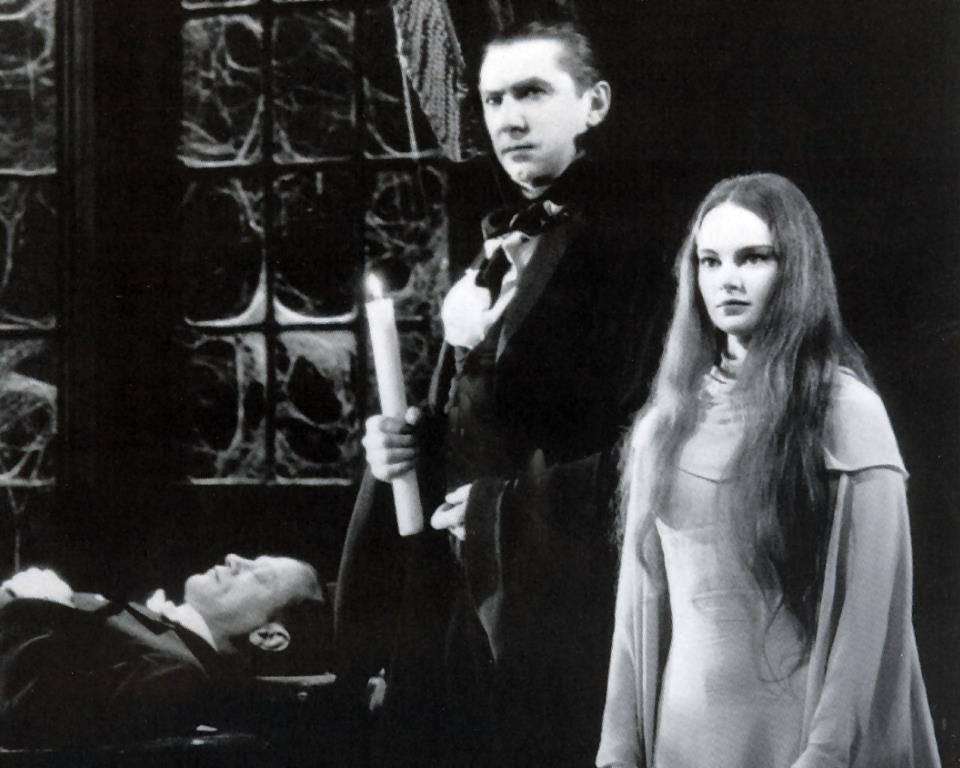
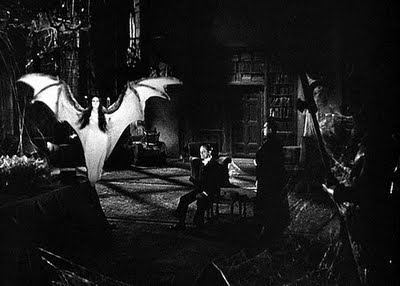
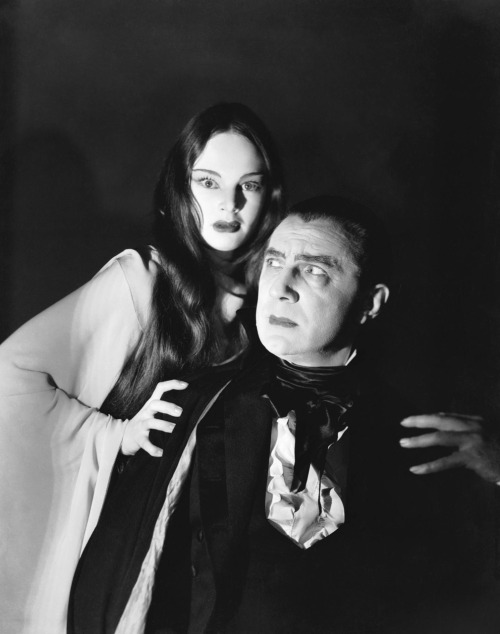
Mark of the Vampire (Tod Browning, 1935) Oooh!  Here's a Hallowe'en nugget!  Bela Lugosi as a vampire in a film directed by the original director of Dracula, Tod Browning? What could be better than that?

Well, just about anything, but all is not lost.  The film is full of Browning's atmospheric touches—which made Dracula so creepy—and he does himself better here with extensive fog effects, a "real" flying vampire, and a hot she-vampire that's creepier than Lugosi, himself.


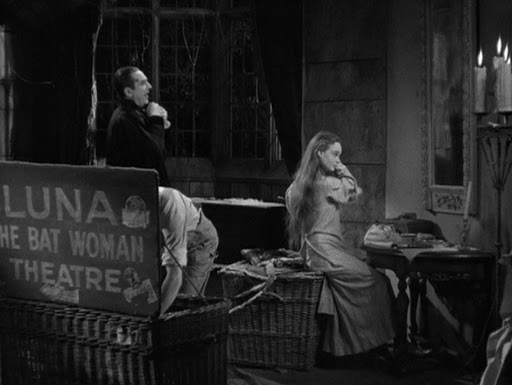
A remake of Browning's London After Midnight (a Lon Chaney silent film classic considered lost), this version is re-set in Prague. Plans for the wedding of Irena Borotyn (Elizabeth Allan) and Fedor Vincenti (Henry Wadsworth) are dampened when her father, Sir Karell Borotin (Holmes Herbert) is found murdered, two holes in his neck and his body drained of blood.  The police are baffled, but not the townspeople, who blame it all on Count Mora and his daughter Luna (Bela Lugosi and Carol Borland), who the locals think reside in the Borotyn castle near town, despite being dead for many, many years


The marriage is postponed, the case, being investigated by Inspector Neumann (Lionel Atwell), goes cold and Irena goes to live with her guardian, the Baron Otto van Zinden (Jean Hersholt).  And, wouldn't you know it?  Right before the wedding can occur again, another attack occurs—this time Fedor turns up double punctured after walking by the Borotyn castle.  Then, Irena is attacked.  Things are getting to be a real pain in the neck, so the inspector brings in noted vampire specialist Professor Zellen (Lionel Barrymore), who suggests a two pronged attack (naturally), they'll dig up the body of Sir Karell to see if he in thrall to the vampire, and they'll search the Borotyn castle for Mora and Luna.


There's more to this than meets the eye, and far less with a twist ending that makes horror fans see red


Still, before they stake these vampires, Browning's atmospherics are fun, effective and slightly risible and although it disappoints for toying with the audience (and for the many 20/20 hindsight "but if..." questions after), it's genuinely creepy.


Tuesday, October 23, 2012

Mad Love (1935)/The Hands of Orlac (1928)

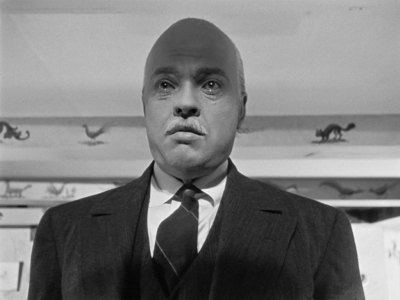
Mad Love (Karl Freund, 1935) It's been filmed many times since the silent era—most recently in 1958 starring Mel Ferrer and Christopher Lee, and another in 1962 as The Hands of a Stranger—but the most famous version of the 1920 French novel (by Maurice Renard) "The Hands of Orlac" is this 1935 version by German director Karl Freund.*  Well, "most famous" is a relative term—this one was pretty much forgotten until Pauline Kael exhumed it in her essay "Raising Kane" as an example of what she considered Orson Welles' derivative direction of Citizen Kane.  There are similarities, but vague ones—Peter Lorre's mad doctor bears a very slight resemblance to the elderly Charles Foster Kane, and his maid carries a pet cockatiel on her shoulder.**

Big deal, that.  Oh, and, of course, it's a deep-shadowed black-and-white film with deep-focus—a bit standard when dealing with low light levels in black-and-white (especially when the cinematographer is Gregg Toland, who worked on both films).  Beyond that, Mad Love is a completely different proposition than Citizen Kane and comparisons between the two are desperate and tortured, (as the writer could be at times).

But, that madness aside, Mad Love is a late version of German Expressionism from the silent era of film, and a direct descendant of:


The Hands of Orlac (Robert Weine, 1928) the silent version, re-teaming the director and star of The Cabinet of Dr. Caligari, Weine and Conrad Veidt.  Both stories involve the maiming of a brilliant concert pianist in a train wreck.  His fiance, in a desperate attempt to save his career—emplores a surgeon to perform a radical double-hand transplant that has unforseen circumstances.  The difference between the two is motivational—in the latter version, the surgeon performs the surgery, not just for the sake of music, but also for his desperate love of the fiancee, an actress in a theater macabre that he devotedly attends every night, going so far as to buy the waxwork figure of her in the lobby as an object of adoration.

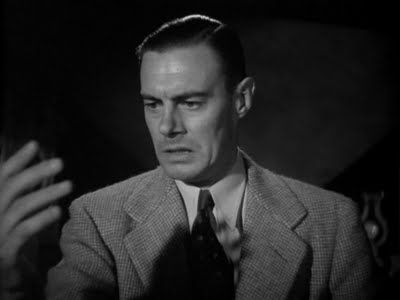
The operation is a success, but on the other hand, it isn't.  There's just one hitch, the same one that befell Dr. Frankenstein (coincidentally, the pianist in Freund's version is played by Colin Clive, the doctor in James Whale's version)—be careful where you shop for spare parts.  In this case, Orlac's hands are replaced by those of a murderer—a strangler in the silent version, a master knife-thrower in Freund's.  Before long, the composer is struggling to do his five finger exercises, and working on other handiwork, as well.  Before long, he is implicated in a murder, and beset by nightmares that his hands are out of his control (they are, after all, the devil's playground).


The two diverge at this point, with Mad Love concentrating on the insane machinations (literally in one instance) of Lorre's insane Dr. Gogol—in the silent version, the surgeon's role diminishes significantly at this point—and Orlac's new talents become even more literally "handy."

Both versions weigh heavily on the psychological, as Orlac and his new hands lose their grip on reality, but the first one is quite satisfied with takinbg the macabre elements so far.  The later version, post-Frankenstein and Dracula relishes the more twisted elements of the subject, going places that the original finds fanciful and, frankly, superstitious.  Mad Love embraces the possibility that the murderer's hands will, actually, assert their sense memory allowing Orlac to throw pointy things very, very accurately...and the difference between the two films is only a span of seven years.  Interesting how an audience's capacity for the weird and supernatural—and Hollywood's willingness to deliver it—could become so prevalent. 


* Freund was the German director/cinematographer whose most enduring influence came in the early days of television production when his 3-camera recording technique revolutionized filmed comedy shows (before a live audience)—a concept that started during his days with "I Love Lucy" but continues to be used today.

** Welles used a super-imposed shot of a cockatiel during what he considered a "rough transition" that didn't have enough dramatic impact, and later joked that he did it "just to wake people up."

Tuesday, February 8, 2011

A Night at the Opera

A Night at the Opera (Sam Wood, 1935) A career resuscitation for the zany Marx Brothers (or 3/4 of them—Zeppo does not make the studio transition with brothers Groucho, Harpo, and Chico), this was the first film made with the boys under their new contract with M-G-M, under the tutelage of Irving Thalberg. It was Thalberg's bright idea to take the Vaudeville vets back to Square One—back to the hit-days of The Cocoanuts, as they play glorified Rosencrantz's and Guildensterns to a couple of love-crazy kids for whom life is throwing a cold shower. It rather douses the film, as well, and softening the brothers' hellz-a-poppin' approach of the latter Paramount films. Unlike their previous film, Duck Soup, anarchy does not reign, but merely drizzles a little, getting the floor wet enough to allow the "bad guys" and authority figures to slip and fall.

I prefer the latter, where the focus is on the insanity of the brothers intruding on the niceties of the real world, with only rare interludes into unmolested cinema "reality."  It was a nice satiric touch to make them the heads of a small bankrupt nation who aspire to greatness (and economic recovery) by going to war,* and the send-up's of blind patriotism ring true in any decade.

Sadly, at the time, that didn't translate into boffo box-office, Thalberg's view of Duck Soup's drop in attendance was "there was no one to root for" (translation: anyone normal) so, starting with this film, the percentages were reversed.  There are lulls of song between the comedy bits, appropriate given the opera background of the story, giving breathing spaces to let audiences catch their collective breath—the kinds of interludes that prompted Groucho (in the film Horse Feathers**) to break the fourth wall to turn to the cinema audience and grouse: "I have to stay, but that's no reason the rest of you can't go to the lobby for a quick smoke or something!"

A Night at the Opera (written by George S. Kaufman, Morrie Ryskind, Al Boasberg, and, reportedly, the great Buster Keaton) sees Groucho as false-impressario Otis P. Driftwood, under contract and slightly under-thumb of society-craving Mrs. Claypool (Margaret Dumont).  Chico is the manager of Riccardo (Allan Jones), who aspires to opera stardom and is in love with Rosa (Miss Kitty Carlisle—as she was known as a panelist on "To Tell the Truth").  Harpo is the dresser of Lassparri (Walter Woolf King), a gas-bag opera star,who also has designs on Rosa.  Immediately it becomes a case of clashing egos, thwarted love and abuse of power and entitlement, perfect diva-size targets for the Marxes to lampoon.  It's safe and sane, such a pity.  But, there is enough rich material to satisfy Marx Brothers fans.

And, thanks to the wonders of technology, you can skip over the other parts if you so desire.***  Where's my remote?  (Probably under Mrs. Claypool)

Still, one must be grateful.  Half a classic film is better than no classic at all. 


* Mussolini took Duck Soup as a personal insult and had it banned in Italy.


** Did it ever occur to you that the titles for the first Marx Brothers films (except for The Cocoanuts)  could be euphmisms for "Bull-shit?" Well, it certainly occurred to me!

*** In his review of A Night at the Opera, Roger Ebert says that is exactly what he does.