Showing posts with label Robert De Niro. Show all posts

Friday, December 7, 2012

Silver Linings Playbook

No Dolby; No Squelch
or
"Hey!!..."

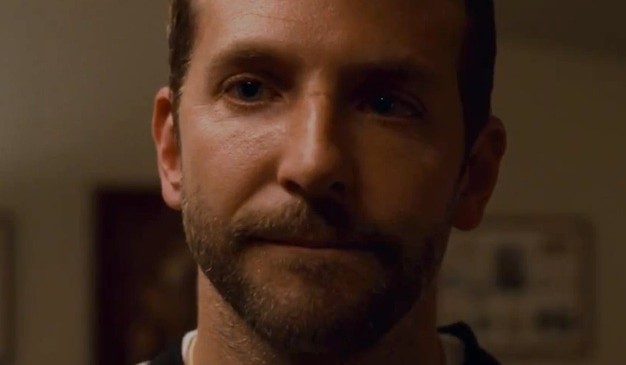
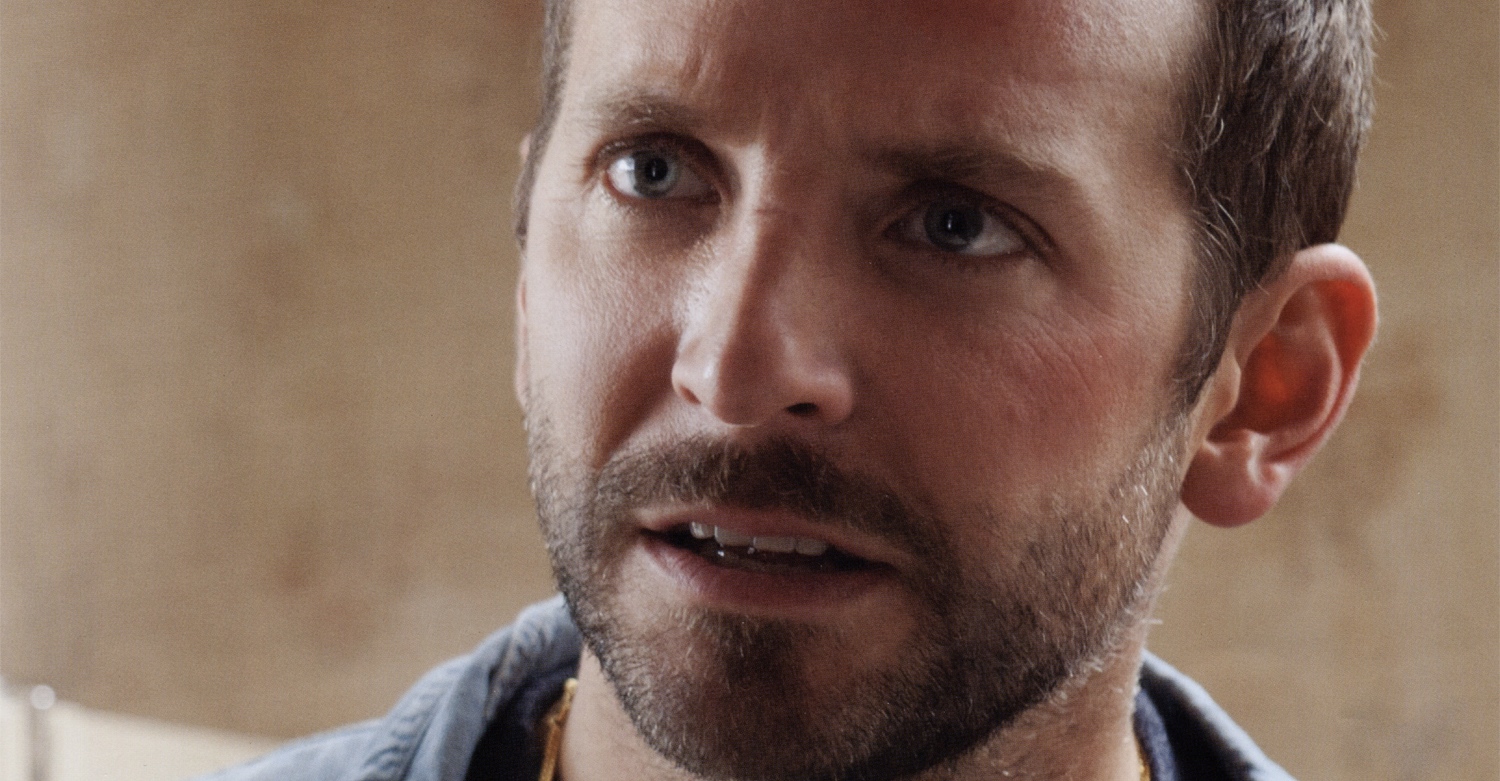
In Silver Linings Playbook, there's a scar above Bradley Cooper's nose that I found myself focusing on throughout the entire movie.  It's not like Harrison Ford's chin-scar that has followed him around from movie to movie; this one is just a line-scab that never seems to heal and I found that apt—the movie's all about a guy, Pat Solatano, Jr., whose lost everything and wants to get it back, despite that losing it might have been the best thing that ever happened to him.  He's undiagnosed bi-polar, but he keeps wanting to return to the halcyon days when he didn't know he was bi-polar and was married to Nikki (Brea Bee), a schoolteacher, and was living a fairly normal life, or as normal as bi-polar can be, undiagnosed or not.

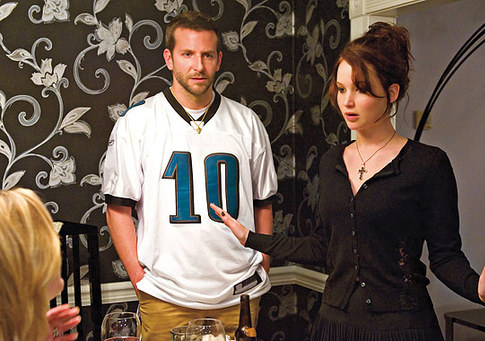
When he gets out of the Baltimore Psychiatric Hospital, he's focused on getting his old life back—he's whipped himself into shape, goes (reluctantly) to a therapist, stays on (reluctantly) his meds, and is determined to make himself the man Nikki wants him to be—there's just that little thing about the restraining order and the fact that he caught her having sex with a school administrator.  And that he caught them making love to their wedding song which was Stevie Wonder's "My Cherie Amour," which sends him into an "episode" every time he hears it.  And there's that focus issue.  He's not kidding himself anymore, but his constant stream of truthiness, socially correct or not, keeps getting him into trouble, with his folks (Robert De Niro and Jacki Weaver), his brother (Shea Whigham), his pal Ronnie (John Ortiz) and Ronnie's wife Veronica (Julia Stiles)—who just happens to still be friends with Nikki.  Pat, Jr. latches on to them to try and make contact with his ex, and to do so agrees to have dinner with them.  Also invited is Tiffany (Jennifer Lawrence), Veronica's sister, who has issues of her own, still grieving from the death of her policeman-husband.

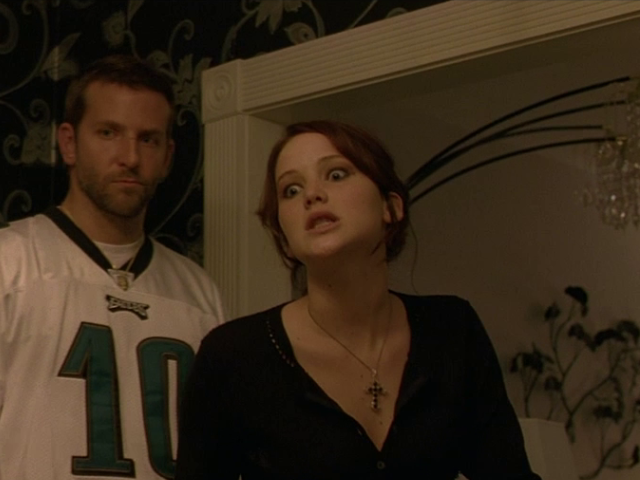
Pat and Tiffany do NOT get along at dinner, and only connect over their mutual history with anti-depressants.  That seems to be enough for Tiffany, as she announces she's had enough family time and asks Pat to walk her home.  They share enough information there for Tiffany to be repulsed by Pat, and for Pat to think Tiffany is crazy.  

But, then, Pat thinks everybody is crazy (except for himself).

And...he might be right (except for the last part).  He's very quick to point out the eccentricities in others, probably because he possesses those traits himself.  He notes his Dad's OCD—he goes through rituals while watching each Philadelphia Eagles game, as he's taken to book-making since losing his job, and has a sports fanatics' passion for football (and probably more so as he's been banned for life from the stadium).  In Pat's mind, everybody is dysfunctional, because Pat's mind is dysfunctional.  While reading the books on Kiki's syllabus, he tosses "A Farewell to Arms" through his attic window for its downer ending.  And his own obsession with his ex-wife becomes a means towards an end for Tiffany when she offers to sneak a letter to Nikki for him—if he'll be her partner in a dance competition.

The director is David O. Russell, who also adapted the book (by Matthew Quick) and did a brilliant job cataloging family feuds in The Fighter.  Family seems to be his forte, mining the mania for subtle comedy while not diminishing the seriousness of the hysteria bubbling under the surface.  And Russell imposes enough energy in his direction and editing that he invigorates the already simmering outbursts the performers put into it.  De Niro we already know can pull a manic act for both comedy and drama and Wilkins manages to keep a look for fret even when happy.  The ones who surprise are Lawrence, who's cute as a button and volatile as a cougar in a surprising performance, and Cooper who has a crazy flame in his eyes throughout.  His outbursts never surprise; it's his semi-even keel that is interesting to watch, and worry about.*

Yes, they're crazy.  But, in Russell's world-scheme, everybody is in the U.S. of OCD, whether the obsession is sports, gambling, love, and competition.  And Russell does a nice job of turning the dark side of rom-coms before the camera, and making decided call-backs to the past for his ending.  Despite our relationships with the past and flirtations with the future, hope still vaults eternal in the perpetual grasping for something better, in the hope of no longer clinging to what was.

One suspects, after the movie is over, that that tell-tale scar will start to disappear.

Silver Linings Playbook is a solid Matinee.

Congratulations to long-time readers "Walaka" and "Otis" on their engagement!


  * In the same scheme of things, Russell has cast Chris Tucker as one of Pat's fellow hospital incarcerees.  It's the best performance Tucker has ever given, subtle, scary and controlled.  Anybody who's seen his other work, knows what he's capable of  and the effect here is like watching Jerry Lewis do drama, but without the self-awareness and ego.  


Tuesday, April 3, 2012

Hi, Mom!

Hi, Mom! (Brian De Palma, 1970) Second full-length film (although it seems more a comedy pastiche in final form, like the Zucker Brothers were making at the time) that De  Palma and his producing buddy Charles Hirsch cooked up as a sequel of sorts to Greetings (retaining Robert De Niro and his "character" John Rubin), while having absolutely nothing to do with the first film.  Ostensibly about a young film-maker who wants to make "peep-show art" out of filming the real lives of his neighbors in the co-op across the street—shades (opened, naturally) of Rear Windowit meanders into Rubin's plotting a relationship with one of his subjects (Jennifer Salt), while at the same time becoming involved in an experimental theater group, staging a radical audience participation vehicle called "Be Black, Baby!"

Mean-spirited (but in a smart way), with that stagey kind of improv quality to it that only works 40% of the time, it feels like De Palma taking off the gloves, cracking his knuckles and using his camera like a fist against complacency. It also has that bi-partisan cynicism to it that's very refreshing—for instance, "Be Black, Baby!" is shown being presented (in grainy black and white on a rounded edge square screen) over a parody of NET,* now called NIT—National Intellectual Television.  It's a chortling, vicious piece of satire done in multi-parts (with the Rubin segments interrupting and becoming more and more inconsequential, the "peep-art-show" concept having long been abandoned**), starting with citizens being accosted on the street about their failure to know what it means "to be black in America," then more segments that are less cinema verite, but have a good improv feel, and then the actual presentation of the play in which privileged whites are challenged, force-fed "soul" food, beaten, robbed and arrested (with one attempted rape thrown in for good measure), before being released to the outside world again—"Hope you enjoyed the show!"—at which point, they're interviewed about their experience (the best line in the whole thing is "Clive Barnes was right!").  In one swell foop, art, pretentiousness, and "touchy-feely" moccassin-walking are given the mau-mau, and come up wanting.

It's "bad-kid movie-making" with a smart-alecky breeziness ("Hi, Mom!") that beats any number of elaborately formal set-pieces that De Palma has subsequently staged.  One misses this "turk" De Palma***—the one that would do things that upset audiences, and sit back, cigar in his teeth, saying "Wait'll you see the next one!"  Maybe it's not De Palma's fault.  Maybe we've just become insensitive enough that nothing he can produce shocks us anymore.

If that's true, imagine how miserable Hitchcock would be.


* The percursor to PBS.

** The best segment in the Rubin sandwiching sequences is one where he meticulously plans a seduction of Betty Shaefer—Salt's character—in order for him to film it—yes, a sick idea, but quaint in these days.  But, things go awry when he arrives at the apartment and she tries to pull him into bed immediately, while he does his best to keep anything from happening, a lovely little turn on sexual roles, expectations, and how much power a director "actually" has.  De Niro does his best work here, hemming and hawing and making excuses, constantly glancing at his watch and re-buttoning every shirt-button she's unbuttoned,  and trying to use any of his by-now useless preparations in order to delay, delay, delay (you might say "the worst laid plans")


*** And he might, too.  In an interview, the director has said that the "Be Black, Baby" segments of Hi, Mom! are the best thing he's ever done.  Sad to think that, after all his successes, the elder De Palma looks back and sees this edgy, slap-dash sequence as the epitome of his career.  But...if one is dissatisfied with one is doing, with all the compromises and concessions to getting a picture made and marketed, it's easy to look back on the brash days and say "That's when I had the freedom to do anything I wanted!"  After the bludgeoning De Palma's films of The Bonfire of the Vanities and Redacted took, one can see that a bit more clearly.  He could make that kind of film today.  But, the market...and the critical elite...will bash it down.

Tuesday, August 2, 2011

What Just Happened

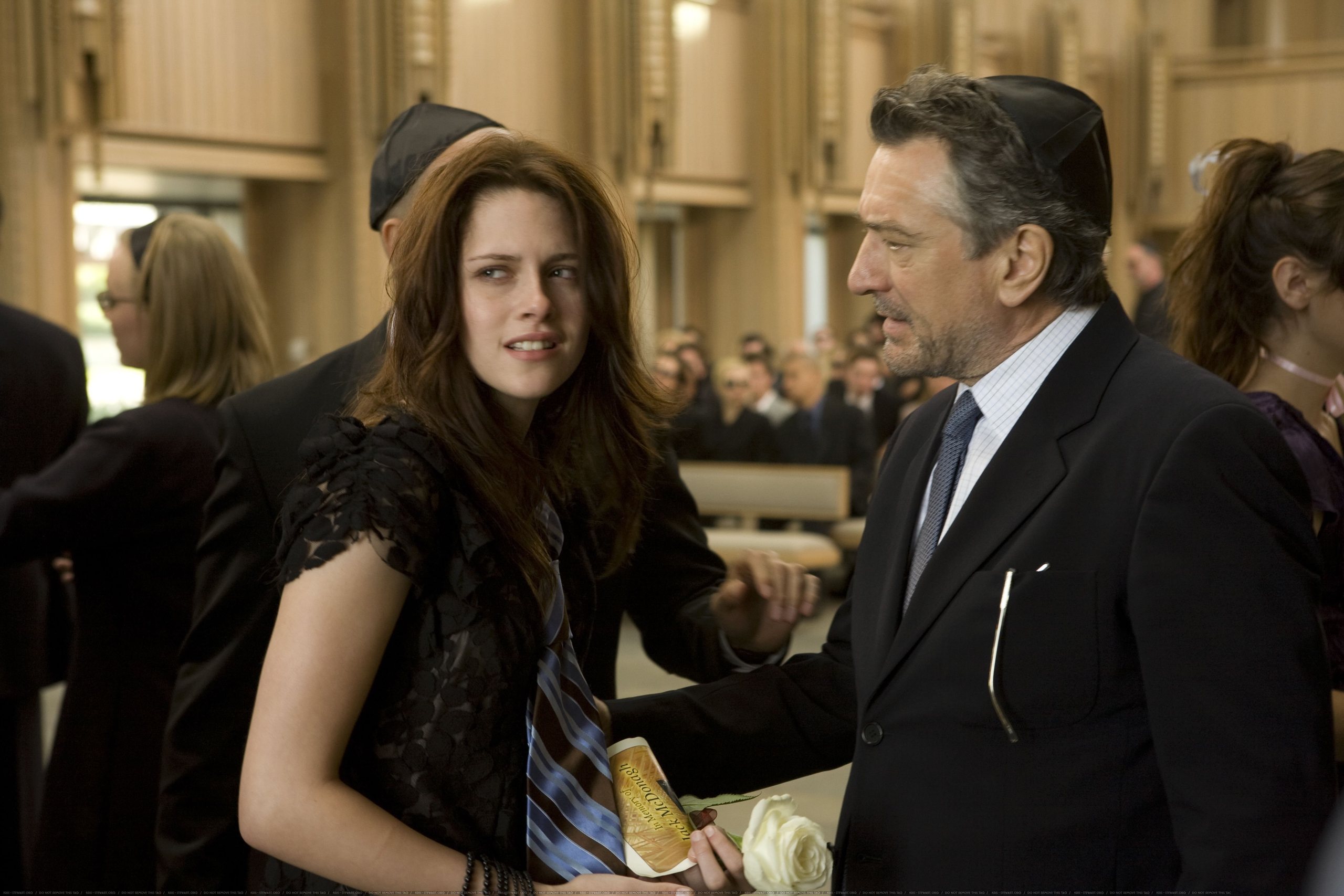
What Just Happened (Barry Levinson, 2008) Ben (Robert De Niro) is a producer in Hollywood and he has a tough life.  His new movie starring Sean Penn just previewed and the cards don't look good.  The director, wanting to be "edgy," has a scene where the bad guys shoot Penn's dog, then kill Penn.  Audiences are upset about the dog.  The studio (run by Catherine Keener) is upset about the audiences and wants to re-cut the film, the director is upset about his "vision" being changed and refuses to cooperate.  Ben wants the to keep the director happy, the studio happy, the audiences happy, the two ex-wives (including Robin Wright) and three ex-children (including Kristen Stewart) happy, while still worrying about where he's standing in a Vanity Fair "Power in Hollywood" photoshoot.

On top of that, he's got a big budget movie starting its shoot on Friday and the star (Bruce Willis playing Bruce Willis) is being payed $20 million to star in it, but there's one little hitch—he's grown "a Grizzly Adams" beard, and the studio is panicking—people want to see Bruce Willis when they see Bruce Willis and they want Ben to coax the temperamental star to shave it off, which he refuses to do for "artistic reasons."*  Ben's life is an endless soliloquy of superficial arguments, hastily-composed rationalizations and insincere ego-stroking in the gamesmanship of Hollywood, played over a Blue-Tooth behind the wheel of a constantly in-motion Lexus. 

Based on producer Art Linson's book (sub-titled "Bitter Hollywood Tales From the Front Line") and adapted by him for this film, it's a nice study of how removed from reality, logic and best practices the industry is.  But, at the same time Barry Levinson's film of it, while duly making note of the sliding loyalties Ben displays, also seems to expect you to feel sorry for him.  One would, if one didn't want to have this life.  There is no tragedy here, merely minor inconveniences that whittle away at Ben's soul and career.  But, he still has a roof over his head.  He has a car (and the insurance for it), a cell-phone, a blue-tooth, a fancy-schmancy espresso machine, the ear of many Hollywood players, and the phone numbers of ambitious actresses.  Boo to the Hoo.  Yes, Hollywood's crazy...but it's not homeless and crazy.

That's why backstage dramas in tinsel-town are really only good when played for laughs, and should only be reserved when the writer-director-producer has completely run out of ideas (and when that happens, they should read a book, instead).  You look at movies like The Oscar, or The Big Knife, with the hand-wringing of the elite, and you can look right into the soul of industry people who have lost touch with their audiences**...like Norma Desmond screeching about her woes.  It's why Sunset Blvd. is such a classic gem of a movie.  Norma is crazy...and pathetic...and clueless.

Howard Hawks had it right.  After awhile, he was making movies about making movies—but, they were well-veiled allegories.  Anytime Hawks had a group of disparate people coming together with a single goal in mind, he was talking about what he and his crew did for a living...only they were flying the mail, or capturing live rhinos, driving the cattle, getting the headline, or battling the monster at the research station...anything but making movies.  That would be as much fun as watching sausages being made.  If you want to complain about being in the entertainment industry, try pumping gas...then, have a drink or climb onto the shrink's couch.  Don't get "meta" on the audience.  They go to the movies to escape their troubles, not hear about yours.

But, like Fellini, pretty soon the writers start penning their autobiographies.  Linson might be thinking that he did a good job changing the names to protect the innocent, but listening to  his DVD audio commentary with director Levinson, one hears the vagueness, the "rote"-ness of his expressions, as if he's just passing through, and once the credits come up, he's already out the door (he's gone before the "A Barry Levinson Film" credit comes up).  The two were in separater facilities recording their tracks, and as Linson gets up he says "Good seein' ya, Barry" "uh...talking to ya," says Levinson.  "Oh.  Yeah...well..." says Linson.  "We should get together when you come to New York."

Yes, we "really" should.


* True story, although I won't mention the movie or the star (it's easily found, actually).  But, it reminds me of the struggles Richard Donner had while making Superman, the Movie—making a man fly was easy compared to star-negotiations.  Donner had a meeting with Marlon Brando, where the actor was pitching character ideas that would keep him from having to appear on camera, like playing Superman's kryptonian father as a suitcase or "a green bagel," and Gene Hackman didn't want to shave his moustache to play Lex Luthor.  Donner finally said to Hackman on-set. "Look, Gene, you shave yours off and I'll shave mine off."  Hackman agreed, shaved and came back on-set.  "Okay, now it's your turn."  Donner then peeled off the fake moustache he's been wearing, which delighted Hackman.

** (The same could be said for politicians—anybody in Washington looking at cutting the health-plans for those in the legislative branch...if not, why not?)

Saturday, May 14, 2011

Righteous Kill


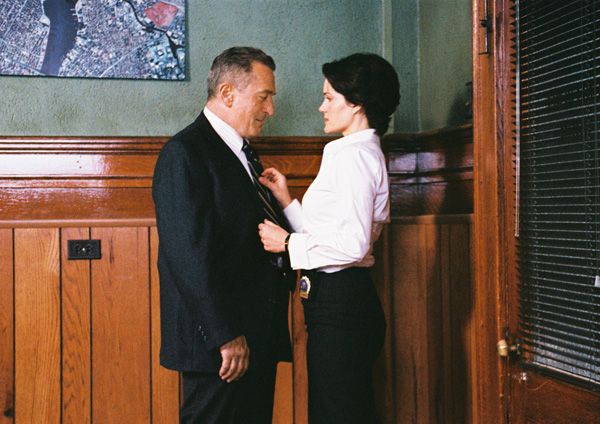
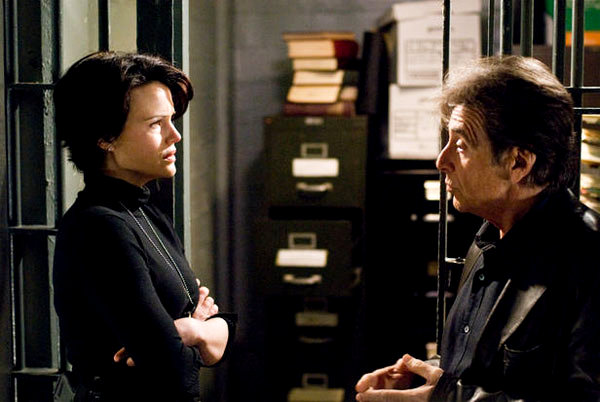
Righteous Kill (Jon Avnet, 2008) Someone is killing Scott Free's—those scum-bags that you just know are guilty but have some smooth-talking fancy-pants lawyer or some milque-toast judge who lets 'em walk, sneering, to prey on Society again...until they show up with a bullet-hole in the middle of their forehead.  Two buddy cops, Turk (Robert De Niro) and Rooster (Al Pacino) start to add things up when one of the perps they arrested shows up deader than a Keanu Reeves performance.  Looks like it's murder "and somebody's responsible."  A vigilante?  Certainly.  But, if its revenge they're after, why are so many of these guys showing up dead?  It's then that they think that the killer may be a cop.

But who?

Complicating matters is that most of the cops, including De Niro, Pacino, plus Carla Gugino, John Leguizamo, plus Donnie Wahlberg-o are creeps, so it could be any of 'em, except for the Captain of the squad (Brian Dennehy) but only because you couldn't believe Dennehy could sneak up on anybody but a bed-ridden quadriplegic.

So the question is: which of the crazy actors is playing the crazy character killing all these people?

The answer: who cares?  With a movie this terrible, and victims painted so sneeringly evil they're cartoons it's hard to work up much sympathy or even interest in finding their killer.  That's the problem of the writer.  But director Avnet is so ham-fisted, he can't seem to hold a shot or light a set without sabotaging the drama of a scene.  He's so busy "nuancing" things that you have trouble following the plot.  He's not even talented enough to get out of the way of De Niro and Pacino (or, God forbid, rein them in) to make a scene play.

And, let's face it, having those two legends on the screen should be a treat: they didn't work together in The Godfather: Part II (obviously), but their scenes in Michael Mann's Heat were tantalizingly short.  Here, they're in almost every scene together (although Avnet can't seem to find the wherewithal to keep them in the same shot), and you realize they're like oil and water, or Mumbles and Loudmouth—they're two actors who've known each other for years, but their characters don't seem to.  Or else the movie would be over in five minutes.  But no, the suspicions and subsequent doubts must be fully explored, the red herrings must stink up the joint, and the script-writer must throw in a couple of feints that make no sense once the movie is over—they're there just to con the audience.*

What a waste.  The big mystery is given this script, how could it attract two of the most iconic, respected and (when paired) legendary actors?  Sounds like the biggest con was going on behind the scenes. Righteous Kill is the last thing you would expect a film starring De Niro and Pacino would be—a very pedestrian run-of-the-mill movie.

* Now, movies are by nature, the manipulation of reality—and the audience—to tell a story.  But, there's doing it well, and there's doing it the Righteous Kill way.  This week, we'll look at a movie that stylishly—and very slyly—does it right.

Wednesday, December 9, 2009

Everybody's Fine

"But the Film? N'yeah, Not So Much!"

Widower Frank Goode (Robert De Niro) has a big family reunion planned when all the kids at the last minute cancel. Assuming, as do we, that they're just avoiding seeing "the old man," he packs his bags, his keys and his pills, and buses and trains across the country to drop in, unannounced, on each and every one of them, with a mystery note. He doesn't fly, you see, as he's suffering from pulmonary fibrosis, which he's acquired from his job of weather-coating phone-cable with PCB's. It is the very nature of this movie to let no plot-detail go unutilized in this bubble-world of a movie, so, of course, that becomes important later.

When visiting each kid, he realizes that they're leading somewhat less successful lives than they and his late wife had led him to believe. And he's determined to get everybody back together for a big get-together at Christmas.

It sounds like the excellent Christmas "ABC Movie of the Week," "
The Gathering," in which a dying Edward Asner attempts to have one last Christmas with all his estranged adult kids before he goes to the Great Gift Return in the Sky. But this is actually based on an Italian film by "Cinema Paradiso" director Giuseppe Tornatore called "Stanno Tutti Bene" (or "Everybody's Fine") and de-cultured, simplified, sweetened and topped by an ineffectual Paul McCartney song by Kirk Jones (who made "Waking Ned Devine" and "Nanny McPhee" and should know better).

I haven't seen the original (shame on me,
I loved "Paradiso"), but I know it wasn't as slick and as simple-minded as this version. For example, it hinges on the false premise that nobody ever talks in this family...ever. The entire movie could have been solved in an hour by Dr. Phil. Everybody keeps secrets, sure. But usually not very well. How long did these kids think they could keep their charades going, especially with the major life-changes they entail? The machinations that daughter Rosie (Drew Barrymore) has to go through are herculean and more than a little uncredible for what she's hiding, and also speak of a lack of feeling that the rest of her performance belies. Added to that, the plot device of inflating your importance to your parents has been used in every sit-com ever conceived—but pulling it off on an elaborate movie budget tends to make the concept explode like shrapnel. It's especially frustrating, after seeing a mature film for adults like "Up in the Air" to see froth like this, designed for the eye-candy-and-blue-hair crowd, where no opportunity for closure goes unachieved with an unsubtle slam.

The cast in uniformly great, howver. De Niro (man, he looks plasticized in that poster—they airbrushed out all his wrinkles to attract a younger crowd) schlumpfs around the country, asking, ironically, "Are you not talking to ME?" and still manages to find simple, interesting ways to be "a joe." The kids are played by Barrymore,
Kate Beckinsale and Sam Rockwell*, who all do fine jobs given the paucity of material, though Rockwell looks particularly frustrated with his role.

Who could blame him? This isn't a film. It's a "project," gussied up with an all-star cast of available talent who have nothing in common other than they wanted to work with De Niro; a constuct that looks good on the surface, but has no underlying thought to it that would make it legitimate in its own right, and plausible as a story. It's "
Meet the Fockers" done as drama, a collection of parts that don't fit for a coherent film, much less as a representation of real life. Everybody involved should be sentenced to a year of working in theater where they might stumble on some actual characters to play and thoughts to express. Their aspirations are too low, and need to be adjusted.

"Everybody's Fine" is a Cable-watcher, probably on "Lifetime."


* That's another thing: there's no way
De Niro could have had these three kids without marrying three different wives. Nobody looks like they belong in the same family. It looked good on paper on the Miramax ledger-sheet, I'm sure, but it looks like sham on the screen.

Thursday, June 19, 2008

Olde Review: The Godfather Part II

This was part of a series of reviews of the ASUW film series back in the '70's. Except for some punctuation, I haven't changed anything from the way it was presented, giving the kid I was back in the '70's a break. Any stray thoughts and updates I've included with the inevitable asterisked post-scripts.


"The Godfather Part II" (Francis Ford Coppola, 1974)

Seanator Geary: "I despise your masquerade. The dishonest way
you pose yourself. Yourself and your whole fucking family."

Michael Corleone: "Senator, we're both part of the same hypocrisy,
but never think it applies to my family"

This Saturday's ASUW film in 130 Kane is Francis Ford Coppola's production of "The Godfather Part II."

Imagine the plight of Francis Ford Coppola. He is hired out of relative obscurity in the movie industry to direct "The Godfather" which becomes the #1 box office draw in history. Not being prone to attempt originality, Paramount Studios asked Coppola to make a sequel. Coppola agreed, stipulating that it be a more ambitious project, but above all else, it had to be necessary to "The Godfather" story.

Incredibly, it is. Part II needed to be told. And it is a better film than the original.
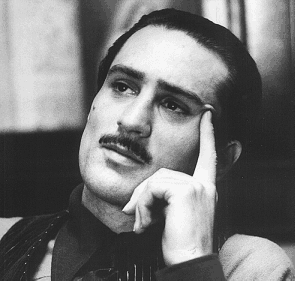
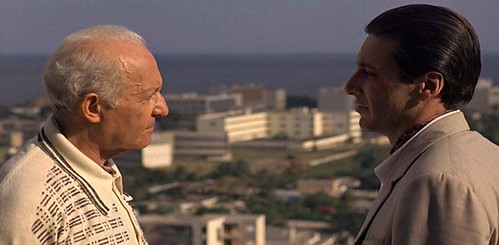
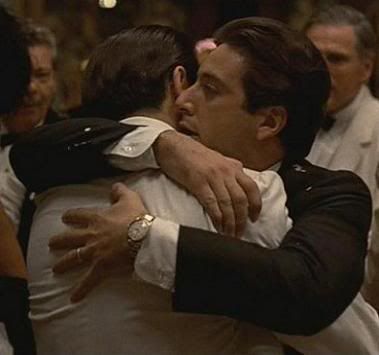
Part II tells two stories, the ones on either side of "The Godfather" time-wise: Before (between 1900 and 1940) when Vito Corleone (Robert DeNiro, played by Marlon Brando in the original) comes to America and rises to power; and After (between 1958 and 1963) when his son Michael Corleone (Al Pacino) is attempting to expand his empire, while, at the same time, losing his family. It is possible to enjoy Part II without seeing the original, but I don't think it would be as rich an experience. But don't worry about it. If you do, you might miss what is on the screen, which is considerable.

Vito Andolini (named Corleone by an uncaring immigration official) comes to America to escape a family-wide vendetta by the Don of Corleone, Sicily. He is only eight years old at the time. A vendetta of this type--the very strong against the very weak was never present in "The Godfather." All wars were between strong men, young and old. But in "The Godfather Part II," the differences between stalker and prey are more apparent, the difference between stalkers less so, for
Vito Corleone in avenging his family's death, takes that revenge on the same Don, who has grown old and infirm and helpless.

Coppola perfectly captures the look and feel of New York's Little Italy in this section (which is almost completely subtitled so, again, go early if you want to read them, and understand what's going on)
* In the Italian ghetto, families are kept close together, in fact, the community is kept close together by the conditions, and it is upon this unity that Vito Corleone builds his dynasty. He already has a family (an unquestioning wife, and sons who will follow in his footsteps) and friends, for whom he uses his power. Don Vito rises to power for the benefit of his family, his friends and for himself.

It is not that way for
Michael Corleone, Don Vito's favorite son, onto whose shoulders the reign of his father has fallen. It is interesting to note that first Michael became Godfather, and then established his family, as opposed to his father, for the two men, as Coppola wishes to show, are completely different.

Above all else,
Michael is a businessman in this film, manipulating everyone in his business dealings. The turnings and twistings of plot in Michael's sequences are subtle, very convoluted, so try to keep the names straight if you want to understand what is happening.

But the main point in Michael's story is that while he may continue
his brilliant business career, he does so at a cost. Though he may be able to protect his family from outside forces, he cannot control the forces attacking his family from within. So that, at the end, Michael, though still powerful, probably the most powerful Mafia chieftain, is left alone, to brood over his success...and failure. Coppola who wrote and directed "Godfather II" said this soon after the film was made:

"One of the reasons I wanted to make 'Godfather II' is that I wanted to take Michael to what I felt was the logical conclusion. He wins every battle; his brilliance and his resources enable him to defeat all his enemies. I didn't want Michael to die. I didn't want Michael to be put into prison. I didn't want him to be assassinated by his rivals. But in a bigger sense, I also wanted to destroy Michael. There's no doubt that, by the end of the picture, Michael Corleone, having beaten everyone, is sitting there, slone, a living corpse...I admit I considered some upbeat touch at the end, like having his son turn against him to indicate he wouldn't follow in that tradition, but honesty...wouldn't let me do it. Michael is doomed.

I think we can be thankful that Coppola chose to elevate this film from what it might have been in other hands to tell us something extra about those two men--father and son--about our times, our country, and ourselves.

I wish I could talk more abou this film, but time prevents me. I will say that it is a beautiful fim, visually; done with genuine feeling and just a touch of spectacle. It is also very violent, though not as much as the original, that Pacino and DeNiro, in their respective parts are brilliant...and that it is being shown Saturday, October 9th at 7:30pm.

Broadcast on KCMU-FM October 8th and 9th, 1976


* Though it sounds smarmy and somewhat condescending, I think the issue was the seating at 130 Kane. Sitting in the balcony made it an eye-strain to read sub-titles, so getting a seat on the main floor was preferable.


In a post-"Sopranos" world, it is necessary to re-inforce that the "Godfather" movies weren't supposed to celebrate the Mafia, but cast them in a Shakespearean sense of tragedy. Michael may win his battles, but his descent into his own private Hell, the complete refutation of everything that his father represented, and the annihlation of the life that both father and son envisioned for him. Coppola always wanted to put the screws to Michael; to make him a King with riches but no heirs, and for all his success to lose everything that he should be valuing.

But, a lot of people just saw him winning all his battles. The hell with his family. The hell with his dreams. He was livin' large, man!

So when Coppola was enticed to make "Godfather III," he presented a withered, frail Michael, and tempted him with a clean slate, the re-unification of his family, and maybe a chance at happiness--a pure soul--and snatched it away from him, and closed the book on Michael's life.

But nobody liked that.

It is our custom in this country to venerate our villains. I've noted before that Marlon Brando was appalled when his biker bad-ass in "The Wild One" was embraced by the youth culture. In "Star Wars," Darth Vader was the coolest; in the prequels, when Lucas deconstructed Vader as a tragic figure...and worse, a lackey, it was rejected. Pacino's mui-loco-in-the-cabeza Tony Montana from "Scarface" is an icon now.

We venerate our villains. We tear down our heroes.

What's up with that?

Thursday, April 10, 2008

Ronin

"Ronin" (John Frankenheimer, 1998) John Frankenheimer's long directorial career started out with him as a young television "turk," who wasn't afraid to be controversial or veer into the surreal. Early works like "The Manchurian Candidate" (the earlier, better one), "Seven Days in May" and "Seconds" (Rock Hudson's finest hour) showed a film-maker not afraid to tackle political and social issues in an entertaining, often satirical way. He'd veer off into odd territory like "Grand Prix," and "The Gypsy Moths," where the indifferent material would win out over his film-making expertise. The films would be a technical marvel, but descend into soap-opera when not behind the wheel, or falling through space. On ocassion, he'd even hit the skids ("Prophecy," "The Extraordinary Seaman," "99 and 44/100% Dead"). But then, there are his thrillers, like "Black Sunday," and even "French Connection II" (which had Gene Hackman's "Popeye" Doyle in France to track "Frog One") that in their final acts are primers on how to stage chases and action finale's--bare-boned, fast-paced and visceral. "Ronin" was like an entire final act--lean and mean, with no fancy motivations and cryptic dialogue. Even the point is obscure--it is never established what is in that suitcase that everybody wants, nor does it matter. They just want it, and are willing to plot, and double-cross and double-deal to get it. The characterizations are on the thin side--people just have their jobs to do, and their marks and targets to hit. And the cast is superb. Robert DeNiro, Jean Reno, Sean Bean, Natascha McElhone (where's she been?), Stellan Skarsgard, Michael Lonsdale, and Jonathan Pryce, all doing professional, unsentimental work. The set-pieces are amazing, especially a car chase through the Paris tunnels. But just as much care goes into the staging of the planing. If anybody wants to see how the "Mission:Impossible" franchise should be done, this movie is the model.

Tuesday, March 4, 2008

The Good Shepherd

"The Good Shepherd" (Robert DeNiro, 2006) Francis Ford Coppola was the fellow who spearheaded this project, and bless my tapped telphone line it has that same sort of "Godfather" family epic-feel to it, with just enough schmaltz and soap to keep it from getting too caught up in its overarching theme of constant paranoia. It also carries the similar pall of "the sins of the father" to it. You just know that the ambitions of the men in the movie will doom their families, if not themselves. Edward Wilson (Matt Damon) is recruited out of college to join the Skull and Bones secret society, and with his first ratting out of a professor (Michael Gambon), his career as a spy takes the fast track. It's derailed slightly when a quickie with the Boss's precocious daughter (Angelina Jolie) results in pregnancy and a marriage of convenience. Then, when fencing with the Soviets keeps him overseas for years, his fairweather family-life causes a Cold War on both sides of the Atlantic. Soon, Wilson learns, a little too late, that he should trust no one, as he plays against (and develops a mutual admiration with) his equal in the KGB. But its the same old story we've gotten used to in the spy genre. Everybody's a snake looking out for Number One, and trying to make "that Big Score," and yeah, okay, there's only a gray flannelled thread of difference between the spy network and Corporate America. Which brings us right back to "Godfather" country. CIA-Mafia-GM, there's no (*yawn*) difference. The only likable character in the entire film is director Robert DeNiro's turn as "Bill Sullivan"--a veiled version of Bill Donovan, but he's there for two quick dashes of cold-water perspective and is gone. Matt Damon seems not to age at all during the film, whereas Angelina Jolie does seem to gain twenty years. This film came out at the same time as "The Good German," and I was hoping someone would combine them into "The Good German Shepherd." Well, I can dream...

It's interesting (well, to me, anyway) to wonder why Damon chose this part, seeing as how his "Bourne" films are merely the "fantasy" side of the "spy" franchise. If he thought that playing the "button-pusher," rather than the blunt instrument was an acting "stretch," he couldn't be more wrong.

Monday, February 4, 2008

The Score

"The Score" (Frank Oz, 2001) It's notable for being the last movie Marlon Brando was in, and his presence is probably why DeNiro and Norton and Bassett signed on, because, really, this is no great shakes as a film. It's a simple "heist movie," with some interesting switch-backs along the way, which works as an effective metaphor for a bunch of people generating a paycheck for themselves. But if you expect to see sparks fly between DeNiro and Brando (The Two Don Vito Corleones) the way they did between Pacino and DeNiro in "Heat," you're going to very disappointed. Bassett is completely wasted in the movie as "The Girlfriend," and Norton pulls off one of his "so-good-it's-scary" impersonations, this time as a retarded kid, which borders on the cruel. No, the only sparks are the ones that happened between Brando and director Oz. Brando didn't like the way he was being directed, so he decided he'd play games calling Oz "Miss Piggy" (of course, Oz played her in "The Muppets") It's just another indication of how far Brando was slipping--a perpetual jokester and lover of comedy, he couldn't even be charitable acknowledging Oz's gifts as a performer. "The Score" is not a great indicator of anyone's work (except the cinematographer's), but it's a shame that Brando went out on this one.

Wednesday, November 14, 2007

Stardust

"Getting killed by pirates...heart eaten by a witch...meet Victoria--I can't seem to decide which is worse!"

Matthew Vaughn's film of "Stardust" is so far removed from his last film, "Layer Cake," that it would take a Babylon Candle to bridge the two (Don't know what a "Babylon Candle" is? Then you'll have to see the film. You should anyway). "Layer Cake" was a whooping, swooping kitchen-sink-and-porsches story of drug-dealing in contemporary London. And while some of the stylistic touches are the same for "Stardust," the story couldn't be more different. For instead of modern-day Britain, he is spinning his camera through Neil Gaiman's Faerie-Land.

Gaiman's reach is all things mythical, from the twee to the atrocious--across the stars, underground, beyond the pale and underneath your fingernails. He borrows from all sources, and puts them through his own personal salad-shooter and spits them out with his own dressing. In his work you'll find echoes of Shakespeare, Marlowe and Milton, G.K. Chesterton and Jorge Luis Borges and the Brothers Grimm, Greek mythology and Roman gods, History and Urban Legend, The Arabian Nights and the Book of the Dead, The Bible and the DC/Marvel Multiverses. I've been reading Gaiman with delight (no pun intended) for years, starting with his "Sandman" saga, which dragged on for maybe a dozen more issues than necessary because he had so many stories he wanted to get to, but I also love his "Violent Cases," and much of his book-work. It is with some trepidation that one watches his forays into film--Jon Peters owns the film-rights to "Sandman," for instance, and Gaiman wrote the English translation for "Princess Mononoke," and worked on "Mirrormask," and there's talk of filming "Good Omens," the book he co-wrote with Terry Pratchett. That's scary talk. For what it's done to the works of Alan Moore, Hollywood looks like a gold-plated abortion clinic, and one wonders if they could do any justice to Gaiman's work. Even to attempt to film his "Signal to Noise" would be to destroy it.

"Stardust" makes the transition fairly well, though it eliminates the faeries and sprites that populate Gaiman's world like smoke, dust and flotsam do in Ridley Scott's (they also serve as little "Rosencrantzes" and "Guildensterns"). They throw in a sock-o finale, and the film has none of the delicacy of Charles Vess' illustrations from the graphic novel that Gaiman expanded to book-length. In fact, it has the sensibility several refinements up from Monty Python-design. But it does retain Gaiman's special form of "myth-busting," the wink-and-a-nod to the "real" world that suffused "The Princess Bride," but without the Borcht Belt cinched around its waist.

What's interesting is how Paramount is selling it...or not selling it, as the case may be. Looking at the poster, you'd think it was one of the endless string of pre-teen or teen fantasy novels adaptations that are filling the Previews, or as reverent as "Chronicles of Narnia," when nothing could be further from the truth, (but there are enough spinning helicopter shots of big landscapes to reassure the Suits that it has a "Lord of the Rings" quality). It's frequently hilarious in surprising and snarky ways, especially in the casting. Michelle Pfeiffer may not be the best at holding an accent, but her comic timing, and willingness to play against her looks is delightful. Robert DeNiro makes an entrance and you worry that he's been put in the wrong movie, but then he comes through with flying colors. Peter O'Toole does wonders with his limited screen-time as the Lion-King of a family of blue-bloods, and Rupert Everett shows up long enough to tweak his image hilariously. It's a fun, fine, un-gooey fairy tale that charms and delights. It's not doing well at the theaters, so do yourself a favor and go. Don't wait for Paramount to get their act together to convince you.

"Stardust" is a matinee