Showing posts with label David O. Russell. Show all posts

Friday, December 7, 2012

Silver Linings Playbook

No Dolby; No Squelch
or
"Hey!!..."

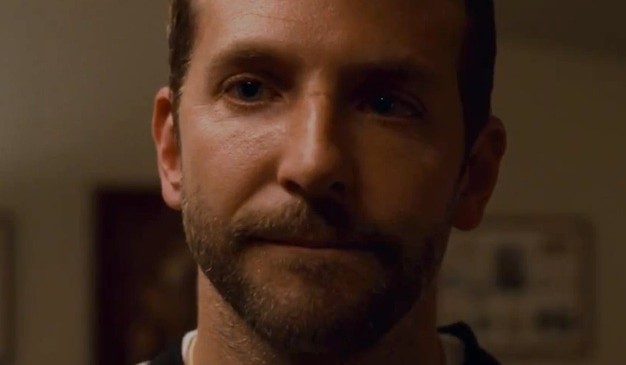
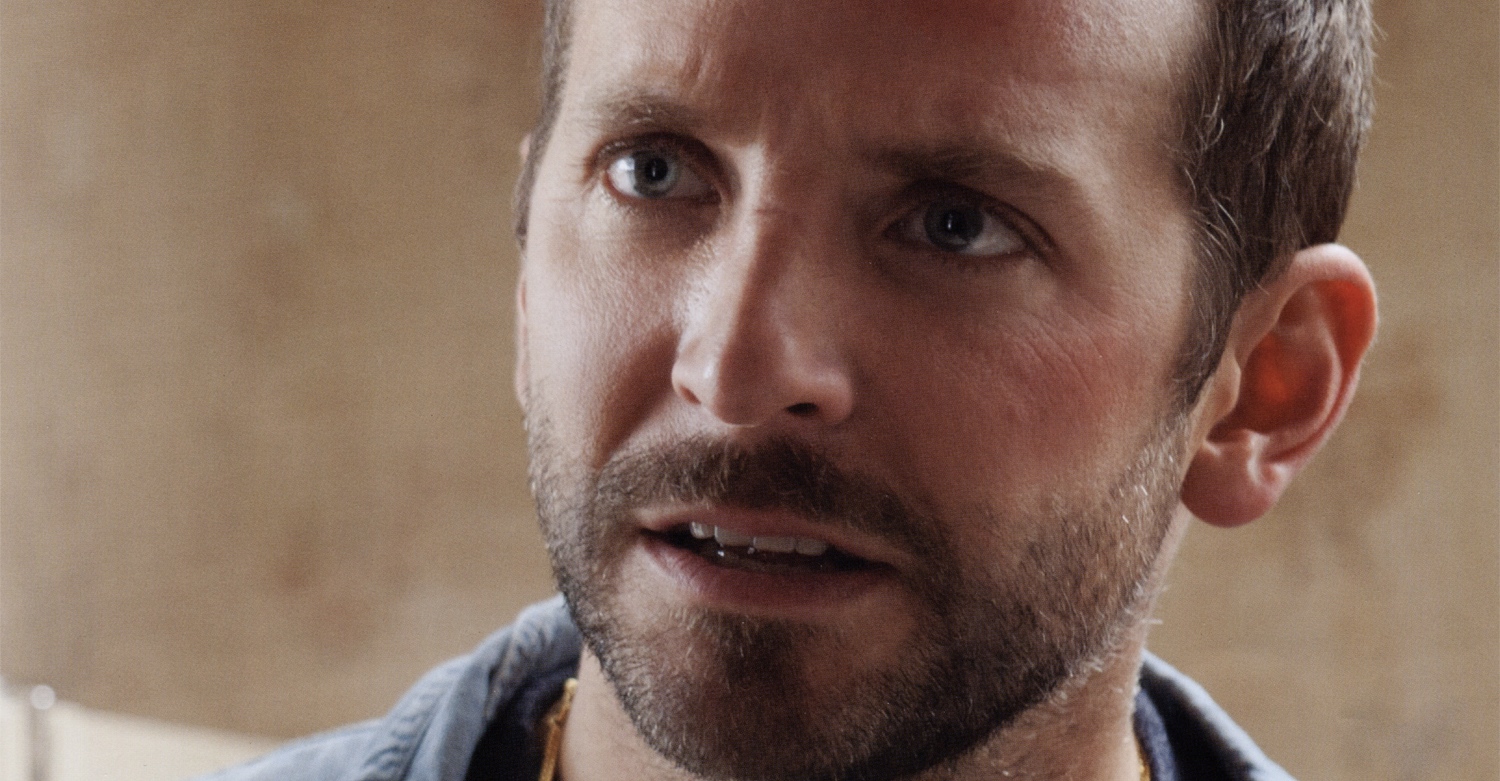
In Silver Linings Playbook, there's a scar above Bradley Cooper's nose that I found myself focusing on throughout the entire movie.  It's not like Harrison Ford's chin-scar that has followed him around from movie to movie; this one is just a line-scab that never seems to heal and I found that apt—the movie's all about a guy, Pat Solatano, Jr., whose lost everything and wants to get it back, despite that losing it might have been the best thing that ever happened to him.  He's undiagnosed bi-polar, but he keeps wanting to return to the halcyon days when he didn't know he was bi-polar and was married to Nikki (Brea Bee), a schoolteacher, and was living a fairly normal life, or as normal as bi-polar can be, undiagnosed or not.

When he gets out of the Baltimore Psychiatric Hospital, he's focused on getting his old life back—he's whipped himself into shape, goes (reluctantly) to a therapist, stays on (reluctantly) his meds, and is determined to make himself the man Nikki wants him to be—there's just that little thing about the restraining order and the fact that he caught her having sex with a school administrator.  And that he caught them making love to their wedding song which was Stevie Wonder's "My Cherie Amour," which sends him into an "episode" every time he hears it.  And there's that focus issue.  He's not kidding himself anymore, but his constant stream of truthiness, socially correct or not, keeps getting him into trouble, with his folks (Robert De Niro and Jacki Weaver), his brother (Shea Whigham), his pal Ronnie (John Ortiz) and Ronnie's wife Veronica (Julia Stiles)—who just happens to still be friends with Nikki.  Pat, Jr. latches on to them to try and make contact with his ex, and to do so agrees to have dinner with them.  Also invited is Tiffany (Jennifer Lawrence), Veronica's sister, who has issues of her own, still grieving from the death of her policeman-husband.

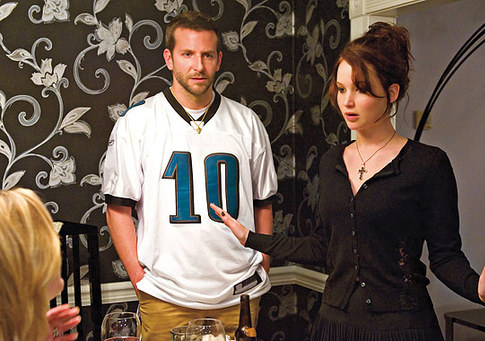
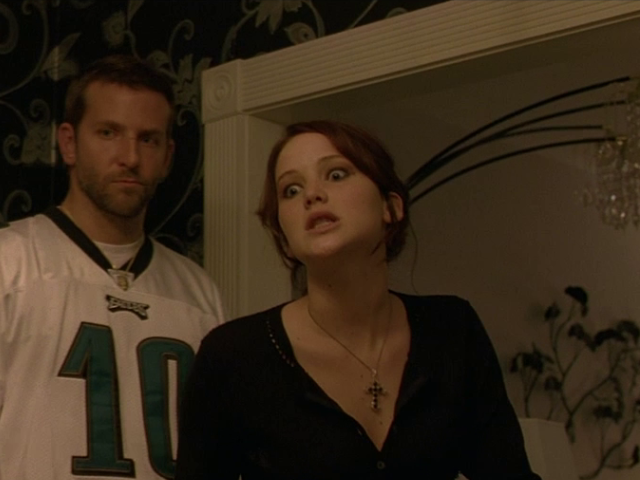
Pat and Tiffany do NOT get along at dinner, and only connect over their mutual history with anti-depressants.  That seems to be enough for Tiffany, as she announces she's had enough family time and asks Pat to walk her home.  They share enough information there for Tiffany to be repulsed by Pat, and for Pat to think Tiffany is crazy.  

But, then, Pat thinks everybody is crazy (except for himself).

And...he might be right (except for the last part).  He's very quick to point out the eccentricities in others, probably because he possesses those traits himself.  He notes his Dad's OCD—he goes through rituals while watching each Philadelphia Eagles game, as he's taken to book-making since losing his job, and has a sports fanatics' passion for football (and probably more so as he's been banned for life from the stadium).  In Pat's mind, everybody is dysfunctional, because Pat's mind is dysfunctional.  While reading the books on Kiki's syllabus, he tosses "A Farewell to Arms" through his attic window for its downer ending.  And his own obsession with his ex-wife becomes a means towards an end for Tiffany when she offers to sneak a letter to Nikki for him—if he'll be her partner in a dance competition.

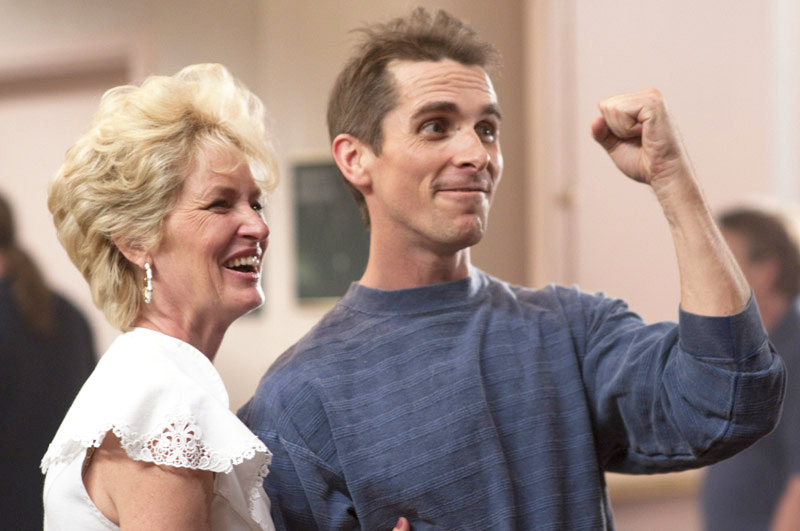
The director is David O. Russell, who also adapted the book (by Matthew Quick) and did a brilliant job cataloging family feuds in The Fighter.  Family seems to be his forte, mining the mania for subtle comedy while not diminishing the seriousness of the hysteria bubbling under the surface.  And Russell imposes enough energy in his direction and editing that he invigorates the already simmering outbursts the performers put into it.  De Niro we already know can pull a manic act for both comedy and drama and Wilkins manages to keep a look for fret even when happy.  The ones who surprise are Lawrence, who's cute as a button and volatile as a cougar in a surprising performance, and Cooper who has a crazy flame in his eyes throughout.  His outbursts never surprise; it's his semi-even keel that is interesting to watch, and worry about.*

Yes, they're crazy.  But, in Russell's world-scheme, everybody is in the U.S. of OCD, whether the obsession is sports, gambling, love, and competition.  And Russell does a nice job of turning the dark side of rom-coms before the camera, and making decided call-backs to the past for his ending.  Despite our relationships with the past and flirtations with the future, hope still vaults eternal in the perpetual grasping for something better, in the hope of no longer clinging to what was.

One suspects, after the movie is over, that that tell-tale scar will start to disappear.

Silver Linings Playbook is a solid Matinee.

Congratulations to long-time readers "Walaka" and "Otis" on their engagement!


  * In the same scheme of things, Russell has cast Chris Tucker as one of Pat's fellow hospital incarcerees.  It's the best performance Tucker has ever given, subtle, scary and controlled.  Anybody who's seen his other work, knows what he's capable of  and the effect here is like watching Jerry Lewis do drama, but without the self-awareness and ego.  


Friday, January 21, 2011

The Fighter

"Put Back What You Use"
or
"I-Yi-Yi-Yi-Yi'm Not Your Stepping-Stone"

The family that preys together, stays together.  For the extended family of boxer Micky Ward (Mark Wahlberg), the preying is mostly internal although they have the illusion that they're getting the best of everybody else.

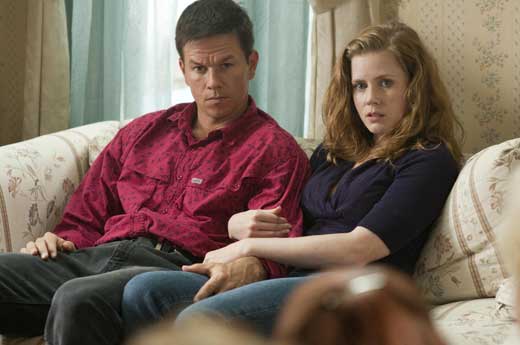
Micky is the younger brother (step-brother, actually) of Dickie Eklund (Christian Bale), former up-and-coming boxer, who had one glory moment: knocking down Sugar Ray Leonard in a match some years before.  Now, he's a part-time trainer for his half-brother and a full-time crack addict.  HBO is making a documentary about Dickie, who, despite his years and habits, still thinks he's on the comeback trail.  But the pipe keeps him missing training sessions with Micky, leaving the heavy lifting to his trainer (Mickey O'Keefe playing himself).  While the boys' lioness of a mother (Melissa Leo) manages Micky and enables Dickie, it leads to some bad decisions on matches for Ward, leaving him battered and disillusioned.  The higher-ups at the sports networks have Ward pegged as a "stepping-stone," the fall-guy they use to advance other fighters in the winning circle to boost ratings, and that reputation follows him around his home-town of Lowell, Massachusettes.  Ward's on a downward spiral, and any outside help is treated with suspicion.  "You can't trust that guy.  He ain't family." says Dickie, lounging in the limo his brother's money rented, sucking a beer.

Yeah.  About that...

Perspective is all in The Fighter.  And the boxing motif is the perfect setting.  Micky is caged by his relations with his family, but every time he tries to strike out on his own, he gets attacked by Mom (playing the suffering card), step-brother hangs back and then takes his licks, and a coven of sisters and half-sisters are a unified greek-chorus of mom-ditto-speak.  All you need to make this a match is a soft canvas to fall on, so Micky's a fighter always on the defensive.  It's no reason he doesn't say much, but the eyes are far away, looking for a way out, looking for an opportunity to make a move, looking for anything.

"Your fahther looks at my ass, too, but at least he tawks ta me," says Charlene (Amy Adams, while not looking at him), the "bah-girl" Micky keeps staring at.  Micky's so down for the count, he thinks even she's out of his league.  And she might be, but she keeps showing up in his corner, alarmed at the punishment he's taking.  When she questions it, Micky tells her everybody's not concerned.  "Who's 'everybody?'" she asks.  "My mother, my brother," he replies.

Yeah.  About that...


The Fighter is a mostly true story.  Ward is a better, tougher fighter than the movie wants to give credit for (the underdog status makes for a better story, I'm sure, but the dismissive commentary on the soundtrack during the fight sequences is the real thing...taken from the actual broadcasts...Ward was considered an underdog), and Dickie DID do all those things, but his timing was a bit better in real life.  One wants to say that the best character arc in the movie is Dickie's, but that would be falling into the appreciation trap the movie sets up.

Because Micky's is the best character arc, although it seems a very simple Rocky-like success story on the surface.  It's the approach that Micky takes with the forces in his life that are tearing each other apart which is the most interesting aspect of the story.  Micky has been wronged by his family, but he won't discount their worth, or their place in his life, even over the objections of his new supporters—they have to find a way of dealing with each other and their conflicts, with or without him.  For a fighter to take the stance that he does, reaching compromise with the warring factions in his life—to stand up and take control, risking everything from everybody—is a complete negation to what he does for a living and how he was raised.*  The acting kudos are going to go to Bale (who is incredible, not to slight him) and Leo and Adams (who has two great scenes involving an intercom, and throws some nice punches in a chick-fight), but Wahlberg is the champ in this movie, with the tougher part (he trained for this through his last six roles), which he does almost purely physically.  Micky is a man of few words, and not too many moods, but Wahlberg, restrained and less showy, does all of it with body language and does the difficult fight scenes, as well—in the latter taking a lot of body-blows that are not hidden with oblique camera angles or trickery.  Wahlberg has worked with director David O. Russell before—in fact it was Russell's war pic Three Kings that first showed how good an actor Markey-Mark could be.  Russell keeps the movie on edge with quick cutting and an improvised feel, even managing to make the final fight scenes nerve-rattling, despite the suspicion that one is going to see a typical boxing picture ending.  But, his assurance with good material, performed by such a dedicated cast, manages to keep the movie on its feet, even at the final bell.

The Fighter is a Full-Price Ticket.


Micky and Dickie at the time of the events of the film

* The real-life Ward did much the same thing, often befriending his opponents, including Arturo Gatti, the fellow he boxed in his last three epic fights, often described as the greatest in the sport.  Ward was a dedicated, fearsome fighter, but admired his opposites in the ring, and their talents.  The two fighters, who put each other in the hospital, continue to be good friends.  I find that amazing...and admirable.