Showing posts with label Christ-Allegory. Show all posts

Tuesday, September 3, 2013

Elysium

Zero Tolerance for Citizens
or
Spinning That Ol' Wheel of Fortune

I expect nearly everybody was looking forward to Neill Blomkomp's next film, after the gooey splash District 9 made.  His new one, Elysium, has the same kind of life-lesson—"what have you done for someone else lately?" and how one's perspective changes when you walk around in someone else's downtrodden shoes.  

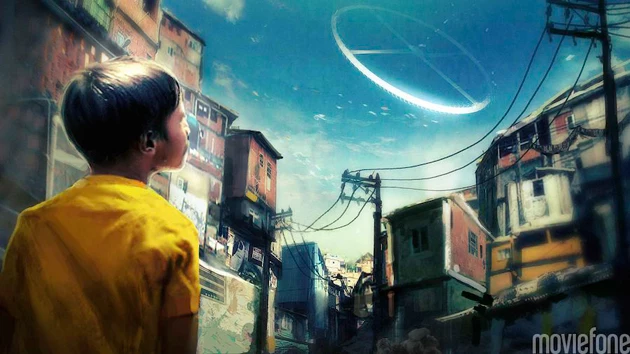
The approach is slightly different, though, even if the futuristic milieu is still glum.  In this future, the current economic climate hasn't changed, only the locations have.  Earth, after years of neglect, is one big slum, there is no distinction between urban and rural anymore, the green spaces are dead, and there is a space-age version of urban flight—the "one percenters" have moved on up to an orbiting oasis called Elysiumand it is, as in Greek Myth, the isle of the Fortunate, a paradise, with estates and luxury homes perched inside it's rotating ring. It's the ultimate gated community.  A large star in the sky, it is out of reach but never out of the sight or the minds of the stragglers of Earth who hope to get there by fortune or by smuggling themselves by shuttles, which Elysium's defensive perimeter either discourages or destroys.


The parallels to today's refugee and immigrant desperation is baldly presented, and obvious to anyone whose world-view isn't in spec-fic but down here on Earth, much as apartheid was morphed into xenophobia in D-9. Add to that that the penthouse in space also seems to have access to the ultimate in universal health-care, a medi-bed that scans you and...simply cures you (it seems).  Other than those fanciful details, everything's played a little straighter, no doubt because you have big stars like Matt Damon and Jodie Foster, rather than just Sharlto Copley (although he's here too, bless him), so the financial risks are slightly more, so they make the stakes in the film a little higher, too.  Higher in that the government (naturally) is up there in Elysium, in the form of President Patel, who has a rather prickly defense secretary (Foster, channelling Angela Lansbury from The Manchurian Candidate), who has a unique sense of how to protect The Ring, supplementing the force of robot-police with soldiers of fortune, like a particularly nasty one named Kruger (Copley), who would probably kill for a hobby if he wasn't being paid for it.


Down on Earth, it's dog-eat-dog, and former car-thief Max Da Costa (Damon) is trying to go straight, working towards the dream of going to Elysium by working in one of the factories mass-producing the robo-cops that keep the populace under their teflon thumbs.  But an industrial accident leaves Da Costa dying, with only five days to live.  His only chance is to somehow get up to Elysium and one of those miracle-med-things, so, with a few super-drugs pumping through his system, he signs up to do some dirty work for a former employer, which involves stealing industrial secrets—which just happen to be Elysium's security codes—that will unlock the station's defenses and allow a mass exodus from Earth to Elysium.


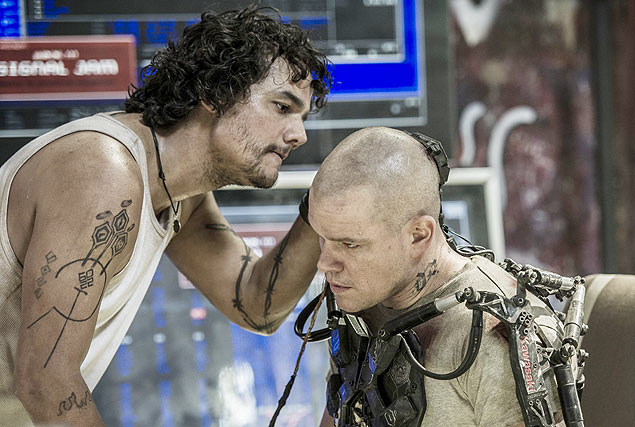
Da Costa allows himself to be merged with a powerful exo-skeleton and neural-net to download the codes, then, once there—well, let's just say things get personal, as these things are wont to do, but not selfish, as that flies against the "hero" sense that movies must have, so there has to be some deflection of need for Da Costa to some other....blah-blah-blah.  Face it, the exo-skeleton could be a crucifix motif, so Da Costa has to do some sacrificing because...well, that's the way they do it in movies these days.  There can't be any motivation of "self" because apparently that would make you as "bad" as the Elysium-buyers.  So, ultimately, Da Costa has to do all the fighting and scraping for somebody else, and, as per usual, it's an acquaintance's sick child.  Again.


And that's the main thing that makes Elysium less than thrilling: for all the "neat" visuals, for the interesting "take" on today's events, for all the good intentions and the perversions of such, it feels like every other sci-fi Christ allegory and leaves you feeling a little hollow while its trying to make you feel noble and unselfish while watching it.  Well, I've seen that before, and I thought the intention of sci-fi was to show you something different.  It is a noble effort, but ultimately, it suffers from story-sameness, and recycled ideas from the cookie-cutter school of script-writing.  It's too bad because Elysium has a lot going for it.


Elysium is a Rental. 


Gotta say that Elysium has some pretty cool concepts for its pleasure-wheel

Friday, January 9, 2009

Gran Torino

"...Beats a Lonely Rhythm All Night Long"

Walt Kowalski—retired Ford employee—has just become a widower, hates his kids and despises his grand-kids. His wife asked the fresh-faced parish priest to keep an eye on Walt and he despises that, too. And his Hmong neighbors? He's a Korean War vet, so that's a no-brainer..

What he loves you can count on one gnarled hand, merely: his old dog Daisy, a cooler of PBR on his porch in the evening, his mint-condition 1972 Gran Torino...and his privacy. Invade that, and his face, frozen into a perpetual sneer, starts to show some teeth, and...if you're lucky...he may respond to you with merely a low growl. Usually, what he issues forth is a stream of obscenity and invective with a few choice slurs thrown in. He's a reflexive racist with one saving grace—he hates everybody. He's not a happy man, and in perpetual attack mode, but leave him be on his front porch with a half-rack, a pack of Camel straights and Daisy, in the evening, and it's okay.

Leave him be.
He has guns. Lots of them.

Clint Eastwood said he was retiring from acting at about the same time that Paul Newman announced his own retirement. For Newman, it was a quick decline to the grave. But Eastwood directed Angelina Jolie in the fine "Changeling" and after its premiere at Cannes began working on "Gran Torino" as both director and lead actor. He's 78 years old, and he's released two movies this year. That's impressive, but you can see why he wanted to do this role. The film, spare in its scope, hearkens back to the cinema of the 70's, when Eastwood began his directing career. And the themes raised in the film are similar to other projects he's directed, specifically "The Outlaw Josey Wales" and "Bronco Billy," with their accumulation of "family" by accident. Additionally, Walt Kowalski is a neighborhood version of Eastwood's previous snarly outsiders who stand apart from polite society, acting--at the very least--impolite. Then, there's the vigilante aspect; Eastwood was pretty much the poster boy for taking the law into your own hands in the era before spandex superheroes on-screen. But, just as he's done in about every film since his Oscar-winning "Unforgiven," he has turned expectations of what to expect from him and his movies on their ear.

One critic has opined (and been roundly criticized, I think, unfairly) saying that this is Eastwood's version of a "
Rooster Cogburn" role. And it is. Just as John Wayne channelled a bit more theatricality into that role beyond his usual screen persona, Eastwood does the same, amping up the comic aspects of Kowalski a few degrees beyond the surly men of few words and violent actions of his previous roles. The growling may be laid on a little thick at times, but Eastwood, his hair spare and almost completely white now, his body slack with age, the furrows in his face as deep as canyons, and a voice full of gravel, still possesses a power few actors can carry off on-screen. Even approaching 80, he can still scare the crap out of you, as in a scene where after cold-cocking a gang-banger and repeatedly slamming him in the face, the camera looks up at his crazy-buggy eyes and bared teeth. "If I have to come back here, it's going to get fucking ugly!" he spits. And you believe it.

The story is about a Michigan resident set in his ways and his house as his neighborhood changes in ethnicity. To him, it's an invasion. But it doesn't stop there. After the families come the gangs targeting the kids, and Kowalski's neighbor Tao is assumed by his gang-member cousin to be a natural recruit. His initiation: steal Walt's Gran Torino.

Bad move. And only another bad move on Walt's part prevents somebody getting killed. Tensions escalate among the neighbors, and when Tao is nearly pulled into a gang-retribution for screwing up, Walt does some boot-stomping—they're on his lawn—
and he becomes a reluctant hero to his neighbors, who begin piling his porch with flowers and food for saving "Toad"-Kowalski's kindest word for the kid.

What's great about this movie is that any other writer (
Nick Schenk did the script) or director would begin softening up Walt's character and turn this into a nice, comfortable sentimental goo for general audiences. But Eastwood doesn't go there. His Walt is a bully, who knows that you intimidate by getting into people's faces and slamming them fast, making him on an equal aggressive and moral footing with the gangs (nobody mentions that Walt's bar-crowd and perpetually barbed shit-slinging—all done to ribald comic effect—is a parallel to the tough-talking hoods in their gangs, as they're both cliques and community sub-sets). It's just a matter of who's got the most cajones and least ability to blink under stress—like a Western gun-fight. Walt's history in Korea has given him body-bags more experience than the street-toughs will ever know. He understands intimidation.

Tao's sister is a smart, tough kid who stands up to the gangs...and to Walt...and she's the conduit to what understanding of the culture he can scrape up. He respects her strength and her sense of Family, far more than his own family can. But all this standing up and tough-talking and chest-expansion comes down to conflict and escalation and given Walt's history...and Eastwood's...it can't come to any good.

Except for this movie. There's going to be complaints about insensitivity and stereo-typing and bad language and slurs and lack of respect for the Church and all sorts of other drivel.
There's going to be sniping about amateurish acting among the ethnic, young cast and, to be sure, there are flaws. But call me a troglodyte, I loved this movie, and it made me nostalgic for the stripped-down story-driven ones of the past.

And I couldn't help thinking "Jesus Christ, let's give the old bastard an Oscar for his performance in this one, can't we?" Mickey Rourke is basically stretching the same muscles as Eastwood does here, although less sentimentally, and much as I love Sean Penn's performance in "Milk," he's got an Oscar.

Eastwood gave it to him...finally.

"Gran Torino" opens in many more theaters throughout the country today and is a Full-Price Ticket. Call me "sentimental" and I'll slap you silly.

Monday, March 31, 2008

Superman Returns - Take Two

Superman Returns (Bryan Singer, 2006) There have to be reasons other than money to film a remake of a very successful movie because, in some ways, it's a zero sum game: the audience is familiar with the product so you don't have to do so much to establish it, on the other hand, if you don't bring something new to the screen, there's not much incentive for people to come to see your movie. In the case of Superman Returns, I might guess that Bryan Singer wanted to take advantage of the advances in technology that could bring a whole new look and a desire to bring a new slant to a character that is embedded in our culture. In doing so, he has produced a much more somber movie than those of the Reeves franchise; less comic strip, more graphic novel.

He focuses on the allegorical nature of the Superman story and lays it on thick. It's like he is channeling C Day Lewis at times. We begin with the voice of Marlon Brando as Jor-El (from the first Richard Donner movie):

"They only lack the Light to show the way. I have sent you, my only Son".

As the man himself says:

Singer: Well, yeah, that's true, so I guess it's going to come up! (Laughs) I think that it [Superman as Christ figure] is kind of a natural evolution, because he began as kind of a Moses figure, of the child sent by the parents down the river to fulfill a destiny.

And that, obviously, translates into these kinds of allegories, Christ being a natural one, because Superman's a savior. And even more so in my film, because he's gone for a period of time, and then he returns. For me to say that those messianic images don't exist in the movie would be absurd
.

Christianity Today Movies
In other words, if you want to, you can read all kinds of stuff into the movie. Superman (Brandon Routh) struggles with his role as savior:
Superman: Listen; what do you hear?
Lois Lane: Nothing.
Superman: I hear everything. You wrote that the world doesn't need a savior, but every day I hear people crying for one.

He is captured, scourged and left to die.

Some of the scenes seem almost shot to resemble a medieval painting:

And then, guess what? He rises again.

But, maybe, it is not a Christian allegory, after all. Maybe it is a movie about father-son relationships, about inheritance. In this version of the story, Superman has returned to Earth to find that Lois Lane (Kate Bosworth) is now a mother though with a partner, Richard White (James Marsden), she feels ambivalent enough about not to have married. The movie teases us about the possibility that Richard is not the father of Lois's child, Jason (Tristan Lake Leabu). If not he, then who? You guessed it - however, this is one of the weakest parts of the movie - we get hints: coy glances between Clark Kent and Jason, a suggestion that Jason can see the resemblance to Superman that supposedly everyone else always misses, Lex Luthor (Kevin Spacey) suspects a reaction to green kryptonite, and then there is the matter of the grand piano. How could a child who we have been clearly told is not in great physical health to begin with and is now having an asthmatic attack as he watches his mother being threatened by one of Luthor's thugs, how could he have the strength to push a piano across the room unless ..? It's not like Singer doesn't know what he is doing here - otherwise why does he turn the whole idea into the best joke of the movie when Jason, trapped with Lois on board Lex's boat, moves ponderously to a locked door and pulls at the handle only for the door to open - because his father(?) is on the other side at that very moment unlocking it. Yet, he can't resist teasing us again with the kiss that supposedly resurrects Superman in the third reel. So is he or isn't he? Would it be the greatest irony that a son of Superman should be such a weak child? Or is his weakness because he is the union of a human and an alien?

Even Lex Luthor gets into the act with the father-son stuff:

Lex Luthor: Kitty, what did my father used to say to me?
Kitty Kowalski: You're losing your hair.
Lex Luthor: Before that.
Kitty Kowalski: Get out.
Lex Luthor: He said: You can print money, manufacture diamonds, and people are a dime a dozen, but they'll always need land. It's the one thing they're not making anymore of.

and later:

Lex Luthor: Crystals inherit the traits of the minerals around them - kind of like the son inheriting the traits of his father.
Much as he tries to meld the psychological themes into the action, it feels like the movie is made of two disconnected parts. On the one hand, we have all the stuff going on between Superman and Lois and then there is the small matter of Lex Luthor's plot to take over the world. There is little enough contact between Lex and Superman - one big scene really. Even when Superman defeats Lex, there is no face to face showdown. The effect of shoe-horning the family plot into the movie seems to be the crowding out of the other players. Whatever happened to Clark? OK, Singer makes the point that he has been away, that no-one really cares about him anymore but this is Clark Kent - star reporter for the Daily Planet. Would Perry White (Frank Langella) really only give him his job back because someone on the staff has died? And, talk about a lack of chemistry. There is zilch between Lois and Clark though maybe it's because of the way that Routh plays him. Clark has to be the counterpoint to Superman - he is the exaggeration of human weakness as Superman is the epitome of strength. To make him plausible, Reeves played up the goofiness and made him attractive in a Cary Grant kind of way (remember Bringing Up Baby?). Instead of Reeve's wry smile and practiced clumsiness, Routh's Kent is just bewildered and lost. No wonder Lois blows him off so easily. As for Perry White, what has happened to the cigar-chomping tyrant? Where is JJ Jameson when you need him? Langella plays White like an accountant - muted and reasonable. Jimmy Olsen (Sam Huntington) has grown up too and he seems to be in the movie more to provide exposition than anything else.

This mutedness comes out in Superman too. He seems almost embarrassed to be a hero. He doesn't interact with anyone whose name isn't on the movie poster. When he emerges from the jetliner having saved the day, we don't even get a wave:


After saving Kittie (Parker Posey), the crowd just stand and watch, taking photos on their cellphones:

Many of the shots of Superman show him small against the background. Singer has gone big for the technology and sometimes, it seems more important than the Man of Steel. Yet, it is the subtle things that grabbed me - like hearing and seeing Superman's cloak rustle in the wind. To me, that is better than the supposed show-stoppers:


So if you are not in the mood for some 'up, up and away', then this might be the Superman movie for you. Maybe it captures the mood of the times more.

Wednesday, January 9, 2008

I Am Legend


"Come Out, Ne-ville! Coooome Ouuuut!"

I have been in love with Richard Matheson's novel "I Am Legend" since I first read it in high school. A horror- sci-fi story, it tells of a world-wide plague that turns the world into either corpses or vampires, except for the one man who carries the immunity who spends his days hunting, and his nights being hunted.


It's been filmed three times, each version having its strengths and weaknesses, but none of the them really coming to the heart (er, so to speak) of the story.


"The Last Man on Earth" (Ubaldo Ragona/Sidney Salkow, 1964) Vincent Price stars as Dr. Robert Morgan, the last survivor of a plague that has turned the majority of the Earth's population into vampires. By day, he lathes a number of wooden stakes and hunts down the creatures, driving the stakes into their hearts to kill them. The closest the movies have come to Matheson's original concept, although the ending is changed, making Morgan an ersatz Christ-figure*, impaled by a spear in a church, his arms flung wide in a crucifixion pose. Made in Italy on the cheap, "The Last Man on Earth" is still a satisfying film merely for the strength of the ideas, the dusky black and white cinematography and Price's excellent performance. But don't take my word for it--you can download it or stream it here. It's been in the Public Domain for years (although MGM has come out with a nicely re-mastered version on DVD)


"The Omega Man" (Boris Sagal, 1971) Army Colonel Dr. Robert Neville (Charlton Heston) survives a world-wide plague as a result of a biological war between the Chinese and Soviets. Holed up in a bunkered, apartment in Los Angeles he leads a solitary life--by day blasting the mutated victims with his high-powered, high-intensity-beamed assault rifle. By night listening to their taunts, armored against their organized attacks. The mutants are light-sensitive albino's, banded together as a sort of political/sociological cult ("The Family"), led by a zealot named Matthias (Anthony Zerbe), who see Neville as a threat to their way of life, and well, yeah, that's a pretty effective rifle he hauls around. Using his own blood's immunity, he's trying to bring back the pigment-challenged. One of Heston's interesting forays into sociological sci-fi in the 70's, "The Omega Man" lays it on a little thick and heavy with the race-relations metaphor, but the cast is uniformly excellent especially Heston and Rosalind Cash. Again with the Christ-allegory as Neville is impaled in a fountain, arms floating out in a crucifixion pose while giving his life-saving blood to the rag-tag band trying to carry on his work. Though not strictly Matheson, it does reflect the times in which it was made.


"I Am Legend" (Francis Lawrence, 2007) Lieutenant Colonel Dr. Robert Neville (Will Smith)and his German Shepherd, Sam, are the last surviving unaffected Manhattan residents of a plague brought on by a mutating vaccine. All the bridges have been destroyed in an attempt to halt the disease which has become airborne. Neville is unaffected. Animals, only by contact. And the two cruise the car-jammed streets looking for food, and trying to make their way through the entire DVD inventory at the local video store. At noon, he and Sam go to the South Street Seaport, waiting for someone--anyone to respond to his broadcast plea.

"My name is Robert Neville. I am a survivor living in New
York City. I am broadcasting this message on all AM frequencies. I will be
at the South Street Seaport everyday, at midday, when the sun is highest in the
sky. I can provide food. I can provide security. I can provide
shelter. If there is anyone out there. Anybody. Please. ** You are not alone."
He has been waiting in his private hell for three years.

The effects work of a deserted Manhattan is nothing short of astonishing and several shots of Neville tracking deer in his Mustang GT500 are played out to please any action aficionado. Kudos to director Lawrence (who managed to salvage a good movie out of "Constantine" against all odds). Smith is amazing throughout this movie. He's the only game in town, literally, and he is extraordinarily frugal in what he displays throughout the first two-thirds of this movie. His rituals, his by-play with Sam, his clinging to normalcy, and his studied work ethic never give a hint that he's cracking up. Flashbacks in moments of unconsciousness are the only indication of his loss and his desperate feelings of responsibility. At some point, something's got to snap.

When they do, they take the movie with it. Oh, things are intriguing for a good long time after that, and appear that everything's fine--it's a bit like the plague really. But at some point, it becomes a confused muddle, story-wise and philosophy-wise, and that I place squarely at the hands of script-"doctor" Akiva Goldsman.***

Warning! Quarantine Zone!
Stand by for a retinal scan and display your ticket stub! This quadrant infected with Viral Spoilers! If you have not seen the movie, proceed no further!! I repeat, proceed no further!!!

First, let's back-track to the novel. In Matheson's original story, Neville discovers that not all the contaminated inhabitants have been turned vampiric. Some have been merely rendered sensitive to light, and during his daytime raids, Neville has killed a bunch of them. A representative from this group infiltrates his stronghold, and fills him in, telling him that he is now considered on the same scale as the the vampires of legend, coming to their houses in their sleep and killing them. Neville is eventually captured and sentenced to die for his crimes, as he ponders his fate that, now, he is the legend of death, not the ones he was hunting down.
Pretty dang bleak. But a fascinating concept, and a mind-bender of a story-turn. But nobody's done it like that. In the films Neville dies, but always as the sacrificing Christ-figure, who can one day restore the Human Race. Not the book. In the book, the Human Race is dead. Changed forever. No going back. And the last man of earth, the ancient old-guard, is the new source of horror. But the movies won't go that far--there's always got to be a glimmer of hope that the blood of the Savior can save Humanity.

Now, back to this movie. Things go swimmingly the first two-thirds of it, but things begin to snap after Neville rather ingeniously captures a female mutant to test his vaccine on (GA Series 319, compound 6, trivia-buffs). He makes a report that the mutants**** (standing in for Matheson's vampires) have stopped showing any sign of human behavior. Then he's immediately proven wrong in the most elaborate way possible--they emulate his own Rube Goldberg trap. Nothing is made of Neville's obvious miscalculation. By this time, his grief is too great and he's not thinking. And the movie is going someplace else and not using The Scientific Method doing it.

He is rescued at a very opportune time by two other survivors, who have heard his radio message and take him back to his apartment. All well and good. Something has to give in the scenario or there's no forward momentum. The woman tells him that God directed her to him to take him to a Survivor Stronghold in Vermont, to which Neville (no doubt because he's a scientist) gives her the statistics of the disease (90% dead, a few percent mutant, who eat the immune-which when you think about it, might cure them, but no such luck) telling her that with such an effective kill-rate that there can't be a God, and that we did it to ourselves, thank you very much.***** She then replies that its easier to hear God when it's so much quieter (sounds like Goldsman with the happy-meal schizophrenia, again).

So, what happens? The mutants storm Neville's strong-hold for the Third Act Attack--a staple of any action movie, and our plucky survivors head for the fairly impregnable lab, where it becomes quite apparent that Mutant #1 is going to break through the glass to get to his souless-mate. Neville grabs his vaccine, gives it to the other survivors and tells them if they find the Survivor Stronghold to give 'em that blood sample--that un-refrigerated, bound-to-go-bad blood sample--to further his work, sticks 'em in a secret hidey-culvert and tells them to leave when it's light. Then he blows himself up with a grenade and takes the mutants with him, because, as we all know from watching the news, suicide-bombing is the very epitome of heroism these days.

Fade to Black. Our two survivors end up at the fortess-walls of the colony. What will they find when they get there? More mutants? A blasted Statue of Liberty in the sand? Harrison Ford and Sean Young in that other ill-considered feel-good ending to a sci-fi movie? No, the door opens on an idyllic little town with a Main Street, and in the background a white church-steeple with a bonging bell. They've come just in time for services, it appears. And hopefully the guards with the machine guns won't force them to attend.

What we have here is one step beyond using Neville as a Christ-allegory. It's a pro-religion/anti-science zombie movie. If the Vatican was "consoled" by "The Golden Compass's" soft opening last weekend, they must be positively spilling wine on their cassocks celebrating over this one!

As good as it starts out, this one takes "I Am Legend" so much farther afield from its source material than the others, that I can't be happy about it. Smith is great. The abandoned Manhattan scenes are amazing. But...

The script obliterates a great book for another hokey feel-good ending. After all, isn't that how you're supposed to feel after a devastating plague with a 90% kill-ratio? The film ends with a Bob Marley tune (kudos to that, but Marley is used for another confused metaphor that in the context of the film is just stupid). Maybe they should've ended with a rousing up-beat group-sing of "Tomorrow" from "Annie."

Gloriosky in the highest.

"I Am Legend" is a very, very cheap matinee, but only because you'll want to see the effects scenes in theaters.

* I could do a few dozen pages on "Christ-allegories-in-the-movies," but let's just point out a few of them: E.T., the Extra-terrestrial, Cool Hand Luke, The Star Wars films, Braveheart, Narnia (of course), Blade Runner, The Superman films (especially.."Returns"), The Matrix, and ad infinitum spiritu.

** In just one of the beautiful touches in his performance, Smith's voice cracks on that one word only.

*** The name "Akiva Goldsman" on a writing or producing credit is enough to spoil any movie-going experience for me, although I have always given the benefit of the doubt--but than as I'm sure Goldsman would tell me, repeating any behavior expecting an outcome that never occurs is a sign of insanity. It was Goldsman who destroyed the first "Batman" movie franchise with his cartoonish, pun-heavy scripts. He "cracked" the script for "A Beautiful Mind" by reassuring movie-goers that schizophrenia was nothing more than delusions of grandeur with visions of Ed Harris and Paul Bethany included--forget any unpleasantness. His by-the-numbers adaptation of "The DaVinci Code" made it boring for anyone who read the book, and breezily incomprehensible for anyone who didn't. His scripts for "Practical Magic" and "Lost in Space" are incomprehensible humorless muddles. And "I, Robot" had one good, recycled and paranoid idea in its empty little head and chucked the great ones of Isaac Asimov. I'm not sure "whose windows he's washing" to be so successful with so much hack-work in his resume, but the man is the 21st Century Joe Eszterhas.

**** I've been calling them Danny Boyle "Red Bull" zombies, as they have the same out-sized aggressive energy as Boyle's "28 Days Later" zombies, but with a case of the energy drink in them. They are pigment-less, hairless albino's who start to burn at the first touch of sun, and during the day they apparently huddle in dark spaces and huff and puff spasmodically. And they screech a lot, with distended CGI-enhanced faces. So, they're basically vampires, but zombies have a higher "Q" rating, so they're called zombies.

***** I will say, however, that how the mutating disease comes to be is not only a plausible scenario, but wickedly likely.