This week, we're re-publishing some reviews of the films from the post 9-11 environment.
 "Weapons of Myth Destruction"
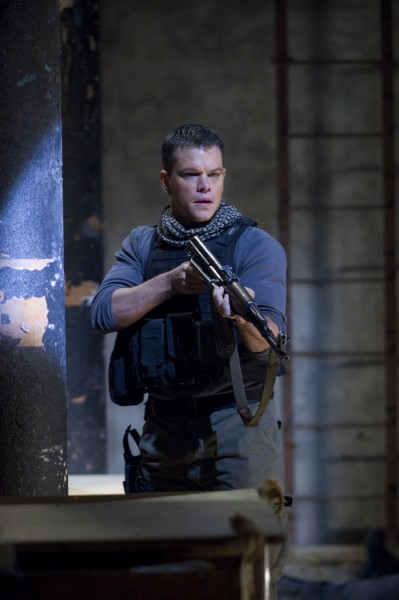
The team that brought you the more popular of the "Bourne" movies (Paul Greengrass, stunt coordinator Dan Bradley and star Matt Damon) basically take the same "run-and-shoot" scenario into the Iraq War in Green Zone—a government operative goes rogue and takes on the higher-ups with something to hide, who are willing to kill him in order to silence him. And just as The Bourne Ultimatum felt like a re-tread of The Bourne Supremacy, Green Zone has the same worn been-there, fragged-that quality, owing more to tracts like Body of Lies (which this one closely resembles, despite having an "original" screenplay by Brian Helgeland) and the earlier collaborations of this particular action troika. It's the Iraq War, but without the "shock-and-awe," unless the awe comes from a stifled yawn.
The same issues—the manufacture of intelligence to promote a "sellable" war scenario—are at play in both the Greengrass and Ridley Scott films. The main difference being that this one lands square in the middle of the early "dazed and confused" days of the Iraq War (having just passed its seventh Anniversary) with the first crews of Army inspectors coming up trumps in their search for the legendary Weapons of Mass-Destruction, the Holy Grail of this Crusade. Adapted freely—very freely—from the book "Imperial Life in the Emerald City" (which reads like a book version of the documentary No End in Sight), the screenplay posits American efforts to steam-roll a provisional government into Iraq by propping up their own Iraq partisan (based on Ahmed Chalabi) who hadn't set foot in Iraq for thirty years and was of dubious integrity, and the double-blind of an Iraqi general (played by Yigal Naor), whose reports of destroyed WMD's are falsified by the White House, and the promised assurances of participation in any new government for cooperating are ignored in the process of "De-Ba'athification."* Helgeland took the strategic failings of the Coalition Provisional Authority and used them as background for the cut-and-paste screenplay, constructing an "Army rebel" scenario in which Damon's "Roy Miller" is disgruntled with how his squad is continually sent on bogus WMD searches, chasing wild geese rather than chemical weapons. It becomes clear to the acronym-spewing MOP'd op that something is SNAFU, as the sites they fight to raid appear free of ordinance of any kind...and haven't for a very long time. Miller's investigation with the help of a frustrated CIA agent (Brendan Gleeson) becomes an effort to keep the SNAFU's from becoming FUBAR before he goes Tango Unicorn. Besides the angry and destabilized citizenry, they also have to fight a CPA op hard-wired to the White House (represented reprehensibly by Greg Kinnear) and the Special Forces commander who doesn't ask and doesn't tell, but merely re-loads (the terrific Jason Isaacs, nearly unrecognizable, looking like Bono in fatigues). You can't swing an HD camera (in simulated field-documentary fashion) without coming into conflict with somebody. **
It's one of those trope-heavy screenplays heavy on the "table-turning" dialogue ironically bantered back-and-forth during different stages of the screenplay—the big ones (delivered with the required dripping sarcasm) are "don't be naive," and "you didn't ask to confirm?" Ho-ho! Gotcha. You are so "occupied." These are the small PR victories lost in the cluster of the Iraq War.
It's not that Green Zone is bad. It is quite competent. But it is tired, and tired at its reckless pace feels silly and unnecessary...and a waste of time. Still, far more people will see Green Zone than No End in Sight, so if the message has to be "Damonized" at least it's doing some good, though in 20/20 hindsight.
Now...about the next one...
Green Zone is a Rental.
* Although the process is a matter of public record as is the Coalition Provisional Authority's dissolving of the Iraqi Army, the "playing" of the general is more akin to President Bush's tactics in dealing with Democratic senators while he was governor of Texas—he'd make promises to get a crucial vote and renege on those promises.
** Like the "Bourne" films and Greengrass' United 93, the film doesn't have a still shot in it, or a held shot of more than four seconds, making Kathryn Bigelow's The Hurt Locker look serene by comparison, but it's not as bad as second-unit director Dan Bradley's work on. Quantum of Solace, which looked like it was filmed from the POV of a Mixmaster set to "discombobulate." The guy's who's turned this sort of stuff into a science is J.J. Abrams, who's designed a personal system for hitting the camera—actually whacking it—in a certain rhythm to give it a "shaky-cam" stutter while letting you follow the action and still identify the participants.
Wednesday, September 14, 2011
Green Zone



Tuesday, May 4, 2010
In Bruges
 "In Bruges" (Martin McDonagh, 2008) First off, the title may be mis-leading as it's missing a word. By rights, and by its constant usage in the film, the movie should be called "In Fooking Bruges," as that's the way the picturesque "fairy-tale town" in Belgium is usually adjectived in the film. "In (implied Fooking) Bruges" is rated "R" for "Strong Bloody Violence, Pervasive Language and Drug Use." Not much of the latter, but large quantities of beer are consumed. The language is pervasive (love that term), but it is also numbing in that, after awhile, it stops being shocking and the repetitiveness becomes part of the joke.* And the violence is strong and upsetting—blood flies in large gouts, and there is a lot of perforation going on, followed by blood spatter. I mention all this as a warning for the faint-of-heart going in, because I'm going to be saying this is a great, funny film with a lot of heart—bloody, throbbing and gooey—and cold-bloodiness, and anybody thinking they're going to be seeing, say, "Dr. Strangelove," are going to be upset at the carnage. But that blood-letting is necessary for the very reason that "In Bruges" is making note of how fragile we all are. We break. We bleed. We suffer. We sacrifice. We put ourselves through Hell on Earth. Which on bad days, and bad vacations, can look like fooking Bruges.
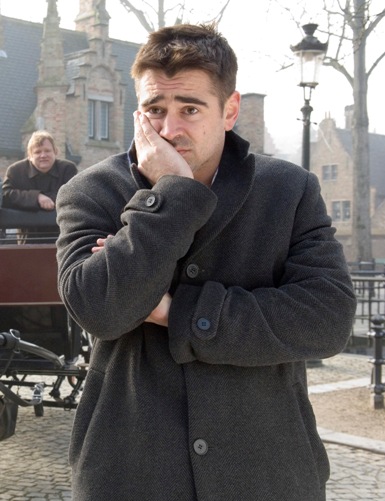
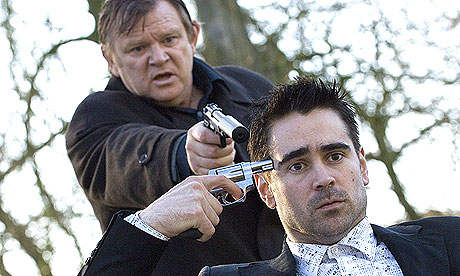
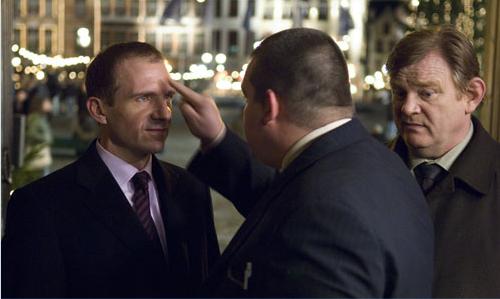
Ray and Kenny (Colin Farrell, Brendan Gleeson) are two Irish hit-men who are on holiday, of a sorts. Actually, they're laying low after Ray's first "hit"—the assassination of a priest (Ciarán Hinds in a cameo)—also manages to kill a child. It's Ray's first job for Harry Waters (Ralph Fiennes) and he's botched it. Badly. The best for them is to get out of town for two weeks until the furor dies down. So, they're sent to Belgium, specifically to Bruges—"the most preserved city in Europe"—to get lost in the Christmas tourist season. "It's a shit-hole," says Ray, still reeling guiltily. He hates it. In fact, he'd probably hate any place on Earth in his state of mind, except the one place he cannot go. For Ray, Bruges is worse than Hell. Kenny is enjoying the sight-seeing and fascinated by the antiquity of the place and keeps trying to interest Ray in the city, calling him the "worst tourist in the world." "Ken," replies Ray. "I grew up in Dublin. I love Dublin. If I grew up on a farm, and was retarded, Bruges might impress me but I didn't, so it doesn't.."
And that, there, is why I fell in love with this film. The rough language that has a rhythm and groove, and feels like it's falling out of the minds of Farrell and Gleeson and Fiennes in unfiltered stanzas. It's Mamet with a lilt (especially in Farrell's hands). It's a comic flow that when these three ace actors toss in their syncopated pauses it maximizes the laugh factor exponentially. Sentences build and explode in beated punch-lines that flow naturally from the material. It's coarse and brutal, but behind the words are human feelings of desperate men.
Ray is badly shaken up by the death of that child. It haunts him, keeps him awake at night and makes him fear for his soul. He drinks to deaden the pain. Ken, the veteran, has been at it awhile, owing a debt to Harry Waters from the past and is loyal to a fault. And Harry is a vicious gangster who loves his family and lives unswervingly by a precise code of honor. These are bad men with silver linings of virtue tucked away where no one can hurt them. In their own ways, they are romantics. Homicidal romantics, maybe. But, then, that's the work.
Steeped in quirky characters, and nearly prat-falling over itself with implied comedy, "In Bruges" manages to do something unique in the post-Tarantino action revolution of stylization, and pervasive...everything—it manages to have soul, a caring one, at that, where actions have consequences that don't get lost in the final reel amidst the carnage and wise-cracks.
* And, as in the film "Once," there is something about the word spoken with an Irish accent that makes it less harsh and far more charming, like the name of a seaside Gaelic town.







Tuesday, March 23, 2010
Green Zone
"Weapons of Myth Destruction"
The team that brought you the more popular of the "Bourne" movies (Paul Greengrass, stunt coordinator Dan Bradley and star Matt Damon) basically take the same "run-and-shoot" scenario into the Iraq War in "Green Zone"—a government operative goes rogue and takes on the higher-ups with something to hide, who are willing to kill him in order to silence him. And just as "The Bourne Ultimatum" felt like a re-tread of "The Bourne Supremacy, "Green Zone" has the same worn been-there, fragged-that quality, owing more to tracts like "Body of Lies" (which this one closely resembles, despite having an "original" screenplay by Brian Helgeland) and the earlier collaborations of this particular action troika. It's the Iraq War, but without the "shock-and-awe," unless the awe comes from a stifled yawn.
The same issues—the manufacture of intelligence to promote a "sellable" war scenario—are at play in both the Greengrass and Ridley Scott films. The main difference being that this one lands square in the middle of the early "dazed and confused" days of the Iraq War (having just passed its seventh Anniversary) with the first crews of Army inspectors coming up trumps in their search for the legendary Weapons of Mass-Destruction, the Holy Grail of this Crusade. Adapted freely—very freely—from the book "Imperial Life in the Emerald City" (which reads like a book version of the documentary "No End in Sight"), the screenplay posits American efforts to steam-roll a provisional government into Iraq by propping up their own Iraq partisan (based on Ahmed Chalabi) who hadn't set foot in Iraq for thirty years and was of dubious integrity, and the double-blind of an Iraqi general (played by Yigal Naor), whose reports of destroyed WMD's are falsified by the White House, and the promised assurances of participation in any new government for cooperating are ignored in the process of "De-Ba'athification."* Helgeland took the strategic failings of the Coalition Provisional Authority and used them as background for the cut-and-paste screenplay, constructing an "Army rebel" scenario in which Damon's "Roy Miller" is disgruntled with how his squad is continually sent on bogus WMD searches, chasing wild geese rather than chemical weapons. It becomes clear to the acronym-spewing MOP'd op that something is SNAFU, as the sites they fight to raid appear free of ordinance of any kind...and haven't for a very long time. Miller's investigation with the help of a frustrated CIA agent (Brendan Gleeson) becomes an effort to keep the SNAFU's from becoming FUBAR before he goes Tango Unicorn. Besides the angry and destabilized citizenry, they also have to fight a CPA op hard-wired to the White House (represented reprehensibly by Greg Kinnear) and the Special Forces commander who doesn't ask and doesn't tell, but merely re-loads (the terrific Jason Isaacs, nearly unrecognizable, looking like Bono in fatigues). You can't swing an HD camera (in simulated field-documentary fashion) without coming into conflict with somebody. **
It's one of those trope-heavy screenplays heavy on the "table-turning" dialogue ironically bantered back-and-forth during different stages of the screenplay—the big ones (delivered with the required dripping sarcasm) are "don't be naive," and "you didn't ask to confirm?" Ho-ho! Gotcha. You are so "occupied." These are the small PR victories lost in the cluster of the Iraq War.
It's not that "Green Zone" is bad. It is quite competent. But it is tired, and tired at its reckless pace feels silly and unnecessary...and a waste of time. Still, far more people will see "Green Zone" than "No End in Sight," so if the message has to be "Damonized" at least it's doing some good, though in 20/20 hindsight.
Now...about the next one...
"Green Zone" is a Rental.
* Although the process is a matter of public record as is the Coalition Provisional Authority's dissolving of the Iraqi Army, the "playing" of the general is more akin to President Bush's tactics in dealing with Democratic senators while he was governor of Texas—he'd make promises to get a crucial vote and renege on those promises.
** Like the "Bourne" films and Greengrass' "United 93," the film doesn't have a still shot in it, or a held shot of more than four seconds, making Kathryn Bigelow's "The Hurt Locker" look serene by comparison, but it's not as bad as second-unit director Dan Bradley's work on "Quantum of Solace," which looked like it was filmed from the POV of a Mixmaster set to "discombobulate." The guy's who's turned this sort of stuff into a science is J.J. Abrams, who's designed a personal system for hitting the camera—actually whacking it—in a certain rhythm to give it a "shaky-cam" stutter while letting you follow the action and still identify the participants.
Monday, February 4, 2008
Harry Potter and the Goblet of Fire
"Harry Potter and the Goblet of Fire" (Mike Newell, 2005)  Year Four at Hogwarts, and Harry must learn that he can not stop death, that at times he must stand alone, trust his friends, and though he may be a natural at magic, it can't keep him from acting like a stupid muggle in front of girls. Oh, and (He Who Must Not Be Named) comes back. That's big. Who's new? Lots of kids (Hogwarts is visited by exchange students from France (girls) and some teutonic country (boys), Miranda Richardson as The Daily Prophet's gossipy-pain-in-the-neck Rita Skeeter, Brendan Gleeson (marvelous) as "Mad Eye" Moody, and Ralph Fiennes, chewing as much CGI scenery as possible as HWMNBN--Fiennes clearly relishes the role. At this stage of development, all the regulars are at the heighth of awkwardness, looking slovenly and disheveled, and just a bit homely. Harry must participate in a prom as well as the Tri-Wizard's Something-Or-Other, and one had best place their bets on Harry on the latter (in the former he's a complete wash-out). Director Mike Newell bustles things along and tries to put eveything in at the cost of giving A Big Important Event For Harry (and the emotional high-point of the film) a little too little background to make us care. The films are getting darker, both in subject matter--but also in lighting, the beginning of the film is nearly indecipherable without one of those divining maps from Part Three, "Harry Potter and the Rather Inocuous Magical Prop" (that was the name of it, wasn't it?).