Showing posts with label Ethan Hawke. Show all posts

Sunday, May 11, 2008

Fast Food Nation


Fast Food Nation, (Linklater, 2006)

Harry Rydell: It is a sad fact of life, Don, but the truth is we all have to eat a little shit from time to time


Scene 1: We are in a brightly-lit fast food restaurant. Two men are sitting in a garishly-upholstered booth. One is an overweight man with wild, uncombed hair and a three-day growth on his face. He is wearing a faded t-shirt underneath a corduroy jacket with missing elbow patches. The legend on his t-shirt says, ' Roll cameras, action, cut' and he may or may not be a film director. The other is a thin-faced nervous man with stringy long hair and thick glasses. He is wearing a buttoned-down striped shirt and in his top pocket are a collection of pens and pencils. Some of the pens have leaked onto his shirt leaving a multi-colored stain on the front. He is tapping his hands nervously on the table; he may or may not be a writer.

Overweight man: The way I see it, it's all about conscience and free will. You know, whether you really care about this stuff and whether you care enough to actually, you know, like, do something about it.

Nervous man: Right.

Overweight man: So, we need to show it all, the whole enchilada, you know what I mean, the guys that sell this stuff, the schmucks that work in the restaurant, all the crap, how we are all part of this big machine and we don't even know it.

Nervous man: O.K. ...

Overweight man: Could I get another cup of coffee over here?


He directs his question at a young woman dressed in the uniform of the fast food chain. Her name tag says Amber and she looks like she is a high school senior.

Young woman: Sorry sir, we don't do refills.

Overweight man: See what I mean. They just want to screw you over, get your money and get you out the door. Goddammit.

Nervous man: So, how far you want to go back with this?

Overweight man: What do you mean 'how far back?"

Nervous man: Well, it's not just the fast food companies, is it? I mean, where does all this shit come from? You got your meat packers and your ranchers. They're all part of it too, man.

Overweight man: Right, yeah. Then there's the illegals too. We could get a whole angle on the illegals. Show the mules bringing them over and handing them over to these places that don't have no unions, no safety regs. Yeah we could do a whole slant on that.

Nervous man: O.K so now you got your problem but what about your solution? What about this stuff about conscience? How are you going to work that in?

Overweight man: How about this? Let's take your average guy, stuck working for one of these corporations, you know, a family man just like that guy over there.


He points to a man sitting in a booth with a woman and two kids. The kids are eating their meals while the woman is staring out the window. The man is watching a certain area of Amber's anatomy as she bends over to wipe down a table for an older man who looks like he's auditioning for a Marlboro commercial. Or maybe he's a rancher.

Nervous man: Yeah, let's say he used to work for some cable company and now he's got a job thinking up marketing schemes for this burger chain. Only the more he finds out about the product, the more he thinks he's being asked to peddle crap.

Overweight man: So how about if he has to go and look at one of those meat packing places they have around here. And then we could show how those kinds of places are just bending all the rules to make the big bucks, trucking in illegals from Mexico, screwing them over, you know, no contracts, no safety regs, just giving it to them in the ass. But he doesn't see it at first because he just believes what he sees.

Nervous man: Yeah, literally screwing them in the ass. So what happens?

Overweight man: He's gotta find out about what really goes on but who's going tell him? Who's not benefiting from all this?

Nervous man: What about Marlboro man over there. Maybe he's one of those ranchers that doesn't buy into all this. He's got developers leaning on him on the one side and the meat packers on the other.

Overweight man: OK I like it. So we got to find a way to put them together.


His gaze wanders outside to the motel parking lot opposite. He watches as a red pick up truck pulls up and a tall, well-built man gets out and goes up to one of the doors. It opens and a few moments later, he comes back out followed by two Hispanic looking men who get back into the truck bed. He is just able to see the faces of a woman as the motel door closes. It's the face of a thousand women he has seen before, cleaning his hotel room or standing behind the counter of a restaurant like this.

Overweight man: Then, there's people like her.


He points over to Amber who has come off shift and is now sitting at a booth opposite a woman and a man. The two adults look as if they could be sister and brother. The woman is wearing a uniform with a badge shaped like a dog. The man looks like he hasn't changed his style of clothes since he was a stoner at Berkeley in the 60's.

Nervous man: What do you mean?

Overweight man: Well, you think she gets more than minimum wage? You think she likes selling this crap? Maybe she just wants to go out and party or maybe she's one of those animal activists.

Nervous man: What would someone like that be doing working in a place like this?

Overweight man: That's my point. All these people - they are all caught up in the same freaking mess - it gets us all and no one can do anything about it. I mean, even if you went right up to one of those packing plants, cut the freaking fence and let the cows out they probably wouldn't even be smart enough to escape. And we're just the same, man. We're like those cattle stuck in the pens. Sticking together until it's time for someone to blow a freaking hole in our head.

Nervous man: I don't know, man. Seems like an awful lot to get in one movie.


Cast of characters

Overweight man: Richard Linklater
Nervous man: Eric Schlosser
Amber: Ashley Johnson
Man in the booth: Greg Kinnear
Marlboro man: Kris Kristofferson
Pick-up driver: Bobby Cannavale
Hispanic man 1: Wilmer Valderrama
Hispanic man 2: Armando Hernàndez
Woman in the doorway: Catalina Sandino Moreno
Woman with the dog badge: Patricia Arquette
Stoner guy: Ethan Hawke

Fast Food Nation also features:

Bruce Willis
Paul Dano
Ana Claudia Talancón

It is available on DVD from 20th Century Fox.

Wednesday, January 9, 2008

The Complex Art of Film Noir: Winter 2007

I: "Before The Devil Knows You're Dead"*

In Broad Daylight

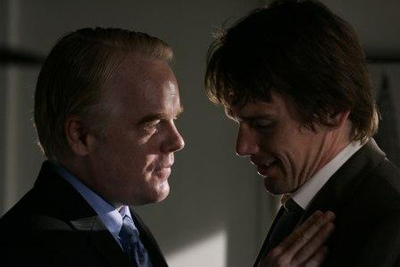
The road to Hell is paved with good intentions. Just ask Andy and Hank Hanson. They both need money because they want to do right by their families: Andy, so he can get out of debt and maybe move with his depressed wife to Rio De Janeiro; Hank, because he's a few months late in child support, and he wants to do right by his daughter...oh, and his mistress, and ...well, all of Hank's dreams are short-term.

But Andy has a plan that's fool-proof: a robbery. "No one gets hurt. It's perfect." Trouble is, Hank's a fool, and he agrees before he knows all that it entails. Andrew, a real estate accountant, gives him a down-payment. "There's $2,000. See what that does for you. Imagine the rest."

They can't imagine. Because, as they say in the magazine-shows, things go "horribly, horribly wrong."

"Before the Devil Knows You're Dead" might belong to that sub-genre of comedy films called "The Incredible Mess," where seemingly simple plans go increasingly awry, but it's no comedy, except in the perverse way perfect disasters pile upon perfect disasters. But I would contend that the movie, as written by Kelly Masterson, is a film noir, that species of film where the world maliciously has it in for an honest man, and corruption runs so deep that it's manifested in a shade of fathomless blackness--"where the world is dark with something more than night," as the saying goes. One of the laureates of the proto-noir story was Raymond Chandler, who laid out the ground-rules for his brand of detective fiction in an essay titled "The Simple Art of Murder," first published in 1944, and quoted extensively below.** In it, he railed against the "drawing room" brand of of detective fiction as weak and unrealistic, and that a detective-hero must try and find Truth in a fabric of deception, obfuscation, and agendas so thick it's like wading through a cess-pool. "Before the Devil Knows You're Dead" is so steeped in layers of corruption that any transgression amplifies to the worst possible conclusion, and by chain reaction drags the innocent down as well as the guilty in a tragedy of Shakespearean consequences. No one is immune from the veil of evil. The world of "Before the Devil Knows You're Dead" is so corrupt, there is no hero. And it all happens in broadest daylight.

There's been "daylight-noirs" before, like "Gun-Crazy," and, of course, "Chinatown" takes place in sun-blasted L.A. But "Devil" takes place in New York, and mostly gentrified New York at that. New York, because the director is Sidney Lumet, who quite rarely makes a movie anywhere else. Lumet's an odd choice for a noir film, although he's made many films in the squalor of New York--"Serpico," "The Pawnbroker," "Prince of the City," "Q & A," and he's made many movies that intertwine family and crime--"Dog Day Afternoon," "Murder on the Orient Express," and "Family Business." As a director, he's not very stylish, and is, in fact, pretty clunky, as in "Twelve Angry Men," and "Fail-Safe," or, dare I mention it, "The Wiz." Lumet expends his energy on performance, rather than construction. In fact, Lumet has rarely risen above his roots as a director of live television: a master shot, the occasional close-up, and that's about it. His camera work is utilitarian, at its best, sometimes inelegant, brightly lit, nothing fancy. He tends to using film scores, thinking them too pervasive and detracting from a scene's manufactured reality. When he does try something different (in other films, it was crudely distorting lenses) it's always in your face. Here, it's an editing transition that flashes forward and back three to four times, similar to the "druggy" transitions in "Easy Rider," but with an annoying clacking noise at each edit. The story-telling technique employed is similar to that of another noir, Stanley Kubrick's "The Killing," where the actual caper is viewed from one character's point of view, then rewinds back to another participant's during the same time period and beyond. The plot advances and coalesces in increments until the inevitable end-game where all stories come together. And "Devil" ends in the only way this noir-in-daylight could end.

Because it's Lumet, it's the performances where the movie shines: Philip Seymour Hoffman is all sweating self-pity as Andrew, Ethan Hawke is Hank, a pitiful train-wreck doing a poor job of trying to appear together, Albert Finney goes a bit over the top as their father Charles, and Marisa Tomei shows the promise that her early Oscar win belied as Andrew's wife, caught in the middle. But the smaller performances of minor characters like Michael Shannon and Aleksa Palladino stand out as well. It's a blackly depressing film that owes whatever greatness it achieves to the writing and performances.

"Before the Devil Knows You're Dead" is a cheap (and sleazy) matinee.


II: "Gone Baby Gone"

That, in All Things

Now walk down these mean streets a little further--all the way to Boston. Here you'll find private detective Patrick Kenzie, the very definition of the term John D. MacDonald used to describe Raymond Chandler. "He writes," said MacDonald "like a slumming angel." Kenzie knows the back-alleys, the crack-dens, the gang-bangers, the dealers, the dive bars and the angles and he knows how to handle them with a cock-suredness that belies his years.*** But that street cred only takes you so far, because although he's lived in Boston his entire life, New Orleans transplant detective Remy Bressant (Ed Harris--extraordinarily good) tells him "I've been here longer than you've been alive." And Bressant has seen the long continuous story of those places Kenzie merely visits. But if Bressant knows more, nobody tops Captain Doyle (Morgan Freeman, completely dominating the three scenes he's in), whose daughter was kidnapped and killed, and has dedicated his life to making sure it doesn't happen again on his watch. 4 1/2 year old Amanda McCready has gone missing from the neglectful eye of her good-for-nothing mother and Kenzie and his partner Angie Gennaro (Michelle Monaghan) have been hired by an aunt to find her, however reluctant they are to take the case. Within 24 hours, there's a good chance they can find her alive and unharmed. She's been gone, now, for 60.

And soon, after all the slumming and the chance-taking, the compromises with the police and the stake-outs gone bad, the case comes to a dissatisfying end, and like any good noir dick, that's just not good enough for Kenzie. He has to keep pushing for Truth, no matter how hidden, no matter the consequences. But the Truth hurts and can lead to decisions made for the best of reasons but the worst of consequences. And this "slumming angel," this noir-hero by Chandler's precise description, will suffer the consequnces for his decision, both personal and professional. But because he is the hero, he must fight that corruption even if the result is not a more perfect world, but the same tainted world as when he began. And maybe, even one that's worse.

As it happens, there is no moral high ground here. There is no "right" and "wrong" for the situation is too far out of control for there to be a "right" and a "wrong" and the two step over each other's line as often as a police tape is crossed. The resolution of the story, the choices made can be argued for days, and the last shot of the movie damns even as it takes the film to a logical conclusion.

This has been a great year for Casey Affleck. First, he stepped out of the star-crush to become more than a glorified extra in "Ocean's 13," carried the bulk of "The Assassination of Jesse James by the Coward Robert Ford," and now holds his own against Morgan Freeman and Ed Harris at the heighth of their powers. His performance in "Gone Baby Gone" shows great versatility and an amazing range. But if Casey's potential has come to fruition, the emergence of Ben Affleck as a director is nothing short of revelatory. Here he shows a command of time and place, and a wonderful eye for faces that lend authenticity to the grime of the surroundings. An action scene at night may not be as focussed and suspenseful as it should be, but the rest of the movie is assured, and negotiates moral discussions without getting bogged down in high-handedness or slowing the movie down. That fine directorial touch extends all the way to the wickedly oblique final shot that will creep on you days after the fade to black. Given this auspicious debut, one looks forward to the next film featuring Ben Affleck behind the camera.

"Gone Baby Gone" is an impressively full-price ticket

* After the Irish toast: May you have food and raiment, a soft pillow for your head. May you be forty years in heaven before the devil knows you’re dead.

** Raymond Chandler, perfectly describing the fetid world of "noir" in "The Simple Art of Murder:"

"The realist in murder writes of a world in which gangsters can rule nations and almost rule cities, in which hotels and apartment houses and celebrated restaurants are owned by men who made their money out of brothels, in which a screen star can be the fingerman for a mob, and the nice man down the hall is a boss of the numbers racket; a world where a judge with a cellar full of bootleg liquor can send a man to jail for having a pint in his pocket, where the mayor of your town may have condoned murder as an instrument of moneymaking, where no man can walk down a dark street in safety because law and order are things we talk about but refrain from practising; a world where you may witness a hold-up in broad daylight and see who did it, but you will fade quickly back into the crowd rather than tell anyone, because the hold-up men may have friends with long guns, or the police may not like your testimony, and in any case the shyster for the defense will be allowed to abuse and vilify you in open court, before a jury of selected morons, without any but the most perfunctory interference from a political judge.

It is not a very fragrant world, but it is the world you live in, and certain writers with tough minds and a cool spirit of detachment can make very interesting and even amusing patterns out of it. It is not funny that a man should be killed, but it is sometimes funny that he should be killed for so little, and that his death should be the coin of what we call civilization."


***
Raymond Chandler, "The Simple Art of Murder" again, describing the detective hero:

"In everything that can be called art there is a quality of redemption. It may be pure tragedy, if it is high tragedy, and it may be pity and irony, and it may be the raucous laughter of the strong man. But down these mean streets a man must go who is not himself mean, who is neither tarnished nor afraid. The detective in this kind of story must be such a man. He is the hero, he is everything. He must be a complete man and a common man and yet an unusual man. He must be, to use a rather weathered phrase, a man of honor, by instinct, by inevitability, without thought of it, and certainly without saying it. He must be the best man in his world and a good enough man for any world. I do not care much about his private life; he is neither a eunuch nor a satyr; I think he might seduce a duchess and I am quite sure he would not spoil a virgin; if he is a man of honor in one thing, he is that in all things. He is a relatively poor man, or he would not be a detective at all. He is a common man or he could not go among common people. He has a sense of character, or he would not know his job. He will take no man’s money dishonestly and no man’s insolence without a due and dispassionate revenge. He is a lonely man and his pride is that you will treat him as a proud man or be very sorry you ever saw him. He talks as the man of his age talks, that is, with rude wit, a lively sense of the grotesque, a disgust for sham, and a contempt for pettiness. The story is his adventure in search of a hidden truth, and it would be no adventure if it did not happen to a man fit for adventure. He has a range of awareness that startles you, but it belongs to him by right, because it belongs to the world he lives in.

If there were enough like him, I think the world would be a very safe place to live in, and yet not too dull to be worth living in."