Showing posts with label Rebecca Hall. Show all posts

Saturday, May 11, 2013

Iron Man Three

Rust Never Sleeps
or
The Hot Mess Protocol (Chaotica in Extremis)

One still finds it incredible, if not amazing, that the most popular film-series in the Marvel Universe* continues to be "Iron Man."  Don't get me wrong.  Tony Stark's character is an important one in the pulps (are they still using pulp paper?), but relatively minor next to Captain America, Spider-man, The Fantastic Four or The Hulk.  Now, Cap and Spidey're doing fine in the flickers, but the others, not so much.  And the "Iron Man" series is the lynch-pin for the "Avengers" movies Marvel is creating as major events in the film-calendar.

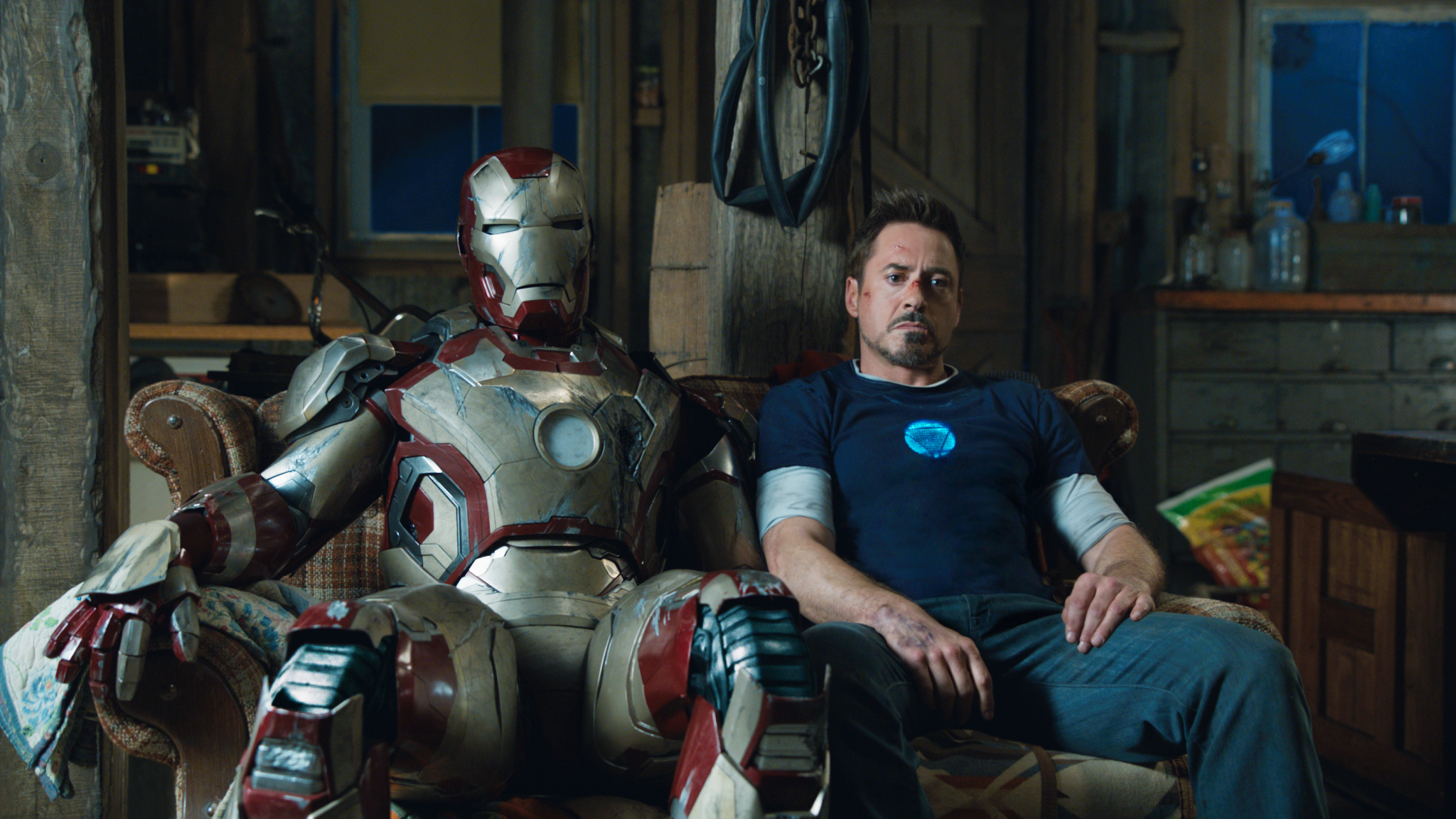
The secret to its success seems to be, single-handedly, the casting of Robert Downey Jr. as billionaire-tech Tony Stark, a move that was initially resisted by Marvel.  But Downey's refusal to stick to text, traditional acting rhythms, and mercurial energy makes even the most generic of roles a circus act, balancing on a tight-wire, never being predictable and finding interesting ways, by body and soul, to entertain, even when cocooned in a tin can.  He's the best special effect in the "Iron Man" series, and dominated and energized the other characters in Joss Whedon's first "Avengers" movie.


Now, out of the factory comes "Iron Man Three" (as it is presented in the titles), the third film where most film series (post-Star Wars, and excepting the films that choose to bifurcate their last chapters) seem to stop, usually because either star-salaries and their negotiations are unsustainable, a logical character arc is achieved, or the film-makers have run out of ideas, or audiences, of interest.  Three seems to be a good stopping point for super-hero movies, too.  Face it, by the third movie, it's all about the toys and the merchandising.  In this one, there's a veritable garage of Iron Man suits in enough variations that they'll be clogging toy store-shelves in a week (and bargain bins in six months).  That's not the reason to see the movie, though, as each suit has little to no screen-time, with no explanation of what they are or what makes them special in any way.


This one is a movie version of the comics' "Extremis" storyline, originally written by Warren Ellis, but changed significantly and inserting one of Gear-head's major villains, the Mandarin—(as portrayed by Ben Kingsley) but not in a way that will impress comics fans, although general audiences might find the use amusing and apt for the times.  Tony Stark is having issues with PTSD from his encounter with "Gods, aliens, and wormholes" in the Avengers movie**  Stark Industries (and it's CEO, Pepper Potts—Gwyneth Paltrow, once again) is being schmoozed by the creepy head of AIM, Aldrich Killian (Guy Pearce), while Tony, sleep-deprived by nightmares, vows to deal with Mandarin-orchestrated terror attacks that have become personal—Jon Favreau's Happy Hogan is left in a coma after an attack on one of America's great industrial centers, Grauman's Chinese Theater, by creepily glowing human bombs.  Tony calls out the Mandarin, inciting an attack on his Malibu cliff-house, leaving him presumed dead and without resources, hiding out in Tennessee.  If all this isn't complicated enough, Col. James Rhodes, the "Iron Patriot," (Don Cheadle) goes after the Mandarin himself at the behest of the government, and is captured, making his combat suit a threat, as well.

That's the plot—colluding and combusting—and Tony must rely less on his established mechanical persona than his own wits and ingenuity.  Would that the filmmakers were, as well.

Favreau, who oversaw the first two movies, executive-produced this one.  The writer-director of this mess is Shane Black, who collaborated with Downey in the not-bad movie Kiss Kiss Bang Bang, and he makes the first two efforts seem brilliant by comparison.  Oh, the charm of Downey is still there—there's one particular scene between him, Paltrow and Rebecca Hall in a three-way snark-argument that's particularly nice—and concerted efforts have been made to keep him out of the suit and his own man throughout most of film.  But the movie's gears seize up every time a big action kerfluffle begins, and the only rhyme or reason for shot placements seems to be to keep the multiple cameras recording the events out of line of sight with each other.  The editing suffers from some odd inserts in the middle of the action that merely confuses, rather than informs what is going on.***  

And, it seems a little obvious to accuse an "Iron Man" movie of a deus ex machina overdose, but this one suffers greatly from it and finally breaks down in a denouement that polishes and shines everything in a nice little package and makes you wonder "that easy, huh?"  This film could have used a little Geritol, frankly, feels a little like spinning its wheels, all the while you hear a lot of grinding in the works.  The film proudly states that "Tony Stark will return."  Oh.  Wow.  Can't wait.

Iron Man 3 is a Rental


Tony Strak kinda, you, know, uh, explains it all for you.


* © Disney Corp.

** In that movie, which is only referenced as "New York," Iron Man must fly a Big Exploding Thing into a wormhole connecting Asgard's multi-verse realm to deal with an Earth-threatening happenstance.  In that other dimension, his suit gives out and he falls unconscious to Earth where he is caught by Dr. Bruce Banner's Hulk, without any of the neck-snapping consequences incurred by girl-friends of Spider-man.

*** Chris Nolan's "Batman" films have gotten flack for that, but Nolan's story-telling sense usually gets him through rough patches and "wait-a-minute" moments that this "Iron Man" entry immediately brings to mind.

Wednesday, May 18, 2011

Everything Must Go

"Priced To Move"
and
"'Bye-Bye' Says the Junk in the Yard"

Job had it easy.

After being fired from his job for some sexual malfeasance that he was too drunk to remember, Nick Halsey (Will Ferrell) drives home—stopping on the way to get a case and a half of PBR—and finds that all of his belongings are on the front lawn, strewn about, the flotsam and jetsam of a life that's hit a reef.  The house locks have been changed.  The garage code is different.  There's a note on his door from his wife saying she's leaving him and "Don't Call." His credit cards don't work.  His bank account has been frozen.  His cell-phone is disconnected. 

That solves the "don't call" problem.

Then, his company car gets repossessed.

What else can happen?  Well, his next-door neighbor (Stephen Root) can pass by and say "...saw this coming a mile off."

"Thanks for warning me..." says Nick, simmering.

There's a nice tone-shift to Everything Must Go.  It stars Ferrell, who goes dramatic here, but the doofus-slob-schtick that he has honed over the years serves him well as he goes through humiliation after humiliation—as a performer, he's never steered clear of making himself appear foolish.  He has, in fact, embraced it.  The physical comedy looks nicely unplanned, but still has a chortling superior sting to it.  Ferrell can be a cruel comedian but it's mostly self-imposed, the barbs on the wires facing inward like a crown of thorns.  And he has a nice explosive quality that makes you wonder when he's going to go offThe fuse between comedy and drama is enticingly short.  There's a bit of Peter Sellers to Ferrell at his best that makes you want to laugh almost defensively.  That's in good play here.

Everything Must Go is based on Raymond Carver's short story "Why Don't You Dance?"* (you can read the whole thing here—go ahead, it'll only take five minutes) and writer-director Dan Rush has done yeoman's work taking the author's slice of a story and expanding it to feature length.  In fact, the couple that dominate the story don't even appear.  Rush has taken the bare-bones carcass of the story and reconstructed it, focussing on the pain—and the emotional journey—of the man with the rummage sale of a life, laid bare for all the world to see...and eventually, pick over.

I love Carver's writing.  He makes kernels of story that feel emotionally real, of lives tipped over and spilling, the contents of privacy exposed to the air and either flowering or rotting.  A little push and we could all go there, his situations just a happenstance, a coin-toss, away.  Would we act that way?  Do we recognize ourselves in such circumstances?  And Rush takes the premise and goes back in time and forward, filling the gaps, creating the world of the man who, at first, drunkenly, defiantly lays his past bare...and then, lets it go.

Most of Everything Must Go works.  There is a logical progression to what Rush has put together to get to the point of the Carver story, although it may seem a little bottled up with some contrivance—a side-track to a story involving Laura Dern probably wasn't necessary, but it opens the movie up a bit and it's always nice to see Dern.

But it's all Ferrell, with some nice work by Michael Peña, Rebecca Hall, and Christopher Jordan Wallace, who has the most to do (besides Ferrell), as the kid who hangs around and gets sucked in to the situation, and like others, manages to gain something from the deconstruction of a marriage.  One wonders if the comedian, fearing that he might be found out by going sentimental, doesn't hold back some effort, thereby bringing more of a sense of peace...or closure...to the character by the film's end.  But, then, maybe that hesitancy is the punch-line he wanted, walking away leaving the audience wanting more.  It's a far cry from Land of the Lost.  And admirable.

Everything Must Go is a Matinee.


Yeah.  No.  It doesn't feel like this chirpy trailer at all.


* Since writing this, I've discovered there is a short Australian film based on the story, and following Carver's story far more closely called Everything Goes. It stars Hugo Weaving and Abbie Cornish.
You can find it on the web.

Tuesday, October 5, 2010

The Town

"Prince of Thieves, Pillar of the Community"
or
"Taking Down the Cathedral of Boston"

Ben Affleck's directorial debut for Miramax, "Gone Baby Gone" revealed a film-maker of complexity and subtle visual skills, creating an intriguing film noir of corruption in high places for the best of intentions and the moral ambiguity of holding true to an ideology versus the considerations of pragmatism.  It was an ambiguous film that resolved the mystery, but not the implications of its characters' actions, and guaranteed lively debate long after its ending.

But what was clear was Affleck's ability to find the perfect shot and staging for making his points, along with a documentarian's eye for the lived-in detail; Affleck's vision extended beyond the bubble inhabited by the culprits in the scenario, and into a real recognizable, even mundane world.

So, my anticipation for his second film, "The Town," has been high.  My respect for Affleck the actor has never been high (save his subtle work as TV-Superman George Reeves in "Hollywoodland"), but "Gone Baby Gone" made you sit up and take notice of Affleck the director and writer.

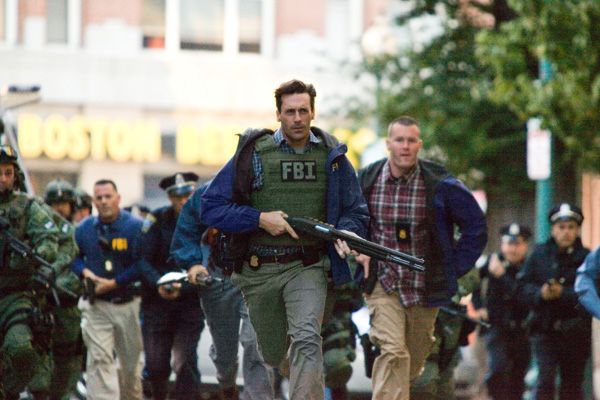
I'd have been happy with more of the same, but Affleck has changed gears impressively for this crime drama about a foursome of expert knock-over artists (the FBI agent assigned to the investigation—played by Jon Hammcalls them "The Not-Fucking-Around Crew") trained from endless hours of watching the endless array of CSI shows on TV, and the second generation of Charlestown townies doing the dirty work their fathers have engineered, or are paying the price for.  It looks like robbery, but it's more like literal class war-fare (with automatic weapons) between the have-nots and the "Hahvard" elite of Cambridge.  Affleck stages three intricate robberies, each one different in scope and technique and each with their own visceral power that catches one off guard with some truly impressive ways of presenting them.  The first, a bank robbery, starts with a black and white silent image (save for some electronic telemetry sound-design) from a security cam that explodes into color and sound when they burst through the door.  The second, an armored car robbery, with an elaborate get-away through tight streets and back alleyways that is truly frightening.  The third...I won't even say.  But, it recalls some doom-laden Alamo-like circumstances from a lot of fine film-makers of the past, and, like the other action set-pieces, it's filmed efficiently to provide just enough information, and propel forward to the next gut-wrenching development.  Howard Hawks once said of Don Siegel's hard-hitting approach to film violence "That stuff's hard to do."  Affleck makes it look easy, and he avoids embraced movie-cliches nimbly; he even provides one of the most inelegant fights since the fight in the bar in "The Treasure of the Sierrra Madre."

"The Town" has a great screenplay, too.  Frustrating, deep and complicated, it also provides nice grace notes that reverberate throughout the movie, and hang in the mind on the way home.

The story begins with that first robbery.  One of the managers (Rebecca Hall, who plays fragility as well as she does brittleness) is forced at gun-point to open a time-lock safe, while the crew spends as much time destroying incriminating evidence, as they doing sacking the loot.  An alarm is tripped and so she is taken hostage by the gang led by Jeremy Rennerdoing great repugnant work—and Affleck, and released at the ocean's edge.  The trigger-men soon realize that she lives in their neighborhood, and it's decided to deal with her, which to avoid Renner's John Coughlin killing her, Affleck's Doug McRay takes over, and he becomes smitten as he sees the effects the trauma has wrought on her. Unaware of his part in their crisis, they begin a tentative relationship, and soon, he's caught in the middle, trying to hide double-truths from both his girl and his gang

"I'm sorry," he says (quite honestly) as she relates her fears about the incident.  "It's not your fault," she says, automatically...and the banal nicety hangs like an indictment between the two.

Affleck is less concerned with the expressive image here, and more concerned with the impactful presence, coding his film with broad strokes that link characters with circumstances and localesIt's a broader, more tough-as-nails approach to film-making than his first film, and that extends to his portrayal of violence which is presented unflinchingly and coldly and fast.  Lives end in an instant, and the deaths are unromantic and not pretty.  In the meantime, the tensions of all things good and bad unravel skeins of connection, and the film ends unresolved...but not ambivalent.

"The Town" is a One Hell of a Matinee.

Tuesday, September 9, 2008

Vicky Christina Barcelona

"Juan is the Loneliest Number That You'll Ever Do"
or
"To Javier and Javier Not"

"Vicky Christina Barcelona" (Woody Allen, 2008) The latest film in what will, no doubt, be called Woody Allen's "Scarlett" period, "Vicky Christina Barcelona" was shot almost totally in Spain, and benefits from the change of location. It's a large part of what drives the plot and the two women who vacation in Spain for different purposes.

Vicky (Christina Hall) is studying Catalan architecture (particularly Gaudi), and spends the time in Spain as a prelude to getting married to staid, reliable Doug (Chris Messina). Christina (Scarlett Johansson) has just written and directed an 18 minute film starring herself, and broken up with the latest in a series of men in impetuous affairs. She has no business in Spain, but goes to spend time with Vicky and get away. Vicky values the safe and dependable. Christina is searching, "certain only of what she doesn't want," as explained by a ubiquitous Narrator (Christopher Welch), whose constant comments make the film feel less a visual experience than a story with pictures.
While in Spain, the two women are approached by darkly handsome artist Juan Antonio (Javier Bardem) who offers to fly the women to the town of Oviedo for the weekend to view the Gaudi works, drink wine, and make love. Vicky thinks Juan is a creep. Christina is intrigued, but both women end up going, Vicky to protect her impetuous friend.

Juan is soulful, attentive, but it is obvious he is in love with his ex-wife Maria Elena (
Penelope Cruz), despite the fact a) they couldn't make it work, and b) she stabbed him in a rage. ("Oh, that..." she says dismissively when it's brought up)
Things get complicated, but never enough for the Narrator to be lost for words or explanations, and when Maria Elena shows up again in Juan Antonio's life, the movie turns, at equal turns poetic, and dangerous. Despite the mannered ways that Allen's films can frequently turn out, this group of actors is particularly well-suited to working outside of Allen's tic's and rhythms. The closest any of the characters come to the Allen neurotic persona (a staple in Allen's films, either played by Allen or a stand-in) is Vicky, but she's much more sure of herself, if not her situation.

Bardem is sadly, relaxed in the film, but Penelope Cruz is a force of nature, this generation's Sophia Loren. After being stuck in some unmemorable films with some straight-jacketed performances, the last few years and films have displayed a bravura presence, and she runs a gamut of emotions in this one to full effect. It's a tough role to pull off--she's held up as an icon until she appears, and when she shows up later in the film, arriving bedraggled from the hospital after a suicide attempt, Cruz more than fills the bill, with her extremes of behavior never seeming contrived or phony. And Johansson has rarely been better represented on-screen--one close-up in particular of Christina listening to Juan Antonio explaining his love for his ex-wife fairly burns on the screen with resentment.

It may ultimately prove to be a minor Allen film, but as a change of pace and an expansion of style it couldn't be more successful.

"Vicky Christina Barcelona" is a matinee.