Showing posts with label Emma Stone. Show all posts

Thursday, January 24, 2013

Gangster Squad

Manifest Density
or
The War for the Soul of Los Angeles (such as it is)

Ruben Fleischer's third film (after the very good Zombieland and the excremental 30 Minutes or Less) is Gangster Squad, a Hollywoodized version of the efforts by the LAPD to take down the efforts of Mickey Cohen, the lieutenant of Bugsy Siegel's Jewish mafia, who took over Siegel's interests when the mob kingpin was murdered in 1947.

If one is looking for a history lesson, one should look elsewhere.  This is a glamorized, fictionalized version of the events set in some art-deco post-war version of Los Angeles that doesn't seem to have existed anywhere except the Warner Brothers gangster films and Brian de Palma's The Untouchables, to which this film owes a great debt.  The gangsters all wear dark clothes with long coats (the better to identify them) and are all greasy and ugly, while the police are all good-looking guys in nice suits who bend the rules a bit (with the possible exception of Chief Parker, played with a gruff somnambulance by Nick Nolte, who headed up the similar "Hat Squad" in Lee Tamahori's Mulholland Falls).*

It all feels very false, from how the gangsters rarely hit anything despite the thousands of rounds shot from tommy guns, and the Gangster Squad "hit" ratio usually fares better.  The Squad (hand-picked by the leader's wife, played by Mireille Anos, for being rough-necks and not promotion-headed top-of-their-classers) consists of boss John O'Mara (who did exist, but did not run the unit) as played by Josh Brolin, Jerry Wooters (played by Ryan Gosling), Max Kennard (Robert Patrick)—a sharpshooter, Conway Keeler (Giovanni Ribisi) a surveillance/electronics expert, as well as two PC members for the 21st century audience—Anthony Mackie (so good in The Adjustment Bureau) and Michael Peña.   Their target is Mickey Cohen (Sean Penn in a make-up that makes him look like he walked out of Warren Beatty's Dick Tracy), who's reputation is movie-inflated to make him seem like he's an empire-building Al Capone, rather than the cheap hood with star connections he ultimately was.

Fleischer is more interested in flash than being true to the source.  His fights are surprisingly well-staged, one shot per flying fist, but not Bourne-edited so one can easily follow it—an early fight in an elevator borrows heavily from a similar scene in a James Bond movie but actually goes places the 007 film merely used for suspense.  Once in awhile, he'll go for a Matrix-y slo-sloo-slooo-mo effect (rather than a fleeting Peckinpah image) just to make a point of something, like cartridges flying out of a machine gun, or a Christmas ornament exploding due to gunfire, but it's just slowing things down as opposed to telling a story.  Brolin's fine, nuanced even, but Gosling's McQueen-ish hipster act is wearing a little thin, and the chemistry exhibited between he and Emma Stone from Crazy, Stupid Love is completely missing here.  Mackie, Peña, and Patrick are far more engaging probably because they don't fit the established mold. 

It's entertaining, to a certain extent, but one gets the feeling, after patterns have been set that bring to mind other films, that one is being sold a bill of goods, and we are.  

The real-life Cohen was convicted of tax evasion (not murder) in 1950, serving four years.  Upon his release, he established several businesses (the ones portrayed in the film) and was again convicted of tax evasion in 1961 and released (again) in 1972.  Cohen died in his sleep in 1976.


Gangster Squad is a Rental.


The real Mickey Cohen, photographed in 1950
The real "Gangster Squad"


* Amusingly, his driver is Officer Darryl Gates (played by Josh Pence) who would be Chief from 1978 to 1992.

Friday, July 6, 2012

The Amazing Spider-man

Spider-man v. 2.0
or
"With Great Power Comes Sequels, Re-Boots, Etc....(A Spider-man's Work is Never Done)"

It may be a web-strand too soon to be doing a re-boot of the "Spider-man" franchise, but The Amazing Spider-man does do one thing that justifies its existence—it's better than the Tobey McGuire/Sam Raimi first film in the original trilogy, and right off the ledge manages to have the fun, energy, pop-soapishness, and inventiveness of the second film in that series, the one with Dr. Octopus.  We have to go through the origin story again (but that's okay, we seem to have to with every "Superman" film, and evidently will with the next one).

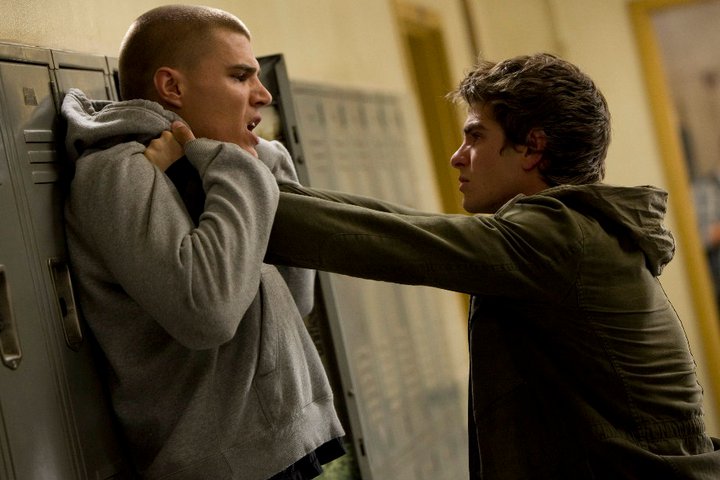
The story is basically the same—Peter Parker (Andrew Garfield) is a smart high school geek with a photog hobby, and his first encounter with an industrial science lab manages to put the bite on him, arachnidally-speaking, then strange things start happening as he does whatever a spider can, conflicts, conflicts, conflicts (of the physical and angst variety), "with great power comes great responsibility," yadda yadda yadda.  But there's a lot of "Spidey"-history to draw on, and the writers (James Vanderbilt, Alvin Sargent—who added a lot to Spiderman 2—and Steve Kloves—who mentored Harry Potter) have tinkered and brought a lot of missing pieces to the table.  This time the love interest is Gwen Stacy (Emma Stone, who appears to be the oldest person in school, but that may be part of the appeal of the character, certainly to Parker), daughter of an NYPD captain (Denis Leary, who plays it straight, tough, and with impeccable comic timing), and bowing to the fanboyish, his web-powers are not so organiche's got the little web-shooters now, although interestingly, he doesn't develop the web-goo.  Oscorp is still around, although we never see its CEO (or do we?), so's the Daily Bugle—but Parker doesn't have a job there yet, so there's no J. Jonah Jameson (how could replace or improve on J.K. Simmons' interpretation?).  The villain is another industrial bio-scientist, Curt Connors (played as if was Peter O'Toole by Rhys Ifans and he's terrific), who—not giving anything away here—eventually turns into the Lizard.

What's different is motivation and sub-text.  Echoing the Potter series, attention and emphasis is paid to what happened to Peter's parents (Campbell Scott and Embeth Davidtz) that put him in the care of Uncle Ben and Aunt May (Martin Sheen and Sally Field, both extraordinarily good) and indications are that is the story which will run throughout this movie-arc (as well, I suspect, as the consequences of keeping secrets (as I said, there's a lot of history to drawn on). 

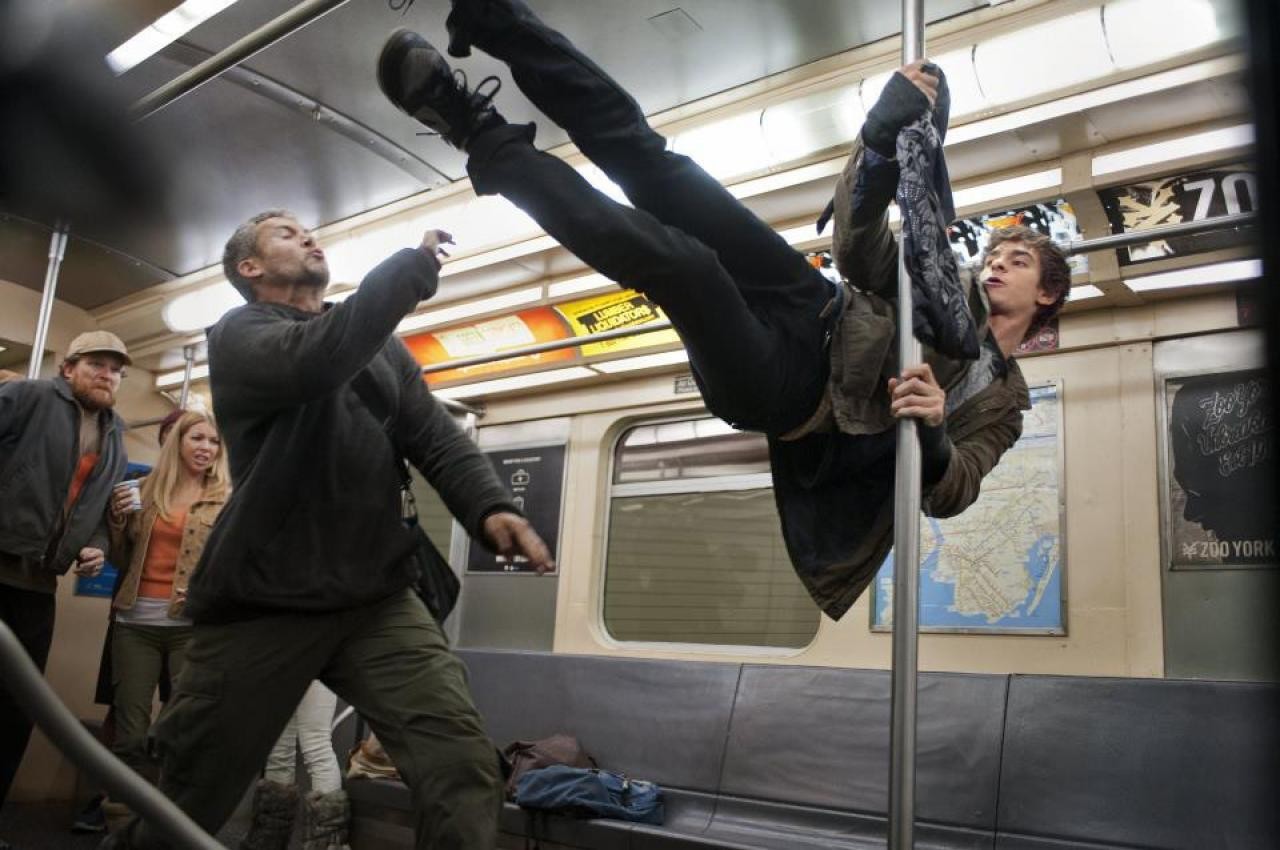
What's also different and good is how everybody's perfected the formula, including director Marc Webb (who made the, to me, extraordinarily fine (500) Days of Summer): Garfield's Parker is more in line with the comic character, mood-swinging as well as web-slinging, and his Parker is awkward, stammering, frequently inarticulate and perceived outwardly as something of a jerk, a simp, or worthless* (hey, wow, they got the character of a misunderstood teenager down), and the fights, which in the past have been rushed and often unfollowable, now flow and, frequently—thanks to CGI—in one continuous shot that swoops, loops and parallels Spider-man's flight patterns.  The pace is still there, but thanks to stunt arranger and second-unit director Vic Armstrong (a few of the Bonds and Indiana Jones), it's not all a blur.  Also, under Raimi, some of these fights were brutal and sadistic, and, don't get me wrong, these are no less savage, and take more of a toll on the participants.**  But the desperation is there, and the "wrong-ness" of the abuse of power, which kept my moral compass (or is it "Spidey"-sense?) from peaking out in the red zone.  

So, yes, it's the same story, but more sure-footed (by having its hero less so), and also intriguing for what it might hold in the future.  The first trilogy seemed to be a little wobbly as it went along, searching for story.  This one already feels like it knows where its going, and will find the best and most opportune path to get there.***

The Amazing Spider-man is a Full-Price Ticket.  (I saw it in IMAX 3-D, but it's not really necessary).


* And—a nice touch—he's thin and ungainly, not buffed-out, like the typical "strong-man" super-hero, which is the way he was when Steve Ditko first drew him.  Nice.

** This does bring up something that will be difficult to sustain: Parker is frequently shown battered, bruised, and slashed from these fights, which makes his encounters post-fight with Aunt May a little illogical.  And at some point, when will she clamp down on him, or child-protective services step in? 

*** A couple more things: there's no interpretation of the "Spider-man" theme from the 60's cartoon ("Hey there, there goes the Spider-man!") but James Horner's score is his most inventive in a long time—if a little needlessly bombastic in rare instances; there is a "coda" of sorts, but early in the credits (so you won't be missing anything if you don't stay for the full credit roll); and the Stan Lee cameo actually made me smile and feel affectionate towards the man.  Now, that's amazing.

Tuesday, September 27, 2011

The Help

"The Other Side of the Bridge Club (Insuring Domestic Tranquility)"
or
"You Ought Not to Joke About the Colored Situation"

You go into The Help with a certain amount of trepidation.  Will it be so politically correct as to have no bite?  Will it be a "TWGSTD" movie, where the true story of the oppresssed is supplanted by "the drama" of a privileged person's conscience to help?* Will it be a Neapolitan "Chick-Flick," all sugary ice cream of different flavors and colors?  We've seen plenty of those, and one would hope that we've evolved out of our tribalism enough that film-makers—even commercial film-makers—hedge their story by surrounding the center with white-washing vanilla.**

Stanley Kramer, after all, has been dead for ten years.

With The Help, it's a hesitant answer of "Yes" and "No."  "Yes," the story has elements of "White Guilt" saves the day, but only in the short term, and said Guilty Party, Eugenia "Skeeter" Phelan (known as "Long-Haul" to her high school friends for actually attending and graduating college and pursuing a journalism "job," rather than settling for domestic tranquility) may have a sense of accomplishment, but it costs her.  And the issue of "You think you're gonna help us?" is very pointedly brought up by the character of Minny Jackson (played by her real-life inspiration, Octavia Spencer, in an excellent performance).  Say it, sister.  Nice touch of dignity, that. 

Young Miss "Skeeter" (Emma Stone), is ambitious, as are all the white women in the segregated community of Jackson, Mississippi; her ambitions don't center around who throws the nicest bridge club setting (or has it thrown for them), or making a name for herself preserving the traditions of The South.  She wants to be a journalist, which, given the times, relegates her to ghosting a "best-bleach-for-the-sheets" column for the local newspaper.  But, gnawing at her no. 2 pencil is what happened to the woman who raised her as a child.  No, not mother Charlotte (Allison Janney, who tends to periodically rise above her material), but the house-servant, Constantine Jefferson (the always wonderful Cicely Tyson—I've missed her), who accepted and applauded her graceless duckling ways in a city of debu-taunting swans, and who disappeared while she was away at college, never to return.  The vacancy of Constantine and her story inspires her to talk to the "help" about their stories, and how they maintain during their domestic servitude.  Fearing a backlash from amongst the womens' society, she initially only gets to talk to a reluctant Aibileen Clark (Viola Davis, whose movie this is**), who tells her of her early days and of her family's molasses-like progress from house-"slaves" to house-"servants."

It involves the telling of tales on the pastel and flower-printed white woman she works for, a friend of "Skeeter's" (Anna Camp) and of the Red Queen of the Bridge set, Miss Hilly Holbrook (Bryce Dallas Howard, a subtle, ethereal actress, allowed to go "broadly comic," which, as when Meryl Streep does it, is not pretty).*** Set about the time of the Medgar Evers murder, where any sort of racial consciousness-raising was cracked down upon by Jackson police and strict curfews enforced, The Help has a tendency to overlook the more serious event in the timeline of its narrative, veering more towards comedy in Tate Taylor's adaptation (Taylor is a lifelong friend of novelist Kathryn Stockett's and acquired the rights to her novel before publication), but there is enough genuine tension in scenes of servants trying to get home by curfew, that the plight of the women in the serving class, and the genuine danger they faced in up-braiding their employers, and the structure imposed on them, simmers under the surface.  Even in the face of somewhat trivially humiliating comeuppance, any sense of triumphant table-turning seems negligible against the long road to some sense of justice, however piddling (though entertainingly apt to provide a shit-eating grin) those small victories might be. 

As such, The Help, like those small victories, is a measured success.

(And I appreciated the handy list of uses for Crisco).

The Help is a Matinee.


* "The White Guy Saves The Day," ala "Robinson Crusoe," Dances with Wolves, Glory, Guess Who's Coming to Dinner, Mississippi Burning, The Last Samurai, Avatar, heck, even "Transformers"...

** The closest it comes to teetering over the edge is in a sub-plot of an ostracized Southern belle from the other side of the tracks (played by Jessica Chastain), who embodies a white version of Southern social stigma, and, in a reverse of the normal Hollywood strategy of "white moves first," is shown "the ropes" by one of "the help," an act that becomes mutually beneficial.

*** Octavia Spencer is a real "find" here and a shoo-in to get a Best Supporting Actress nomination come Oscar season, but I hope that Academy voters will also give a Best Actress nod to Davis, whose tremulous fire in her role would make it her second nomination in three years—her first being Doubt, in which her one-speech scene managed to outshine Meryl Streep, Amy Adams and Philip Seymour Hoffman.

**** As if this embarrassment of acting riches wasn't enough, Miss Hilly's mother is played by Sissy Spacek, who continues to play ordinary roles in a most extraordinary way.


Tuesday, August 23, 2011

Crazy, Stupid, Love

"Love Sucks (A Cautionary Tale)"
or
"It Takes a Village (To Make a Divorce)"

The sad thing about romantic-comedies, circa the 21st Century, is their dependence on formula: Boy Meets Girl/Boy Loses Girl/Complications Ensue/Boy Wises Up/Happy Ending; or Girl Meets Boy/Girl Loses Boy/Girl's Self-Worth Depends on Boy/Romantic Rival Meets Terrible Demise/Happy Ending (of a sorts).  The last few I've seen of the genre have depended on hitting these plot-points, no matter what city, what occupation, or what sex the film centers around.  Even Bridesmaids, for all its wit and wildness, still ended with the assumption that everything will be alright if "the girl" gets "a man." The "by-the numbers" dance steps that most rom-coms boogie to have the ability to regress me back to the five-year old boy I was who hated "kissing scenes;" the final rosy fade-out inevitably spoils the most romantic of comedies for me, failing to warm my the cockles of my heart or make me feel all-gooey-fuzzy.  Instead, I walk away cheerlessly cynical.  Been there.  Done that.  A fish needs a bicycle.


So, it's a nice surprise, bordering on the revolutionary, when a romantic-comedy turns the formula on its ear enough that I enjoy it.  Don't get me wrong, Crazy, Stupid, Love* has a "happy ending," but there is also a nice glowing lack of resolution.  This is a movie that dares to say that Love is hard work, and, yeah, it sucks, but it could be worth it, because, like Life, it beats the alternative.

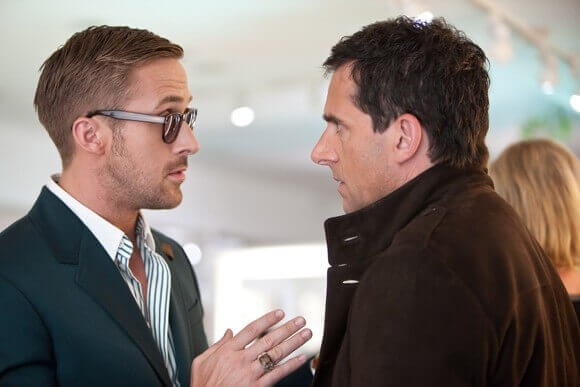
This is not where it starts, but where it starts to get interesting: Chick-magnet Jacob (Ryan Gosling,** he has a nicely subtle double-take for comedy) is in a bar in mid-closer with his latest fling when he takes the time to call over a half-stewed Cal Weaver (Steve Carell, showing exactly why he deserves to be out of TV and in films, something that doesn't happen nearly enough).  The reason?  Cal's moaning is throwing off Jacob's technique.  Cal's been doing that a lot lately (at the office he's told: "Amy heard you crying in the bathroom - we all thought it was cancer.") No, it's not cancer.  After 25 years of marriage, Cal's wife (Julianne Mooreshe's great) has revealed she wants a divorce AND she's slept with another man (Kevin Bacon, he's also great).  This offends Jacob's self-absorbed sensibilities: "Seriously, I don't know whether to help you or euthanize you."

So, Jacob helps Cal to "man up"a younger "Obi-Wan" to the elder's bowl-cut Luke with credit cards as lightsabers, and this, if not turning Cal's life around, at least making it busierAnd complicated.

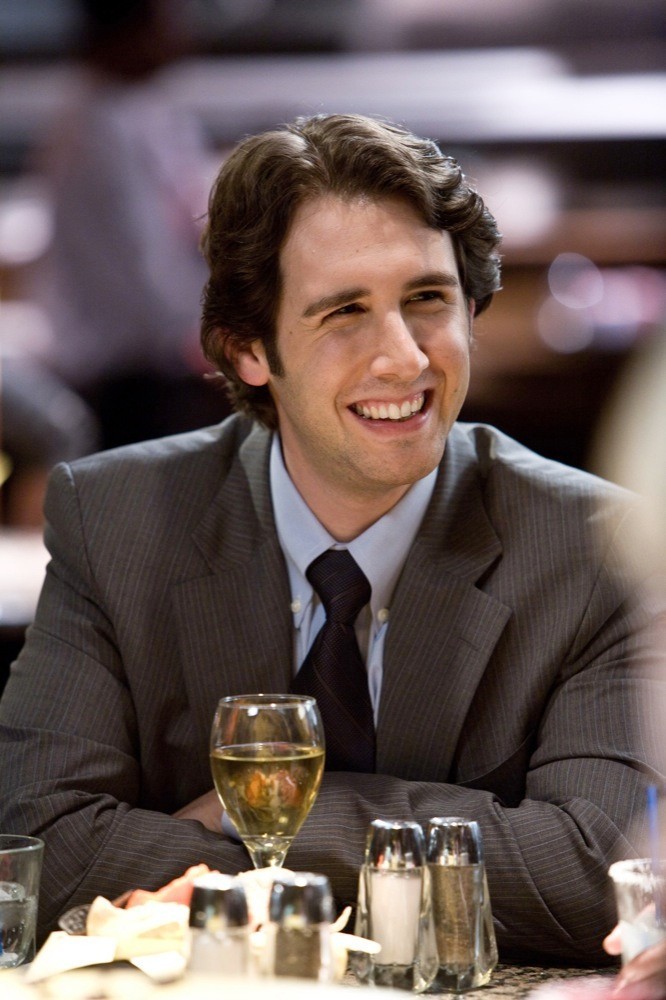
Running parallel to the story is Hannah's (Emma Stone, big-eyed waif) relationship problems ("You're life is so PG-13!" says her token-Asian friend, Liz).  That's because she wants to be engaged to office co-worker Richard (Josh Grobanrather risky of him to look so bad in this movie) and is focused on that, so much so that she plays ignorant to Jacob's innuendos when he approaches her while trolling in a bar.

And, at this point, to say anything more would be saying too much, spoiling the fun and sending the whole Jenga-construction of the film crashing to the rec-room floor (In fact, I've probably said too much already).  Just when you think everything is going as smooth as satin sheets, the film-makers throw you an extra wrinkle, and it's been a log, long while since a rom-com has done that.  The dialogue is fresh though the situations seem familiar—everyone's conceptions of Love and Romance seem to be based on The Movies and directors Glenn Ficarra and John Requa *** and writer Dan Fogelman **** are only too happy to skewer them, while paying some respect—the complications teetering on the sit-comish, then resolving with the most graceless of dismounts.  Applaud anyway because if they're not the best of executions (the performances help here), there are extra points for "artistic" and "difficulty."

Adding to the fray are the effects all this confusion have on "the kids" (Jonah Bobo, Joey King) and the friends (John Carroll Lynchhe's becoming one of my favorite character actors—and Analeigh Tipton).  It, after all, takes a village to make a divorce...very uncomfortable.  And special mention should be made to the movies' best utility player, Marisa Tomei, who surprises with just about every performance these days (Okay, okay, Marisa, you DESERVED that Oscar, okay?).

Highly enjoyable.  Bravo.

Stupid, Crazy, Love is a Full-Price Ticket.

* Yes, it has the superfluous comma, you English Majors, but if you see the title as a list rather than "adverb, adjective, subject," it makes a bit of sense, and the film actually earns the charity for considering the possibility. 

** Gosling is an odd bird.  It's taken awhile for me to warm to him (I'm one of the few people to have seen his awful work in Fracture, but he has a nice laid-back dead-pan style of comedy—as displayed in Lars and the Real Girl—that hews closely to his dramatic work.  Just a nudge, either way determines comedy or tragedy.  He's dangerously good.

*** Okay, this is scary, but hear me out: Ficarra and Requa have written such films as the remake of Bad News Bears, Cats & Dogs, Bad Santa (a bit raw, but actually rather sweet) and...wrote and directed the little seen gay romance, I Love You Phillip Morris—as subversive and weirdly sweet movies to be seen in a long time.  Forgive the early credits—these guys are good.

**** Okay, now REALLY hear me out: Fogelman wrote the screenplay for Cars and the screen-story for Cars 2, wrote Fred Claus...but did fine work on both Bolt and Tangled for Disney.  Seems he can write for real people, too, and not just 'toons.