 "The Other Side of the Bridge Club (Insuring Domestic Tranquility)"
or
"You Ought Not to Joke About the Colored Situation"
You go into The Help with a certain amount of trepidation. Will it be so politically correct as to have no bite? Will it be a "TWGSTD" movie, where the true story of the oppresssed is supplanted by "the drama" of a privileged person's conscience to help?* Will it be a Neapolitan "Chick-Flick," all sugary ice cream of different flavors and colors? We've seen plenty of those, and one would hope that we've evolved out of our tribalism enough that film-makers—even commercial film-makers—hedge their story by surrounding the center with white-washing vanilla.**
Stanley Kramer, after all, has been dead for ten years.
With The Help, it's a hesitant answer of "Yes" and "No." "Yes," the story has elements of "White Guilt" saves the day, but only in the short term, and said Guilty Party, Eugenia "Skeeter" Phelan (known as "Long-Haul" to her high school friends for actually attending and graduating college and pursuing a journalism "job," rather than settling for domestic tranquility) may have a sense of accomplishment, but it costs her. And the issue of "You think you're gonna help us?" is very pointedly brought up by the character of Minny Jackson (played by her real-life inspiration, Octavia Spencer, in an excellent performance). Say it, sister. Nice touch of dignity, that.
Young Miss "Skeeter" (Emma Stone), is ambitious, as are all the white women in the segregated community of Jackson, Mississippi; her ambitions don't center around who throws the nicest bridge club setting (or has it thrown for them), or making a name for herself preserving the traditions of The South. She wants to be a journalist, which, given the times, relegates her to ghosting a "best-bleach-for-the-sheets" column for the local newspaper. But, gnawing at her no. 2 pencil is what happened to the woman who raised her as a child. No, not mother Charlotte (Allison Janney, who tends to periodically rise above her material), but the house-servant, Constantine Jefferson (the always wonderful Cicely Tyson—I've missed her), who accepted and applauded her graceless duckling ways in a city of debu-taunting swans, and who disappeared while she was away at college, never to return. The vacancy of Constantine and her story inspires her to talk to the "help" about their stories, and how they maintain during their domestic servitude. Fearing a backlash from amongst the womens' society, she initially only gets to talk to a reluctant Aibileen Clark (Viola Davis, whose movie this is**), who tells her of her early days and of her family's molasses-like progress from house-"slaves" to house-"servants."
It involves the telling of tales on the pastel and flower-printed white woman she works for, a friend of "Skeeter's" (Anna Camp) and of the Red Queen of the Bridge set, Miss Hilly Holbrook (Bryce Dallas Howard, a subtle, ethereal actress, allowed to go "broadly comic," which, as when Meryl Streep does it, is not pretty).*** Set about the time of the Medgar Evers murder, where any sort of racial consciousness-raising was cracked down upon by Jackson police and strict curfews enforced, The Help has a tendency to overlook the more serious event in the timeline of its narrative, veering more towards comedy in Tate Taylor's adaptation (Taylor is a lifelong friend of novelist Kathryn Stockett's and acquired the rights to her novel before publication), but there is enough genuine tension in scenes of servants trying to get home by curfew, that the plight of the women in the serving class, and the genuine danger they faced in up-braiding their employers, and the structure imposed on them, simmers under the surface. Even in the face of somewhat trivially humiliating comeuppance, any sense of triumphant table-turning seems negligible against the long road to some sense of justice, however piddling (though entertainingly apt to provide a shit-eating grin) those small victories might be.
As such, The Help, like those small victories, is a measured success.
(And I appreciated the handy list of uses for Crisco).
The Help is a Matinee.
* "The White Guy Saves The Day," ala "Robinson Crusoe," Dances with Wolves, Glory, Guess Who's Coming to Dinner, Mississippi Burning, The Last Samurai, Avatar, heck, even "Transformers"...
** The closest it comes to teetering over the edge is in a sub-plot of an ostracized Southern belle from the other side of the tracks (played by Jessica Chastain), who embodies a white version of Southern social stigma, and, in a reverse of the normal Hollywood strategy of "white moves first," is shown "the ropes" by one of "the help," an act that becomes mutually beneficial.
*** Octavia Spencer is a real "find" here and a shoo-in to get a Best Supporting Actress nomination come Oscar season, but I hope that Academy voters will also give a Best Actress nod to Davis, whose tremulous fire in her role would make it her second nomination in three years—her first being Doubt, in which her one-speech scene managed to outshine Meryl Streep, Amy Adams and Philip Seymour Hoffman.
**** As if this embarrassment of acting riches wasn't enough, Miss Hilly's mother is played by Sissy Spacek, who continues to play ordinary roles in a most extraordinary way.
Tuesday, September 27, 2011
The Help


Saturday, October 23, 2010
Hereafter

"The Sweet Hereafter"
I had a friend who disappeared for awhile, and when we made contact again after too long, he had an odd explanation: he'd become psychic, able to read people's thoughts, completely unbidden and unasked for, crowding in with his own, and had undergone a battery of tests to see if he was losing his mind. He hadn't, as much as gaining insight into other people's. For awhile he found ways to exploit his ability, writing a column, diagnosing illnesses (he claimed to be very accurate) and making a living as a working seer. But, he gave it up. It was too painful for him, and his clients were too needy...pathetic, even. Life is complicated enough in one's own mind to be peeping through the windows of others'. I don't know whether I absolutely believe him (I'm as psychic as a block of wood, and he was a writer), but his observations were so ironically down to Earth—"Oh, man!" he told me one time, "Ghosts are ASSHOLES! Why don't they just move ON?"—that I just accepted his stories, while keeping any true belief in check. He was my friend. I supported him.
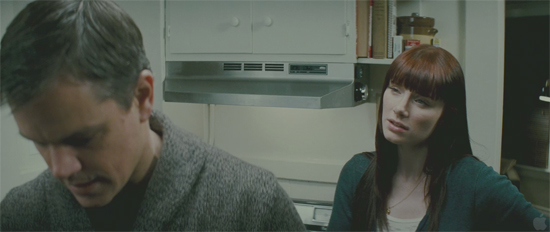
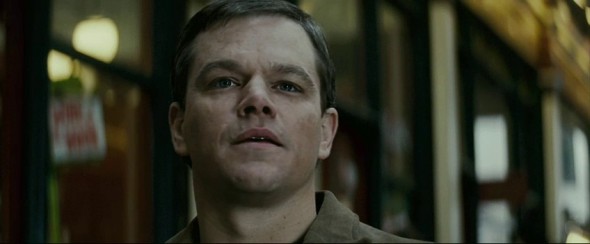
George Lonegan (Matt Damon) wears gloves. Childhood circumstances and medical complications damn near killed him and left him handicapped—all he need do is touch someone, "make a connection," and he is jerked back to an old haunt, the "white corridor" of light that is the foyer of Death. He's been there before, many times, but the touch of an individual's hand takes him to the spirits of the recently deceased of that particular person's past, so that he may pass on their thoughts to those left behind. He wears gloves, so he can avoid these encounters. But he can't avoid the grieving. He used to be a working psychic, ("Look, I don't even DO that anymore." he consistently tells the persistently bereaved*), but he gave it up, despite the imploring of his exploitative brother, Billy (Jay Mohr, toned down and playing a recognizable human being). "You've got a gift!" he is told. "It's not a gift! It's a curse!" Now he works, driving forklift at a sugar warehouse in San Francisco, a "normal" occupation that might lead to a "normal" life. That is his wish. Life, not Death.
My psychic friend's story is highly reminiscent of Lonegan's (nice name, that) in Hereafter, Clint Eastwood's film of an original screenplay by The Queen scribe Peter Morgan. Morgan's subjects are fairly factual, so it's surprising to see him venture into the nether-territory of Bruce Joel Rubin (Jacob's Ladder, Ghost). But, he places it in the here and now, our world where Death can come specifically from all realms, natural and unnatural. The film begins with a spectacular effects sequence recalling the horrific tsunami in Thailand,** that viscerally places the audience into such a disaster. But that is only the beginning. It is what comes after—the surviving of such an extreme occurrence, the coming back from it—that is the subject of the film. How, after Death has touched us, can we go back to a normal life...when what awaits us, normally, is our own ending? How can we live while still grieving?
I called them "The Death Tapes." I have no idea who has them now, I passed all the copies I had to friends who were interested (and who isn't?). I did a recording session that was being used for publicity purposes for a fairly terrible Joel Schumacher pot-boiler called Flatliners, about morbid medical students experimenting with near-death experiences—it is typical hyperventilating Hollywood exploitation—all chases and races-against-time, whereas this Morgan-Eastwood film is intriguingly commonplace. The interviewees were all people who had had NDE's; they'd died, and were pulled back to the land of the living. They were from all walks of life—one woman had been electrocuted in a television studio, another was a Vietnam vet who'd been mortally wounded in a mortar attack. The particulars of how they'd gotten there were all different, but their itineraries were all the same. They'd gone to a corridor of pure white light, where they were met with spirits of their past, and informed, questioned about their circumstances and released back to life. They'd all been significantly changed by their experiences, but in different ways, as Death was no longer the terrifying unknowable it had once been. Been there. Done that. The woman had been yanked back through no choice of her own, through the efforts of EMT's in the studio. The soldier had volunteered to come back, in a way. Asked in that blinding corridor if there was any reason for him to go back, he implored the Voice, "I want to see my son!" which is significant for the detail—he knew his wife was pregnant, but there was no way to know the sex of the child in those years before ultra-sound (Sure, it was a 50/50 chance, but...still...). An expert (as much as one still breathing can be of such things) talked about children who'd gone through "the process" and other adults, speculating that, perhaps, it could be some spasming electrical processes of self-preservation. But the stories were so similar—the same corridor, the after-life "concierge," the specifically relevant memories of the deceased (and not the living—would a brain going through synaptic anarchy be so choosy?)—combine that with the myths of "pearly gates" and exit-interviews with St. Peter, and it becomes disquietingly consistent. Yes, we have the same meat in our brains, but chemically, we all have our own brand of soup. So, then, would everybody see it the same way? Don't know. And we won't know. Not until we "see the light."
The people left behind—in both senses of the experience—(Richard Kind, Bryce Dallas Howard—a brunette, this time—Frankie McLaren, Cécile De France) are changed by the brush with death, but they all have the same goal—a "normal" life, or what passes for normal given the knowledge of extinction. But as that is something that unites us all, players and audience alike, isn't that "normal?"
It all sounds terribly depressing, doesn't it? But it isn't. There are moments of high drama to be sure, but moments of levity, as well. Rather than a dark and morose drama befitting the Hallowe'en season, it ultimately has the feeling more of a star-crossed romance. And Eastwood, who has been known to denature the color palette of his pictures, particularly in Letters from Iwo Jima and Changeling, returns to a more vivid color scheme here, as if to present life in all the glories of luminous sunrises and sunsets. Those looking for a spook-show, like the poor, unsure desperates who crowd the emporiums of the medium-charlatans in the film, should look elsewhere for signs of the occult, or speculation about what it all means.
Eastwood's movie gives us no definitive answers—Hereafter never crosses the threshold into Shakespeare's "undiscovered country," that final frontier we must all travel, the journey of the spirit taking flight unbound by the physical restraints of life, our mortal coil. It remains solidly in the realm of the comfortingly tactile, and concludes with a smile, a touch—simple, normal acts of being, that stave off the nullifying black and the welcoming light.
Hereafter is a Full-Price Ticket
* The script by Morgan (The Queen, Frost/Nixon, The Damned United, The Last King of Scotland) is extraordinarily precise in its use of words...in English and French (there are subtitles...Eastwood, who directed the all-Japanese Letters from Iwo Jima isn't afraid of them), and quickly you pick up that, more than usual, he uses specific ones, over and over, that tie his characters together...almost like they were a mantra.
** This sequence is exploited in the trailers and advertising for the movie, making it seem like it's a 2012 disaster-like "entertainment." But, if I can be allowed a SPOILER-like caution, don't be fooled. This sequence...and another jolting one that recalls an arbitrary terrorist attack...are merely means to an end. The story is about recovery of such incidents, and in living a life of hope, despite the common glimpses through the opening of Death's Door.






Tuesday, July 6, 2010
The Twilight Saga: Eclipse
 "Okay, Enough With the Heavy" ("Decisions, Decisions")
When last we left the increasingly soapish "Twilight" saga, vampire Edward Cullen (Robert Pattinson) had just popped the question to Bella Swan (Kristen Stewart)—the "marriage" question, not the "can I rip your throat open and suck your blood" question. That this one ends with her "coming out" and wearing his ring would indicates that the series might be moving at a TV-soap opera's glacial pace, where you only had to watch the Friday episodes to see the plot advance and miss out on the week's worth of "discussion" episodes.
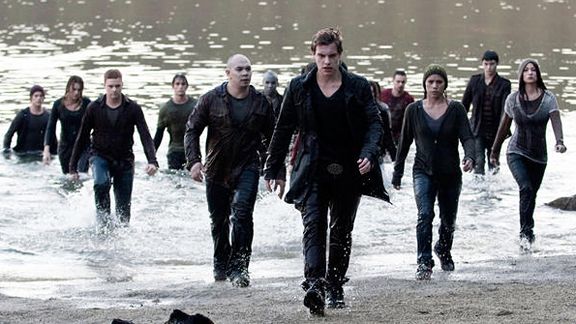
Not true, really. Quite a bit happens in "Eclipse:" the "Victoria's Revenge" plot-line comes to a head; the kids graduate from high-school; there's a war between the Cullens and the "Newborn"—a clutch of newly initiated vampires with a more-than-natural blood-lust; there's an endless "Team Edward"/"Team Jacob" back-and-forth; the cementing of "Bella Mandella" as a catalyst for "Cold Ones"/Quileute co-existence; the Volturi rears its ugly head, appearing to be the real threat to eternal peace and quiet; and it appears that "Twilight" saga author Stephanie Meyer might have stepped back and considered what it was she was writing.
Because with "Eclipse," it becomes clear that Meyer isn't "just" writing a teen-horror "weepie" (although she is!), she's also writing a story about young people choosing their path in life...or after-life. Suddenly, Bella's quest becomes more focused and it becomes less about her being a damsel in distress bounced from one cult to another, and more of her exercising her choice. That it is painful and has consequences just enhances the importance of it (aren't all life-choices?), and in a couple of badly needed fleshings-out of some of the Cullen coven's back-stories, it is made clear that she's lucky to even have that choice.
It's the best of the "Twilight" movies (so far), which started out abysmally, got better under Chris Weitz's direction, and now has a nice kinetic veneer from "30 Days of Night" director David Slade. Slade does everybody one better the way he handles this one—the action sequences are full of momentum that still can be followed (there's a rip-snorting battle between Team Cullen, with the begrudging aid of the Quileute werewolf pack, and the Newborn that has rips and snorts aplenty) and Slade even manages to include moments of lyricism that nobody has bothered to use, yet. An early scene has Edward and Bella ostensibly studying for an English final in a bucolic sun-dappled field of flowers. A close-up of their faces reveals not the "sparkly-diamond" effect on Edward's face (which has always looked a little stupid), but rather it reflecting a pattern on hers. Now, that's the way it should be done. And that they're sitting in a field of wildflowers suddenly and metaphorically places their romance in a natural context: from death and decay, life will grow—Bella and Edward are as natural as flowers and dirt. Nice.
This one does a whole lot of things well. There's a great chase sequence near the beginning, which is a terrific primer on action directing—it reminds one of the "speeder-bike" sequence in "Return of the Jedi," only done better. An uneasy sequence with the love triangle in a freezing tent, gives the boys a chance to play off someone other than Stewart, and they both do fine, subtle work without losing any of their characters' malevolence for each other. Edward's character is no longer a sulking simp' he was in "New Moon," and even dashes off a good humorous line or two (he gets the film's biggest laugh, sneering at Taylor Lautner's six-pack: "Doesn't he own a shirt?"),* Lautner is a little iffy here, doing good work when being aggressively challenging, but not so much when called on to be "intense," and Stewart isn't required to do all the heavy lifting this time, as many of the Cullen's back-stories are allowed out in the daylight, providing Ashley Greene's Alice, Nikki Reed's Rosalie and especially Jackson Rathbone's Jasper moments to shine. Rathbone has been reduced to wall-paper in the past movies, but, here, he's subtle, intense...and very interesting...a long-suppressed Southern accent creeping into his words every so often. He shows how this "teen-vampire" shtick should be done (Now if they'd just do something with the wonderful Elizabeth Reaser ("Ma" Cullen), I'd be happy). The series also improves itself by casting Bryce Dallas Howard, who does brief, fine work as the revenge-driven Victoria, and getting a score by the gifted Howard Shore.
It's hooey, of course—high-blown romantic purple-prose in teen-speak with an injection of morosely doomed monster self-pity. But, it's becoming increasingly well-packaged and more sharply defined, and, as I said, Meyer has done her homework and figured out what the monster she created really is. As much as I want to dismiss the "Twilight" series, I acknowledge that this is one of the few multi-part stories that has improved as its rolled along, rather than snowballing into more gigantically leaden productions (Hello...Potter). Partially, it's that the directors have gotten better as the series has raked in the cash, but also the film-makers have found ways to streamline Meyer's excesses, while giving her and the audience exactly what they want. While not exactly a valedictorian, it certainly gets some award for "most improved student."
"The Twilight Saga: Eclipse" doesn't suck. It's a Rental.
* I still don't "buy" the Edward character, as he's written as a love-sick moon-calf, rather than a being that's lived a couple centuries. "Old school" he may be, but he has the thought processes of a teen-ager. Dramatically appropriate for its audience, maybe, but someone who's lived as long as he has would probably be a bit smarter and more mature.




.JPG)





Saturday, May 23, 2009
Terminator Salvation
 "MOVE ON. (CYB)ORG"
"Everyone deserves a second chance," is the lesson of "Terminator Salvation."
They didn't, however, say anything about a fourth.
"The Terminator," of course, was the first low-budget, high-concept success of James Cameron. It launched Cameron's career, and made a star of Arnold Schwarzenegger. The sequel—"Terminator 2: Judgment Day" was an amazing recapitulation and expansion of themes, offered amazing stunt-work, cutting edge computer effects and was, if anything, even more entertaining than the first film. At the time, the most expensive film ever made, it still managed to make a healthy profit for its makers. You couldn't kill these Terminator things.
But while Cameron expanded his horizons and Schwarzenegger became a super-star, no more "Terminator" movies were made. Cameron seemed no longer interested (although he and Schwarzenegger teamed up for the clunky spy flick "True Lies").
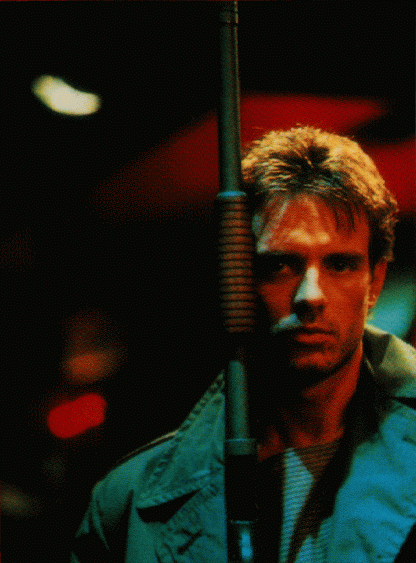
I didn't see "Terminator 3: Rise of the Machines" (which featured Schwarzenegger's final Termination before launching his political career), but the current one is helmed by the worst director extant—McG—who, like a lot of today's directors would be hard-pressed to direct a movie if his camera couldn't move, and whose "Charlie's Angels" movies were not-very-funny bimbo-fications that barely held together (actually they didn't hold together). Surprisingly, he manages to maintain a fairly straight tone for this fourth "Terminator" film, which focuses on the humans' battles against Skynet with an adult John Connor (Christian Bale).
"Terminator Salvation." They should have called it "Terminator Salvage," as most of the good ideas have been used and are recycled into a feature length version of every visualization of those battles (complete with requisite skull-crushing underfoot) seen in the previous films.*
But, look at the cast, like Cameron's original design a mix of A-list and B-movie actors: Bale,** Michael Ironside, Bryce Dallas Howard, Anton Yelchin (the new "Star Trek" Chekhov plays a teen-age Kyle Reese, the character originally played by Michael Biehn), even Jane Alexander and Helena Bonham Carter (in a brief but effectively creepy role). Also Sam Worthington—who started filming James Cameron's "Avatar" awhile ago (quite awhile ago).
Wish they had something better to do. The plot is a demolition derby of past "Terminator" hits mixed with "The Road Warrior" and a "Transformers" movie. One expected to see Hasbro in the producing credits, as the only thing new in this are toy-exploitable "Terminator" creations: Terminator motorcycles, mighty-morphin' prison ships with separate pilots (why would robot-ships need pilots?), and underwater T's, I guess you could call them "Termi-gators." Plus, there's an older model that makes a computer-generated "guest" appearance. There's some plot-holes you could transport T-800's through over why some things, like explosions, will bring on Skynet attention, but a major fire-fight (with flares) amongst humans does not. And for all the technical wizardry on display, you can see the cinematic seams showing when cutting away from a post-apocalyptic setting to the green-screened CG expansion.
Things blow up "real good," the usual things are not what they seem, and, as per usual, the whole thing climaxes in a claustrophobic industrial setting.*** It's the same elements as before, just re-assembled in another order...if that. An entirely superfluous "further adventure" is hinted at, but one hopes they don't bother and just scrap this franchise.
James Cameron has moved on—to "Titanic" and the upcoming "Avatar." And Arnold Schwarzenegger has moved on, as well.
Maybe we should, too.
"Move along. Nothin' to see here." "Terminator Salvation" is a rust-encrusted Rental.
* Well, you could say the original was recycled, as well. A court ordered that a sum be paid and that acknowledgement be made to Harlan Ellison as "Terminator" more than resembled his "Outer Limits" episodes "Soldier" and "Demon with a Glass Hand." I didn't see him mentioned in the credits for this movie. Hopefully, he saw some cash (Come to think of it, I didn't see Cameron's name, either).
"Salvation" does introduce a new angle to its franchise—but it, too, is a well-worn cliche of science fiction and super-hero magazines.
** Bale uses a variation of his deep-Batman voice throughout, which I thought was just an affectation when I realized that Michael Ironside—and practically everybody—is talking in a husky rasp.
*** After 30 minutes, I began thinking "Hey! Where's the requisite beating-up of dirt-bags?"
Patience, patience...it showed up half an hour later.






Tuesday, June 3, 2008
As You Like It
 hot or cold--his "Henry V" and "Hamlet" and "Dead Again" being good, and over-heated messes like his version of "Frankenstein" and 2007's "Sleuth" being where he just can't manage the material, or, in an attempt to light them up a bit, he starts being a bit too fusty with them, bringing in a swooping camera amid histrionic performances. Those are the Branagh movies where you want to grab him by his ascot and say, "why don't we call it a night, let everyone get some sleep and think things over."
Monday, January 14, 2008
Spiderman 3
 Oh, What a Tangled Web We Weave....
I’ve always taken a jaundiced view of the Marveltm superheroes tm as opposed to the DCtm variety. Where the spandex crowd from Detective Comicstm sprang from pulps and adventure fiction, Marvel’s were derived from Stan Lee’stm previous job--writing romance comics. Back when I picked up the occasional Marvel in the 60’s it was always apparent that they were soap operas with fights, and that it was only a short spidey-jump from “*SOB!* I forgot to have children!” to “*SOB!* I will be Spiderman…No More!” The Marvel Superheroestm are drama-queenstm. This was never more apparent than the ending of the first “Spidermantm” movie when Peter Parkertm walks away from the girl who’s just professed her love to him (and in a graveyard *SOB!*), because “with great power comes great responsibilitytm-okay I'll stop”(as with the soaps, this sentiment lasted until the next movie, which ended with them together—I guess responsibility ain’t so great, after all). “Spiderman” was a soap opera punctuated by brutal, ugly fist-fights (which don’t look so cool when not freeze-framed in pop-art patterns) I vividly recall reading the geek-reviews saying “Spiderman” is just like US!” Ri-ight. I’ll bet they didn’t have two gorgeous co-eds fighting over them in high school, as the comics character did. Where that movie worked was “Spidey” in action—especially in the ending where the camera followed him morphing into so many iconic poses favored by various artists over the years—Ditko, Romita, Kane, Andru, McFarlane. There, the true potential of a movie “Spiderman” paid off.
So, when the second movie, combining “Doc Ock/Spiderman…No More!/Mary Jane’s getting hitched,” came out, the screenplay (co-written by Alvin Sargent and Michael Chabon) practically sang. It was a perfect balance between character/melodrama/action and spectacle. In fact, “Spiderman II” is probably the best comic-book movie ever…and the most enjoyable since the first “Superman.” With the creators knowing what worked now, one anticipated “Spiderman III.”
Now, here it is—the most expensive movie ever made (supplanting even “Superman Returns”**) and what does it show for all that money being thrown around? A bit, actually. The cast is uniformly good given the material with James Franco finally relaxing and having fun with his role as Harry Osborne. Thomas Hayden Church takes his role as The Sandman VERY seriously—he acts like he’s in an Ibsen play—though the most effective performance is by the “Particle-Matter Generator” Gizmo that created the sequence of him first emerging and pulling himself together. Topher Grace makes the most of his non-CGI moments as Eddie Brock/Venom. And Bryce Dallas Howard (Opie’s kid), after looking like something the cat dragged in for M. Night Shamyalan’s movies, cleans up very nicely as Gwen Stacy, as that essential character of the comics finally shows up.*
There are welcome returns (from the grave, flashback-style) of Cliff Robertson and Willem Dafoe, and J.K. Simmons proves once again he’s the perfect embodiment of Daily Bugle Editor J. Jonah Jameson.
Now, for Tobey McGuire and Kirsten Dunst, here's the problem. For the third in the series the writers were obviously looking for something interesting for the two leads to do. "We'd left them in No.2 happily in love. So....let's shake that up a bit." In this one Peter is going bad (didn't Superman do that in his third movie?) and "MJ" is hitting acreer set-backs to star-dom. Spiderman's popularity is up, while hers is down. Wasn't this "A Star is Born?" Only Tobey is Judy Garland, and Kirsten is James Mason. Getting kinda sudsy there, isn't it? McGuire is allowed to cut loose as "Bad Peter" (under the influence of a "symbiote"--that's how they say it--from outer space. Kirsten Dunst gets to sing in an opening sequence that Sam Raimi stages like its right out of MGM. There are some great fights (some of them are more...dust-ups) that lacked the zanily ferocious wit of the ones in II, go on too long, and are marred by some too-intricate camera-work (or camera simulation) for the sake of too-intricate camera work. Finalley, the whole thing ends in another "Spidey's Gotta Save MJ" grudge-match with the web-head up against Sandman, Venom and Son-of-The-Goblin. It far overstays its welcome and ends in what seems like an interminable wallow.
Anything else wrong? YEAH! Too much Stan Lee screen-time! Stan's cameos are getting longer and longer to the point where he might as well have a running character as a street-sermonizer. Stan! Y'know that phrase "'Nuff said?" Mean it next time!! Oh! And have we managed to get EVERY member of Sam Raimi's family on-screen yet? Next movie, Spidey's going to be fighting The Nepotist!
There's an awful lot to enjoy in fits and starts, but you have to be a certifiable card-carrying true-believer to be completely satisfied with this movie. It's a case of the film-makers throwing as much webbing as they can on-screen and seeing what sticks. Unfortunately, not much. What was promising to be the best comics franchise in movies is making the same mistakes as all the others: Too many villains, too much "business" and "busy-ness," and not enough care for the strengths of the characters and what has been done before. They've attempted too much and accomplished too little...while spending as much money as possible.
"Nuff said.
"Spiderman 3" is a rental, and no, you're not going to miss any details on the small-screen--everything's moving so fast you can't see it on the BIG screen either--not even IMAX!
*Curiously, the two women’s roles are completely reversed in the translation from the comics to the screen. In the comics, Gwen is the sincere hometown knockout, while Mary Jane was the flighty supermodel (“Romance” comics, remember? With a little “Archie” thrown in)
** I'm wrong here. Incredibly, the second most expensive movie in history is "X-men 3: The Last Stand." Hell, "X-men 3" didn't even LOOK good!
--------------------------------------------------------------------------
Post-Script: It's always alarming to see how well crap--even well-constructed crap--sells. Now, "Spidey3" is tearing up the box-office with enough momentum that it could very well become one of the "Largest Earning Films in History." In doing some research for an earlier post, I was alarmed to see what is now on the list of the "Big Boffo" films: "Shrek 2" is #3? It wasn't as good as "Shrek 1!" The second "Pirates of the Caribbean?" It was bad--not even fulfilling the promise of the first one, but it's at #6! "Independence Day" at 21? "Narnia" at 24? "Meet the Fockers?" At 29! ("Spidey 3" at the time of this writing is at #33).It's also interesting to note how sequels seem to fare better than the originals--as if their popular momentum has increased (something that might be attributable to more people seeing it initially on home-video than the theater)--certainly "Spiderman 3" bares that out even more than "2" did.
But one can't get too exercised about this: "Norbit" was the top box-office draw one weekend, after all. And as James Aubrey once said: "No one ever went broke under-estimating the intelligence of the American people" (I believe that was right after he green-lit "The Beverly Hillbillies" for CBS).