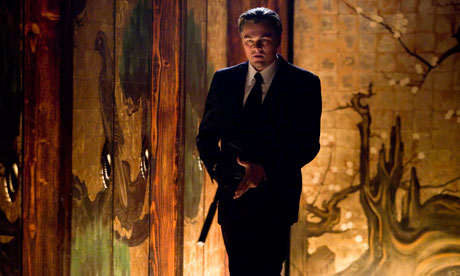
Showing posts with label Leonardo DiCaprio. Show all posts

Wednesday, May 29, 2013

The Great Gatsby (2013)

"Yours in Great Depression" During the Baz Age
or
I'm Half Crazy All for the Love of You....

"There are no second acts in American lives"
F. Scott Fitzgerald

There have been several versions of F. Scott Fitzgerald's Great American Novel that have hit the big screen since the novel was first published in 1925, and nobody seems to get it right, if "right" can be got at all.  There's a "lost" silent version with Warner Baxter, a 1949 version adapted by Richard Maibaum with Alan Ladd, that emphasized Gatsby's gangster roots, the Robert Evans vanity production of 1974 with Robert Redford and Mia Farrow, directed bloodlessly by Jack Clayton.  It's a challenge to produce such a tragedy that has a boisterous first act, and such a downer of a second, but that is what makes it so special, and so American.  In fact, the best version must be taken out of the novel, which was written in the midst of the period in which it was set, and take into account future events—the stock market crash in 1929 and the following "Great Depression," which sounded the death-knell for The Jazz Age with a long sustained flat note.  Fitzgerald's prescient, cautionary novel proved historically accurate with 20/20 foresight to the extent that you cannot make a movie of it unironically, given the past that was its future, and you cannot make a complete movie of it while remaining blind to what it did not foresee in reality, but captured artistically and thematically.

Baz Luhrman's version of The Great Gatsby jumps into that irony with both feet and splashes around in it, kicking and squealing like a child drunk with a secret.  It was a weird decision to film it in 3-D, but given the way Luhrman uses it, in vivid eye-popping colors, emphasizing the swoop of camera moves and the solidness of glass partitions, and the illusion of the reflections shimmering over it—and particularly in how he photographs our last views of East Egg, in a way that rather lovingly visualizes the novel's last line ("So we beat on, boats against the current, borne back ceaselessly into the past")—one begins to wonder any other way to do it.*  In a way, the movie feels like one big "Vertigo zoom" in three-dimensions, starting with an art-deco pattern that falls away to the production company logos and ending with an unfamiliar one—until you see it pop up again in Jay Gatsby's monograms.

Then, we begin the touchstones, green light on the dock, the Egg's, the parties, the shirts, the infidelities, "the man who fixed the 1919 World Series," Dr. T.J. Eckleburg, Oculist (correctly spelled this time), the fights, all done in Luhrman's hyper-speed (which is maintained throughout, as opposed to his previous film Australia, which flagged after the first 45 minutes), in a style somewhere between Preston Sturges, Sam Raimi, and Tex Avery, making the performances somewhat inconsistent (but more on that later).  The swooping, veering style allows for some fore-shadowing plummets down skyscrapers and serves as a visual counter-point to Jay-Z's thumping, pumping soundtrack, which is surprisingly synchronous, although slightly discordant and certainly anachronistic.


"One big 'Vertigo' zoom"
The neatest touch that the director throws into this Great Gatsby is the framing story paralleling F. Scott Fitzgerald, as Nick Carraway (Tobey McGuire), incarcerated in a sanatorium to dry out, composes the story at the behest of his psychiatrist (Jack Thompson), which allows Fitzgerald's words to flow out and become part of the story (the name of the sanatorium is Perkins Sanatorium, after Fitzgerald's editor, the brilliant Max Perkins, a nice little in-joke) and become part of the narrative, succinctly and effortlessly, providing a touch of elegance and perspective to the visual shenanigans.

Even that is a little problematic, as you can't believe those words and that phrasing is coming out of McGuire's googly-eyed Candide in this version—Sam Waterston's Nick in the '74 vintage and even Paul Rudd's in the 2000 BBC take, both have the mature feel for Carraway's observer/muse/co-dependent enabler.  It's a miscalculation, but not due to the casting of McGuire, so much as Luhrman's ADD approach to direction.  DiCaprio's Gatsby is prone to such inconsistency as well.  After establishing Gatsby as a figure of extravagant mystery and a certain false style, Luhrman has him marching up to Nick's cottage, servants in line behind, an image that recalls a parade.  It brings a laugh, but is far too comic for the character.  Sure, he's nervous, anticipating the forthcoming tea, and he's slightly out of his element.  But the effect takes away from all aspects of the character, even though it plays into Gatsby's too-romantic notions of reclaiming his past. Nor does it help that DiCaprio still looks like a boy-child here.


But where the casting falls off the most is Carey Mulligan as Gatsby's lost-love, Daisy Buchanan, the instrument of his downfall.  It's a tough character to cast, as difficult as Gone with the Wind's Scarlett O'Hara, seemingly worldly-wise (but actually sheltered), and fatally shallow, selfish in the moment, and murderously practical in the long run.  She needs to be someone who can dash all hopes by merely averting her gaze, and fascinating enough to attract it.  And she has to evoke some sympathy for her acts, despite her flaws.  As good an actress as Mulligan is (and has been) her Daisy comes across, finally, unknowable and not interesting enough to be an object of obsession, as she must be for the whole tale to work.  In fact, it would be tough to think of a modern actress who could be so cool in her actions, and attractive to risk everything for.  Stanwyck could do it, and Hepburn (Katherine), but it would take a full infusion of actorly personality to pull off.  With Mulligan, there's no spider's web of promise, only a longing weakness, around which the story can revolve.  And at the pace Luhrman spins the film, that character needs to have a substantial spine to keep it from flying apart.

It's not there.  There is substantial spectacle and evocation of the times, but the people caught in it cannot hold the thing together. It's just another variation of the theme.  As such, it's an interesting, but not a great "Gatsby."

The Great Gatsby (2013) is a Rental.


* The 3-D also helps the special effects, which, in Luhrman's vision of things have a distant postcard version of things and see quite a bit distanced from the real live action going on out front.  In fact, I imagine the film looking pretty crummy in 2-D, especially in the shots where the large estates look like models.

Saturday, January 5, 2013

Django Unchained

What's Black and White and Red All Over?
or
Wasted Away Again in Tarantinoville

One walks into any Quentin Tarantino film warily.  It's going to be a "cheese-fest," for sure, it's just a matter of the quality of presentation—because it is always going to be about cheese.

And it's always going to be about movies, rather than the subject or genre it revolves around.


But, that's all you can count on; one never knows what to expect (which is a good thing).  One also knows that there will be moments, and even whole sequences of clownishness where he can't help going off the rails of a disciplined narrative to succumb to some cackling goonishness.  Tarantino is a bad little kid.  He's also a major league slugger...who likes to aim for the dug-out and, contrarily, hits home runs.  When he pulls off a whole movie, as he has in the past (particularly Inglourious Basterds), it can be a thrilling wallow—challenging and cathartic; he's got such good ideas that nobody has thought before, even while he plunders others' right and left.  It's just that he can't separate good ideas from bad ones, maybe because the originating Tarant-ego can't discriminate which, because they come from the same source.


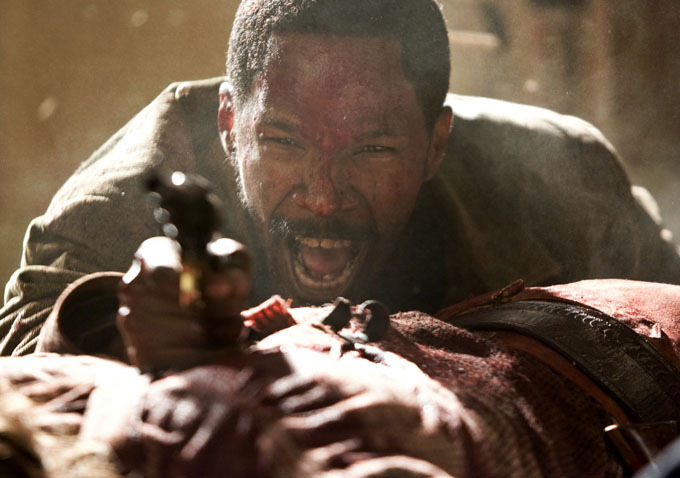
Django Unchained is his latest polyglot of a film, the influences coming from everywhere, the soundtrack a dog's breakfast of styles and eras,* a mixture of high camp, dark humor, and revenge fantasy/wish-fulfillment set once upon a time in the era of slavery, that, even though it rigorously evokes the time and place in design (The South, "1858, two years before the Civil War"), must bow to Tarantino's superficial wishes to what's "cool" in his own head.  There are a couple of scenes that immediately made me think "this is great" (a long, protracted discussion in a bar and a street between Django (Jamie Foxx) and his mentor/patron Dr. King Schultz** (Christoph Waltz) on the similarities between slavers and bounty hunters ("Like slavery, it's a cash for flesh business....Still, I feel guilty about it"), a presentation by Schultz of the Siegfried myth (before a cliff-side proscenium arch that only contains Django as audience), and a bizarre proto-Klan gathering played for Pythonesque laughs.  The set up in the first half of the movie is fine, even intriguing (while the inspirations wheel through your head—not so much Sergio Leone, as The Skin Game, Blazing Saddles, Rosewood), then everything falls apart when, in an effort to rescue Django's wife Broomhilda von Shaft*** (Kerry Washington) we get to Candieland, the plantation owned by the eccentric Calvin Candie (Leonardo DiCaprio), where things seem to go on and on and on and on, the humor dries up, and things turn nasty.  The proclivity towards going overboard while not really advancing the story takes over and becomes paramount, with extended shoot-outs, emphasizing the thinnest of blood exploding out of wounds as if every blood vessel were an artery.  Django Unchained becomes repetitive and, frankly, dull, then a little prematurely self-congratulatory.  

A lot of the problem is that Tarantino has written such a good set-up, that he can't top himself with a finish, and falls back on the action that is neither inspired or clever.  And that is a low-down, dirty shame, especially when it comes to the characters he's spent a great deal of time creating and setting up.  They're inconsistent—ironic, as one of Schultz's major pieces of advice to Django is "during the act, you can never break character."  And yet Schultz ultimately does as does most everyone in the service of getting to the popping blood-bags.  Drama comes from character and most of the individuals in the film break character in ill-considered ways as a quick means to get out of a writerly jam.  The ultimate goal of the piece is foiled by blunt actions  from characters who had previously survived by guile.  That Django must use the same tactics—along with a fistful of dynamite (which, by the way, hadn't been invented yet)  shows an inconsistency in the most important player of the thing, and the star of the show, Quentin Tarantino.  Indulgence is one thing.  Lazy indulgence that trashes the previous good work is quite another.  

Look.  One should never take Tarantino too seriously.  If you do, you're missing a lot of the manic joy of his films for films' sake.  And reverence for such irreverence on his part is more than a little counter-intuitive and weirdly contrary.  But, it is disappointing that the director reached a certain point with this one, and just said "Aw, why work so hard?  Let's blow some shit up" leaving a path of destruction that includes dozens of bodies, and one pretty good idea for a movie, once upon a time.

Django Unchained is a Rental.  
Wilhelm alert @ 00:50:00

Jamie Foxx's Django wears a sun-screening cowboy hat AND shades.
Remember that line from Once Upon a Time in the West
about a man who wears both a belt and suspenders?


* This one is all over the map: start off with Luis Bacalov's song for the Sergio Corbucci western ("with the kind participation of Franco Nero") done in a cross-bred Elvisian/Frankie Laine style, a lot of Ennio Morricone (including a piece that Tarantino thinks is "original" but actually comes from Two Mules for Sister Sara), a piece of Jerry Goldsmith from Under Fire, Verdi's Requiem, and songs like Richie Havens' Freedom, and...most bizarrely, Jim Croce's cheery "I've Got a Name" which he guillotine-edits right before the phrase "And I'm gonna go there free."  Hmm.

** Just realized: "Dr. King."  Heh.

*** See what I mean about Blazing Saddles?  Remember Lili von Schtupp?

Friday, November 18, 2011

J. Edgar


The F.B.I. (Love) Story
or
"What Determines a Man's Legacy is Sometimes That Which Isn't Seen"

J. Edgar Hoover ruled the Federal Bureau of Investigation for 45 years under the Department of Justice.  Over the course of his tenure, he made the FBI his personal weapon in defending the nation from threats as he saw them, even as they changed form—from Bolshevik radicals to hayseed bootleggers and bank robbers to Communists to Civil Rights Activists to his very bosses.  He did this unsubtly and unequivocally with press-trumpeted raids and whispered-about secret files that, if it didn't make him (as the phrase goes) "the most powerful man in the country," he was certainly the most feared.  It was always assumed that Hoover had "the goods" on everyone, and guaranteed his long-held government post with weapons in manila files.

When he died (in office), Hoover's mug had the well-known face of a haggard bulldog—keeping secrets is something that can age you rapidly—and keeping secrets is something Hoover did best.  Not only those of others, but his own.  Rumors swirled about the nature of his relationship with FBI Associate Director Clyde Tolson—that they were secretly gay lovers rather than "gentleman cops," that Hoover was a cross-dresser, and that the reason Hoover didn't pursue the gangsters of La Cosa Nostra in the '40's and '50's was because of compromising photographs in the hands of Meyer Lansky.  Nothing has ever been confirmed.  It's all just rumor, the smirking kind that the powerful get (but there's never any proof).

Which is why news of a Hoover bio-pic, written by Dustin Lance Black and directed by Clint Eastwood seemed so intriguing.  Eastwood isn't afraid to take chances, turning cliches on their ear and Black's clear-eyed script for Milk garnered an Oscar.  Their film J. Edgar promised "red meat," of the kind that could be delightfully and salaciously chewed.

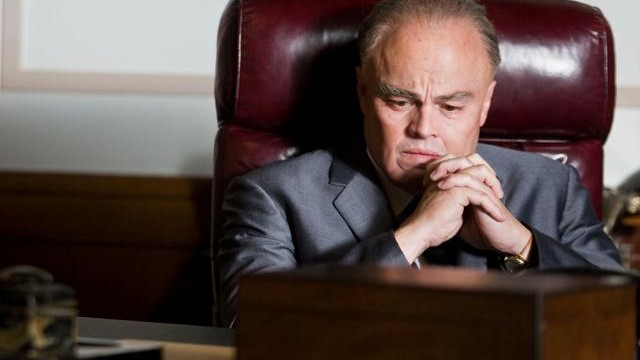
 And the two men have taken chances...but not with the result you would think.  Rather than being a rant or skreed, J. Edgar is actually a sympathetic look at the FBI director and his peccadilloes and shortcomings.  There's nothing hysterical (save for one fist-fight that breaks out between Leonardo DiCaprio's Hoover and Armie Hammer's Tolson) in script or direction, but it offers a look at a severely closeted man who had to be in the times he lived and with the mantle he carried.  Ambitious, yes.  Paranoid, certainly.  Vain and glory-hunting, without a doubt.  Hoover craved the spotlight and his role in being "Head G-Man," while at the same time operating in the shadows, single-mindedly hoarding the secrets of others, while keeping his own in the height of ironies.   At the same time that he espoused the Bureau ethic for red-blooded American males as agents, one wonders if it is done for appearances' sake, a beard that would mask his own leanings while also serving as a "hiding-in-plain-sight" revelation of his own taste in men.

Black and Eastwood conduct the story-telling in flashback, as Hoover in his latter years, decides to set the record straight, dictating his memoirs to an amusingly rotating number of agent-stenographers who disappear as soon as a point is questioned, or a weakness revealed.  The story is a white-wash, reflecting the man's "official" view of the Bureau's history in a mix of incident and myth.  At many times, J.Edgar is a bit reminiscent of Citizen Kane, with its fracturing point-of-view, shifting perspective, and ironic commentary on some of the incidents.*

It also shares Kane's sense of the unattainable summation of a life.  C.F. Kane's had little to do with "Rosebud," just as Hoover's gay leanings was a small part of his whole story.  It began with a controlling mother (Judi Dench), determined to keep young John Edgar from becoming a drunk like his father.  Groomed to become "the most powerful man in the country," Mother Hoover controls her son's life to make him the image of the perfect son, diction lessons to force past a stammer, impeccable grooming, and the enforcement of all of her prejudices.  And the nullification of any behavior less than manly.  He is made in the image of his Mother's "perfect son," even though that image may be completely counter to reality.  It sets him on a lifelong course of fighting her battles, never really being his own man, as much as posing in the presentation he wanted to project.  A performance.  An actMyth and lies.

It is a story soaked in ironies: the man who kept secrets on everybody, but the biggest being his own; the investigator who saw no harm in exposing other's private lives, while keeping an iron grip on his own; the policeman who targetted and made war on many enemies, the primary one being himself.  Black and Eastwood present a case for sympathy, even empathy, for a man who shaped, and was shaped, by his times, who rose through the ranks of power in society, to not be shunned by it, and who searched for verifiable fact while living in denial, and closeted by the bureau of his own making.

J. Edgar is a Matinee.


Hoover and Tolson at their regular table at The Stork Club.


* Not to mention that DiCaprio's "old-man" make-up makes him look more like the aged Charles Foster Kane than the jowly Hoover (still, it's better than the never convincing make-up that Hammer sports as an aging Tolson), and the shots of Hoover witnessing the Inaugural parades of Franklin Roosevelt and Richard Nixon are shot from the same angle as the "newsreel" shot of Kane in a balcony appearance with Adolph Hitler.

Tuesday, July 20, 2010

Inception


"All That We See or Seem..." *

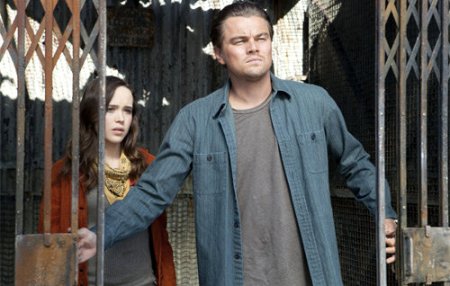
The latest film from that Master of Disorientation, Christopher Nolan—"Inception"—may be his most intricate puzzle yet.  A nest of corporate spies, using dream-suggestion, steal secrets from business rivals to their clients.  One such mission turns into a nightmare, and the team's leader, Dominic Cobb (Leonardo DiCaprio), accepts the subject (Ken Watanabe) of his previous mission's challenge: 1) to implant a suggestion into a rival while sleeping, which 2) requires a nested suggestion—"a dream within a dream"—to be pulled off, the reward being 3) Cobb will be given his dream come true, all inquiries into a previous tragedy will be dropped and he will be allowed to return to his home in the U.S., where his children await him.


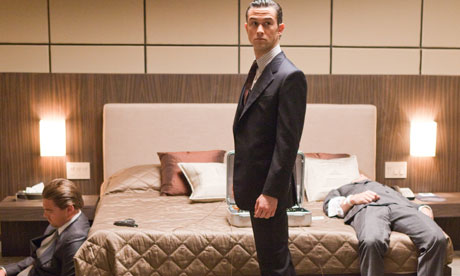
To accomplish this, he must assemble a team: "The Architect," Ariadne (Ellen Page), who will design the dream-scape, "The Point-Man," Arthur (Joseph Gordon-Levitt), who will monitor the progress of the mission and initiate the extrication from the dream, and "The Forger," (Tom Hardy), whose intricate research will reassure the subject that the dream has a basis in fact.  Then, there's Cobb.  An incredible asset, but a liability, he suffers from the guilt of not preventing the death of a previous team-mate, his wife Mal (Marion Cotillard), who pops up in the shared dream-scapes to unravel the scheme and punish him.  Of course, she's just his guilt talkingThe team's emotions have as much importance in dreams as the images.


Something about this sound familiar to you...beyond the surface "Mission: Impossible" trappings, gene-spliced with a psychic "Fantastic Voyage?"  An "Architect," like a set-designer, the "Point-Man," like a producer or location scout, the "Forger," like the cinematographer recreating verisimilitude, all illusionists dream-synced to accomplish a single goal;  Nolan is talking about The Movies.


He isn't the first: Howard Hawks equated the social structure of any inter-dependent team with the circus of techs and talents involved in film-making, and Hitchcock frequently ruminated on how the movies were a dream-scape (that often turned into nightmares) with his highly subjective angles and cutting.  But, Nolan—given his dream-projects—chooses to make movies that exploit and comment on the special illusory power of film: shifting narratives and time-lines, the power of the edit (and the critical when), the magic of movie-making that goes beyond simple photo-recording, and narratively bending that reality to your will.  Movies are a dream, tapping into our psyches, and also influencing them, their ideas infecting us (as we're often told in the film) "like a virus.".  One of the neatest narrative gambits in "Inception" is Cobb's rule for knowing you're in a dream: "Think—how did you get here?"  In a movie, you're edited into a situation, dropped from one place to another with a single splice.  Like magic.  Like a dream.


In "Following," Nolan threw us into "the deep-end" of an obsessive-compulsive's life, fracturing the time-line, with our only clues to structure being the protagonist's appearance (like a dream).  "Memento," we follow a man with cognitive dissonance, who can only retain a memory for 15 minutes, we alone are left to remember the dream to its beginning.  "Insomnia" centers around a man who can't dream, and "The Prestige" tells its tales of magic and science while playing with the conventions of story-telling.  Nolan's non-superhero films are all about movies—and how movies can be used to fool you, like a magician's trick.  His weakest films depend on it to hold them together; more than just an editing "gimmick," the films would be pointless without the structure.


There is no doubt in my mind that Nolan equates the two—and he leaves a final layer of his dream-within-a-dream-scape on the soundtrack at the end of the film to take us out of it.** The film's last visual gambit also calls into question dream versus reality, but does so in a very filmic way.  There has been some kvetching about that last shot being an obvious ploy to head-fuck—like the arbitrary shot of the ice-pick at the end of "Basic Instinct"—but that's missing the point: the significance of the shot is when Nolan cuts away from it. ***


When I did my "Now I've Seen Everything" piece on Nolan, I wrote this:

"In Media Res" is the term for one of his films, the lens aperture opening for a limited amount of time, and closing with events still in flux, the world changing, and the future uncertain. One has the sense of the film merely stopping, with the story-line continuing past the audience's part in it, again leading to a lack of fulfillment...or dread. In either case, one exits a Nolan film dis-oriented, uneasy...but not often dis-satisfied.

That still applies here.  And Nolan gets to do his time-bending tricks in a significantly different way, revealing them in personal dreams, while maintaining a (rare for him) linear time-line.  That strategy comes to fruition with a unique sequence where the team (and we) are plunged into deeper and deeper nested dreams, each with its own time-scale and dis-orientation, cutting back and forth between them as they progress at different speeds and different orientations (dependent on what is happening in the previous tier of dream-level).  It is a bravura sequence that leaves one a bit breathless, shaking one's head that it is so intricately staged and communicated.  I don't recall seeing anything quite like it.

There are little quibbles, of course: Nolan's dream-scapes never veer far into the surrealistic, remaining quite concrete in how things look and act, and the dream sequences maintain the hard-edged quality of movies and video-games (but, hey, it's Nolan's dreams); the third dream-level (which recalls a war/spy assault on an impenetrable mountain HQ) seems to be unaffected by the physical forces that so influence and warp the second; and the mission (and the entire movie is "the mission" making the general feel of the thing a bit slight) has a smug amoral satisfaction to it, that is vaguely disquieting, and no sense of good and evil (only profit and loss) which would give the movie some sort of conscious weight.

But these are minor distractions...vague notions in the subconscious while grooving on the movie.  I don't think "Inception" is Nolan's best film (I vacillate between "The Dark Knight" and "The Prestige"), but as an exercise on the possibilities and power of film—as both medium and message—is a dense, intricate, satisfying film that's fun to puzzle out during and after its playing.

No, I have no regrets.

"Inception" is a Full-Price Ticket.

* From Poe's "A Dream Within a Dream," which, in imagery, rumination, and motivation, fits many of "Inception's" themes—it probably inspired many aspects of it:

Take this kiss upon the brow!
And, in parting from you now,
Thus much let me avow-
You are not wrong, who deem
That my days have been a dream;
Yet if hope has flown away
In a night, or in a day,
In a vision, or in none,
Is it therefore the less gone?
All that we see or seem
Is but a dream within a dream.

I stand amid the roar
Of a surf-tormented shore,
And I hold within my hand
Grains of the golden sand-
How few! yet how they creep
Through my fingers to the deep,
While I weep- while I weep!
O God! can I not grasp
Them with a tighter clasp?
O God! can I not save
One from the pitiless wave?
Is all that we see or seem
But a dream within a dream?


** SPOILER ALERT: That audio clue is in the film's final minutes as Edith Piaf's emblematic "Non, je ne regrette rien" plays on the soundtrack until it is gradually replaced by the staticy thrum that indicates the waking process from the dream-scape; when it ends, the film ends.  That it is used in the film as the team's traditional "safe-word" alarm to extricate them from a dream is the film's final tie-in to being a dream-state.  It is significant that it is THIS song, as it is tied to Piaf so indelibly, and echoes as well to Marion Cotillard, who played the chanteuse in her Oscar-winning role in "La Vie en Rose," and here, plays Cobb's tragic wife, who represents his biggest regret.  This is one of ripples running through "Inception," through layers and layers and layers.  Like a glass onion.

*** And if you're looking for an answer to whether it's a dream or reality ("it's a FILM, dummy!"), just apply the "How did he get there?" rule: the whole movie is about "how he gets there."