Showing posts with label Christopher Nolan. Show all posts

Saturday, August 11, 2012

Now I've Seen Everything Dept.-Update: Christopher Nolan


Planners and Schemers, 
Madmen and Dreamers

Christopher Nolan can pretty much do anything he wants in Hollywood now.  He could film the phone-book (out of order, probably) and there would be no lack of investors to throw cash at the project. His last few films have been extraordinarily expensive epics, a far cry from his humble beginnings as an experimental film-maker.  His ability to make more movie for less budget in his early career vaulted him pretty quickly into Hollywood's A-list, as his limited budgets (for Following and Memento) made him a good risk with studio funds. His ability to keep the reins on a story-line, but also evoke feelings of dread and disorientation have made him a director of down-beat and uniquely crafted movies. And with the exception of one film, all of his films have one shared quality.

Storytelling dictates a linear approach; you're supposed to have a beginning, a middle and an end. The shortest distance between "Fade From Black" to "The End" is a straight line, or, if you're of the bent, a story-arc. But if you look at a Christopher Nolan film, it looks more like a
mobius strip.

Stitched together by
Frankenstein.

"In Media Res" is the term for one of his films, the lens aperture opening for a limited amount of time, and closing with events still in flux, the world changing, and the future uncertain. One has the sense of a Nolan film merely stopping, with the story-line continuing past the audience's part in it, again leading to a lack of fulfillment...or dread. In either case, one exits one of the director's films dis-oriented, uneasy...but not often dis-satisfied.


Following (1998)
This is Nolan's first film success, a short caper/character study that feels a bit like a "Mamet" filmed by the BBC, with the same deliberate cadence of the dialog, but with one major difference--it's presented out of sequence and with no sense of linear construction. The only clues you have to when things work out in the timeline are the lead character's appearance. Sometimes he looks like a slob (he's an unemployed writer) and sometimes he's dressed like a sharp (he's been given sartorial tutoring for a particular line of work) and sometimes he's spitting out teeth (he's been beaten up).

The story itself is a trifle; a writer, suddenly single, begins a bad habit of picking people out in a crowd and following them home--nothing kinky, just research. But random chance brings him to one person who notices he's being followed and, as they say, things get complicated. One wonders why Nolan's elaborate editing scheme is there in the first place, as the plot resolves in the same way in either order (the DVD gives you the choice of viewing options). The only real reason to do it is obfuscation. An interesting exercise, but a bit pointless, unless it can be rationalized as the film being bracketed by a police grilling and the writer is remembering the story in pieces. But if it was obfuscation the director wanted, one would think there was a more interesting way to do it than relying on post-production.

But it did put him in the proper mind-set for his next film, where the editing structure is far more rigid, and is part and parcel for the film-concept.


Memento (2000)
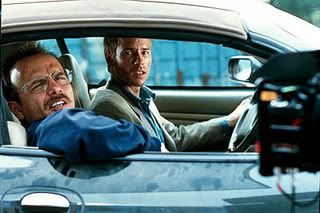
As opposed to the scrambled editing structure of FollowingMemento has a diabolical editing scheme, going two linear directions at once, forward and backwards: the black and white sections heading for the future, and the color sections retreating to the past. It tells the story of Leonard Shelby (Guy Pearce), a former insurance-fraud investigator, who we learn suffers from anterograde amnesia--he can't make new memories--due to injuries suffered in a home-assault which killed his wife. Despite the fact that he forgets what he's learned in his investigation every five minutes, he attempts to hunt down the second man in the assault for revenge. Because of his condition he's forced to leave clues to himself via instant Polaroid's, tattoo's, and notes, and depends on the help of accomplices Natalie (Carrie Ann-Moss) and Teddy (John Pantoliano) to form a through-line in his unstable quest. The film begins with a murder, and it ends with another one, and we are left with the scenario of a human loose-cannon, pursuing his empty clues whereever they may lead.

It's a fascinating idea for a film, and the conceit is a great one. Not unlike a classic murder mystery played backwards, with all the clues that have been building, revealing the actual events at the end to the viewer. Unfortunately, the ultimate effect of the film is not revelation but helplessness-there is no satisfaction gained from the answer, only a sense that there is no mystery, just random acts of violence. One feels hoodwinked.

And ultimately, like Following, the film would be pointless if not for the backward chronology; if it weren't for that construction, the film would be completely unsatisfying, and, like the classic murder mystery chronology, or any film whose weak story-line is propped up by starting with the consequences, the manipulation of time is its one strength.

Still, its an interesting experiment. And the performances by Pearce, Moss and Patoliano are expert in themselves, Pearce, revealing all that he can know at any given time, and Pantoliano and Moss being deliberately obtuse, not to reveal too much.


Insomnia (2002)
Following and Memento were both made on shoe-string budgets, but this remake of a Norwegian film has an all-star cast of Oscar winners, and something Nolan hasn't tried before, a linear timeline.

Two homicide cops under investiagtion by their department are sent to a friendly district in Nightmute, Alaska to cool off and help in a homicide investigation. The partners are a bit wary of each other, not sure of what the other will tell, and since the charge involves planting evidence--who do you trust? One thing Detective Will Dormer
(Al Pacino) doesn't factor in is the perpetual sun-light all day above the Arctic Circle.* If he was having trouble sleeping before, now he's suffering from full-on sleep deprivation and his judgement, along with his already questionable ethics, are making him slip up. And given that the killer (Robin Williams) is at least as smart as he is, the results could be fatal. Nolan has fun with the chases evoking the same sort of "French Connection"-style" philosophy** but turned on its fishing-village ear. Pacino and Williams crackle in their scenes together, though fellow Oscar-winner Hillary Swank, with less meat and scenery to chew on, has less to show for it. And Nolan, sticking to the clock, compensates with atmosphere and intriguingly shot set-pieces that keep you guessing. Appropriately, this is the only film that has a definite ending, with Dormer finally achieving a rest of sorts in the only blackness the environment can provide.


Batman Begins 
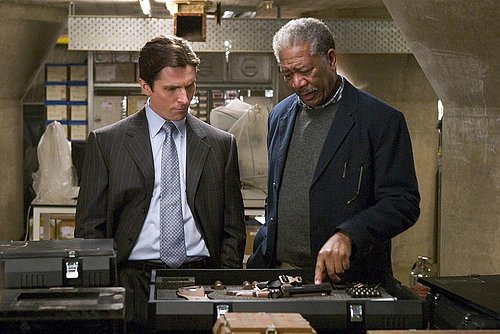
(2005) After Insomnia, Nolan was handed the keys to Warner Brothers' staked-like-a-vampire "Batman" series to "revamp" the franchise back into fighting strength. He's aided immeasurably by a good cast, particularly Christian Bale using George Bush boorishness for his portrayal of Gothan City billionaire Bruce Wayne, who dresses as a bat to carry on his murdered father's legacy of helping the down-trodden and oppressed. But the top-heavy cast also includes Michael Caine, Morgan Freeman, Liam Neeson, Cillian Murphy, Gary Oldman, Rutger Hauer, Ken Watanabe, Tom Wilkinson (and Katie Holmes). Like the old joke goes: "Any 'names?'"

But that origin story. That one always gets in the way--
starting with the Wayne kid's parents being murdered? Not even Tim Burton led with that. No, Nolan juggles the time-line a bit to start with us--and Bruce--off-guard and a bit lost, fighting for his life in a foreign prison. He's recruited by Ra's Al Ghul and the League of Assassins to maximize his potential and leave his past behind--a past that is slowly released for viewing. Then his pilgrimage and training complete, it's back to Gotham for acquiring all those toys.


Nolan and scripter
David Goyer have a lot of ground to cover with a lot of characters--two villains (maybe three), Gordon's story and Alfred's, the fate of the Wayne fortune, and Bruce's childhood girlfriend, and oh, yeah, the intertwining plots of the villains. They keep everything moving and even pull off a surprise or two, but the final attack on Gotham City is an over-extended and splintered mess that focuses on too many characters for its own good and too much property damage for the city's. You begin to wonder what's been saved. But there's enough promise to whet one's appetite for the inevitable follow-up.


The Prestige (2006)
Written about more extensively here, The Prestige is a good-looking period film that sets up a perfect crime and the perfect revenge in one fell swoop as two competing magicians devote their careers and lives to out-tricking and out-illusioning the other. But illusions are in the eye of the beholder, and it all comes with a cost. Like all magic tricks, you feel a bit disappointed when the secrets are revealed, and the film leaves one with the same sense of vague let-down, even with the extraordinarily creepy and resonating final image. Nolan's set-ups in this film are terrific, but in time one realizes just how self-destructive this competition has been.

Hugh Jackman and Christian Bale star with strong supporting turns by Michael Caine and David Bowie (as electrical innovator Nicola Tesla), and a perfunctory "girl" role by Scarlett Johanson, that could have been done by anybody, frankly. But Nolan knows how to get the maximum out of his performers, including Jackman in a good performance in something that doesn't involve claws.


The Dark Knight 
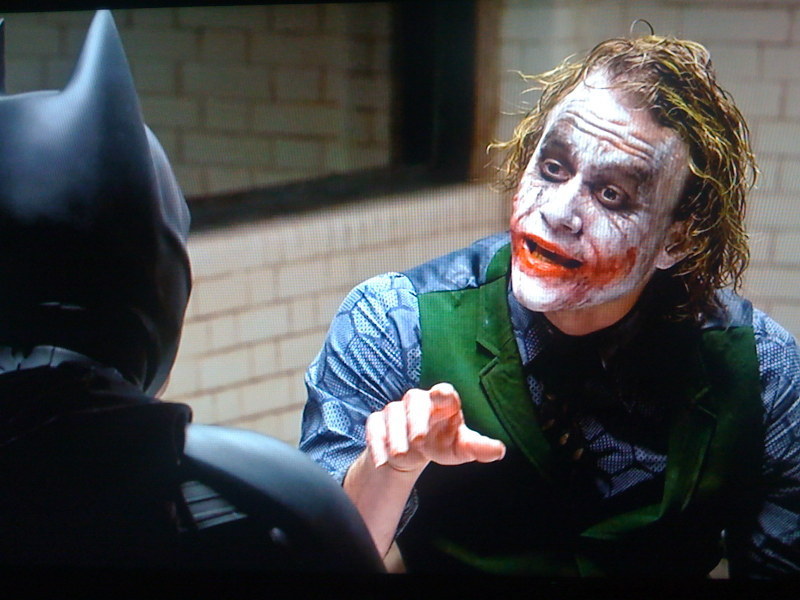
(2008) Full review here. Nolan's second "Batman" film raises the stakes for the entire cast, adding Heath Ledger's trickster Joker and Aaron Eckhart as D.A. Harvey Dentwho has taken up with Wayne old flame Rachel Dawes (now played by Maggie Gyllenhall). Ledger's unique take on The Joker grabbed all the attention—and the Best Supporting Oscar that year—but the extremely well-integrated storyline combining The Joker, Two-Face, Batman, and Rachel and the intertwining of their fates makes this one the most cohesive of Nolan's latter films; it's a puzzle that fits together intricately and inelegantly, creating a satisfying whole despite the chaos that churns in its center.


And it is chaos.  Some critics have made too much of Ledger's Joker saying he's an agent of it, while also concocting elaborate plots that require a lot of preparation, seemingly belying the words.  Yet, he is chaotic, and not just in the results he produces.  The very idea that he does one thing and says another shows him to be inconsistent, undependable, untrustworthy, mercurial, as changable as the stories he spins for his smile of scars.  He's just the guy who will blow away any elaborately arranged house of cards, the opposite of Wayne's predictable planner and schemer, a man not unlike the director.


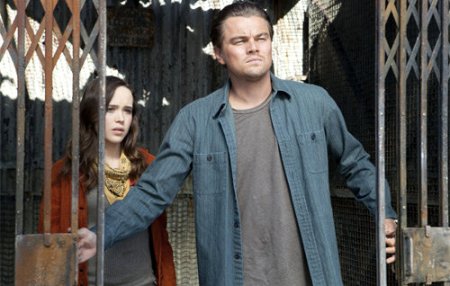
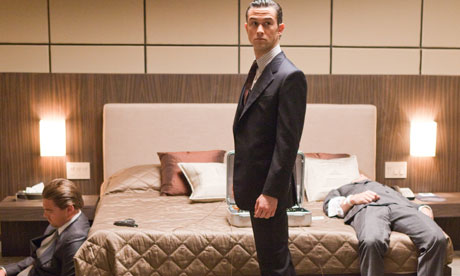
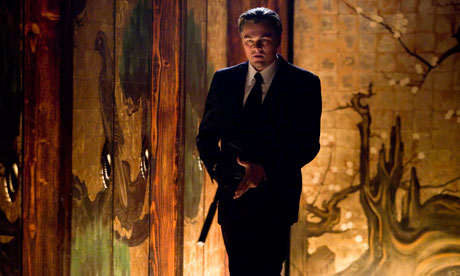
Inception (2010) Full review here.  Oh, yeah.  It looks good.  It looks great, and its elaborate set of rules and regulations provide some consistency in a shaky foundation of dream-scapes and the even more tremulous ones of character.  That's the conflict of dream-team-leader Cobb (Leonardo DiCaprio)—keeping things dependable, despite the vagaries of personality.  He runs an industrial spy ring that does "Mission: Impossible"-style invasions into targets' minds while they sleep, creating whole worlds to maneuver through.  As in most of these stories, the best laid plans go awry and the crew has to punt in order to  accomplish their goals.  For Cobb's team, he's their weakest link; his guilt over the death of his wife (Marion Cotillard) on a previous job threatens to unravel the sturdiest of missions—an element of reality that betrays the unreality of the various scenarios his group puts together.

The structure of Inception is fun—dreams within dreams within dreams within a movie, which is, as its a product of imagination, just another dream, revealed puckishly by Nolan by playing the "safety" song "Non, je ne regrette rien" over the credits in the final few minutes of the film, gradually being replaced by the awakening thrum just as the film...ends.  Cute.  And Nolan's flash-backs, forwards, and brief interruptions and insertions are further complicated by an elaborate nested-dream sequence that dominates the last half of the film.  Even though played in deadly earnest by another terrific cast, it's Nolan's lightest film, as he plays with the form (necessitating repeated views) of how we watch movies, stretching the rules of film-watching...if not film-making.


The Dark Knight Rises (2012) Full review here.  Nolan's third (and presumably final) "Batman" movie ends the story quite definitively, by providing "The Dark Knight," eight years in retirement, with one last challenge that in many ways reflects his origins.  It's a good full circle approach, and makes one suspect that Nolan may have had this as a grand design, rather than, say, just pulling out elements of Batman Begins to tie everything in a nice thematic bow.  

But those elements feel like after-thoughts a bit, hanging threads that mar the look of a nice design.  The most interesting aspect of TDKR is Tom Hardy's Bane, a hired thug, with several masters, but who appears to be working on his own.  Bane is another "Dark Knight" opposite--where Bruce Wayne is enmeshed in armor, Bane is pretty much organic, less of a construct.  Stronger and faster than Batman, he can best him in a fair fight...and cruelly take advantage of the loser's injuries so he'll never get up again.  Where Wayne's face is exposed in his disguise, Bane's is covered with a morphine breather, where Wayne tried to protect Gotham City, Bane wants to level it.  That central conflict provides the momentum of the movie, but there are many side-trips for the rest of the cast, including a young beat-cop who was inspired by Batman as a child (Joseph Gordon-Levitt) and another creature of the night—Selina Kyle (Anne Hathaway)—who seems to have as many loyalties as lives.  And the film ends with things still in a state of flux, as Gotham City needs to rebuild and the fates of many of the characters in question.

The only thing definitive is Batman, after a career of working in the shadows, had been forced into the light and ends his work with a blinding flash.

The Dark Knight rises...like the sun.


What's next for Nolan?  Resting, apparently...and plotting.  He's overseeing the new Superman movie, writing and producing, but Zack Snyder is directing.  Will he still experiment with the form of film-making, seeing how he can push the illusion and the metaphor, making more and more elaborate puzzles, or will he simplify and streamline, taking away the riddles and the obfuscations and say something directly?  The Dark Knight Rises closes the book on the Bruce Wayne-Batman, but also seems to have ended a chapter in Nolan's directorial story, as well.  Whatever direction, it will be interesting to see. 


* If you've looked at the map you know it isn't.

** That is, the bad-guys have free rein and the cops have to play by the rules.

Tuesday, July 24, 2012

The Dark Knight Rises

The Bane of Our Existence
or
"Okay, What Joker Put Yeast in My Dark Knight?"


"All stories end in death, and he is no true story teller who would keep that from you"--Hemingway

"If you want a happy ending, that depends, of course, on where you stop your story"--Welles


So, Christopher Nolan's "Batman" trilogy ends in a nearly 3 hour film that neatly wraps up the story.  How does it end?  That would be telling.  The comics went through a phase where Bruce Wayne ruminated that he was working towards a world where he wasn't needed.  That's a nice little "buttoning up" of the "Dark Knight" story, but it's not complete.  What of Bruce Wayne?  Nolan has the opportunity in his version to really end it—he doesn't have to sell comic books next month—so, he can take it anywhere he wants to go.  And one realizes (if one really wanted to end the story) that the only real happy ending that could be achieved is if Bruce Wayne became the one thing he never knew as a child—a caring, present father.  Anything else makes the story a tragedy, and Bruce Wayne the last victim of the gunman's bullets that killed his parents.  Given this series' downbeat tone (that of the sacrificial martyr) and of the available previews for The Dark Knight Rises, such a scenario does not seem likely.  Given that, Nolan can take the tragedy of his hero in any number of directions.

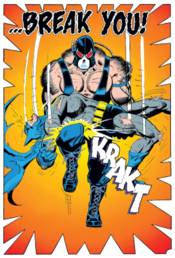
Bane (Tom Hardy here) is the perfect villain to bring into the mix.  A hopped-up minor character, he is best known as the lead antagonist for the "Knightfall" storyline (that seemed to last a couple years).  In "Knightfall," the drug-pumped super-villain released every criminal in Gotham's prison system for The Bat to deal with, while he hung back, biding his time.  Then, when the Batman, weakened and exhausted, finally confronted him, Bane broke his back, leaving Wayne paralyzed and unable to fight on.  It fell to the rest of "The Batman Family" (including the once-and-future "Robin's") to take on the mantle and continue the fight.

Nolan's canvas is a bit broader, taking into consideration the events of the two previous films to create something a bit more apocalyptic, a rumination on the fractious quality of good vs. evil and the slippery slope to Hell that ideology and good intentions can be tilted towards.  Nobody's pure in this one, there's no whack-job with delusions of grandeur behind the assault on Gotham City, with avarice their sole motive.  Everybody, wearing white or black, thinks they're doing the right thing.  And everybody's wrong.


It's eight years since the events of The Dark Knight that resulted in the deaths of D.A. Harvey Dent, Rachel Dawes, and the subsequent disappearance of the man suspected in the killings, the Bat-man (Christian Bale).  Now, Bruce Wayne is an exile in his newly-rebuilt Wayne Manor, walking stiffly with a cane due to some unknown injury (part of me wants to think it was due to him being stabbed by one of The Penguin's umbrellas).  He sees no one, is a recluse, and there are rumors he's turned into a Howard Hughes-style eccentric, apparently due to a massive investment in a clean energy prototype that failed and cost Wayne Enterprises a fortune...or at least half of it.  The chief backer for the project, Miranda Tate (Marion Cotillard) tries to get past the constant guards of faithful butler Alfred (Michael Caine, putting in the most emotional performance he's done in years) and Wayne exec Lucius Fox (Morgan Freeman), who fill the functions of acting as Wayne's heart and brains (and conscience), if not as surrogate Mother and Father.  A rival exec, Daggett, is trying to take over W.E., by any means necessary, in this case, employing a terrorist named Bane, who has his own bones to pick (and break) with Gotham's golden boy.  At the beginning of the film, Gotham in morosely complacent (and obviously filled with exposition), having cleaned up crime by the draconian Dent Anti-Crime Act, which has incarcerated over a thousand criminals in Gotham's Blackgate Prison.


But things are percolating underground, disrupting Gotham's infrastructure.  Bane has an army of misfits and big plans that have outgrown the desires of his patron, and there's a lithe cat burglar named Selina Kyle (Anne Hathaway), who is caught with her hands in the Wayne Manor safe by the man himself ("Oops," she says, not very convincingly).  Yes, she's pilfered Martha Wayne's pearl necklace, but more importantly, Bruce Wayne's fingerprints.  What does she want with those?


It's only one piece in an intricate puzzle of escalating consequences that Batman must unravel if he is, once again, to save Gotham City, and he must confront his past and overcome great injury, physical and emotional, if he is to prevent a catastrophe...one of his own devising.

That's the gist of it, but it is convoluted by elaborate set-pieces that are, frankly, jaw-dropping, and ends up with Gotham isolated from the rest of the nation, in the hands of criminals with big ideologies and little concern for how roughly they're applied.  The police are paralyzed—most of them trapped in the deep infrastructure of the city (a little too conveniently) while Bane initiates a countdown to total destruction.

A countdown of five months.

To quote The Riddler: "????"  Five months?  How suspenseful is that?  And you'd think that somebody, somewhere, would be able to unravel the plot or situation in such a time-frame.  But, it's basically a set-up for what Nolan depends on to generate suspense throughout the movie—the last minute "save," that is usually explosive and comes from nowhere, because the writer-director has made motivations ambiguous enough as to be unreadable.*  Everyone has got a secret that will be revealed at the most opportune moment of drama.  If the mystery was revealed in a drawing room, it would feel like cheating, and the revelations almost psychic.

Speaking of unreadable, Tom Hardy's Bane is hampered by a mask of a morphine dispenser (to keep him from feeling pain), as opposed to the enhancement-juice-pumping-apparatus from the comics (This leads one to ask: if the guy can be stopped by breaking the mask, why does Our Hero employ so many body-blows?  Face-shots, man!!).  He is perpetually muffled by this thing, which Hardy compensates for with an almost jolly Father Christmas speaking style, making a clever, unnerving ying-yang effect for the character.  Ultimately, though, he's something of a vapor-tiger, like Darth Vader, the big bloated bloviator who's merely a "blind," a distraction for the real danger.

But...five months??**

Another thing: Nolan has come out publicly saying that he wants to make a Bond movie (and the snowbound facility infiltration in Inception is a bowler-tip to them).  I would submit that he already has, this film being it.  So much of it is borrowed from Bond that all one needs is a casino scene to make it complete (a costume party has to suffice***).  The opening sequence, the-villain-that-feels-no-pain, the duplicitous females, obligatory "Q" scene, the tick-tock final set-piece and other aspects can be attributable to Bond films of the past.  At least someone is borrowing from the Bond series this time, instead of the other way around.

But, his world of comic-book fantasy is far more gritty and down-to-Earth than any other, and that's what makes "The Dark Knight Trilogy" good; it's relatable, it feels like it could happen, if someone had the will, the wherewithal and the wallet to do it.  It also feels of our time.  There's been a lot of gas about the politics in this film—uninformed, desperate gas—but the whole uprising scenario, the subjugation of the privileged with no benefit to the less fortunate, the breaking down of society and the cleaving of its people is the stuff of water-cooler vitriol and feels like the temper of the times.  The Tea Party AND the Occupy Wall Streeters can both find things to point at and go: "See?"  I'm not going to speculate which side is right, and Nolan is obtuse (and politically slippery) enough to play it right down the yellow stripe of the road.  But, this British director is saying something about the State of the Union with a full child-warbled rendition of The Star Spangled Banner (before a particularly horrific football game) and a shot of American flags in tatters on a city street, deep in the movie.  They're there for a reason, but not for anything specific enough other than "we're a fragile alliance and we're in trouble."

And that we need heroes—selfless ones, for whom profit is not a motive—and that, "anyone can be Batman."**** 

The Dark Knight Rises is a long-afternoon Matinee.

Bane's "big moment" in 1994.


* Case in point:  there's a scene where Catwoman uses a Wayne-supplied bat-bike to blow a hole in a tunnel to make an evacuation tunnel for the sealed-off city, a task initiated by the Caped Crusader.  Following it, Nolan sits on a pull-in shot of Hathaway with an enigmatic smile on her face that communicates...nothing.  Except an odd complacency.  It will only be resolved...if there's anything TO be resolved, later in the film. 

** There are neat touches, and a refresher of both The Dark Knight AND Batman Begins will help.  One nice thing—Nolan recalls a scene from BB when a young Bruce Wayne falls down a tunnel and is subsequently rescued by his father, by having a similar scenario played out here, with the Obi-Wan presence of a dark father figure from his past.  Nice touch.


*** A masked ball at which, like in Batman Returns, Bruce Wayne doesn't wear a mask.  Heh.

**** Just not Nicolas Cage, please...

Tuesday, July 20, 2010

Inception


"All That We See or Seem..." *

The latest film from that Master of Disorientation, Christopher Nolan—"Inception"—may be his most intricate puzzle yet.  A nest of corporate spies, using dream-suggestion, steal secrets from business rivals to their clients.  One such mission turns into a nightmare, and the team's leader, Dominic Cobb (Leonardo DiCaprio), accepts the subject (Ken Watanabe) of his previous mission's challenge: 1) to implant a suggestion into a rival while sleeping, which 2) requires a nested suggestion—"a dream within a dream"—to be pulled off, the reward being 3) Cobb will be given his dream come true, all inquiries into a previous tragedy will be dropped and he will be allowed to return to his home in the U.S., where his children await him.


To accomplish this, he must assemble a team: "The Architect," Ariadne (Ellen Page), who will design the dream-scape, "The Point-Man," Arthur (Joseph Gordon-Levitt), who will monitor the progress of the mission and initiate the extrication from the dream, and "The Forger," (Tom Hardy), whose intricate research will reassure the subject that the dream has a basis in fact.  Then, there's Cobb.  An incredible asset, but a liability, he suffers from the guilt of not preventing the death of a previous team-mate, his wife Mal (Marion Cotillard), who pops up in the shared dream-scapes to unravel the scheme and punish him.  Of course, she's just his guilt talkingThe team's emotions have as much importance in dreams as the images.


Something about this sound familiar to you...beyond the surface "Mission: Impossible" trappings, gene-spliced with a psychic "Fantastic Voyage?"  An "Architect," like a set-designer, the "Point-Man," like a producer or location scout, the "Forger," like the cinematographer recreating verisimilitude, all illusionists dream-synced to accomplish a single goal;  Nolan is talking about The Movies.


He isn't the first: Howard Hawks equated the social structure of any inter-dependent team with the circus of techs and talents involved in film-making, and Hitchcock frequently ruminated on how the movies were a dream-scape (that often turned into nightmares) with his highly subjective angles and cutting.  But, Nolan—given his dream-projects—chooses to make movies that exploit and comment on the special illusory power of film: shifting narratives and time-lines, the power of the edit (and the critical when), the magic of movie-making that goes beyond simple photo-recording, and narratively bending that reality to your will.  Movies are a dream, tapping into our psyches, and also influencing them, their ideas infecting us (as we're often told in the film) "like a virus.".  One of the neatest narrative gambits in "Inception" is Cobb's rule for knowing you're in a dream: "Think—how did you get here?"  In a movie, you're edited into a situation, dropped from one place to another with a single splice.  Like magic.  Like a dream.


In "Following," Nolan threw us into "the deep-end" of an obsessive-compulsive's life, fracturing the time-line, with our only clues to structure being the protagonist's appearance (like a dream).  "Memento," we follow a man with cognitive dissonance, who can only retain a memory for 15 minutes, we alone are left to remember the dream to its beginning.  "Insomnia" centers around a man who can't dream, and "The Prestige" tells its tales of magic and science while playing with the conventions of story-telling.  Nolan's non-superhero films are all about movies—and how movies can be used to fool you, like a magician's trick.  His weakest films depend on it to hold them together; more than just an editing "gimmick," the films would be pointless without the structure.


There is no doubt in my mind that Nolan equates the two—and he leaves a final layer of his dream-within-a-dream-scape on the soundtrack at the end of the film to take us out of it.** The film's last visual gambit also calls into question dream versus reality, but does so in a very filmic way.  There has been some kvetching about that last shot being an obvious ploy to head-fuck—like the arbitrary shot of the ice-pick at the end of "Basic Instinct"—but that's missing the point: the significance of the shot is when Nolan cuts away from it. ***


When I did my "Now I've Seen Everything" piece on Nolan, I wrote this:

"In Media Res" is the term for one of his films, the lens aperture opening for a limited amount of time, and closing with events still in flux, the world changing, and the future uncertain. One has the sense of the film merely stopping, with the story-line continuing past the audience's part in it, again leading to a lack of fulfillment...or dread. In either case, one exits a Nolan film dis-oriented, uneasy...but not often dis-satisfied.

That still applies here.  And Nolan gets to do his time-bending tricks in a significantly different way, revealing them in personal dreams, while maintaining a (rare for him) linear time-line.  That strategy comes to fruition with a unique sequence where the team (and we) are plunged into deeper and deeper nested dreams, each with its own time-scale and dis-orientation, cutting back and forth between them as they progress at different speeds and different orientations (dependent on what is happening in the previous tier of dream-level).  It is a bravura sequence that leaves one a bit breathless, shaking one's head that it is so intricately staged and communicated.  I don't recall seeing anything quite like it.

There are little quibbles, of course: Nolan's dream-scapes never veer far into the surrealistic, remaining quite concrete in how things look and act, and the dream sequences maintain the hard-edged quality of movies and video-games (but, hey, it's Nolan's dreams); the third dream-level (which recalls a war/spy assault on an impenetrable mountain HQ) seems to be unaffected by the physical forces that so influence and warp the second; and the mission (and the entire movie is "the mission" making the general feel of the thing a bit slight) has a smug amoral satisfaction to it, that is vaguely disquieting, and no sense of good and evil (only profit and loss) which would give the movie some sort of conscious weight.

But these are minor distractions...vague notions in the subconscious while grooving on the movie.  I don't think "Inception" is Nolan's best film (I vacillate between "The Dark Knight" and "The Prestige"), but as an exercise on the possibilities and power of film—as both medium and message—is a dense, intricate, satisfying film that's fun to puzzle out during and after its playing.

No, I have no regrets.

"Inception" is a Full-Price Ticket.

* From Poe's "A Dream Within a Dream," which, in imagery, rumination, and motivation, fits many of "Inception's" themes—it probably inspired many aspects of it:

Take this kiss upon the brow!
And, in parting from you now,
Thus much let me avow-
You are not wrong, who deem
That my days have been a dream;
Yet if hope has flown away
In a night, or in a day,
In a vision, or in none,
Is it therefore the less gone?
All that we see or seem
Is but a dream within a dream.

I stand amid the roar
Of a surf-tormented shore,
And I hold within my hand
Grains of the golden sand-
How few! yet how they creep
Through my fingers to the deep,
While I weep- while I weep!
O God! can I not grasp
Them with a tighter clasp?
O God! can I not save
One from the pitiless wave?
Is all that we see or seem
But a dream within a dream?


** SPOILER ALERT: That audio clue is in the film's final minutes as Edith Piaf's emblematic "Non, je ne regrette rien" plays on the soundtrack until it is gradually replaced by the staticy thrum that indicates the waking process from the dream-scape; when it ends, the film ends.  That it is used in the film as the team's traditional "safe-word" alarm to extricate them from a dream is the film's final tie-in to being a dream-state.  It is significant that it is THIS song, as it is tied to Piaf so indelibly, and echoes as well to Marion Cotillard, who played the chanteuse in her Oscar-winning role in "La Vie en Rose," and here, plays Cobb's tragic wife, who represents his biggest regret.  This is one of ripples running through "Inception," through layers and layers and layers.  Like a glass onion.

*** And if you're looking for an answer to whether it's a dream or reality ("it's a FILM, dummy!"), just apply the "How did he get there?" rule: the whole movie is about "how he gets there."

Monday, July 21, 2008

The Dark Knight

"Ya Wanna See an Actor Disappear?"

No, that title is not what you think it is (and shame for going there), but Heath Ledger does such a sick, twisted, inspired version of The Joker, he blows away all pre-conceived notions of the character and his own acting history. Ledger literally gets lost in The Joker, with the smeary, sloppy make-up, his voice that goes from wormy-Richard Dreyfuss to bellowing Ahab-roar (with occasional stops at Bugs Bunny chirpiness), and a gait that sometimes shambles, sometimes totters, sometimes Frankenstein-stomps. All that theatricality is entertaining, but it's the moments of lucidity that are scary. "You're insane!" says Gotham mob-boss Sal Marone (Eric Roberts, doing relaxed, sleazy work), not without reason. "No, I'm not," replies the self-proclaimed Agent of Chaos resignedly. "No...I'm no...tt!"

Ledger's not the only show in town in "
The Dark Knight". Aaron Eckhart makes a complicated "White Knight" of DA Harvey Dent (it's really his story), Christian Bale's Bruce Wayne and booming Batman are deeper than the portrayal of "Batman Begins"--more soulful, less Bush-brash--and Michael Caine and Morgan Freeman do able support for roles slightly more down-played than the last film's. This time, Gary Oldman's Lt. Gordon has more to do, and the longer he's on-screen, the better you like him, and Maggie Gyllenhall gives the character of Rachel Dawes more of a spine (with a contrarily slinky walk) than Katie Holmes was able to provide.

The buttoned-up script is full of triangulation. There's the good-guys--Gordon, Dent and Batman--against an Axis of Evil-- The Mob, Joker and Chinese financiers (and when one disappears from the screen they're replaced by another). And that's about as black-and-white as things get. Everything else is in convoluted, mordant shades of gray. There's the romantic triangle of Dawes and Dent, with Bruce Wayne as third-wheel. The Batman "team" of Wayne,
Alfred and Lucius Fox (all ensconced in the Wayne Enterprises high-rise while Stately Wayne Manor is being rebuilt). The plot devices are triangulated traps that have an either/or scenario with a third more-horrific option--which becomes The Joker's trademark, ensuring that something bad will happen no matter what. Targets are coordinated in sets, separating the weak from the herd and laying a further trap. It's Joker's way of providing Gotham "a better class of criminal." Batman's vigilantism has made the common petty thief think twice about stepping out of line. Now the Joker sets up elaborate conspiracies that bait and switch and then turn on a dime to a more complicated and deadly resolution. "You've changed things." he crows at Batman. "There's no going back." When Wayne begins to question whether he needs to take deadlier action because Joker has "crossed the line," Alfred reminds him "You crossed that line first, Master Bruce." Hours before, Wayne had considered giving up the fight with a legitimate civic-minded public figure arriving for Gotham in Dent. Now, he's fighting harder than ever, if only to not step further across that moral line dealing with the new criminal madness. And The Joker? He starts to take actions protecting The Dark Knight, realizing that they can't kill each other: "You... complete me" he cackles, in one of the chilling laugh-lines he spouts in an interrogation scene.

"The Dark Knight" ticks along (although it's overlong by half an hour--
Director Nolan has a hard time knowing where to stop the escalating madness), with increasingly bizarre acts of cruelty (the film gets a PG-13 only because Nolan cuts away from some of the more grisly aspects--but takes the character design of one iconic Bat-villain in a more charred and eaten-away manner than even the comics devised). By the end, some of the cast has been culled, and a long entrapment scene has gone on far too long, with still another set-piece just around the corner. At some point, every one of the good guys takes a hit, usually for noble purposes, but each keeps plugging away, trying to prevent having to put tooth-paste back in the tube, as consequence upon consequence piles up. And in the end, The Batman must re-adjust his modus operandi, taking on a new guise in his battle, one that he can only accomplish alone. At the same time, he handicaps himself to ensure he can't cross the line with too much power. He's left running in front of a metaphorical fast-moving train, knowing that at any moment he's going to have to turn and stop it.

"Dark Knight?" This thing is black as pitch.

In fact its relentlessly gloomy, and the sick thing is one looks forward to Ledger showing up for some light sickness to contrast the darkness. In fact, what has distinguished the "Batman 2.0" series of films is how they take the super-hero tropes and make them...practical and familiar. Nolan has kept this film-world translation of Gotham City looking gritty and realistic--far more so than the high-spired, mono-railed futuristic Gotham of "Batman Begins"--and the feel of the film is of an intricate crime drama, rather than a super-hero epic. The opening bank robbery is a nicely taut set-piece with more than one twist. And Nolan is far more adept at staging his action than previously. But by de-clowning The Joker, one wonders how some of The Dark Knight's three-color villains will translate to this milieu. One wonders where one goes from here. And one anticipates the next installment when this one has ended.

And that's a genuine accomplishment.

"The Dark Knight" is a full-price ticket. Don't take the kids.


Friday, July 18, 2008

Now I've Seen Everything Dept: Christopher Nolan

With the release (today) of "The Dark Knight" it would do well to revisit the career of the British director who raised the "Batman" franchise from the grave. Christopher Nolan's ability to make more movie for less budget in his early career vaulted him pretty quickly into Hollywood's A-list, as his limited budgets (for "Following" and "Memento") made him a good risk with studio funds. His ability to keep the reins on a story-line, but also evoke feelings of dread and disorientation have made him a director of down-beat and uniquely crafted movies. And with the exception of one film, all of his films have one shared quality.

Storytelling dictates a linear approach; you're supposed to have a beginning, a middle and an end. The shortest distance between "Fade From Black" to "The End" is a straight line, or, if you're of the bent, a story-arc. But if you look at a Christopher Nolan film, it looks more like a
mobius strip.

Stitched together by
Frankenstein.

"In Media Res" is the term for one of his films, the lens aperture opening for a limited amount of time, and closing with events still in flux, the world changing, and the future uncertain. One has the sense of the film merely stopping, with the story-line continuing past the audience's part in it, again leading to a lack of fulfillment...or dread. In either case, one exits a Nolan film dis-oriented, uneasy...but not often dis-satisfied.


"Following" (1998)
This is Nolan's first film success, a short caper/character study that feels a bit like a "Mamet" filmed by the BBC, with the same deliberate cadence of the dialog, but with one major difference--it's presented out of sequence and with no sense of linear construction. The only clues you have to when things work out in the timeline are the lead character's appearance. Sometimes he looks like a slob (he's an unemployed writer) and sometimes he's dressed like a sharp (he's been given sartorial tutoring for a particular line of work) and sometimes he's spitting out teeth (he's been beaten up).

The story itself is a trifle; a writer, suddenly single, begins a bad habit of picking people out in a crowd and following them home--nothing kinky, just research. But random chance brings him to one person who notices he's being followed and, as they say, things get complicated. One wonders why Nolan's elaborate editing scheme is there in the first place, as the plot resolves in the same way in either order (the DVD gives you the choice of viewing options). The only real reason to do it is obfuscation. An interesting exercise, but a bit pointless, unless it can be rationalized as the film being bracketed by a police grilling and the writer is remembering the story in pieces. But if it was obfuscation the director wanted, one would think there was a more interesting way to do it than relying on post-production.

But it did put him in the proper mind-set for his next film, where the editing structure is far more rigid, and is part and parcel for the film-concept.


"Memento" (2000)
As opposed to the scrambled editing structure of "Following," "Memento" has a diabolical editing scheme, going two linear directions at once, forward and backwards: the black and white sections heading for the future, and the color sections retreating to the past. It tells the story of Leonard Shelby (Guy Pearce), a former insurance-fraud investigator, who we learn suffers from anterograde amnesia--he can't make new memories--due to injuries suffered in a home-assault which killed his wife. Despite the fact that he forgets what he's learned in his investigation every five minutes, he attempts to hunt down the second man in the assault for revenge. Because of his condition he's forced to leave clues to himself via instant Polaroid's, tattoo's, and notes, and depends on the help of accomplices Natalie (Carrie Ann-Moss) and Teddy (John Pantoliano) to form a through-line in his unstable quest. The film begins with a murder, and it ends with another one, and we are left with the scenario of a human loose-cannon, pursuing his empty clues whereever they may lead.

It's a fascinating idea for a film, and the conceit is a great one. Not unlike a classic murder mystery played backwards, with all the clues that have been building, revealing the actual events at the end to the viewer. Unfortunately, the ultimate effect of the film is not revelation but helplessness-there is no satisfaction gained from the answer, only a sense that there is no mystery, just random acts of violence. One feels hoodwinked.

And ultimately, like "Following," the film would be pointless if not for the backward chronology; if it weren't for that construction, the film would be completely unsatisfying, and, like the classic murder mystery chronology, or any film whose weak story-line is propped up by starting with the consequences, the manipulation of time is its one strength.

Still, its an interesting experiment. And the performances by Pearce, Moss and Patoliano are expert in themselves, Pearce, revealing all that he can know at any given time, and Pantoliano and Moss being deliberately obtuse, not to reveal too much.


"Insomnia" (2002)
"Following" and "Memento" were both made on shoe-string budgets, but this remake of a Norwegian film has an all-star cast of Oscar winners, and something Nolan hasn't tried before, a linear timeline.

Two homicide cops under investiagtion by their department are sent to a friendly district in Nightmute, Alaska to cool off and help in a homicide investigation. The partners are a bit wary of each other, not sure of what the other will tell, and since the charge involves planting evidence--who do you trust? One thing Detective Will Dormer
(Al Pacino) doesn't factor in is the perpetual sun-light all day above the Arctic Circle.* If he was having trouble sleeping before, now he's suffering from full-on sleep deprivation and his judgement, along with his already questionable ethics, are making him slip up. And given that the killer (Robin Williams) is at least as smart as he is, the results could be fatal. Nolan has fun with the chases evoking the same sort of "French Connection"-style" philosophy** but turned on its fishing-village ear. Pacino and Williams crackle in their scenes together, though fellow Oscar-winner Hillary Swank, with less meat and scenery to chew on, has less to show for it. And Nolan, sticking to the clock, compensates with atmosphere and intriguingly shot set-pieces that keep you guessing. Appropriately, this is the only film that has a definite ending, with Dormer finally achieving a rest of sorts in the only blackness the environment can provide.


"Batman Begins"
(2005) After "Insomnia," Nolan was handed the keys to Warner Brothers' staked-like-a-vampire "Batman" series to "revamp" the franchise back into fighting strength. He's aided immeasurably by a good cast, particularly Christian Bale using George Bush boorishness for his portrayal of Gothan City billionaire Bruce Wayne, who dresses as a bat to carry on his murdered father's legacy of helping the down-trodden and oppressed. But the top-heavy cast also includes Michael Caine, Morgan Freeman, Liam Neeson, Cillian Murphy, Gary Oldman, Rutger Hauer, Ken Watanabe, Tom Wilkinson (and Katie Holmes). Like the old joke goes: "Any 'names?'"

But that origin story. That one always gets in the way--
starting with the Wayne kid's parents being murdered? Not even Tim Burton led with that. No, Nolan juggles the time-line a bit to start with us--and Bruce--off-guard and a bit lost, fighting for his life in a foreign prison. He's recruited by Ra's Al Ghul and the League of Assassins to maximize his potential and leave his past behind--a past that is slowly released for viewing. Then his pilgrimage and training complete, it's back to Gotham for acquiring all those toys.


Nolan and scripter
David Goyer have a lot of ground to cover with a lot of characters--two villains (maybe three), Gordon's story and Alfred's, the fate of the Wayne fortune, and Bruce's childhood girlfriend, and oh, yeah, the intertwining plots of the villains. They keep everything moving and even pull off a surprise or two, but the final attack on Gotham City is an over-extended and splintered mess that focuses on too many characters for its own good and too much property damage for the city's. You begin to wonder what's been saved. But there's enough promise to whet one's appetite for the inevitable follow-up.


"The Prestige" (2006)
Written about more extensively here, "The Prestige" is a good-looking period film that sets up a perfect crime and the perfect revenge in one fell swoop as two competing magicians devote their careers and lives to out-tricking and out-illusioning the other. But illusions are in the eye of the beholder, and it all comes with a cost. Like all magic tricks, you feel a bit disappointed when the secrets are revealed, and the film leaves one with the same sense of vague let-down, even with the extraordinarily creepy and resonating final image. Nolan's set-ups in this film are terrific, but in time one realizes just how self-destructive this competition has been.

Hugh Jackman and Christian Bale star with strong supporting turns by Michael Caine and David Bowie (as electrical innovator Nicola Tesla), and a perfunctory "girl" role by Scarlett Johanson, that could have been done by anybody, frankly. But Nolan knows how to get the maximum out of his performers, including Jackman in a good performance in something that doesn't involve claws.


What's next for Nolan? His "Batman" follow up
opens today, and the press has been very enthusiastic without the back-lash that is usually generated over something this anticipated (or, if one wants to be crude, "hyped"). The story seems like a natural, but again, there are a lot of elements to juggle. Hopefully, Nolan can come to "The End" with a satisfying conclusion that buttons everything up definitively. But one doubts it. The large part given to
Aaron Eckhart as D.A. Harvey Dent leads readers of the "Batman" stories to know that there is one more story to be told, hopefully with better results than the last time it was tried. Plus, the way the film is being promoted, one is left to conclude that it will be another Nolan film where the problems of the world are left unresolved, and endings are not happy...but merely ambiguous.


* If you've looked at the map you know it isn't.

** That is, the bad-guys have free rein and the cops have to play by the rules.