Showing posts with label Aaron Eckhart. Show all posts

Saturday, April 2, 2011

Battle: Los Angeles


"Limited Intel"
or
"That is Some John Wayne Shit"

There is a great movie here somewhere. Unfortunately, Steven Spielberg already made it with his version of War of the Worlds.  Spielberg took the H.G. Wells concept of Martians tearing up the bucolic English countryside, made it urban U.S.A. (via the "War of the Worlds" broadcast of the Mercury Radio Theater) and took it in a decidedly post-9/11 direction, focussing on an enemy's bewilderingly unfathomable "other"-ness, the utter devastation of a hi-tech civilization's infrastructure, and forced American viewers to confront a vision they might not have broached during the quiet desperation of their daily lives: this country's version of refugees.

At the same time, he completed a trilogy of stories (started with Close Encounters of the Third Kind and E.T.: The Extra-Terrestrial) in which men-children must confront their sense of wonder (or disbelief) and use the knowledge of worlds not their own (and the beings in them) to jump-start their consciousness beyond their limited world-view, and, in a sense, grow young with the Universe by growing up and accepting the responsibilities of their positions.  The Heavens conspire to ground them.   

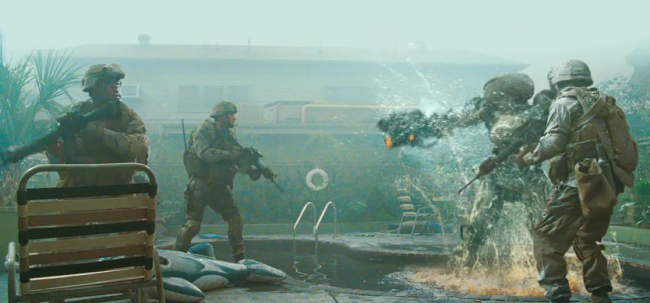
There is nothing like this kind of deep-thought in Battle: Los Angeles.  This is a war-movie of the modern era (but only technologically, the script is cliched with "boo-ya-speak") with Transformers instead of Talliban.  The film-makers (director Jonathan Liebesman and writer Christopher Bertolini) hedge their bets (and budget) by narrowing the focus of the story to one regiment fighting an armada of Erector Set exo-skeletoned aliens through the back allies of Santa Monica, California, attempting to secure a lone offensive while evacuating a handful of civiliansThe global conflict happens in the background on television monitors (the reason for the attack is some pundit-theorist's idea that they want our water, but it's only lip-flap for a half-hearted rationale), we just get to see the street skirmishes of this rag-tag clutch of war-hardened dog-faces as they battle the 'bots and each other not far from the pier.*

The action looks like Iraq and Afghanistan (and now, God help us, Libya), filmed in a confused snatch-and-grab style, but Liebesman gives you little context or overview, so it all just looks confused, as opposed to caught in realitythings only chill out for FX-heavy vista shotsRestrepo between Pico and Pier StreetAnd try as they might to make it feel authentic with shouted overlapping dialogue, there's just too much jargon of what Full Metal Jacket author Gustav Hasford called "the phony-tough and the crazy-brave."  It may walk and shake like CNN, but it talks like The Sands of Iwo Jima.  It's not relatable.  It's not personal.  It's not horrifying.  You don't feel this war.  You don't dodge the heat-rays and tracer rounds in your theater-seats.  It's as engaging as watching it on Fox News.  That is, not at all.  Eat your popcorn and wait for the armistice.

And I could quibble about the Intelligence gathering here.  Sure, they figure out that the sudden meteor showers are an invasion force pretty quickly, but the fighters fall as quickly as George Lucas' storm-troopers and battle-droids.  The attacks happen fast and devastatingly, but the things look electricity-based; one overhead nuclear pulse would take everything out.  Game Over.  It's shooting tin-cans then.  But, that never happens.  Instead, each city has an alien Command Central that controls everything in its area.  Isn't there a signal that can be jammed?  The only time Battle: LA gets interesting is when one of the "spam-in-a-can" fighters gets captured, and Staff Sergeant Nantz (Aaron Eckhart, trying very hard to rise above) and a civilian veterinarian (Bridget Moynahan) start a triage vivisection to answer the question "Okay, how do you kill one of these things?"  Now, that feels about right, practical strategy and the horrors of war combined in one icky sequence.  The rest just seems like contrivance, a recruitng feature for the Marines that won't offend any minority group.  A war movie shouldn't feel that safe.

A little bit better than the excremental Skyline, but not good.

Battle: Los Angeles is a Cable-Watcher.


* Inspired by the P.A. announcemnts from M*A*S*H

Tuesday, February 22, 2011

Rabbit Hole

"Ghost-busting"
or
"Coping Mechanisms"

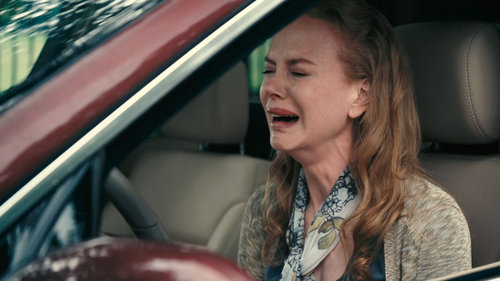
'Becca (Nicole Kidman) is going through the motions.  She's doing everything expected of her and dutifully.  The planting of new flowers in the garden, the making of stringent recipes of comfort food, the grief support group.  All those motherly instincts and nothing to mother, and everything—absolutely everything—reminds her of the void in her life.  Her child is dead, a victim of a car-pedestrian accident.  Her sister (Tammy Blanchard) is pregnant, her mother (Dianne Wiest) keeps bringing up her own dead child—Becca's brother, friends with kids avoid her as if death were communicable, the flowers get crushed, the pans go empty.  Life goes on, horribly.

Husband Howie (Aaron Eckhart, all clenched jaw and knotted body language) can't let go, sitting up every night endlessly watching a phone-video of little DannyThis frustrates 'BeccaSo do the "professional wallowers" of the support groupShe's avoiding grief, while Howie and the others are embracing it, and both sides are going too farShe starts to find ways of relieving herself of Danny's things, each one precious to Howie.  They start to splinter, the pressures of the void hammering them from both sides.

Life goes on, horribly.

Audiences have been avoiding Rabbit hole like those parents avoid Becca, the subject matter presuming to be a downer. More's the pity as there is enough humor in the cracks of the angst to make it worth seeing and nod appreciatively at the simulations of life and death and the grief that comes between.  Director John Cameron Mitchell stays out of the way, mostly, merely observing the struggles from sympathetic angles, while not making a big thing of the POV—making him a far subtler director than, say, Tom Hooper of The King's Speech.  The performances are pitch-perfect along the scale of emotional expression, from buried thought to screaming match, with Kidman sublimating technique for organic feeling to Wiest's haunted portrait of mother love.  You pull for these people as they learn to live with death, even if they only get a "C" average.

It would be unfair to say too much of the plot other than the set-up, but it touches briefly on comics and concepts of parallel universes and alternate realities—an alternate form of Heaven and the possibility that somehow, somewhere, things are different and that the cosmic dice might roll a different way.  Possibilities erode the concept of the concrete reality, and sometimes the best way out of a trap is to imagine the way out, rather than accept that there isn't.

A downer?  Maybe.  But I found something heartening in a film that suggests that the only way to fill the void of death is with larger doses of life.  And that the holes those voids leave can only be healed—not so much in reality—but, in another dimension, the warrens of our soul.

Rabbit Hole is a Matinee.

Monday, July 21, 2008

The Dark Knight

"Ya Wanna See an Actor Disappear?"

No, that title is not what you think it is (and shame for going there), but Heath Ledger does such a sick, twisted, inspired version of The Joker, he blows away all pre-conceived notions of the character and his own acting history. Ledger literally gets lost in The Joker, with the smeary, sloppy make-up, his voice that goes from wormy-Richard Dreyfuss to bellowing Ahab-roar (with occasional stops at Bugs Bunny chirpiness), and a gait that sometimes shambles, sometimes totters, sometimes Frankenstein-stomps. All that theatricality is entertaining, but it's the moments of lucidity that are scary. "You're insane!" says Gotham mob-boss Sal Marone (Eric Roberts, doing relaxed, sleazy work), not without reason. "No, I'm not," replies the self-proclaimed Agent of Chaos resignedly. "No...I'm no...tt!"

Ledger's not the only show in town in "
The Dark Knight". Aaron Eckhart makes a complicated "White Knight" of DA Harvey Dent (it's really his story), Christian Bale's Bruce Wayne and booming Batman are deeper than the portrayal of "Batman Begins"--more soulful, less Bush-brash--and Michael Caine and Morgan Freeman do able support for roles slightly more down-played than the last film's. This time, Gary Oldman's Lt. Gordon has more to do, and the longer he's on-screen, the better you like him, and Maggie Gyllenhall gives the character of Rachel Dawes more of a spine (with a contrarily slinky walk) than Katie Holmes was able to provide.

The buttoned-up script is full of triangulation. There's the good-guys--Gordon, Dent and Batman--against an Axis of Evil-- The Mob, Joker and Chinese financiers (and when one disappears from the screen they're replaced by another). And that's about as black-and-white as things get. Everything else is in convoluted, mordant shades of gray. There's the romantic triangle of Dawes and Dent, with Bruce Wayne as third-wheel. The Batman "team" of Wayne,
Alfred and Lucius Fox (all ensconced in the Wayne Enterprises high-rise while Stately Wayne Manor is being rebuilt). The plot devices are triangulated traps that have an either/or scenario with a third more-horrific option--which becomes The Joker's trademark, ensuring that something bad will happen no matter what. Targets are coordinated in sets, separating the weak from the herd and laying a further trap. It's Joker's way of providing Gotham "a better class of criminal." Batman's vigilantism has made the common petty thief think twice about stepping out of line. Now the Joker sets up elaborate conspiracies that bait and switch and then turn on a dime to a more complicated and deadly resolution. "You've changed things." he crows at Batman. "There's no going back." When Wayne begins to question whether he needs to take deadlier action because Joker has "crossed the line," Alfred reminds him "You crossed that line first, Master Bruce." Hours before, Wayne had considered giving up the fight with a legitimate civic-minded public figure arriving for Gotham in Dent. Now, he's fighting harder than ever, if only to not step further across that moral line dealing with the new criminal madness. And The Joker? He starts to take actions protecting The Dark Knight, realizing that they can't kill each other: "You... complete me" he cackles, in one of the chilling laugh-lines he spouts in an interrogation scene.

"The Dark Knight" ticks along (although it's overlong by half an hour--
Director Nolan has a hard time knowing where to stop the escalating madness), with increasingly bizarre acts of cruelty (the film gets a PG-13 only because Nolan cuts away from some of the more grisly aspects--but takes the character design of one iconic Bat-villain in a more charred and eaten-away manner than even the comics devised). By the end, some of the cast has been culled, and a long entrapment scene has gone on far too long, with still another set-piece just around the corner. At some point, every one of the good guys takes a hit, usually for noble purposes, but each keeps plugging away, trying to prevent having to put tooth-paste back in the tube, as consequence upon consequence piles up. And in the end, The Batman must re-adjust his modus operandi, taking on a new guise in his battle, one that he can only accomplish alone. At the same time, he handicaps himself to ensure he can't cross the line with too much power. He's left running in front of a metaphorical fast-moving train, knowing that at any moment he's going to have to turn and stop it.

"Dark Knight?" This thing is black as pitch.

In fact its relentlessly gloomy, and the sick thing is one looks forward to Ledger showing up for some light sickness to contrast the darkness. In fact, what has distinguished the "Batman 2.0" series of films is how they take the super-hero tropes and make them...practical and familiar. Nolan has kept this film-world translation of Gotham City looking gritty and realistic--far more so than the high-spired, mono-railed futuristic Gotham of "Batman Begins"--and the feel of the film is of an intricate crime drama, rather than a super-hero epic. The opening bank robbery is a nicely taut set-piece with more than one twist. And Nolan is far more adept at staging his action than previously. But by de-clowning The Joker, one wonders how some of The Dark Knight's three-color villains will translate to this milieu. One wonders where one goes from here. And one anticipates the next installment when this one has ended.

And that's a genuine accomplishment.

"The Dark Knight" is a full-price ticket. Don't take the kids.