Showing posts with label Marion Cotillard. Show all posts

Wednesday, February 6, 2013

Rust and Bone

Last Man Standing
or
You Don't Know What You Got 'Til It's Gone 

Jacques Audiard's new film De Rouille et le D'os  (Rust and Bone, in English) is as far afield from his last film, The Prophet, as could be.  That film was a mini-Godfather, that showed the traps a criminal puts himself into, whether he's in prison or the King of the Hill.  

Rust and Bone, though, is a love story about the transitory nature of selfishness and the numbing vacuousness of complacency, which sounds like it'd be a a dull film, or a pedantic English theme.  Combine it, though, with kick-boxing and killer whales chewing your legs off, and it becomes a different animal altogether.


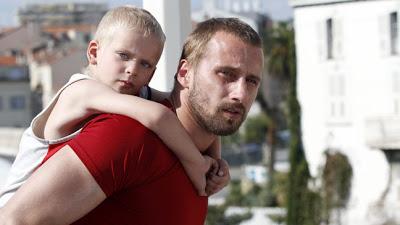
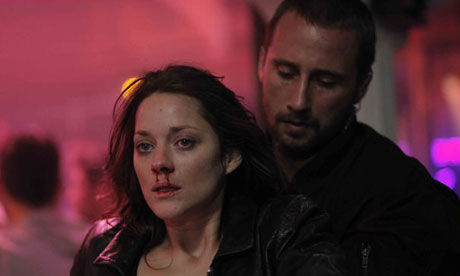
Ali (Matthias Schoenaerts), unemployed father of Sam (Armand Vendure), crashes with his sister in Antibes, while he tries to get his act together.  He jogs, he works out at the gym, dreams of being a kick-boxer, but the best he can do is bounce at a night-club, where he meets Stéphanie (Marion Cotillard), or rather rescues her, from an altercation.  She's a performer with a local Marineland park, directing killer whales through stunts and tricks, before a live audience.  Everything is going well during one performance when an accident happens and, as a result, Stéphanie loses both legs below the knees.  Submerged in depression, contemplating suicide, she calls Ali for help (it would be another of his string of odd jobs to earn money), where he starts to help her with therapy, specifically carrying her down to the wheelchair-inaccessible beach, so she can swim.


Ali is so deeply rooted in his own needs, that almost by osmosis, Stéphanie begins to care more about herself, and stops living in the past.  The sex helps.  But Ali is entirely self-absorbed and wants to keep things casual.  For further money, he starts participating in paid street-fight competitions, while Stéphanie takes the plunge and decides that she'll invest in artificial limbs and learn to walk again.

It's such a lop-sided story of co-dependency that it may seem like a frustrating film, but the performances of the two leads, Cotillard and Schoenaerts, go a long way in keeping interest.  Cotillard, in particular, seems to be oozing this performance out of some deep, dark place in her core (either that or she didn't sleep for a week) that is painful but fascinating to watch, while Schoenaerts is such a non-expressive performer, you might think that he is so completely internalized that he just walked off the street.  

And it's the performances that balance this film out, making the paths the actors take even necessary to sell the circumstances when the movie veers into melodrama, making an emotional course correction to get to an ending that...well, might have a point, even if a conventional one.

Meanwhile, Audiard does some impressive work with merely images, as the character of Ali is somewhat uncommunicative, and subtle shadows over people's faces suggest a shift in attitude between them.  And the whole Marineland sequences are like a sensory-overload nightmare—music constantly blaring, a robotic response-non-response from the performers to the audience, the pure, dumb folly of it all is quite an amazing sequence of textures and tones that provide a great deal of foreshadowing, even though you don't know what's coming—you just know that the place is on the knife-edge of panic and chaos.

So, an interesting film once it gets started, but then suffers a shift-tone that leads to some mighty convenient changes of heart, and makes Rust and Bone get all gooey inside, without (thank God) anthropomorphizing the whales.

Rust and Bone is a Matinee.


Tuesday, July 24, 2012

The Dark Knight Rises

The Bane of Our Existence
or
"Okay, What Joker Put Yeast in My Dark Knight?"


"All stories end in death, and he is no true story teller who would keep that from you"--Hemingway

"If you want a happy ending, that depends, of course, on where you stop your story"--Welles


So, Christopher Nolan's "Batman" trilogy ends in a nearly 3 hour film that neatly wraps up the story.  How does it end?  That would be telling.  The comics went through a phase where Bruce Wayne ruminated that he was working towards a world where he wasn't needed.  That's a nice little "buttoning up" of the "Dark Knight" story, but it's not complete.  What of Bruce Wayne?  Nolan has the opportunity in his version to really end it—he doesn't have to sell comic books next month—so, he can take it anywhere he wants to go.  And one realizes (if one really wanted to end the story) that the only real happy ending that could be achieved is if Bruce Wayne became the one thing he never knew as a child—a caring, present father.  Anything else makes the story a tragedy, and Bruce Wayne the last victim of the gunman's bullets that killed his parents.  Given this series' downbeat tone (that of the sacrificial martyr) and of the available previews for The Dark Knight Rises, such a scenario does not seem likely.  Given that, Nolan can take the tragedy of his hero in any number of directions.

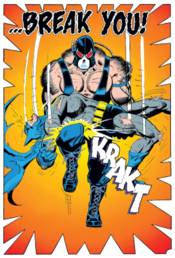
Bane (Tom Hardy here) is the perfect villain to bring into the mix.  A hopped-up minor character, he is best known as the lead antagonist for the "Knightfall" storyline (that seemed to last a couple years).  In "Knightfall," the drug-pumped super-villain released every criminal in Gotham's prison system for The Bat to deal with, while he hung back, biding his time.  Then, when the Batman, weakened and exhausted, finally confronted him, Bane broke his back, leaving Wayne paralyzed and unable to fight on.  It fell to the rest of "The Batman Family" (including the once-and-future "Robin's") to take on the mantle and continue the fight.

Nolan's canvas is a bit broader, taking into consideration the events of the two previous films to create something a bit more apocalyptic, a rumination on the fractious quality of good vs. evil and the slippery slope to Hell that ideology and good intentions can be tilted towards.  Nobody's pure in this one, there's no whack-job with delusions of grandeur behind the assault on Gotham City, with avarice their sole motive.  Everybody, wearing white or black, thinks they're doing the right thing.  And everybody's wrong.


It's eight years since the events of The Dark Knight that resulted in the deaths of D.A. Harvey Dent, Rachel Dawes, and the subsequent disappearance of the man suspected in the killings, the Bat-man (Christian Bale).  Now, Bruce Wayne is an exile in his newly-rebuilt Wayne Manor, walking stiffly with a cane due to some unknown injury (part of me wants to think it was due to him being stabbed by one of The Penguin's umbrellas).  He sees no one, is a recluse, and there are rumors he's turned into a Howard Hughes-style eccentric, apparently due to a massive investment in a clean energy prototype that failed and cost Wayne Enterprises a fortune...or at least half of it.  The chief backer for the project, Miranda Tate (Marion Cotillard) tries to get past the constant guards of faithful butler Alfred (Michael Caine, putting in the most emotional performance he's done in years) and Wayne exec Lucius Fox (Morgan Freeman), who fill the functions of acting as Wayne's heart and brains (and conscience), if not as surrogate Mother and Father.  A rival exec, Daggett, is trying to take over W.E., by any means necessary, in this case, employing a terrorist named Bane, who has his own bones to pick (and break) with Gotham's golden boy.  At the beginning of the film, Gotham in morosely complacent (and obviously filled with exposition), having cleaned up crime by the draconian Dent Anti-Crime Act, which has incarcerated over a thousand criminals in Gotham's Blackgate Prison.


But things are percolating underground, disrupting Gotham's infrastructure.  Bane has an army of misfits and big plans that have outgrown the desires of his patron, and there's a lithe cat burglar named Selina Kyle (Anne Hathaway), who is caught with her hands in the Wayne Manor safe by the man himself ("Oops," she says, not very convincingly).  Yes, she's pilfered Martha Wayne's pearl necklace, but more importantly, Bruce Wayne's fingerprints.  What does she want with those?


It's only one piece in an intricate puzzle of escalating consequences that Batman must unravel if he is, once again, to save Gotham City, and he must confront his past and overcome great injury, physical and emotional, if he is to prevent a catastrophe...one of his own devising.

That's the gist of it, but it is convoluted by elaborate set-pieces that are, frankly, jaw-dropping, and ends up with Gotham isolated from the rest of the nation, in the hands of criminals with big ideologies and little concern for how roughly they're applied.  The police are paralyzed—most of them trapped in the deep infrastructure of the city (a little too conveniently) while Bane initiates a countdown to total destruction.

A countdown of five months.

To quote The Riddler: "????"  Five months?  How suspenseful is that?  And you'd think that somebody, somewhere, would be able to unravel the plot or situation in such a time-frame.  But, it's basically a set-up for what Nolan depends on to generate suspense throughout the movie—the last minute "save," that is usually explosive and comes from nowhere, because the writer-director has made motivations ambiguous enough as to be unreadable.*  Everyone has got a secret that will be revealed at the most opportune moment of drama.  If the mystery was revealed in a drawing room, it would feel like cheating, and the revelations almost psychic.

Speaking of unreadable, Tom Hardy's Bane is hampered by a mask of a morphine dispenser (to keep him from feeling pain), as opposed to the enhancement-juice-pumping-apparatus from the comics (This leads one to ask: if the guy can be stopped by breaking the mask, why does Our Hero employ so many body-blows?  Face-shots, man!!).  He is perpetually muffled by this thing, which Hardy compensates for with an almost jolly Father Christmas speaking style, making a clever, unnerving ying-yang effect for the character.  Ultimately, though, he's something of a vapor-tiger, like Darth Vader, the big bloated bloviator who's merely a "blind," a distraction for the real danger.

But...five months??**

Another thing: Nolan has come out publicly saying that he wants to make a Bond movie (and the snowbound facility infiltration in Inception is a bowler-tip to them).  I would submit that he already has, this film being it.  So much of it is borrowed from Bond that all one needs is a casino scene to make it complete (a costume party has to suffice***).  The opening sequence, the-villain-that-feels-no-pain, the duplicitous females, obligatory "Q" scene, the tick-tock final set-piece and other aspects can be attributable to Bond films of the past.  At least someone is borrowing from the Bond series this time, instead of the other way around.

But, his world of comic-book fantasy is far more gritty and down-to-Earth than any other, and that's what makes "The Dark Knight Trilogy" good; it's relatable, it feels like it could happen, if someone had the will, the wherewithal and the wallet to do it.  It also feels of our time.  There's been a lot of gas about the politics in this film—uninformed, desperate gas—but the whole uprising scenario, the subjugation of the privileged with no benefit to the less fortunate, the breaking down of society and the cleaving of its people is the stuff of water-cooler vitriol and feels like the temper of the times.  The Tea Party AND the Occupy Wall Streeters can both find things to point at and go: "See?"  I'm not going to speculate which side is right, and Nolan is obtuse (and politically slippery) enough to play it right down the yellow stripe of the road.  But, this British director is saying something about the State of the Union with a full child-warbled rendition of The Star Spangled Banner (before a particularly horrific football game) and a shot of American flags in tatters on a city street, deep in the movie.  They're there for a reason, but not for anything specific enough other than "we're a fragile alliance and we're in trouble."

And that we need heroes—selfless ones, for whom profit is not a motive—and that, "anyone can be Batman."**** 

The Dark Knight Rises is a long-afternoon Matinee.

Bane's "big moment" in 1994.


* Case in point:  there's a scene where Catwoman uses a Wayne-supplied bat-bike to blow a hole in a tunnel to make an evacuation tunnel for the sealed-off city, a task initiated by the Caped Crusader.  Following it, Nolan sits on a pull-in shot of Hathaway with an enigmatic smile on her face that communicates...nothing.  Except an odd complacency.  It will only be resolved...if there's anything TO be resolved, later in the film. 

** There are neat touches, and a refresher of both The Dark Knight AND Batman Begins will help.  One nice thing—Nolan recalls a scene from BB when a young Bruce Wayne falls down a tunnel and is subsequently rescued by his father, by having a similar scenario played out here, with the Obi-Wan presence of a dark father figure from his past.  Nice touch.


*** A masked ball at which, like in Batman Returns, Bruce Wayne doesn't wear a mask.  Heh.

**** Just not Nicolas Cage, please...

Friday, September 30, 2011

Contagion

"Night of the Coughing Superstars"
or
"Please Wash Your Hands Before Exiting the Theater"

It's not nice to fool Mother Nature.  Or even to crowd The Bitch.  Because, sooner or later, she's going to look at all that nice smooth asphalt we've laid across her, and send up some crab-grass to seek out the weak spots and crack it.

"How do you like them pot-holes, Ozymandias?"*

Steven Soderbergh's "pandepic" Contagion fits quite well in the movie medical chest that includes such plague-filled films as Panic in the Streets, The Satan Bug, and The Andromeda Strain (one could also mention "The Stand," I Am Legend and the recent Rise of the Planet of the Apes—even, if we're talking Gaia's uprising, such natural disasters as The Happening (2008) and The Birds)—an organized, technologically advanced, scientifically-disciplined infrastructure is helpless against a simple organism that spreads through the sheer inevitability of exponentiality.**  It also cross-germinates into the "Butterfly Effect" genre (see Babel, 21 Grams, Crash)—you know, where we're all so interconnected that if a butterfly sneezes in China, we'd better cover our mouths in the United States or else we'll keel over into the Stone Age.***  And with so many stars (all very good, actually), it also reminds of one of those Irwin Allen SAG-slaughter disaster movies of the 1970's, that featured tag-lines like: "Who Will Survive?"

Contagion comes a few years after the majority of us could dismiss SARS and H1N1 in the real world with a blithe "where's the pandemic?" (completely dismissing such very real threats as AIDS and the hair-trigger Ebola and Marburg viruses).****  But, it is chilling that with all our research capabilities, we'd still be running behind any new threat, simply because the little suckers can evolve faster in the gut than we can be creationists in the lab.  And Scott Z. Burns (who wrote Soderbergh's The Informant! and is updating "The Man from U.N.C.L.E." for him) has taken an...er...clinical approach with his screenplay, starting moments after "first contact," following the progress of the disease from China, to the United states, its spread and detection by the Center for Disease Control and their efforts to isolate the cause, and, possibly, find a cure.  However fast they go (and it's a process hampered by testing schedules and production runs...and which pharmaceutical companies will profit from it), it's not enough to prevent wide-spread death and a near-collapse of societal structures throughout the world.  "It's figuring us out faster than we're figuring it out," says one of the techs (Jennifer Ehle) to her boss at CDC (Laurence Fishburne)...and it doesn't have a bureacracy to work through.  The drama is situational, so don't go in expecting ambulance chases and LED countdowns to disaster, but situations where families are ripped apart, investigators become victims, and desperation becomes just another symptom.  It's a procedural with a widely-flung spray pattern.

The cast is amazing...Matt Damon, Gwyneth Paltrow, Jude Law, Fishburne, Marion Cotillard, Kate Winslet...and just when you think they've run out of actors, up turns John Hawkes, Elliott Gould, Demetri Martin, and Bryan Cranston...you half-expect the full cast of Ocean's 13 to show up and cough out cameos.  No one dominates, everybody underplays, and the heroics are human and low-key. 

Nicely done, and food for thought, just wash your hands before eating.

Now, if you'll excuse me, I have a 2:00pm appointment for a flu shot.

Contagion is a...*cough*...Matinee. 

* "Ozymandias" by Percy Bysshe Shelley

I met a traveller from an antique land
Who said: `Two vast and trunkless legs of stone
Stand in the desert... Near them, on the sand,
Half sunk, a shattered visage lies, whose frown,
And wrinkled lip, and sneer of cold command,
Tell that its sculptor well those passions read
Which yet survive, stamped on these lifeless things,
The hand that mocked them and the heart that fed.
And on the pedestal these words appear --
"My name is Ozymandias, king of kings:
Look on my works, ye Mighty, and despair!"
Nothing beside remains. Round the decay
Of that colossal wreck, boundless and bare
The lone and level sands stretch far away.'


** We could also mention "The War of the Worlds," but there, the bugs are the good guys.

*** A better example would be: "If Greece doesn't raise its debt-ceiling, should I rollover my 401k into doubloons?"

**** And yesterday, I heard people are dying from Listeria-infected cantaloupes! 

Thursday, June 9, 2011

Midnight in Paris

"Gertrude Stein Punched Me in the Mouth"
or
"L'époque est toujours plus belle de l'autre côté du pont Einstein-Rosen"

 "A Twenties Memory" by Woody Allen
Copyright © 1966-1971 by Woody Allen


I've been waiting for Woody Allen to make this film since before he asked to Play It Again, Sam (or even What's Up, Tiger Lily?). 

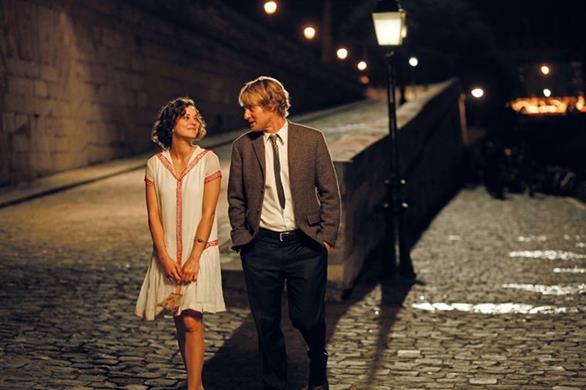
Based on a routine from his stand-up days,* which he later expanded for a piece in "The New Yorker" (see above), Midnight in Paris follows Gil (Owen Wilson) a self-absorbed, neurotically anxious writer of Hollywood fluff ("Wonderful, but forgettable...sounds like something I wrote"), who is obsessed with death,** as he travels to Paris from Pasadena with fiancee Inez (Rachel McAdams, but it could just as well have been Elizabeth Banks) and her conservative family. Gil is working on a novel, long in the gestation, and is distracted by the vapid shallowness that he is about to marry into.  Paris is shops, restaurants, museums and snootiness, and to escape the jejeune de vivre, he takes a late-night walk through the streets of Paris and is approached by a vintage taxi.  Entering the cab for Gil is a magical moment for him, on the same plane-breaking as when Tom Baxter (or is it Gil Shepherd) walks off the screen in The Purple Rose of Cairo.  He is instantly transported to 1920's Paris and becomes lost in "The Lost Generation"  (without the benefit of having survived World War I), meeting Cole Porter (Yves Heck), Ernest Hemingway (Corey Stoll), Zelda (Alison Pill) and Scott Fitzgerald (Tom Hiddleston), all the heroes of his favorite literary era and time, 1920's.  He's enchanted...and as his novel is about the time...inspired.  He goes back to Inez, gob-smacked, unable to explain where he's been all night, but "alibi's" his adventures as a dream (as they are, certainly in the aspirational sense).  He tries to bring Inez to the party, but the magic doesn't work—she's as unthrilled with Gil's stories as he is with her wine-tasting adventures with acquaintance Paul (Michael Sheen). 

She leaves.  And the taxi arrives, bearing Gil and Hemingway to the apartment of Gertrude Stein (Kathy Bates) and Alice B. Toklas (Thérèse Bourou-Rubinsztein), who are playing judgemental hosts to Pablo Picasso (Marcial Di Fonzo Bo) and his enchanting mistress Adriana (Marion Cotillard).  Gil gives his novel to Stein and Hemingway to critique, but he is drawn to Adriana, making her way through the 20's as best she can.

So, the two planes of existence for Gil are set up: his modern-day drudgery on the cusp of a marriage of inconvenience; and his fantasy past, where his dreams are reality and reality can make dreams.  You know where this is going.

It doesn't matter, though.  This is a "feel-good" Woody Allen picture—the kind people like—where the messages are still telegraphed the way they are in "obvious" Allen movies, the coincidences just a little too convenient, but so full of incident, grace and nuance (and quite a bit of humor) that it goes down well (as Allen groused throughout Stardust Memories, audiences "like his earlier, funnier [movies]").  That Gil is such a sunny presence in the past (and as played by Wilson, he has a guileless charm that doesn't sacrifice intelligence—he's the way you'd imagine Jimmy Stewart would play Woody Allen), even his kvetching is charming and not harsh.  It doesn't matter that you be a history buff and "get" all the references,*** (and we meet Luis Bunuel, Man Ray, Salvadore Dali [Adrien Brody], and on a side-trip, Toulouse Lautrec, Gaugin and Degas).  Of course, Gil is enchanted; he is an era when his heroes are still at the stage he is, becoming themselves, with their best work still ahead of them.  His age of magic is their everyday life.  The interesting lesson of the film (and what makes it special and wise) is that knife cuts both ways.  The "lesson" is both sour and sweet, but not hope-crushing—a little bit of salt in the creamy fluff.

And no, nobody punches Gil in the nose—but you can't help noticing that Wilson's is a little broken.

"Midnight in Paris" is an enchanting Matinee.


*  I mentioned before that I was in Europe. It's not the first time that I was in Europe, I was in Europe many years ago with Ernest Hemingway. Hemingway had just written his first novel, and Gertrude Stein and I read it, and we said that is was a good novel, but not a great one, and that it needed some work, but it could be a fine book. And we laughed over it. Hemingway punched me in the mouth.

That winter Picasso lived on the Rue d'Barque, and he had just painted a picture of a naked dental hygenist in the middle of the Gobi Desert. Gertrude Stein said it was a good picture, but not a great one, and I said it could be a fine picture. We laughed over it and Hemingway punched me in the mouth.

Francis Scott and Zelda Fitzgerald came home from their wild New Years Eve party. It was April. Scott had just written "Great Expectations," and Gertrude Stein and I read it, and we said it was a good book, but there was no need to have written it, 'cause Charles Dickens had already written it. We laughed over it, and Hemingway punched me in the mouth.

That winter we went to Spain to see Manolete fight, and he was... looked to be eighteen, and Gertrude Stein said no, he was nineteen, but that he only looked eighteen, and I said sometimes a boy of eighteen will look nineteen, whereas other times a nineteen year old can easily look eighteen. That's the way it is with a true Spaniard. We laughed over that and Gertrude Stein punched me in the mouth.


** Yes, this is the Woody Allen character.  His films never fall too far from the analyst's couch.

*** I certainly didn't—I had to do some referencing for the line: "That was Djuna Barnes (I was dancing with)?  No wonder she wanted to lead."

Tuesday, July 20, 2010

Inception


"All That We See or Seem..." *

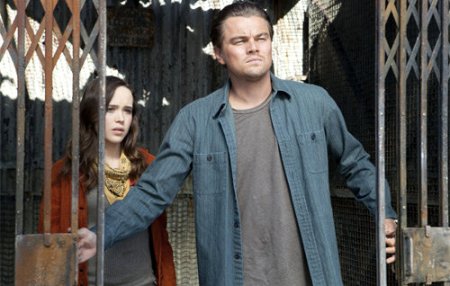
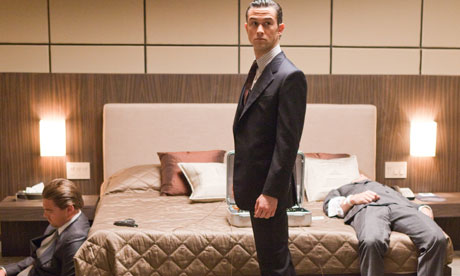
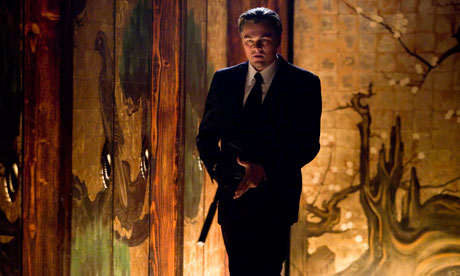
The latest film from that Master of Disorientation, Christopher Nolan—"Inception"—may be his most intricate puzzle yet.  A nest of corporate spies, using dream-suggestion, steal secrets from business rivals to their clients.  One such mission turns into a nightmare, and the team's leader, Dominic Cobb (Leonardo DiCaprio), accepts the subject (Ken Watanabe) of his previous mission's challenge: 1) to implant a suggestion into a rival while sleeping, which 2) requires a nested suggestion—"a dream within a dream"—to be pulled off, the reward being 3) Cobb will be given his dream come true, all inquiries into a previous tragedy will be dropped and he will be allowed to return to his home in the U.S., where his children await him.


To accomplish this, he must assemble a team: "The Architect," Ariadne (Ellen Page), who will design the dream-scape, "The Point-Man," Arthur (Joseph Gordon-Levitt), who will monitor the progress of the mission and initiate the extrication from the dream, and "The Forger," (Tom Hardy), whose intricate research will reassure the subject that the dream has a basis in fact.  Then, there's Cobb.  An incredible asset, but a liability, he suffers from the guilt of not preventing the death of a previous team-mate, his wife Mal (Marion Cotillard), who pops up in the shared dream-scapes to unravel the scheme and punish him.  Of course, she's just his guilt talking.  The team's emotions have as much importance in dreams as the images.


Something about this sound familiar to you...beyond the surface "Mission: Impossible" trappings, gene-spliced with a psychic "Fantastic Voyage?"  An "Architect," like a set-designer, the "Point-Man," like a producer or location scout, the "Forger," like the cinematographer recreating verisimilitude, all illusionists dream-synced to accomplish a single goal;  Nolan is talking about The Movies.


He isn't the first: Howard Hawks equated the social structure of any inter-dependent team with the circus of techs and talents involved in film-making, and Hitchcock frequently ruminated on how the movies were a dream-scape (that often turned into nightmares) with his highly subjective angles and cutting.  But, Nolan—given his dream-projects—chooses to make movies that exploit and comment on the special illusory power of film: shifting narratives and time-lines, the power of the edit (and the critical when), the magic of movie-making that goes beyond simple photo-recording, and narratively bending that reality to your will.  Movies are a dream, tapping into our psyches, and also influencing them, their ideas infecting us (as we're often told in the film) "like a virus.".  One of the neatest narrative gambits in "Inception" is Cobb's rule for knowing you're in a dream: "Think—how did you get here?"  In a movie, you're edited into a situation, dropped from one place to another with a single splice.  Like magic.  Like a dream.


In "Following," Nolan threw us into "the deep-end" of an obsessive-compulsive's life, fracturing the time-line, with our only clues to structure being the protagonist's appearance (like a dream).  "Memento," we follow a man with cognitive dissonance, who can only retain a memory for 15 minutes, we alone are left to remember the dream to its beginning.  "Insomnia" centers around a man who can't dream, and "The Prestige" tells its tales of magic and science while playing with the conventions of story-telling.  Nolan's non-superhero films are all about movies—and how movies can be used to fool you, like a magician's trick.  His weakest films depend on it to hold them together; more than just an editing "gimmick," the films would be pointless without the structure.


There is no doubt in my mind that Nolan equates the two—and he leaves a final layer of his dream-within-a-dream-scape on the soundtrack at the end of the film to take us out of it.** The film's last visual gambit also calls into question dream versus reality, but does so in a very filmic way.  There has been some kvetching about that last shot being an obvious ploy to head-fuck—like the arbitrary shot of the ice-pick at the end of "Basic Instinct"—but that's missing the point: the significance of the shot is when Nolan cuts away from it. ***


When I did my "Now I've Seen Everything" piece on Nolan, I wrote this:

"In Media Res" is the term for one of his films, the lens aperture opening for a limited amount of time, and closing with events still in flux, the world changing, and the future uncertain. One has the sense of the film merely stopping, with the story-line continuing past the audience's part in it, again leading to a lack of fulfillment...or dread. In either case, one exits a Nolan film dis-oriented, uneasy...but not often dis-satisfied.

That still applies here.  And Nolan gets to do his time-bending tricks in a significantly different way, revealing them in personal dreams, while maintaining a (rare for him) linear time-line.  That strategy comes to fruition with a unique sequence where the team (and we) are plunged into deeper and deeper nested dreams, each with its own time-scale and dis-orientation, cutting back and forth between them as they progress at different speeds and different orientations (dependent on what is happening in the previous tier of dream-level).  It is a bravura sequence that leaves one a bit breathless, shaking one's head that it is so intricately staged and communicated.  I don't recall seeing anything quite like it.

There are little quibbles, of course: Nolan's dream-scapes never veer far into the surrealistic, remaining quite concrete in how things look and act, and the dream sequences maintain the hard-edged quality of movies and video-games (but, hey, it's Nolan's dreams); the third dream-level (which recalls a war/spy assault on an impenetrable mountain HQ) seems to be unaffected by the physical forces that so influence and warp the second; and the mission (and the entire movie is "the mission" making the general feel of the thing a bit slight) has a smug amoral satisfaction to it, that is vaguely disquieting, and no sense of good and evil (only profit and loss) which would give the movie some sort of conscious weight.

But these are minor distractions...vague notions in the subconscious while grooving on the movie.  I don't think "Inception" is Nolan's best film (I vacillate between "The Dark Knight" and "The Prestige"), but as an exercise on the possibilities and power of film—as both medium and message—is a dense, intricate, satisfying film that's fun to puzzle out during and after its playing.

No, I have no regrets.

"Inception" is a Full-Price Ticket.

* From Poe's "A Dream Within a Dream," which, in imagery, rumination, and motivation, fits many of "Inception's" themes—it probably inspired many aspects of it:

Take this kiss upon the brow!
And, in parting from you now,
Thus much let me avow-
You are not wrong, who deem
That my days have been a dream;
Yet if hope has flown away
In a night, or in a day,
In a vision, or in none,
Is it therefore the less gone?
All that we see or seem
Is but a dream within a dream.

I stand amid the roar
Of a surf-tormented shore,
And I hold within my hand
Grains of the golden sand-
How few! yet how they creep
Through my fingers to the deep,
While I weep- while I weep!
O God! can I not grasp
Them with a tighter clasp?
O God! can I not save
One from the pitiless wave?
Is all that we see or seem
But a dream within a dream?


** SPOILER ALERT: That audio clue is in the film's final minutes as Edith Piaf's emblematic "Non, je ne regrette rien" plays on the soundtrack until it is gradually replaced by the staticy thrum that indicates the waking process from the dream-scape; when it ends, the film ends.  That it is used in the film as the team's traditional "safe-word" alarm to extricate them from a dream is the film's final tie-in to being a dream-state.  It is significant that it is THIS song, as it is tied to Piaf so indelibly, and echoes as well to Marion Cotillard, who played the chanteuse in her Oscar-winning role in "La Vie en Rose," and here, plays Cobb's tragic wife, who represents his biggest regret.  This is one of ripples running through "Inception," through layers and layers and layers.  Like a glass onion.

*** And if you're looking for an answer to whether it's a dream or reality ("it's a FILM, dummy!"), just apply the "How did he get there?" rule: the whole movie is about "how he gets there."

Thursday, December 31, 2009

Nine

"How Do You Solve a Problem Like Fellini?"
or
"There Ought To Be Clowns (Don't Bother, They're Here)"


There is a great movie, I'm sure, to be made of the Tony Award winning musical "Nine." But this isn't "it." Nor, I think, was "it" an intention for the production company to do so.

In fact, it is hard to determine what "it" is, and what "it" intends to do. Is it a musical adaptation of
Fellini's "8 1/2," or of Fellini's life? Is it even an adaptation of the original musical, as there are far more songs left out of it than are in it?* Locations are changed, circumstances and motivations are sliced and diced. One wonders what was so wrong about a hailed musical confection that the late Anthony Minghella and Michael Tolkin (who wrote the script), current director Rob Marshall, and the producers seem to be running away from it.

They aren't the only ones, merely they slowest of the pack.
Daniel Day-Lewis was a last minute first tier replacement for the more suitable Javier Bardem when Bardem walked off the project pleading "exhaustion"—but not exhausted enough to flee, evidently. Bardem makes very wise career choices. Nicole Kidman replaced Catherine Zeta-Jones after the producers wouldn't accomodate her demands to expand her part. One wonders why they'd balk about making any more changes for their "Chicago" Oscar-winner after making so many of their own.

But, truth be told, the thing is a sorry, sorry mess. Not true to its source, its inspiration, or even to itself, one reads the description of the original musical and wonders why it is not the movie. But one gets an inkling.
Fellini's film, made about a creator's inability to create a harmonious chorus of the voices in his head, his muses, his collaborators and backers all clamoring for attention had a structure, a purpose and an approach. But it did not have a lift, a creative inspiration until Fellini made it about a director rather than a writer. Fellini had no trouble making it, letting his conscience and unconscious be his guide (or Guido, if you will). On the contrary, he was energized by it. His "film that got away" would not occur until a bit later in his career.

The creators of "
Nine" saw it as about themselves, and the difficulty of achieving a vision. One sees the disconnect with the Fellini inspiration as soon as the musical Guido's obsession with the Folies Bergiere is brought to song. Folies Bergiere? Mama Mia! Where's the Circus? Fellini equals circus! Comprende? But, "Nine" the musical—not the film, that gets even worse—is glitz and spangles and presentation with a smattering of psychological insight embroidered in a mash-up (one can't call it a mixture) of half-inspired and un-inspired songs.

"Nine," the movie, is a whoring down of that concept.
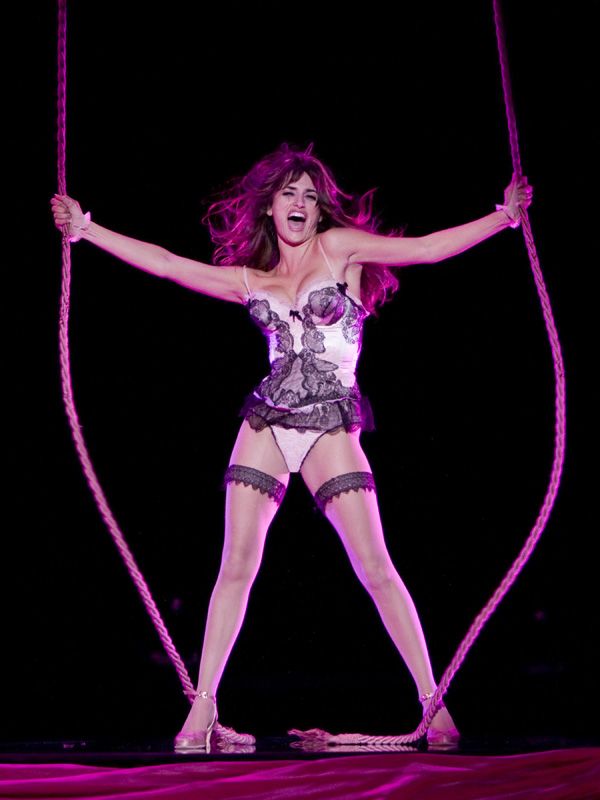
Big stars. Small ideas. A polyglot of a tribute to a movie it doesn't understand, and the broadway production that the money-men didn't feel had enough pizzazz** to put keisters in the seats (Because nothing makes you want to "Fosse, Fosse, Fosse" and booty-shake like ennui and creative stagnation!***). So, we've got Day-Lewis (he's fine—not too believable, but at least he's not doing a John Huston imitation this time).**** We've got Nicole Kidman and Penélope Cruz (wonder what they had to talk about on-set?), Kate...Kate Hudson (??), and....Fergie?(!!). Then, to give it some ethnic legitimacy they throw in Sophia Loren***** and Miramax staples Judi Dench and Marion Cotillard. Cotillard is heart-breaking as the Giulietta Massina look-alike wife—played by Anouk Aimée in Fellini's film (she's even got Massina's brave smile down). Dench does fine by her number, silly and irrelevent as it is, but as if to gin up any excitement, they work over-time trying to make it entertaining. Cruz gets a sizzling number as director Guido Contini's mistress-played by Sandra Milo in the original film. Kidman plays Contini's past star Claudia (based on the Claudia Cardinale character in "81/2"—which would have tied in with Zeta-Jones' participation, but goes back to the original inspiration, "ice queen" Anita Ekberg for Kidman's participation). Loren plays Contini's domineering Mamma, usually a grotesque in Fellini's films.

Director Rob Marshall undercuts the material by over-cutting, editing all the momentum out of the music, which veers from worthwhile ("Be Italian" given a rip-roaring rendition by...give her credit, she's the best thing here...Fergie of "The Black Eyed Peas") to the filler ("Cinema Italiano" given sass by Kate Hudson, but shot and edited like an MTV version of the old '60's "Shindig!" program).

I was looking forward to this one, but very high expectations leave the biggest craters when they fall. Not a fan of musicals, "Nine" only confirmed why I've rarely enjoyed them, as they can be false and irrelevent to anything resembling life or the inpulse to song that it might evoke.

This adaptation of an adaptation of a somewhat autobiographical work by the artist, even though titularly and musically adjusted for inflation, just isn't worth as much as the original. Artistically, it is bankrupt.

"Nine" is a Cable-Watcher.

* Three new songs were written for it, all of them unmemorable—in a bid to score more Oscar nominations for The Weinstein Company which oversaw this sorry mess.

** Imagined conversation: "Y'know? Everybody's singing about their feelin's an' everything! There's not enough dancing with women with big bazooms, and Alfa Romeo's and Fiat's!! Know what I'm sayin'?"

*** Although Fosse did make a musical based around a heart attack!

****...which reminds me, the last movie I've seen that ended (like "Nine") with the director-figure saying "Action" was Clint Eastwood's "White Hunter, Black Heart"—where Eastwood was playing (and imitating) John Huston!

***** Did it occur to the makers that the only Italian in their film celebrating Italian cinema is Loren? And that she didn't work with Fellini?