Thursday, August 30, 2012
Ruby Sparks
or
"The Situation is Crazy. I Am Not."
Stephen King will see this one and slap his forehead for an opportunity missed for a seven hundred page novel. I've known enough authors of fiction that have mentioned a scary thing: they'll start writing, fleshing out the skeleton of an idea, the characters take shape, become three-dimensional, and then suddenly, they live. In fact (and fiction), they become so alive they'll start doing things and going in directions that the author never intended or had even planned for. The figments of the author's imagination take on a life of their own, rebel and...rather than the author changing them, they change the author, or at least his intentions for them.
Eerie. And the basis for Ruby Sparks, the latest film from Jonathan Dayton and Valerie Faris, the folks who directed Little Miss Sunshine. That film I wasn't too crazy about, as it seemed to scream "Indie Sensibilities" from every tortured writerly "quirk" that was tossed in. Ruby Sparks, however, is different—a nicely buttoned-up movie that reverberates with all sorts of echoes that ripple through the film and cross over in a concentric series of folded back references, self- and otherwise.
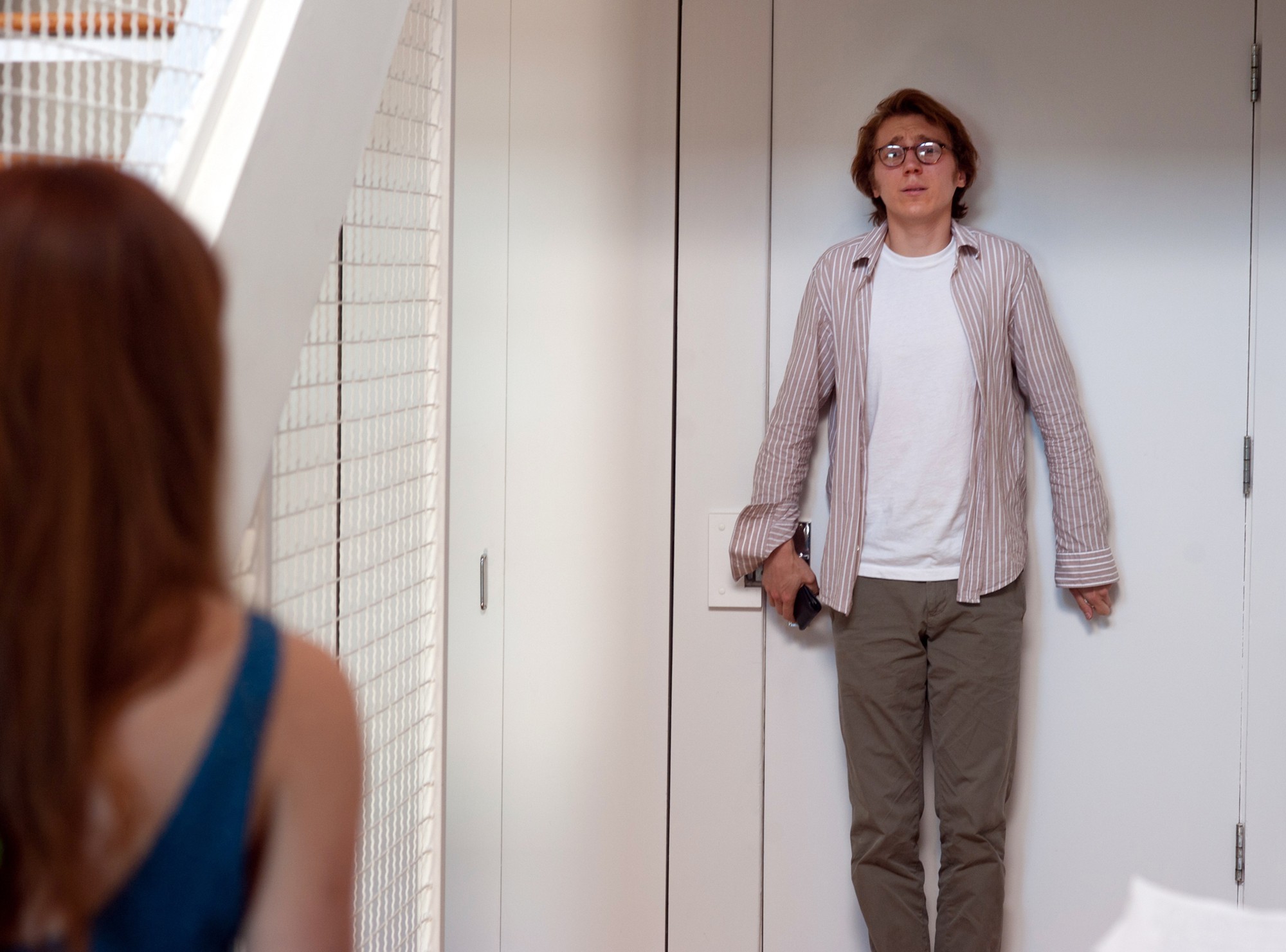
Author Calvin Weir-Fields (Paul Dano) is struggling with a follow-up novel after an initial success—struggling for 10 years, in fact. His shrink (Elliott Gould) gives him an assignment to take the pressure off, and Calvin is inspired, writing about an idealized, neurotic woman named Ruby Sparks. But, he's not just inspired, he's energized, so much so he can't wait to get back to his typewriter (it's this old piece of technology before a PC, or what was known in the Pleistocene era as a "word processor") to continue the work, spend more time with her, creating her. So much so that he starts to fear that he's falling in love with her. His brother reads the pages and his criticism is harsh: "You haven't written a person. You've written a girl. Geeky, messy girls are not what people want." He remains undeterred, writing all night and into the morning. Imagine his horror when he wakes up from his QWERTY keyboard, runs downstairs and finds Ruby (Zoe Kazan) in one of his shirts, eating cereal.
He freaks, naturally, much to her consternation, and then is shocked to discover that everybody can see her, too. She's just not a figment of his imagination; his imagination walks amongst us.
This is the stuff of male fantasy rom-com's. But, Ruby Sparks takes it into some dark places, ala Hitchcock, in the realms of identity, manipulation, male wish-fulfillments, and the odd idealization and expectations that love creates and blinds us to. We all create an object of affection (on both sides, sending and receiving), but whether that object has anything to do with reality depends on both parties and how much they want to compromise to achieve that...whatever it is..."more perfect union," let's say.
The script (by Kazan herself) explores some uncomfortable territory in that regard and Kazan has a knack for writing dialogue that is spot-on, but containing deep echoes that weight them further. It's one of the better rom-com/fantasy scripts to come along in awhile—at least it has a thought in its head—and the performers, while still showing an abundance of the too-eager "cutes," its not enough to keep you wondering how it all could end. Yes, the film has its moments of coy cloyness—for example, when Ruby goes to a family dinner with Calvin's hippy-dippy step-parents (Annette Benning and Antonio Banderas), that amounts to a side-bar, and just lets us know what we already know, that Calvin is a bit of stick-in-the-mud and a buzz-kill, and (surprise, surprise) less capable of change than his own creation, which, if he wanted to, he could correct with a new sentence, or some Liquid Paper.
It doesn't go there (and only for revelation purposes, any more and it might be a good vehicle for Adam Sandler), nor does it end "Happily Ever After" as rom-com's do (but only because they choose to). Ruby Sparks chooses another way, fully committed to not committing and finding the fine balance of compromise.
Ruby Sparks is a Matinee
Friday, September 30, 2011
Contagion
"Night of the Coughing Superstars"
or
"Please Wash Your Hands Before Exiting the Theater"
It's not nice to fool Mother Nature. Or even to crowd The Bitch. Because, sooner or later, she's going to look at all that nice smooth asphalt we've laid across her, and send up some crab-grass to seek out the weak spots and crack it.
"How do you like them pot-holes, Ozymandias?"*
Steven Soderbergh's "pandepic" Contagion fits quite well in the movie medical chest that includes such plague-filled films as Panic in the Streets, The Satan Bug, and The Andromeda Strain (one could also mention "The Stand," I Am Legend and the recent Rise of the Planet of the Apes—even, if we're talking Gaia's uprising, such natural disasters as The Happening (2008) and The Birds)—an organized, technologically advanced, scientifically-disciplined infrastructure is helpless against a simple organism that spreads through the sheer inevitability of exponentiality.** It also cross-germinates into the "Butterfly Effect" genre (see Babel, 21 Grams, Crash)—you know, where we're all so interconnected that if a butterfly sneezes in China, we'd better cover our mouths in the United States or else we'll keel over into the Stone Age.*** And with so many stars (all very good, actually), it also reminds of one of those Irwin Allen SAG-slaughter disaster movies of the 1970's, that featured tag-lines like: "Who Will Survive?"
Contagion comes a few years after the majority of us could dismiss SARS and H1N1 in the real world with a blithe "where's the pandemic?" (completely dismissing such very real threats as AIDS and the hair-trigger Ebola and Marburg viruses).**** But, it is chilling that with all our research capabilities, we'd still be running behind any new threat, simply because the little suckers can evolve faster in the gut than we can be creationists in the lab. And Scott Z. Burns (who wrote Soderbergh's The Informant! and is updating "The Man from U.N.C.L.E." for him) has taken an...er...clinical approach with his screenplay, starting moments after "first contact," following the progress of the disease from China, to the United states, its spread and detection by the Center for Disease Control and their efforts to isolate the cause, and, possibly, find a cure. However fast they go (and it's a process hampered by testing schedules and production runs...and which pharmaceutical companies will profit from it), it's not enough to prevent wide-spread death and a near-collapse of societal structures throughout the world. "It's figuring us out faster than we're figuring it out," says one of the techs (Jennifer Ehle) to her boss at CDC (Laurence Fishburne)...and it doesn't have a bureacracy to work through. The drama is situational, so don't go in expecting ambulance chases and LED countdowns to disaster, but situations where families are ripped apart, investigators become victims, and desperation becomes just another symptom. It's a procedural with a widely-flung spray pattern.
The cast is amazing...Matt Damon, Gwyneth Paltrow, Jude Law, Fishburne, Marion Cotillard, Kate Winslet...and just when you think they've run out of actors, up turns John Hawkes, Elliott Gould, Demetri Martin, and Bryan Cranston...you half-expect the full cast of Ocean's 13 to show up and cough out cameos. No one dominates, everybody underplays, and the heroics are human and low-key.
Nicely done, and food for thought, just wash your hands before eating.
Now, if you'll excuse me, I have a 2:00pm appointment for a flu shot.
Contagion is a...*cough*...Matinee.
* "Ozymandias" by Percy Bysshe Shelley
I met a traveller from an antique land
Who said: `Two vast and trunkless legs of stone
Stand in the desert... Near them, on the sand,
Half sunk, a shattered visage lies, whose frown,
And wrinkled lip, and sneer of cold command,
Tell that its sculptor well those passions read
Which yet survive, stamped on these lifeless things,
The hand that mocked them and the heart that fed.
And on the pedestal these words appear --
"My name is Ozymandias, king of kings:
Look on my works, ye Mighty, and despair!"
Nothing beside remains. Round the decay
Of that colossal wreck, boundless and bare
The lone and level sands stretch far away.'
** We could also mention "The War of the Worlds," but there, the bugs are the good guys.
*** A better example would be: "If Greece doesn't raise its debt-ceiling, should I rollover my 401k into doubloons?"
**** And yesterday, I heard people are dying from Listeria-infected cantaloupes!
Wednesday, July 8, 2009
The Long Goodbye
"The Long Goodbye" (Robert Altman, 1973) Wise-acre. Ass-hole. Cutie-pie. Philip Marlowe's called a lot of names, but in Robert Altman's version of "The Long Goodbye," he's also "The Marlboro Man, The Duke of Bullshit."
As Elliott Gould's Phillip Marlowe says again and again "It's okay with me."
It was supposed to be a straight-ahead adaptation of the Raymond Chandler novel. Leigh Brackett, who had written a lot of Howard Hawks' films (including his adaptation of Chandler's "The Big Sleep") changed the ending, added some characters and complications and Hawks was contacted to direct. Nope. Then Peter Bogdanovich, who also passed, but who mentioned Robert Altman for director. Altman loved the new ending, mentioned Elliott Gould for Marlowe and a deal was made.
And that's where the changes come in. Because the last adaptation of a Chandler Philip Marlowe story was the somewhat irrelevent "Marlowe" starring laconic James Garner in the title roll. Created deep in the 60's, that film feels old-fashioned and a bit musty (even with Bruce Lee kicking apart Marlowe's office!). But for "The Long Goodbye," Altman was going to drop Marlowe into early 70's era Los Angeles, where everybody wore caftans and bushy sideburns, were into macrobiotics, EST and pot—a post-hippie era of conspicuous consumption that had trickled down from Marlowe's beat (problems with the rich) to the exotic dancers and truck-drivers of the pre-disco era.* Marlowe and his code of honor would seem out-of-touch in such a world.
Then throw in Elliott Gould's rat's nest interpretation of the character and you get a completely other sensibility—one begins to suspect Marlowe of being incompetent in such a world, unable to function (he can't even find his own cat), but he does, snapping to whenever some dies (or is about to). And another nice touch is Gould's mumbling patter along the way, supplying his own first-person narrative, ala Chandler.
L.A. in twilight is still the same and the supporting cast of hoods and thugs as menacing as the time the Marlowe books encapsulated (late '30's to mid-50's), but now they're more than just socially deviant, they're demonstrably sociopathic in the form of Marty Augustine (director Mark Rydell), with twisted justifications for their actions, which can sometimes be just a sadistic play of power. And that's what makes Leigh Brackett's screenplay a bit different than the tone she took away back in 1945 when she and William Faulkner adapted Chandler's "The Big Sleep" for Howard Hawks and Bogey and Bacall: there's no sense of right and wrong, it's a sense of right and wrong for "me." And Brackett allows Marlowe to make a final statement condemning that world. It's the only way that this Marlowe...in this world...can "make it right."
There are problems—some stunt-casting—Nina Van Pallandt (mistress of Howard Hughes scammer Clifford Irving) and Jim Bouton (former Seattle Pilot and author of "Ball Four!")—call more attention to the actors than the characters and Altman regular Henry Gibson has no steel core to speak of for his predatory doctor, but throughout, Altman and ace cinematographer Vilmos Zsigmond bring a formal off-the-cuff look to everything in L.A., culminating in two beach shots reflected in windows that present two perspectives on conversations, while in a push-focus the audience is clued in to happenings going on at the surf's edge, one inconsequential, the other, irretrievable. It's a fine example of Altman's ability as a seamless film-maker making his movie in the camera and relying less on the unique art to film-making of editing.
Two posters/One film: Two stories
The original film-poster that confused L.A. audiences into thinking they'd be seeing a straight-ahead thriller. The film was withdrawn for six months and re-instated with the above Jack Davis-designed "Mad" style poster for the New York run, where it was very successful.