"Grimm's Fairy Spy"
or
"Better Living Through Chemical Brothers"
Hanna isn't like any movie you've seen, if you managed to miss some of the more stylish spy thrillers at the end of the 1960's. When the spy-craze went more mainstream more A-list directors started to get into the fray and suddenly the thrills started to be taken over by style as those film-makers attempted to impose some of their own creative instincts into the genre. Sometimes the results were a sub-par thriller, others were just plain pretentious. Some...were interesting (like this one is, and like The American was last year).
Joe Wright is one of the better British directors coming out BBC television work. He's done his bit for the classics, old and new (Pride & Prejudice, Atonement) quite deftly handling the drawing room choreography and even putting a nicely modern spin on things. But, his 2009 film of The Soloist showed a director who wanted to experiment with the form, break out of the stodgy "Beeb" way of doing things and shake the story-telling up a bit (in that film, he turned Los Angeles into a living, breathing, rumbling sci-fi character looming over its strata of citizenry). It was interesting to see him attached as director to what looked like a common "actioner," and one wondered what he might bring to it, given his three previous films and how he appeared to be changing his style.
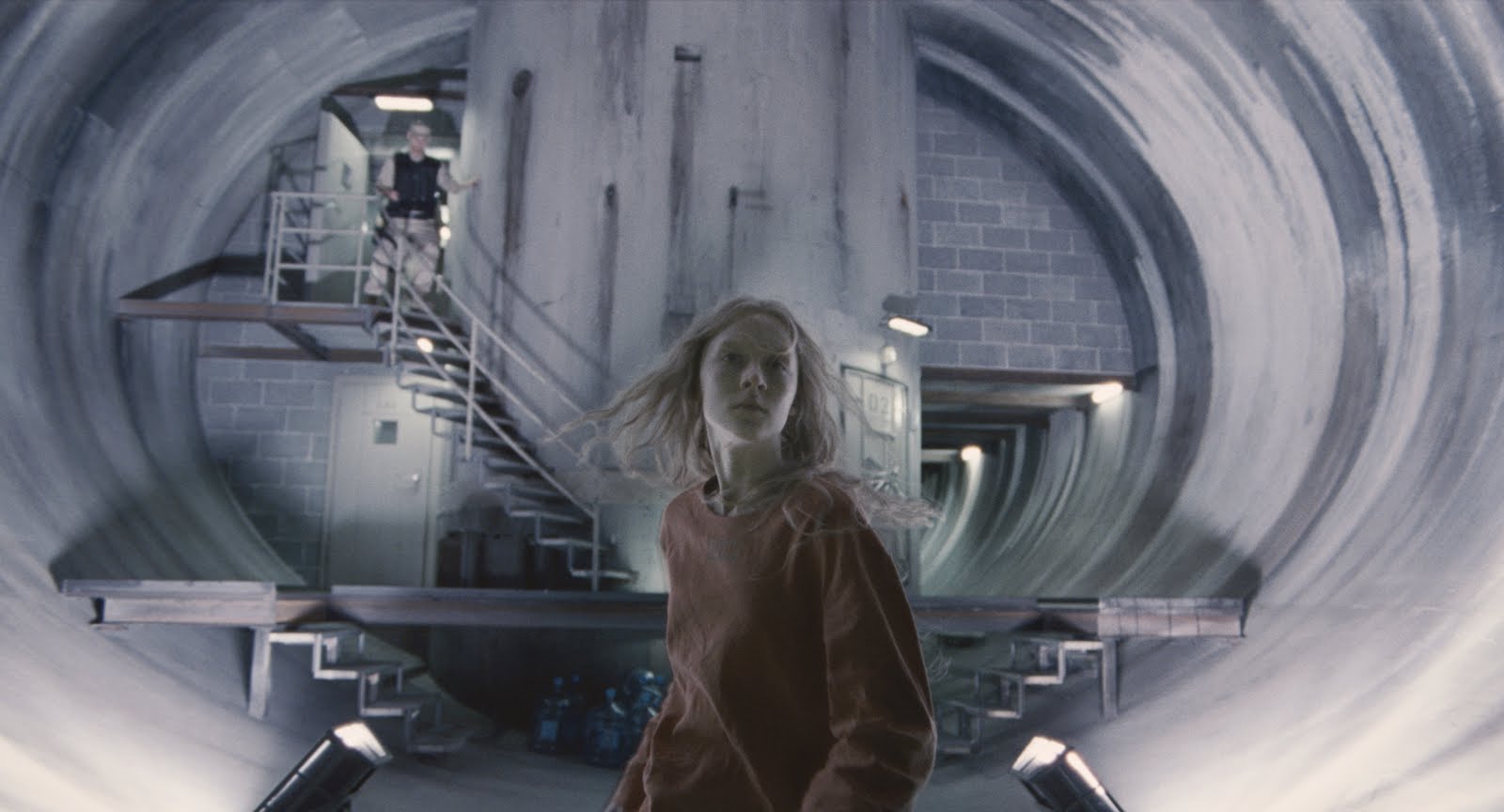
Change it, he did. Hanna is a weird mixture of gloss and QT-perversion, with some very strange camera work that, somehow, never manages to not tell you what is going on, to whom, where and why. No matter how over-the-top the theatrics become, Wright never forgets the basic job of keeping the audience informed, and with a screenplay spare on details and depending on the visual to tell the story, his discipline is critical (imagine, for instance, if Tom Hooper had directed it!) for any basic understanding of the film. Hanna heaps on the atmospherics, not only with a brazen fairy-tale sub-text, but an all-encompassing sound-design/Euro-electronica musical score by The Chemical Brothers,* that recall some of the '60's/'70's work of such composers as Mikis Theodorakis and Giorgio Moroder. But the thumping, edgy noises permeate the entire soundtrack, not just the music, from the sweet tune that one of the Hanna-hunters (Tom Hollander, cast completely against type) whistles, quite nullifying any element of surprise,** to the pounding chase music that keeps the attention focused while Wright spins his camera or shifts perspective, *** to the creepy metal noises and animal sounds that permeate this world.
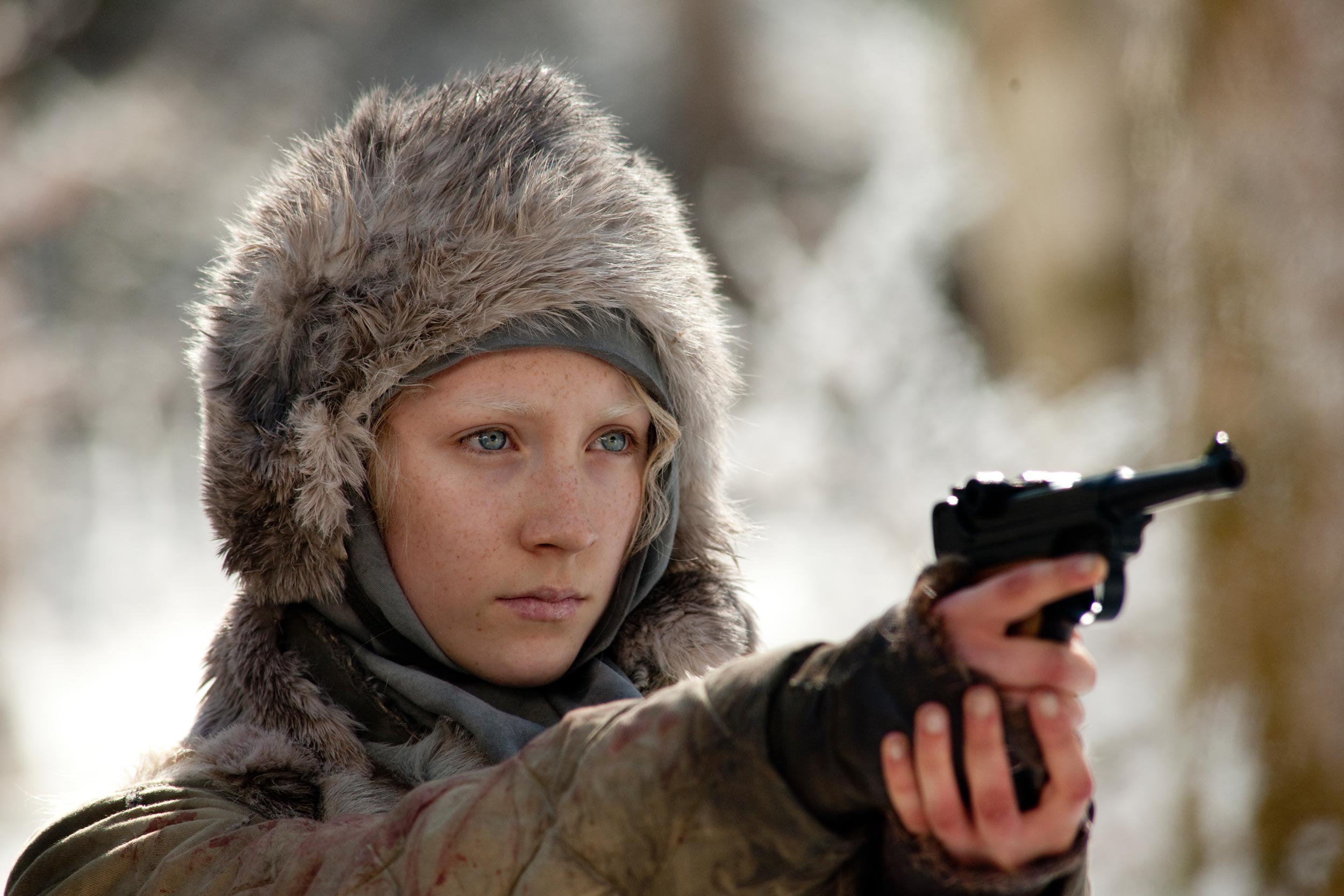
It begins in Finland, in the snow as a caribou is being hunted by a lone figure in fur. She dispatches the animal with one arrow shot ("I just missed your heart"), and begins to dress the animal for food. "You're dead!" says a figure behind her, and a rapid brutal fight breaks out, dependent less on fast editing than rhythm, and she is soon slammed to the ground, a snow angel against her will. "Drag the deer back yourself," says the man, who it turns out is Hanna's father (Eric Bana).
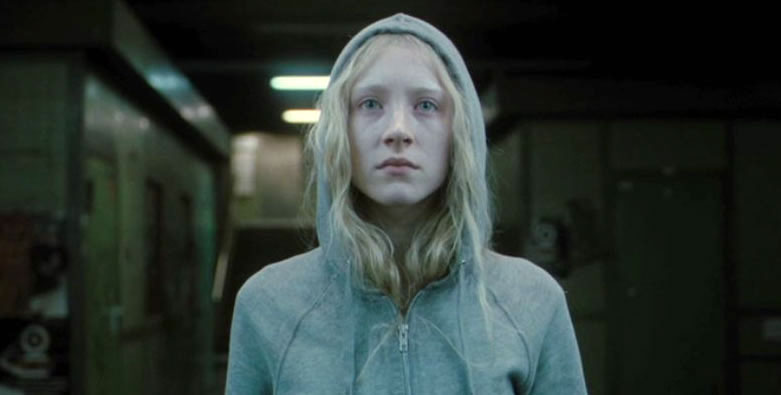
She is Hanna Heller (Saoirse Ronan—pronounced "Seersha"—and she worked with Wright in Atonement, and specifically asked that he direct this) and it is all survivalist training. Hanna has been raised to live on the land, kill and cook her own food, have an encyclopedic knowledge of everything (except electronics, apparently) given that her schooling is from the encyclopedia, speak several languages and have a detailed history that is nothing like her own.
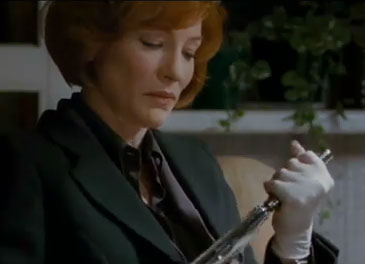
What is her history? What is her father's? We don't get too deep into the film before we learn he's a rogue security agent gone missing, and he's a bee in the bonnet of Marissa Viegler (Cate Blanchett—imagine her being creepy and then go a few steps further), an operative high up the chain of command. And she is Hanna's target. And Hanna must get to her before Marissa can find her. The why's will come, eventually, but already we've invaded a fairy-tale landscape with the sheltered princess (who can snap your neck) and an evil step-mother who stays only a few evil steps behind the whole movie. And given Ronan's goose-like grace throughout the film, one can't help but call to mind all sorts of folk-tales of changelings and bargains and revenge. But it's a spy thriller, too, as cold as they come, so don't expect "happily ever after."
For me, it was a simple story told well that impressed me throughout.
But it just missed my heart.
BANG! Hanna is a Matinee.
* Their impact on the film is incredible. I kept imagining what the film would be like with a "standard" thriller score, and always came up with a duller, less propulsive film.
** This recalls Peter Lorre's child killer in Fritz Lang's M (1931). Hollander vaguely recalls Lorre's look, and, later, Wright stages a fight to the tune "M" whistled from Peer Gynt—"In the Hall of the Mountain King," (after The Social Network, this piece is getting a lot of traction).
*** "What does music feel like?" Hanna asks at an early stage of the script. Here, it feels like having a heart attack in zero-g. One of the reasons this film DOESN't have a traditional score is that Hanna, the character, doesn't know music, and as we're following her struggles, the music reflects her mood, whether placid or on the run. It's rather interesting where those moods show up.
Thursday, April 28, 2011
Hanna









Tuesday, January 25, 2011
The Way Back

"Strangers in a Strange Land"
or
"Every Journey Begins with the First Steppe"
A new Peter Weir film is something of an event. The Aussie director of Picnic at Hanging Rock, The Year of Living Dangerously, Gallipoli, The Truman Show, Witness, and Master and Commander makes meticulous, thoughtful films of ambiguity and great beauty, throwing civilized men and women into clashes of culture (frequently more primitive) exploring the impact, with an eye towards the rough, otherworldly beauty of this world. Along the way, you learn a lot even if the movie does not draw to a dramatic or philosophical conclusion.
So, with little fanfare, here is The Way Back, Weir's latest film, one that has been optioned many times since its source book, Slavomir Rawicz's "The Long Walk: The True Story of a Trek to Freedom," was published in 1956. The veracity of the tale has been questioned a lot in that time, but the evidence is clear: four emaciated men walked into an Indian village, saying that they had walked from a Communist gulag in Siberia across the Gobi Desert and the Himalayas to freedom, a journey on-foot of 4,000 miles. One could speculate—for the length of such a journey—why it had never come to the screen before: too depressing—but think what it would do for soda and popcorn sales!; Elvis wasn't interested, indeed, what star would take on such a rugged movie, Burt Lancaster's brief interest notwithstanding; the movie has a lot of explaining to do about socio-political situations; the Russian market might not be too pleased with the film, and on and on. Weir made it (reportedly for less than $30 million, which seems incredible), but so few studios were interested in it that it almost went straight to video...which would have been a shame, as this is one of those movies demanding to be seen on a big screen.
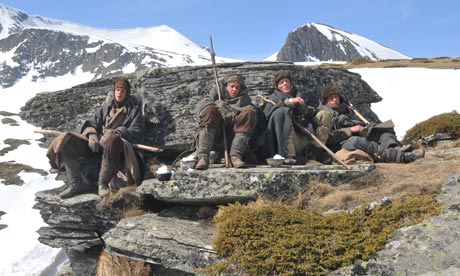
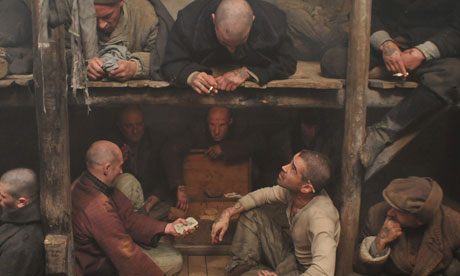
Janusz (Jim Sturgess) begins the film under interrogation in occupied Poland. The year is 1940. He has been turned in (reluctantly) by his wife under torture, and he is sent to a Soviet gulag in the mountainous regions of Siberia. After a period of learning the ropes (and the whips of the guards and the barbed wire of the camp), he becomes a part of a loose group of prisoners of differing skills and supplies to make a fast surgical escape from the gulag and make their way to Mongolia. Based on a loose plan of prisoner Khabarov (Mark Strong), they plan to make it to Lake Baikal, following it to the Sino-Russian railway. Their supplies will run out in mere days, but Janusz is convinced they can live off the land, walking the entire way. Among the group of escaping stragglers are "Mr. Smith" (Ed Harris)—"First name: Mister"—a particularly mysterious American (he tells Janusz, "you have a weakness I can use: kindness"), and, as it seems all movie escape attempts must have, a plays-by-his-own-rules maybe-criminal named Valka (Colin Farrell). The group begins suspicious of each other, but soon forms a close-knit, surprisingly democratic structure, sharing ideas and resources, voting when they're at a crossroads—despite the occasional individual insurrection.
Watching the movie is a slog. At 2 hours, 20 minutes, with the principal characters pushed to their endurance, the film feels longer than its running time, but one is never tempted to do a watch-check. The Way Back is one of those films that keeps you guessing, intrigued and involved every minute, like you were involved in the long walk, craning to see what is around every corner. Weir keeps the pace moving quickly, cutting scenes briskly from one episode to the next, so the film develops a natural rhythm.
But, it's the director's eye for detail—as always—that is striking, with scenes of stark, natural beauty that astonish: taking refuge in ancient caves, the camera pans up, following a bedraggled Mr. Smith's gaze, to two large holes in the ceiling, like the angry eyes of God; walking up a scrabble hill, Weir directs our view up and over the weary travelers to a screen-stretching shot of the expansive Gobi desert; at one point, they find a single solitary structure—a gate with no walls—absurdly marking their goal, while announcing another set-back.
It is a grueling adventure story with fine performances all around, interpreted through Weir's talent for keeping things real, even when they turn startlingly surreal. Go prepared for a tough movie, but a satisfying one, that, like all escapes, becomes a journey of the individual will and spirit, covering all manner of obstacles in physical space, mental discipline, and the longest journey...of time.
The Way Back is a Full-Price Ticket.