 "Grimm's Fairy Spy"
or
"Better Living Through Chemical Brothers"
Hanna isn't like any movie you've seen, if you managed to miss some of the more stylish spy thrillers at the end of the 1960's. When the spy-craze went more mainstream more A-list directors started to get into the fray and suddenly the thrills started to be taken over by style as those film-makers attempted to impose some of their own creative instincts into the genre. Sometimes the results were a sub-par thriller, others were just plain pretentious. Some...were interesting (like this one is, and like The American was last year).
Joe Wright is one of the better British directors coming out BBC television work. He's done his bit for the classics, old and new (Pride & Prejudice, Atonement) quite deftly handling the drawing room choreography and even putting a nicely modern spin on things. But, his 2009 film of The Soloist showed a director who wanted to experiment with the form, break out of the stodgy "Beeb" way of doing things and shake the story-telling up a bit (in that film, he turned Los Angeles into a living, breathing, rumbling sci-fi character looming over its strata of citizenry). It was interesting to see him attached as director to what looked like a common "actioner," and one wondered what he might bring to it, given his three previous films and how he appeared to be changing his style.
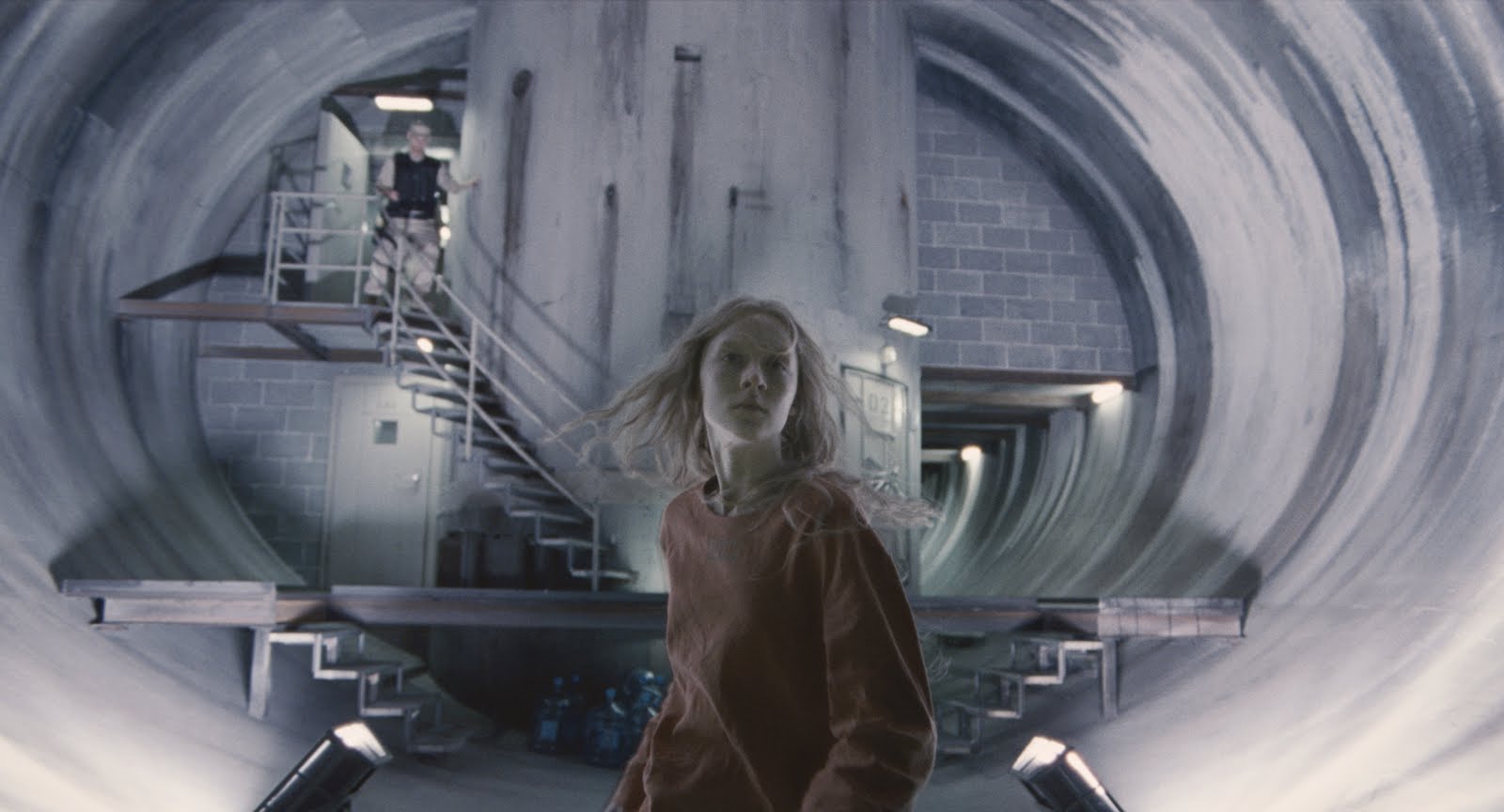
Change it, he did. Hanna is a weird mixture of gloss and QT-perversion, with some very strange camera work that, somehow, never manages to not tell you what is going on, to whom, where and why. No matter how over-the-top the theatrics become, Wright never forgets the basic job of keeping the audience informed, and with a screenplay spare on details and depending on the visual to tell the story, his discipline is critical (imagine, for instance, if Tom Hooper had directed it!) for any basic understanding of the film. Hanna heaps on the atmospherics, not only with a brazen fairy-tale sub-text, but an all-encompassing sound-design/Euro-electronica musical score by The Chemical Brothers,* that recall some of the '60's/'70's work of such composers as Mikis Theodorakis and Giorgio Moroder. But the thumping, edgy noises permeate the entire soundtrack, not just the music, from the sweet tune that one of the Hanna-hunters (Tom Hollander, cast completely against type) whistles, quite nullifying any element of surprise,** to the pounding chase music that keeps the attention focused while Wright spins his camera or shifts perspective, *** to the creepy metal noises and animal sounds that permeate this world.
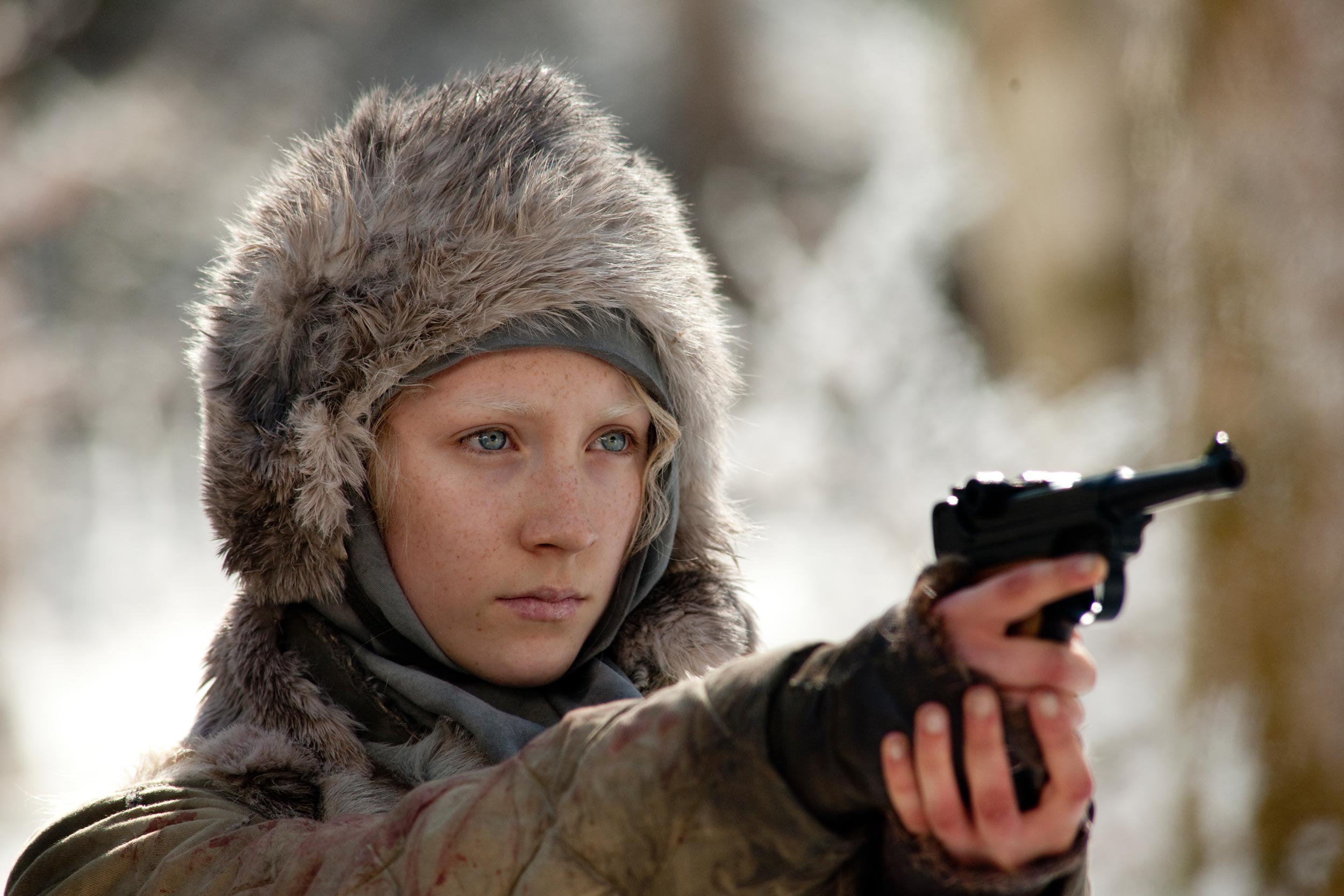
It begins in Finland, in the snow as a caribou is being hunted by a lone figure in fur. She dispatches the animal with one arrow shot ("I just missed your heart"), and begins to dress the animal for food. "You're dead!" says a figure behind her, and a rapid brutal fight breaks out, dependent less on fast editing than rhythm, and she is soon slammed to the ground, a snow angel against her will. "Drag the deer back yourself," says the man, who it turns out is Hanna's father (Eric Bana).
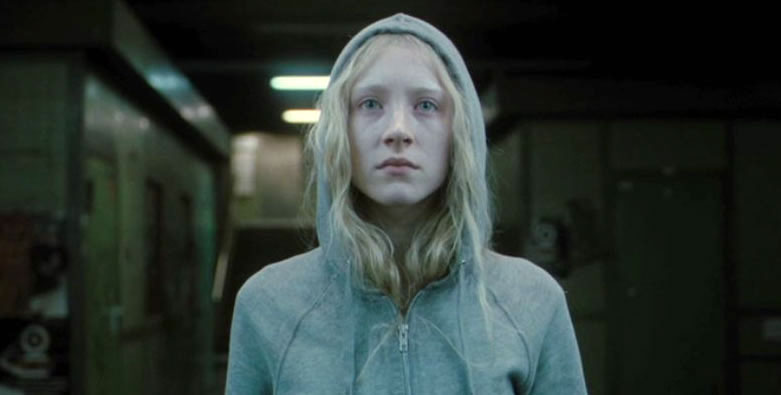
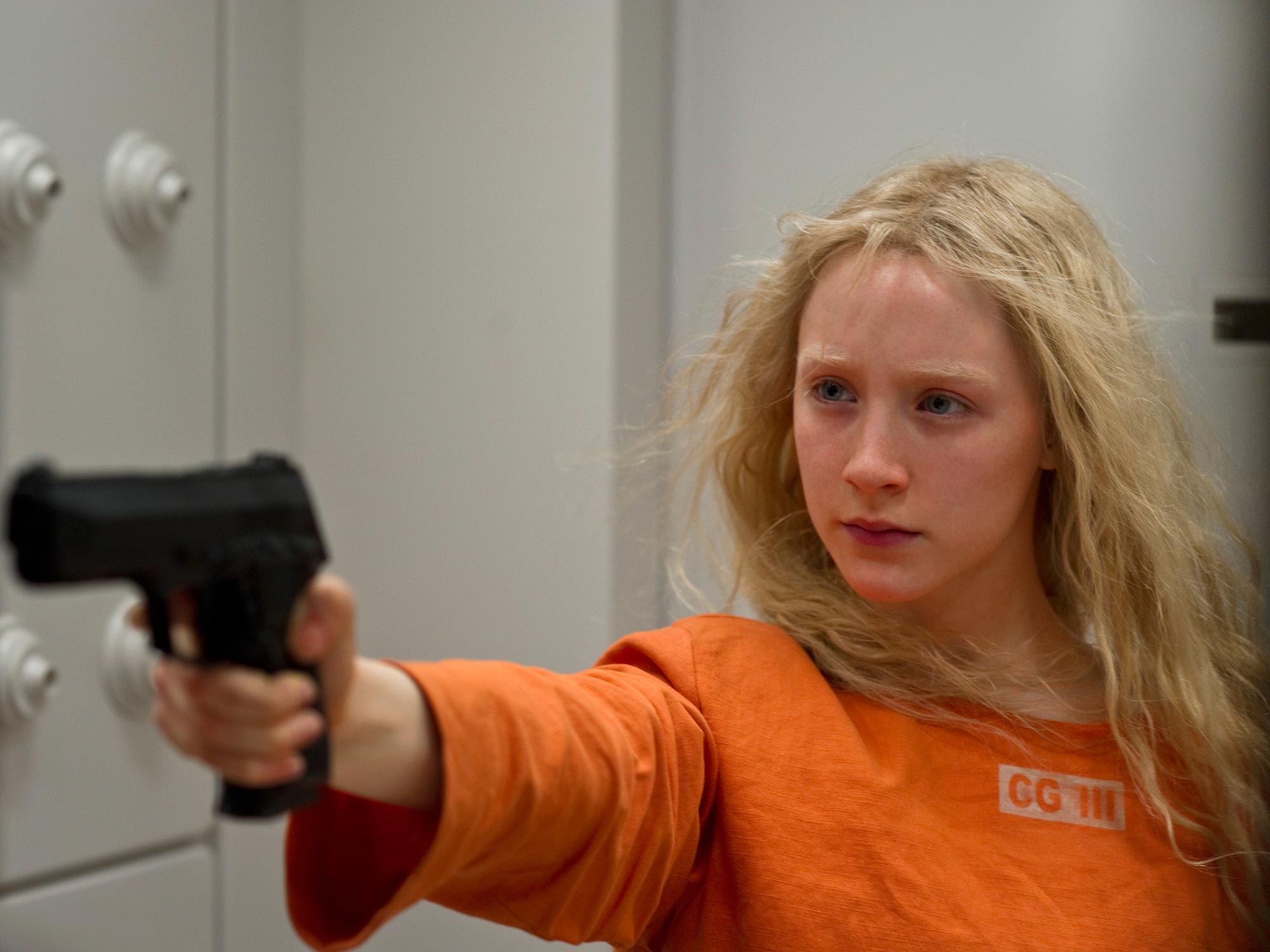
She is Hanna Heller (Saoirse Ronan—pronounced "Seersha"—and she worked with Wright in Atonement, and specifically asked that he direct this) and it is all survivalist training. Hanna has been raised to live on the land, kill and cook her own food, have an encyclopedic knowledge of everything (except electronics, apparently) given that her schooling is from the encyclopedia, speak several languages and have a detailed history that is nothing like her own.
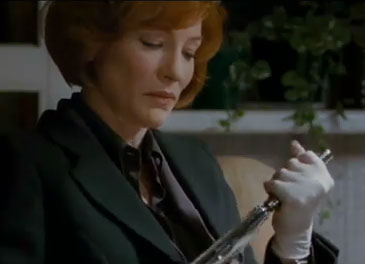
What is her history? What is her father's? We don't get too deep into the film before we learn he's a rogue security agent gone missing, and he's a bee in the bonnet of Marissa Viegler (Cate Blanchett—imagine her being creepy and then go a few steps further), an operative high up the chain of command. And she is Hanna's target. And Hanna must get to her before Marissa can find her. The why's will come, eventually, but already we've invaded a fairy-tale landscape with the sheltered princess (who can snap your neck) and an evil step-mother who stays only a few evil steps behind the whole movie. And given Ronan's goose-like grace throughout the film, one can't help but call to mind all sorts of folk-tales of changelings and bargains and revenge. But it's a spy thriller, too, as cold as they come, so don't expect "happily ever after."
For me, it was a simple story told well that impressed me throughout.
But it just missed my heart.
BANG! Hanna is a Matinee.
* Their impact on the film is incredible. I kept imagining what the film would be like with a "standard" thriller score, and always came up with a duller, less propulsive film.
** This recalls Peter Lorre's child killer in Fritz Lang's M (1931). Hollander vaguely recalls Lorre's look, and, later, Wright stages a fight to the tune "M" whistled from Peer Gynt—"In the Hall of the Mountain King," (after The Social Network, this piece is getting a lot of traction).
*** "What does music feel like?" Hanna asks at an early stage of the script. Here, it feels like having a heart attack in zero-g. One of the reasons this film DOESN't have a traditional score is that Hanna, the character, doesn't know music, and as we're following her struggles, the music reflects her mood, whether placid or on the run. It's rather interesting where those moods show up.
Thursday, April 28, 2011
Hanna








Monday, May 11, 2009
Star Trek (2009)
 "See If You Can Do Better"
I got a call from the Captain about 5 o'clock (that'd be 2000 hours for him)on Friday, and when I saw who it was, I called him back and said "I know what this is about."
The Captain is a life-long Trekker. He knows the arcana of "Star Trek" in its canon, that being the television series—both broadcast and syndicated—and film. Plus, he's a little "inside," having drinks with the late Majel Barrett Roddenberry, introducing Patrick Stewart to "Buzz" Aldrin, and calling up Jonathan Frakes the day show creator Gene Roddenberry died to talk about "what it all meant."
The Captain knows from "Trek." So I was particularly interested in his take on "The New Version" of J.J. Abrams, or "Star Trek Begins" (a version of which producer Harve Bennett had proposed away back in the time-space continuum before "Star Trek V"—you know, the Shatner-directed one best forgotten). I'd watched the trailers warily, noting the emphasis on disrobing cadets and slam-bang action (not mutually exclusive), but noting a certain underlying devotion, not entirely slavish, to the original. They weren't trying to re-invent the warp-drive, which was a good thing.
"So..." I said, "what'd ya think?"
"This is the way they should have always done it.." he began.
Yeah. It is.
"Star Trek" is a rollicking world-and-expectations-shattering version of the Gene Roddenberry original, and most niftily, done in a way that fits within its science-fiction-y concepts. The whole movie is its plot-point and one watches in wonder how the deconstruction happens before one's eyes, while simultaneously nodding acquaintance with the tropes, concepts, and characterizations of the original. One gets the feeling of happy ebullience watching a favorite building imploded with the added delight of seeing it rise simultaneously from its own ashes to be sleeker, shinier and un-compromising
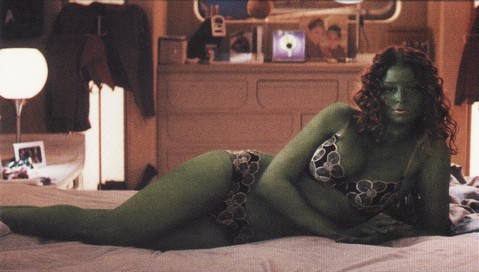
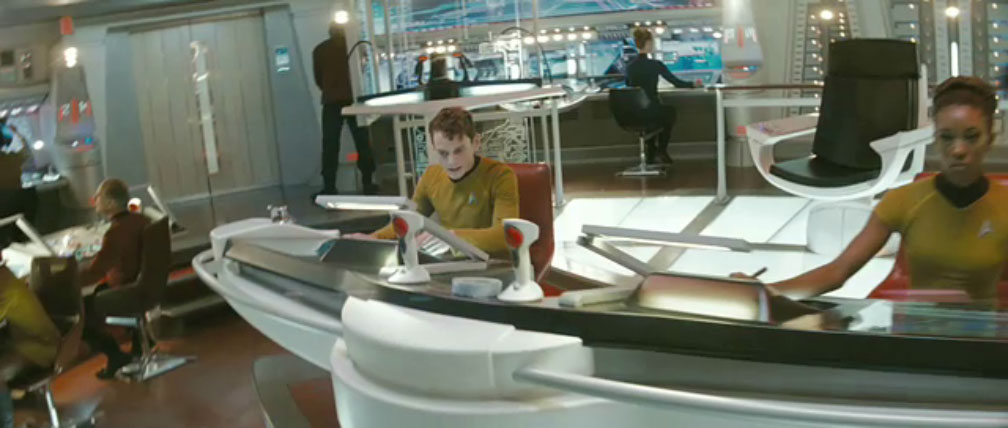
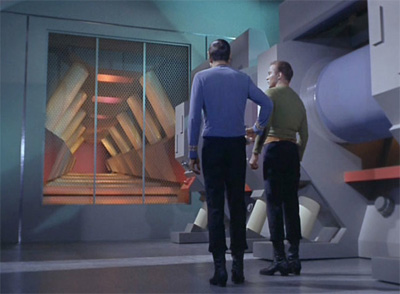
Part of it is due to budget. Abrams was given a fat check to re-launch Paramount's key franchise (which it nickeled and dimed into the ground), so the limitations the creators always had to contend with aren't so apparent. The Enterprise corridors no longer look like motel hallways, Engineering isn't a big space with a back-lit perspective painting behind it, and the aliens restricted to stereo-eyed bipeds with varying head-ridges. No, there's a lot of imagineering going on here in the Enterprise's brave new world of industrial-strength space-faring (at one point the new Captain Kirk sprints—of which he does...a lot—through what I swear was a brewery standing in for some section of the Enterprise's inner workings). The creatures have evolved differently* with nonhuman proportions, sometimes tossing out the human baggage entirely. It's a messy universe, but a full one with good ideas and concepts tossed amid the dialogue. It's a "Star Trek" Universe so full of potential, that there's no chance of coming across a creatively bankrupt parallel Earth, although the film manages to do exactly that in its own clever way.
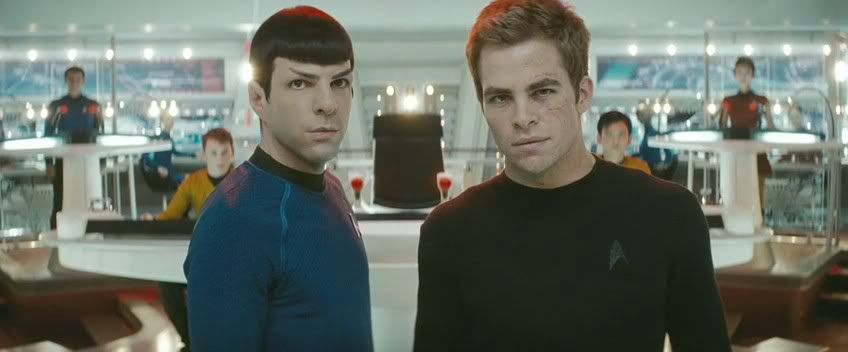
That's the big picture. The question is the actors; the franchise will live or die on how "the New Kids" can portray the old characters. Fortunately, it's where "Star Trek" shines. Everyone will have their favorites—mine are Karl Urban's note-perfect blustering McCoy and Simon Pegg's hyper-driven Scotty—but Chris Pine is a genuine find for Captain James Tiberius Kirk, employing none of the Shatnerisms (well, there's one deliberate vocal steal that made me laugh), but supplying the one thing that Shatner always brought to the table—energy. John Cho's Sulu is terrific and it's a hoot to see Russian actor Anton Yelchin employing the wretched "wessels" accent of the original Chekov. Zoe Saldana is given much more to do as Lt. Uhura, and given that he had Leonard Nimoy on-set for inspiration, Zachary Quinto might have taken the easy way out with a direct imitation, but his Mr. Spock is far less serene, more volatile and haughty, betraying that human half far more subtly than Nimoy did—and I believe saying that might be a court-martial offense in my house.
Where the other "Trek" movies have fallen down have been the secondary characters, but here they're just as important—Ben Cross and Winona Ryder play the star-crossed parents of Spock, while Bruce Greenwood is a superb Captain Christopher Pike. And Eric Bana, who can be on or off depending on the movie, is terrific as the long-suffering, revenge-driven Romulan Nero.
There will be a lot of sniping from the "Trekkies" who want things their way, or no way—that's to be expected with any "Trek" movie. But in the words of the former Captain Kirk: "Get a life."
Star Trek" certainly got a new one.
"Star Trek" is a Full-Price Ticket.
* There is a wickedly funny bar scene where Kirk tries to pick up the comely Lt. Uhura, while between them sits an alien seemingly modeled on the "Spitting Image" version of Leonard Nimoy, when it suddenly dawned on me what it was doing there: "Why the long face?"






Monday, April 14, 2008
The Other Boleyn Girl
 "Lord help the Mister who comes between and my Sister/
and Lord help the Sister who comes between me and my Man"
"Gettin' tickets for the 'girlie-show?'" the ticket-taker said to me.
*Sigh* If only...
Sadly, there's not much life in "The Other Boleyn Girl"--either of them. Peter Morgan's script (from the Phillipa Gregory novel and the BBC production) is a bit cut-and-dried---er, poor choice of words---and it doesn't create anything other than a proper colonist's righteous indignation over the way women in prominent positions were treated back then. Now, the sexism isn't so much like horse-trading (as it is in this film), as in just making sure that standards for men are inequitable with those for women, as we do in these oh-so-much-more-enlightened times. I came away thinking Morgan--who's probably set up a script-writing mill by this time--might want to take a script or two off, and sharpen the quill a bit. But it's not all Morgan's fault--he does get some choice words in once in awhile. The direction by Justin Chadwick is flat and staid--even by Masterpiece Theater standards--without even the benefit of some Merchant-Ivory snootiness to breathe life into the thing.
Then you've got the actors. As "the two Boleyn whores," Scarlett Johansson, as younger sister Mary*, uses 1.5 expressions throughout the entire movie and both involve mouth-breathing--no, sorry, that's unfair--2.5, she has a child-birth scene, and Natalie Portman looks like she's going to run away with the thing, having a fine old time as the smarter, more manipulative Anne but her hysterics towards the end have an air of high-school production--when the chords of her neck stand out you begin to worry that the court is going to catch fire like Sissy Spacek did in "Carrie."
As for Eric Bana, it's not good to be the King. Henry VIII is one of those characters that most actors relish playing whether its Charles Laughton, Robert Shaw or Keith Michell. Bana, though is a sometime thing--he can be "on" ("Munich," "Black Hawk Down," "Troy"), or he can be totally "off" ("Hulk"), giving nothing up for the camera (or audiences) to grab onto. Here he plays a weak King by giving a weak performance--as if that'll do the job convincingly enough. But it would be better to have this lusty, conscience-less King do his selfish terrible deeds and have a good time once in a while. I mean, why completely sever the ties between England and the Catholic Church if you're not having any fun while doing it? The same point is made, it's just not so spot-on...or so deadly dull.
One looks for any good performance in the thing, seeing how its not an action-piece at all, and Kristin Scott Thomas continually looks like there's a bad smell on-set and is allowed one moment of high dudgeon, and Jim Sturgess, the chirpy "Paul-ish" lead of "Across the Universe" seems to threaten to belt out another Beatles tune any minute. There is one ray of sunshine in the whole thing and that is Ana Torrent as Catherine of Aragon, speaker of the earlier "Boleyn whore" line. Every moment she's on the screen there is a power and command that every other member of the cast is lacking. She looks and acts like a Queen who belongs there, rather than one merely playing dress-up.
"The Other Boleyn Girl" is a Netflix rental--don't go out of your way for it.