Showing posts with label Bill Murray. Show all posts

Tuesday, July 3, 2012

Moonrise Kingdom

A Troubled Young Person's Guide to Themes of Defiant Youth (ala Antonioni) with Kubrickian Stylistics (as interpreted by Wes Anderson)
or
Full Metal Jackasses


Moonrise Kingdom might be my favorite Wes Anderson film yet.  The films of Wes Anderson have gotten more and more juvenile, regressing in sensibility, but progressive in terms of connecting with a child-like world-view.  Like his dark companion in film, Tim Burton, Anderson chooses subjects and styles that appeal to his inner kid, pulling in favorite things from his growing up years  to include in his films.  But, unlike Burton, he doesn't concentrate on the dark and morose, focusing instead on a sense of wonder, even if in his world-view the adult act like children and the children try to act like adults.

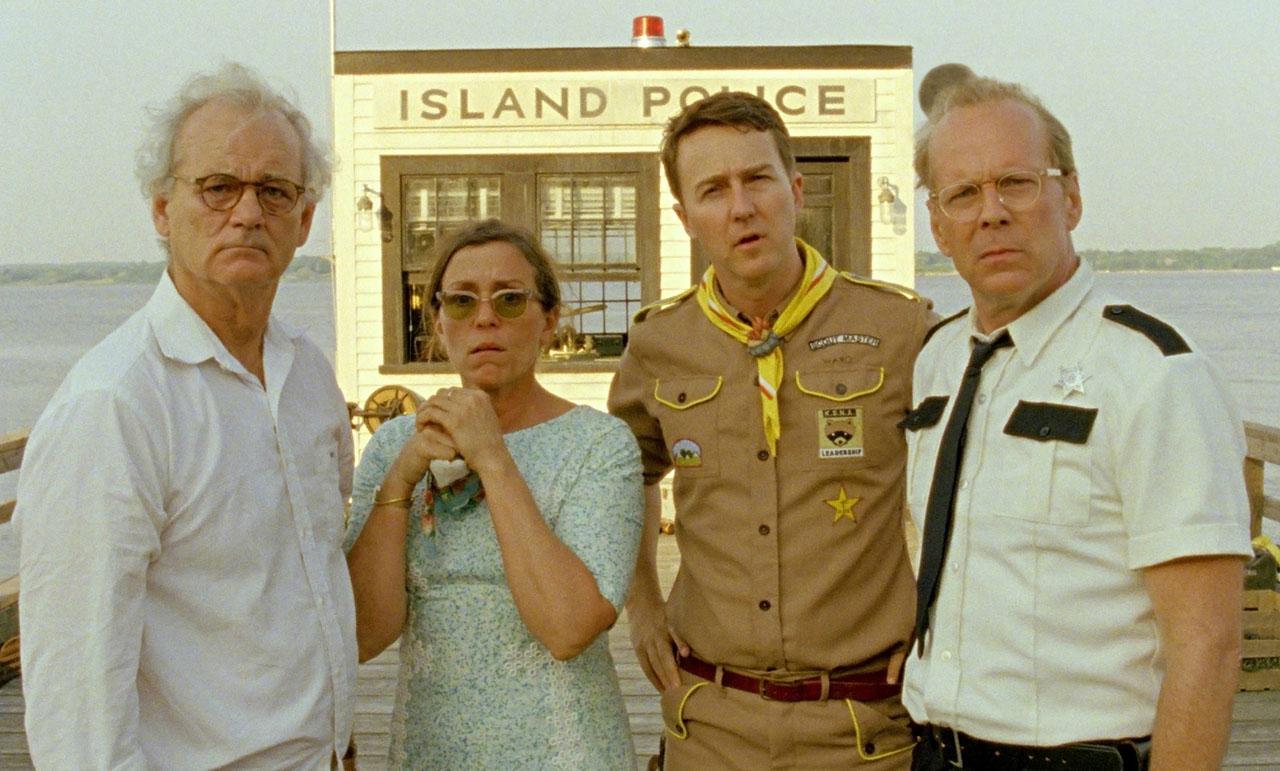
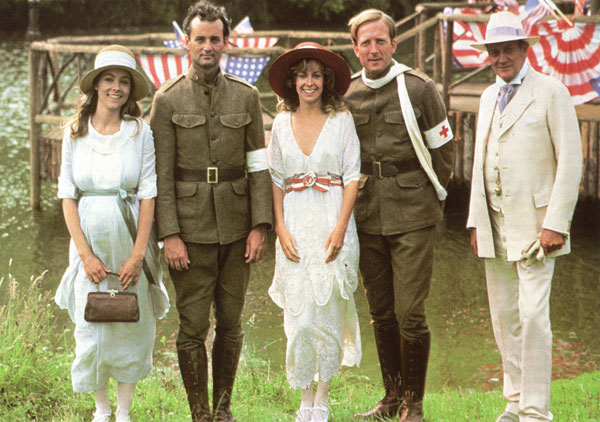
So, Moonrise Kingdom, co-written by Anderson and Roman Coppola (Francis' iconoclastic kid), set in the mid-60's and involving an East coast island community.  There are two factions, the authorities, represented by island law enforcement—Captain Sharp (Bruce Willis) and the troop leader of a group of "Khaki Scouts"—Scout Master Ward (Edward Norton).  There is a dysfunctional family, the Bishops (led by Bill Murray and Frances McDormand).  Both factions represent authority, and empty authority at that.  Their worlds are controlled, regimented, but still subject to outside forces and acts of God, like weather—there's a storm approaching as the film's exposition expert (played by Bob Balaban) is only too quick to report.

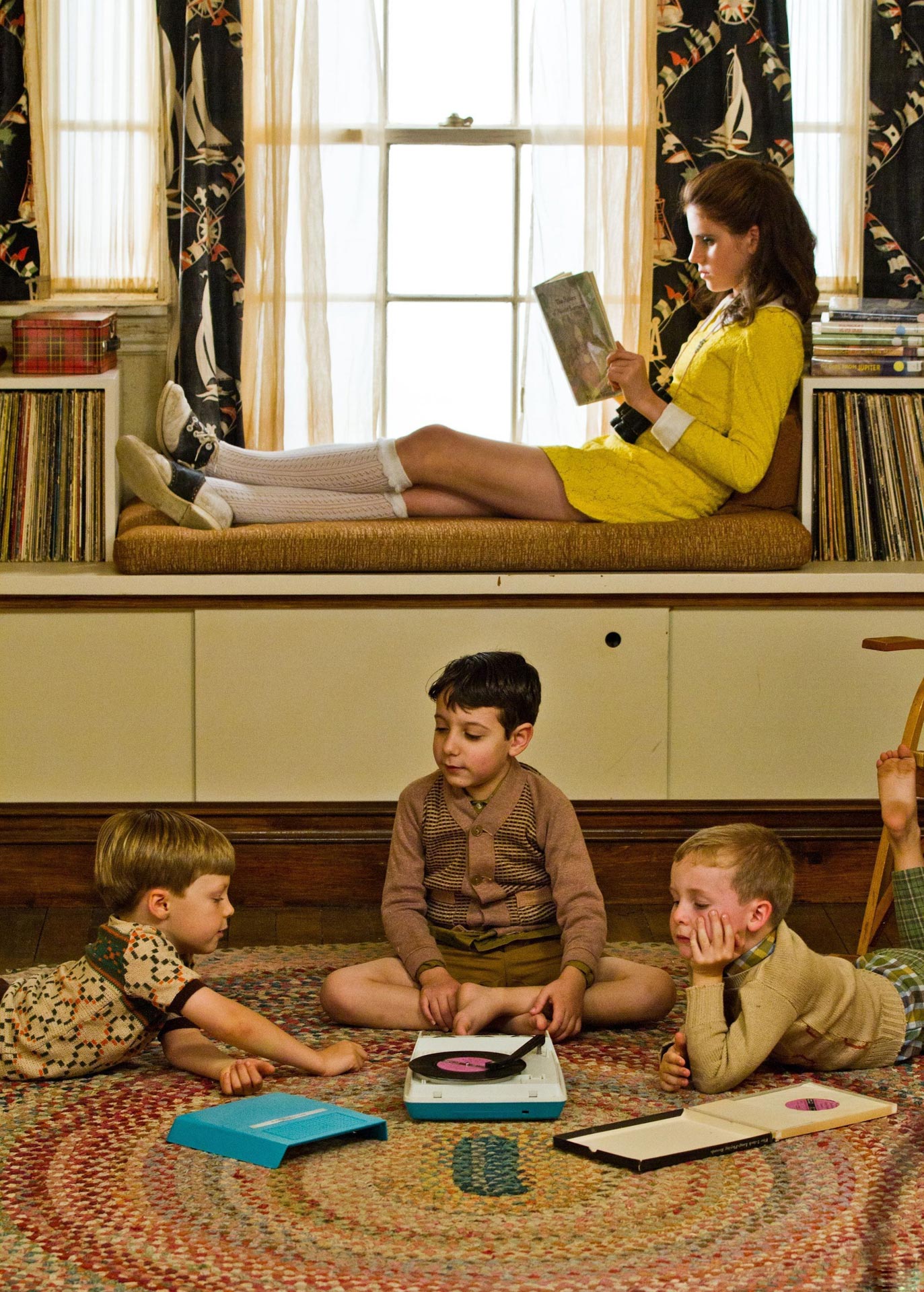
Into this mix come a pair of star-crossed likers, outcasts from both houses, like Romeo and Juliet.  Sam (Jared Gilman) is an orphan with enough issues that his foster parents no longer want him; Suzy (Kara Hayward) is the oldest child of the Bishops and already is labeled as a "very troubled child."  They meet at an amateur production of Benjamin Britten's "Noye's Fludde"*—he's on a scout outing, she plays a raven.  They begin corresponding in secret, and then both escape their cloisters, he from the Khaki Scouts camp, she from her family home.  They live off the land, he with his survival skills and supplies, she with her books and records, a mutually dependent family with different roles.  It doesn't take long for their disappearance to be discovered and the search parties form, the police led by Sharp and the Scouts, led by Ward, with the Bishops poking, prodding and threatening lawsuits.  The kids lead them all a not-so-merry chase, and there are casualties along the way. But, the fugitives press on, despite the fact that, on an island, they can never really escape.

It's a romantic's version of 'the barefoot bandit" story, but without the issues of ego, narcissism, and general public nuisance, and Anderson couches it all in an idiosyncratic format with scrupulous Kubrickian stylistic fluorishes—the measured tracking shots, the hand-held shots of freedom and chaos; the stylized expressionless acting, the structured mise en scene, perfectly balanced on a central fulcrum.  On top of that, it's hilarious, with dialogue that's formal, distinct, played absolutely straight, betraying no irony, delivered in a deadpan lack of elevation.

It's charming-no wonder these kids want out, left to their own devices.  They still want structure, just their own structure, and, although self-imposed outcasts, seem far more together than those of their "betters."

Fun, odd, and rebellious in Anderson's over-stated understated fashion.  Wonder what he'll do when he grows up.


Moonrise Kingdom is a Full-Price Ticket.


* Britten is the classical composer-thread rolling throughout Moonrise Kingdom, and his "Young Person's Guide to the Orchestra" is the starting theme for the film's opening sequence—a gliding, tracking tour of the Bishop's house.  They'll also do a version of it over Alexander Desplat's closing music over the credits.

Thursday, September 2, 2010

Get Low


"The Hell With It. The Hell With Me."
or
"An Old Nutter Attracts More..."

Twain coulda wrote this one: a hermit of 40 years makes his way into town to arrange his own funeral party (which he'd like to attend before it's required, thank you).

That "Get Low," which tells the tale, is based on a true story only makes it that much more enjoyable, even if the film itself turns dark, just as Twain woulda spun it.  It is, when all is said and done, about a funeral.

Frank Bush (Robert Duvall), who has lived apart from the Tennesee community, has developed a reputation as a "Boogie-Man"—for Duvall, this role is the push-back book-end to his "Boo" Radley from "To Kill a Mockingbird"—and gets it in his mind to arrange a "living funeral," where anyone who has a story to tell about him can and might.  For local funeral home director Frank Quinn (Bill Murray), Bush's odd request is an opportunity to make a big score and arrange an ultimate funeralwhatever it takes, he'll do, even if the arrangements start to get a little bit out of his control.  For Murray's Quinn, it's a movie-length warning of "It's your funeral..."

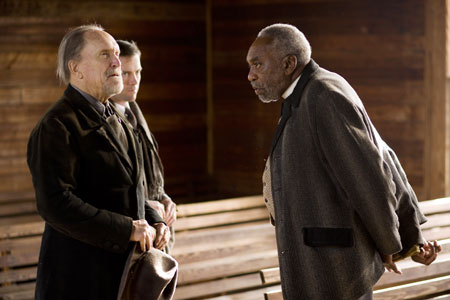
The poster above makes one think that it's a two hander, just Duvall and Murray, but this is an ensemble picture—a very meticulously cast one—with a lot of people, including Lucas Black, Sissy Spacek, Bill Cobbs and Gerald McRaney doing some of their most effective work in years.  Spacek, in particular, is a marvel.  This isn't one of her "splashy" roles, and she's been purposely de-glammed to take the blossom off her ripe strawberry features, but she still manages to make every define her character by the simplest of gestures, or by the "social smile" under pained eyes.  Bill Cobbs plays a prickly minister acquaintance of Bush's, and makes the maximum potential out of a small role—like Duvall used to in his early career—with innate comic timing and a sense of doomed inevitability.  His laugh brings a smile to the face.  Murray does his best work in years.  His Quinn is at heart an opportunist, but makes it look presentable (like any good funeral director!) with the look of feigned dignity and a melancholy elan.

But it's Duvall's picture—he's in most scenes—and one is tempted to call it Oscar-bait for the veteran character actor, as he hasn't had a role this big in years—the arc of the character turning from eccentric to tragic figure without betraying the characteristics on either end of the curve, displaying his capacity to create a living character, able to accomodate the trials and tones of the movie.  Speaking in a voice like brittle rice paper, that flakes off bits of sentences at the end, his Bush is a courtly soul in need of definition.  The old hermit, after spending 40 years in a self-imposed exile from the opinions of others, initially seeks their judgement, first as audience, and then as performer, seeking some ablution or absolution—a trial-run, if you will, in the court of public opinion, before being forced to succumb to the Final Judgement.  It is confession and catharsis, timed with the death of one man, and the return of his widow to her home-town.  Duvall's funeral speech is humble, contrite and confused, and the actor provides an amazing sonic counter-point to his recounting of the history that has dominated and colored his existence.  His performance haunts, in the display of a haunted man.

Director Andrew Schneider, a previous Oscar winner for his short film work, manages to maintain a visual interest throughout the movie, observing events but never calling attention to itself observing.  Characters are sometimes over-whelmed in the surroundings, and the scale of the film is sparingly in line with a small-town closeness.  That the tone gradually shifts from quaint eccentricity to Southern Gothic is probably inevitable for a film that climaxes with a funeral, especially one that starts with humble beginnings and turns grandiose and complicated (in a movie turn towards melodrama that had nothing to do with the actual historical events of the real Felix Breazeale).  But, without the added mystery, and "the story to tell," the film would have had no depth, and would have felt as shallow as a grave in a pet cemetary.   The embellishments give the story added weight, and make the turns of events mean something, as opposed to just being an old man's fancy.

Well worth seeing.

"Get Low" is a Matinee.


The real Felix "Bush" Breazeale, attending his funeral in 1938.

Saturday, September 5, 2009

The Razor's Edge (1984)

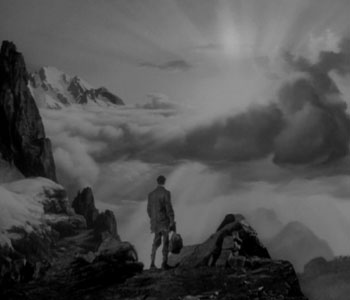
"The Razor's Edge" (John Byrum, 1984) The collaboration between Bill Murray and John Byrum on the screenplay is a case of good and bad: the screenplay's very good, respectful of Maugham, but also digging into Larry Darrell's experiences in World War I that made him a part of the "lost generation," and seek a higher truth than his social-climbing friends; the bad part is that Bill Murray stars in it.

At this point in his career, Murray was a popular comic genius,
taking a rather lackluster first year on "Saturday Night Live," and parlaying it into a film career where he virtually ad-libbed "Meatballs" into a suprise box-office success. "Stripes,""Where the Buffalo Roam,""Caddyshack,""Tootsie" (uncredited, so as not to distract) all built his reputation to where he was becoming a box-office phenomenon (and the capper, "Ghost Busters," he agreed to star in to secure "The Razor's Edge" being made).

Byrum does a fine job directing
the film: the locations (particularly the Tibetan ones) are lush and filled with color, and the performances are spot on: Theresa Russell does wonders with a role that can fall into cliche, but she brings a freshness to it that makes it all the more poignant, and Catherine Hicks makes her "Isabel" more sympathetic and far less hissable than she was in the 1946 adaptation.

The "sore thumb" is Murray—but not entirely. When called on to be dramatically appropriate he is there, but the temptation for the young star to punch up scenes with ad-libs that seem too contemporary or are dramatically inappropriate was not squelched by the director*—either because he owed Murray too much for getting it made, or because he didn't want to throw a bushel over Murray's "star-power."

And one can understand why Murray did it. Larry Darrell is supposed to be an attractive, if slightly remote and disconnected, man. There has to be a reason people care about him so much, especially as he abandons them to go off on his spiritual quest, and why Isabel takes the course of actions to keep him to herself.
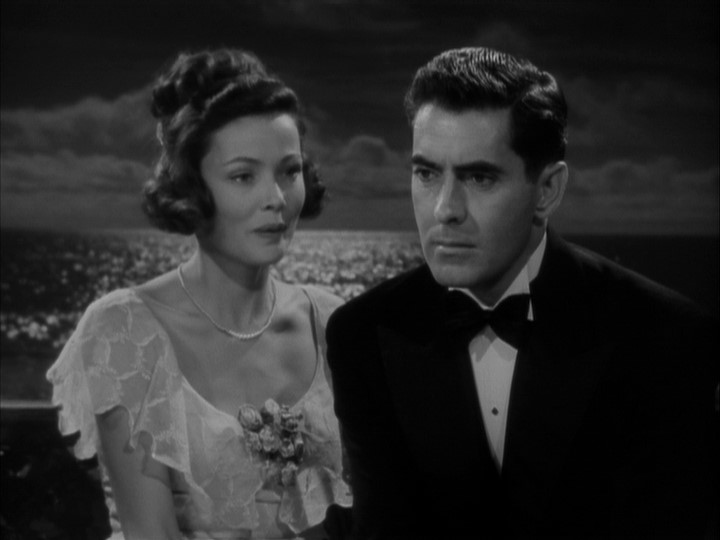
Tyrone Power, in the 1946 version, employed a "thousand yard stare" to suggest deep-seated consciousness, unconvincingly—and, he was Tyrone Power, and the man's "star quality" was sufficient motivation. But, Murray turns Larry from a "party-boy" to a troubled "slacker" with a goofy sense of humor. He's always the funniest guy in the room, and his quips are his expression of affection for his friends. It's the "silver chord" that is shared by pre-war Larry and post-war Larry, and that binds him to his old friends. It's a neat solution to the problem of Murray not being Tyrone Power in looks. But, Murray's funny is a bit too hip for a 1920's room. And though it may occasionally crack up his co-stars, it also makes him the odd man out in the entire scenario.

It's too bad. Given a bit more restraint, this might have been the adaptation of one of
Maugham's best books. As its stands, it did make me dissatisfied enough to want to search out the original book, for which I'll always be grateful.

* The most egregious being Larry's empathetic subterfuge of presenting the stricken Uncle Elliott a much desired invitation to a function and Murray's ad-lib: "If it's a costume party you could wear that cute little bunny suit..." It's so out of left-field, especially at that particular juncture, that it undercuts one of the most dramatic moments of the movie, and Denholm Elliott's terrific performance, it's a bit grand-standing on Murray's part. Maybe I'm being unfair and it wasn't supposed to make the final cut and Columbia insisted there be more "Murray comedy," but it is such an artistic gaffe, that you would think that someone would have objected.


Wednesday, October 22, 2008

City of Ember

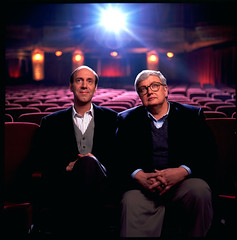
Viewing "City of Ember" took me back to memories of Siskel and Ebert arguing about children's films. Siskel inevitably panned the kiddie flicks for lacking depth, acting and plausibility. Ebert would accuse him of being a curmudgeon and then cite the films various charms... usually imagination and a healthy sense of adventure. And here I sit, of two minds... Siskel and Ebert sitting on my respective shoulders like a fat gray angel and sadly deceased devil.

The film itself is set in a post nuclear holocaust world
where the last humans live in an underground city, waiting for the day when they can return to the surface. But somewhere along the way, everyone forgot about returning and are content to lead fearful and obedient lives in a grim subterranean 19th century London. Two young heroes shake off the city's collective torpor and make a predictably challenging yet successful dash for freedom.

Ebert, still reviewing films for the Chicago Sun-Times, actually illuminates most of the plot holes in his own lukewarm
2.5 star review. The most egregious gaffs (to me at least) were casting a 24 year old Harry Treadaway to portray a young adolescent, the use of a utilitool as a deus ex machina device, and the entirely unbelievable roller coaster ride toward the end. But Ebert the angel reminds me that roller coaster rides through a dark underground river delight the imagination... and creating a deeply immersive and imaginative setting is the film's primary strength. Then Siskel the devil whispers back, "Too bad the characters lack any compelling or imaginative dialogue."

At a deeper level though, Siskel and Ebert would probably agree on the film's transparent politics. The film's underlying symbolism is troubling for a politically left-leaning viewer like myself. As the primary villain,
Bill Murray plays a gluttonous simpleton. His role as the obese mayor of the City of Ember, along with his two henchmen (one effete and the other club-footed,) create a clear portrayal of the enemy. They are fat, lazy, corrupt, and deformed. The heroes are young, attractive, strong and equally quick of foot and mind. This already calls to mind the sort of bigotry that permeated the film "300." And most telling, the two heroes are depicted as unnaturally eager to work hard, putting them in stark contrast to everyone else in the movie. Their challenge is to overcome the stagnation of their society and recapture humanity's potential. As such, they are Ayn Rand repackaged for the middle school set. Every social institution is portrayed as ineffective at best, and criminally corrupt at worst. Religion even takes it on the nose, portrayed as a bunch of head-in-the-sand singing enthusiasts.

It's a dangerously naive view of society (even in a microcosm) to depict it a grossly inept set of systems in desperate need of a savior. It sets up a very antisocial set of beliefs about being above the law, entitled to whatever freedoms you desire, and that rebellion is the only answer. But of course, stories marketed toward youth are unlikely to trumpet wisdom or temperance as worthwhile virtues. If the true test of a film like this is whether or not you'd take your kids to go see it... be forewarned that it's a libertarian manifesto posing as fantasy.


"City of Ember" is a rental (speaking objectively)

Tuesday, April 1, 2008

Caddyshack

"Caddyshack" (Harold Ramis, 1980) One has few regrets in life, hopefully. As one gets older, experience colors perception, and suddenly movies like "The Rules of the Game" speak to you in new ways, and movies like "Caddyshack"...well, I've been spending a remorseful few minutes thinking of all the people I'd recommended this movie, too. Not that "Caddyshack" is horrible, mind you. But it hasn't aged well since my college days.* Fond memories of Harold Ramis' "Animal House for Juvenile Adults" is full of references and gags that seem geezer-ish. But there are some things that hold up. It's Chevy Chase's funniest perfromance in the movies (I believe that is the very definition of "Damning with Faint Praise"), and one of Bill Murray's wildest--you get the impression that they were winging it, Chase improvising the physical with Murray skewering the dialog. It showed Rodney Dangerfield to be a wierdly endearing clumsy performer for the movies, and it's Ted Knight at his foolish best. Two bits still work--the "Baby Ruth" gag, and the little mini-epic contained in it of the minister's perfect game in the rain. But, don't be surprised if the one thing you take away from it is John Dykstra's roly-poly gopher puppet. Here's an interesting "Caddyshack" link.

* It reminds of the recent reactions to the release of "The Man from U.N.C.L.E." series on DVD, where the adults who watched it as kids ask facetiously why it was re-filmed using a "crap filter," that made all the sets look like cheesy back-lots, the performances hammy, and the thrills, not so much. Memories are yet green. The reality is oft-times compost.

Monday, February 4, 2008

Broken Flowers

"Broken Flowers" (Jim Jarmusch, 2005) Don Johnston ("You're Don Johnson?!" "No. With a 'T'") is in a funk. A computer millionaire, he has no energy for anything. No desire. No drive. Certainly no energy for his girlfriend who walks out on him at the beginning of the film. In other words, he's Bill Murray's usual grown-up slacker, but without the savage wit. Murray may be the best conveyor of malaise since "Buster" Keaton was drummed out of the talkies. Adding to his girl-friend's anger, he has just recieved a pink envelope addressed in red ink from an old girl-friend, who warns him that the son he never knew existed is looking for him. It's a mystery,a nd he wants no part of it. But it's a "clue" to his mystery-buff neighbor (Jeffrey Wright) who sets up an elaborate scavenger hunt with four of his "passed ships" as the check-points (and they are Sharon Stone-really good, Frances Conroy, Jessica Lange, and an unrecognizable Tilda Swinton). It's a bit like Ulysses on an Odyssey of old battlefields. But he's a reluctant Ulysses and never too sure what to say to the women, but the object of his quest is his son. And by the end of the film, his world has been opened up, or at least there are more opportunities for him to get into trouble.