or
"I Can Fix This..."
Really, it's a little soon for Tim Burton to be re-making one of his own films—albeit his first live-action short for Disney. One worries that maybe he's run out of ideas, or that he's simply doing what he's always done—take a property and combine it with that goofy blend of the kinky and ghoulish that he has made his own...it's just that this time the property is his...and he's already made it his own once. Maybe, he looked at this product of his younger self with limited resources and thought "I can do better. I can do more." Or along the lines of young Victor Frankenstein, he looked at it his earlier creation and vowed "I can fix this."
At the time of the live-action short, Disney looked at the product of their young animator...and promptly dumped it...only acknowledging it when Burton became an A-list director (with some studio hesitancy) with the first "Batman" film.* Now, Disney is crowing about its brand new Burton movie, and one can only imagine the wry smile that must produce for the director. It was natural for Disney to want an expansion—they owned the property—and although this new version of Frankenweenie has a lot of (dare I say) re-animation of material, it did give Burton a chance to give it a little more depth and play around without the inhibitions of live action.
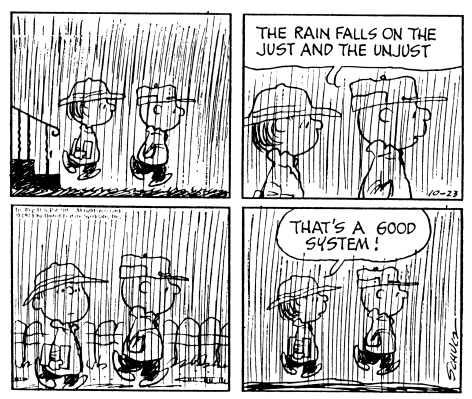
I say inhibitions rather than limitations because the differences are exhibited in a weird and rather contrary way, given that the film is done with puppet figures: emotion. The character of Sparky exhibits a far greater depth of moods than a trained pit-bull terrier could exhibit in live action, not only in its darker moments, but especially in moments of joy—the animation of the dog running elicits fond feelings immediately, as the puppet is rarely touching the ground in motion, not unlike Charles Schulz's "Peanuts" kids who hover over the ground in transit. And although the human figures are Burton cyphers (resembling the human character designs of his first film Vincent) they are still soulful, their eyes expressing more emotions than their faces will betray. Given that the subject matter is about a mad scientist of a little boy who runs the parallel path of his literary namesake to re-animate his beloved dog, killed in a traffic mishap, there's a lot of room for high emotion there, and far more than in the motivations of the original story.
But, Burton takes it further and makes it more than about young Victor. Taking pages from The Nightmare Before Christmas and Batman Returns, he stages the denouement at a city festival that brings all parties together in one spot, the communal experience gone awry. Seems that Victor's work has attracted a lot of attention among his classmates, and as there's a science fair going on, all the kid's are doing the same thing—literally, the same thing, bringing to life their dead pets with very mixed results, and providing Burton a chance to explore other species of monster movies (and recreating scenes from them) than just the one, paying tribute to each, just as he does by including a scene from friend Christopher Lee's turn as "Dracula." Like Victor's experiment, this is a labor of love as Burton—just as with the earlier short—resurrects the movies he loved as a kid, long-buried memories that never really leave, and have influenced Burton throughout his career. It's a fun, resonant electrification of his earlier work, with just enough fresh in it to make it worth the effort and bring it back to new life in leeched black-and-white (which Burton always manages to make look sumptuous). Now, if only we could see something wholly new and original from him, that would be some experiment.
 |
| The original Frankenweenie |


Brad Bird's "Family Dog" (based on animation designs by Tim Burton)