Showing posts with label Bill Condon. Show all posts

Wednesday, November 6, 2013

The Fifth Estate

Assuaging Assange
or
Jury Tampering in the Court of Public Opinion

Julian Assange is not a happy camper...camping in the Ecuadorian embassy ("behind Harrod's" as his portrayer Benedict Cumberbatch describes it) in London. He has let it be known in his own little publicity campaign that he does not like The Fifth Estate, and that it is entirely propaganda from unreliable and untrustworthy sources.  I'll take his word for it, as that's been his business model for Wikileaks for quite a few years. 

The problem is that Assange would not be happy with ANY movie of the story unless HE wrote, produced and directed it, so that he could control the information flow to fit his view of events.* Anyone would, really, in the best of all possible worlds. The difference between anyone and Assange is that he actually thinks he could, and not only that, that he should.

The trouble is, Mendak, it may be your story, but it's not your money financing it, and you're kind of a bad risk, if you know what I mean.  

And, if he would do it, he would insist on doing it himself, even though film is a collaborative medium.  Collaboration, however, might dilute the message, and so, really the only person who could be trusted with it is Assange.  Wait for his version in a couple of decades.  That's the trouble with hubris and megalomania, you always get your message out last and console yourself that you got The Last Word.


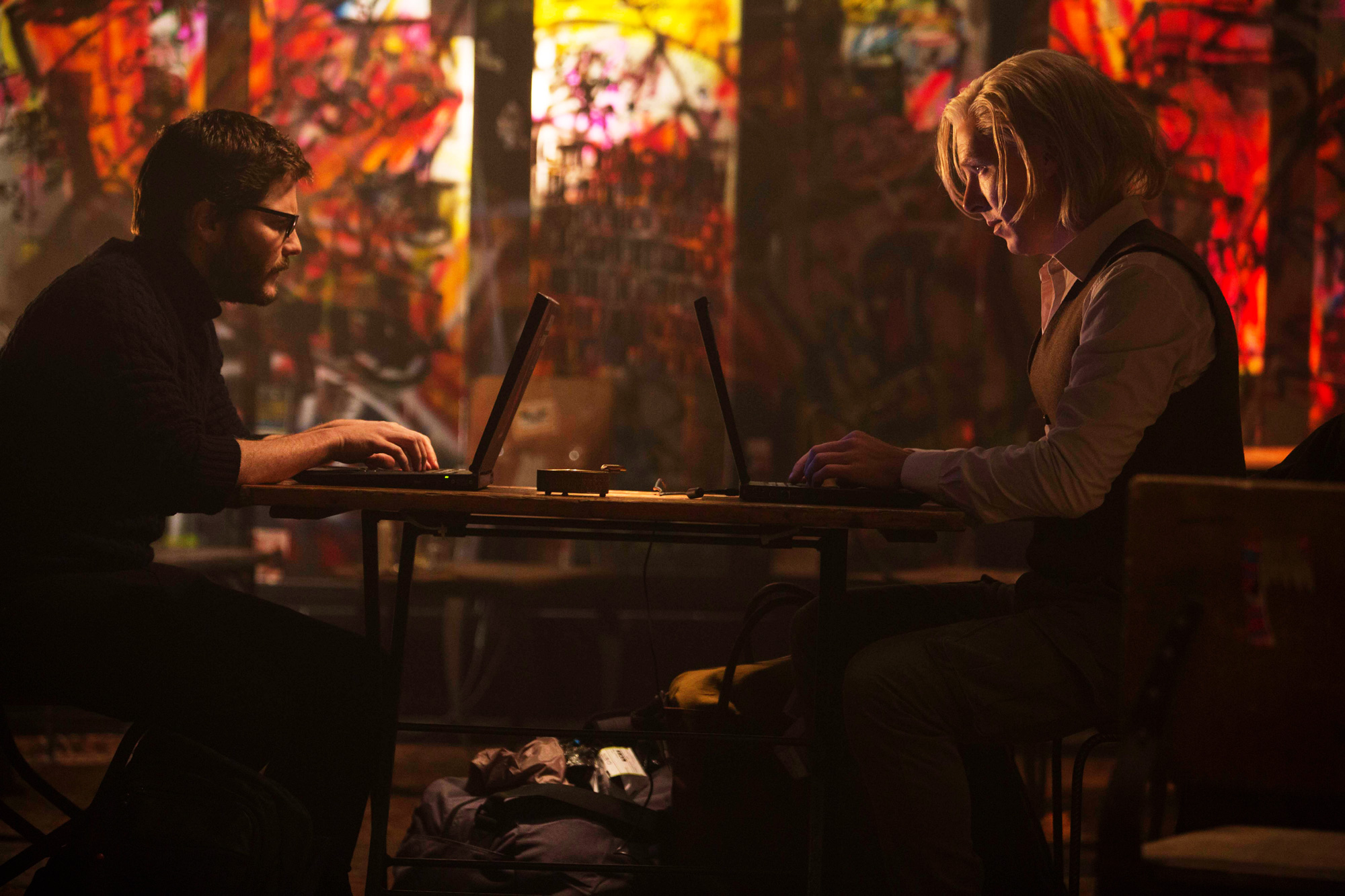
(Well, now that I've revealed my prejudices that I think Assange is a creep and something of a deluded creep...) Bill Condon's film is a return to form on the controversial biographical films he's done in the past (Kinsey, Gods and Monsters), and after mucking about in the very black and white"Twilight" series, here struggles to have any sort of perspective, controversial or otherwise, for a story that is still in process.  It also sweats to make something dramatic out of typing away at laptops, which is intrinsically dull, and about as engrossing as watching a movie about a writer who's writing—good in book form, maybe, but unless you go off into some sort of fantasy-land, it's a completely no-thrills scenario.  

For anyone who's been following the Assange story—which was several headline-making revelations ago—The Fifth Estate does less with the recent Iraq War revelations (some of which—like the "Collateral Murder" video weren't even revelations, having already been published in other sources) than it does with the early ground-breaking days of WikiLeaks, Assange's recruiting of Daniel Domscheit-Berg (Daniel Brühl)—whose book "Inside WikiLeaks" is one of the sources on which Josh Singer (former writer for "The West Wing" —during the non-Sorkin years—and "Fringe") based his screenplay—and the heady days when it exposed corruption in Kenyan elections and dummy-accounting in the Caymans at Julius-Baer.  The worst-kept secret of all was who was running WikiLeaks. Although Assange was the very public face of the site, he would state that there were hundreds of people behind the site, doing due diligence, checking sources, and vetting information that was see the light of day there.

Truth was, there were no "hundreds of people;" it was Assange and Berg and whatever server cluster the two could configure, cobble and co-habit.  Vetting was cursory phone calls, or maybe a clandestine meeting beforehand.  As far as redacting anything that might threaten lives,** that was nearly impossible (and logistically impossible with the release of diplomatic communications that numbered 400,000 in 2010).  As WikiLeaks' revelations become bigger and broader in cope and size, the tiny staff is overwhelmed, keeping an Oz-like public face (Assange's), but not even willing to acknowledge that they might be overwhelmed and out of their depth.  Thus, the "open" source hides the biggest secret of all—there's no infrastructure to the web-site other than Assange and Berg.

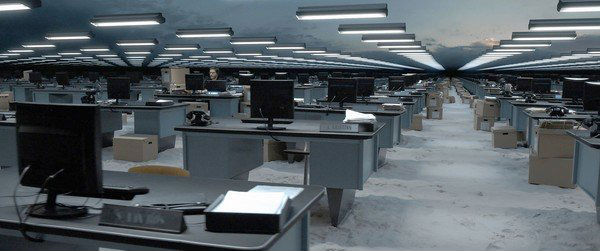
The "reveal" of this information is done in a "cutesy" illustrative manner.  At one stage, Berg wants to talk to the other WikiLeaks members that he's been trading communiques with about sources and information, something Assange is initially reluctant to do.  Then, when it becomes a "make or break" request, he gives in, showing Berg his "hold card"—that the other people Berg has been instant-messaging and e-mailing have merely been alternate Assange accounts.  He's only been talking to Julian, which Berg imagines as a scene out of Being John Malkovich crossed with The Apartment of an infinite number of desks in an office, all with Julian Assange sitting behind them.  It's a little too literal and maybe just a little condescending to spell it out so baldly to the audience, but ultimately that visual metaphor is stretched as, at critical junctures, that infinite number of Assange's keeps coming back to make fantasy-narrative points that seem unnecessary (other than to conjure up that all those Assange's are going to write the complete works of Shakespeare someday).  

The acting is, across the line, superb: Cumberbatch does a fascinating Assange, adroit, and self-contained, like a chess-player, usually thinking about something else than the topic of conversation, and his final bit—an in-character dismissal of "the two films" coming about WikiLeaks (presumably this film and Alex Gibney's documentary) is a cautionary warning; Brühl, seems to be the go-to guy to play Germanic naifs after Good bye Lenin!, Inglourious Basterdsand Rush, and here plays Berg as an all-too-willing apprentice looking for a mentor; Laura Linney, Stanley Tucci, and Anthony Mackie play American diplomats trying to deal with the fall-out, while David Thewliss and Peter Capaldi play two reporters for The Guardian with suspicious hesitance about their "source."


It's a good dramatization, filling in character holes which Gibney's documentary left unexplored.  The two together make a good summary of events that, as yet, have no ending, but have managed to rock the world, making the cyber-world look frighteningly like a glass-house sitting in a field filled with stones.

The Fifth Estate is a Matinee.


* The same attack came from Assange about this year's Alex Gibney documentary We Steal Secrets: The Story of WikiLeaks, which tells the same story, but through interviews and through Gibney's journalistic sensibilities (which produced Enron: The Smartest Guys in the Room, Taxi to the Dark Side, Gonzo: The Life and Work of Hunter S. Thompson, Casino Jack and the United States of Money, and Park Avenue: Money, Power and the American Dream).  Critics have been far harsher on The Fifth Estate than We Steal Secrets, either because 1) the documentary is considered more "legitimate" than the dramatic version; 2) Assange's attacks seem to "stick" better to a dramatic recreation than a documentary, or 3) they actually (at a rate of 95% to 37%—which is quite a swing) prefer the techniques of the documentary to The Fifth Estate . But, then, according to Rotten Tomatoes, they've been harsher on The Fifth Estate than the Stallone-Schwarzenegger yarn Escape Plan, which is just inconceivable, and brings Rotten Tomatoes' validity as an indicator of quality and worth as a taste aggregator into suspicion.

** Assange has said that no "outed" operative has been killed, due to the leaks (although The Fifth Estate fictionalizes one such source (Alexander Siddig) being forced to evacuate with his wife and children (in the same way that Patton fictionalizes what might have happened in WWII if, because of Eisenhower's decision to send gasoline to British tanks instead of American ones, if a tank company all of a sudden ran out of fuel behind enemy lines).  1) Assange is probably not a good source for that kind of information as he'd only get it from "whistle-blowers" who might not want to take claim for any deaths (nor would Assange).  2) It's not going to come from American sources who might not want to further risk others (ie "known associates") of anyone affected by it, despite making the case that there WAS some "collateral murder" (to coin a phrase) and making assange and WikiLeaks look bad.  As someone far more Machiavellian once said "The absence of evidence does not mean the evidence of absence."

Friday, October 29, 2010

Gods and Monsters


Gods and Monsters (Bill Condon, 1998) Frankenstein begot "The Monster."  Mary Shelley created Frankenstein.  But the Modern Prometheus who caught lightning in a bottle and made Frankenstein more than the sum of its parts was director James Whale.

When considering Gods and Monsters, the film purporting to be about the last days of Whale, there is always a giddy part of me that recalls the delirious segment of "Monty Python's Flying Circus" (aren't they all?) called "Farming Club,' in which a serious BBC commentator begins to discuss the composer Tchaikovsky before it deteriorates ("which is a bit of a pity as this is 'Farming Club'"), and then returns to a discussion of the composer with the lead-off: "Tchaikowsky. Was he the tortured soul who poured out his immortal longings into dignified passages of stately music, or was he just an old poof who wrote tunes?"

Cruel, maybe.  But the film makes the mistake that a lot of us who "read" films does—it makes its assumptions out of things it already knows, and, once having made those assumptions, stops.*  It does a fine job of recreating Whale's work making his "monster movies," specifically Frankenstein, the one that towers over them all.  It's good that it at least brings into the light of day Whale's homosexuality and how it might have informed his work.  But, just as his two "Frankenstein" movies overshadowed the rest of his career, Gods and Monsters seems to only concern itself with that aspect of Whale's life.  There's a lot more that the film either ignores or glosses over, in exchange for trumping up a story about a possible relationship that Whale (played by Ian McKellenmight have had with his gardener (Brendan Fraser), a result of which, Whale ended up drowning in his own swimming pool.  As such, it does as much a disservice to its subject as Hollywoodland does to George Reeves.

The fact of the matter is, both movies try to shoe-horn some psycho-babble and ginned-up rumor to try to explain the completely private act of suicide.  We don't what what drove these two men to take their lives.  We can only conjecture.  But, what was on their minds at those final moments can only be explained by the subjects themselves, and those critical thoughts are far more complicated for the sort of detective work that might easily solve "who stole Lady Penelope's diamonds?"**

There's more to Whale than Frankenstein.  He was a prisoner of war during WWI, where he lived a kind of "King Rat" existence, accumulating a sizable amount of cash from his fellow prisoners in poker games.  He was an "out" homosexual at a time when everything was "on the QT and very hush-hush."  He lived in Hollywood very well, from some extremely good investments, and in a long-term relationship with one man.  He directed for both film and stage, and among his other works are The Old Dark House, the Claude Rains version of The Invisible Man, and Show Boat, considered by many to be the best version, which one could argue simply because it contains the towering presence of Paul Robeson.  But there's more, and much more.  However, owing to the vagaries of box-office and the whims of fashion, not all of Whale's work is available to see.  And so, it becomes no longer part of the equation in the matter of considering Whale, the artist.  What we're left with is his best known, but not most typical, work.  Frankenstein explains James Whale as much as "Rosebud" explains Citizen Kane.  And that is, inadequately.

Gods and Monsters is, finally, dishonest.  It serves up melodrama, for what is a more compelling, if depressing, truth.  What this "Master of Horror" finally feared was a life out of his control, that he was no longer master of.  And rather than face that fear of life unimaginable to him, he chose the fast way out.  Not as compelling, maybe, as what Condon's film serves up, but, I think it would be truer to the source—and tie in better with the milieu it's obsessed with—if it was to make the point that Horror isn't cooked up in flashes of lightning and sparking laboratories.  It is far more commonplace.  Horror can be Nature itself, as ordinary as illness and disease and frailty.  It's a better message, I think.  But try and get an audience to go see that.

* Look.  I do it, too.

** The best evidence, of course, was Whale's suicide note, which was kept secret for many years, and as Nature (and Hollywood) abhors a vacuum, that allowed for decades of speculation to become fact—or rather ill become it.  This is what Whale's final message read: 

"To ALL I LOVE,
"Do not grieve for me. My nerves are all shot and for the last year I have been in agony day and night—except when I sleep with sleeping pills—and any peace I have by day is when I am drugged by pills.
"I have had a wonderful life but it is over and my nerves get worse and I am afraid they will have to take me away. So please forgive me, all those I love and may God forgive me too, but I cannot bear the agony and it [is] best for everyone this way.
"The future is just old age and illness and pain. Goodbye and thank you for all your love. I must have peace and this is the only way.
"Jimmy"


Monday, April 14, 2008

Kinsey

"Kinsey" (Bill Condon, 2004) Bill Condon's film of the life and work of Alfred Kinsey, whose scientific study of sexuality in America was the literary equivalent of playing "Doctor" in the '50's ("I'll read yours, if you'll read mine") is a cogent little gloss of the subject which still manages to tell an intriguing and controversial story, while addressing something Kinsey and his researches never did--that of morality, and "feelings." Treating sex as a clinical study wasn't so easy a proposition, as Kinsey, his wife, co-workers and the Rockefeller Foundation that funded him, found out. Condon films the movie in a series of boxes--safe little containers to hold the forbidden fruit. It's when Kinsey is outdoors that he feels the most free. Put him in a rotunda, he's in trouble. What started out as a cold and clinical study by his group soon affects the lives of his researchers, and, when the results are published, the rest of the country. Condon (who wrote the screenplay) starts the movie as a training exercise, grilling his survey-takers (Peter Sarsgaard, Timothy Hutton and Chris O'Donnell--great cast, with Liam Neeson and Laura Linney, playing Kinsey and wife, being very fine) on their approach, their manner, and their reactions to answers as a test subject--neatly introducing the back-story. There's one box that Kinsey won't consider--Pandora's--and he and his staff are only too willing to dive into it--experimentally, of course, in the name of Science--only to find the damage that it can cause. The libido and the psyche are two compoletely different things, and the film almost makes a case for restraint in sexual matters, for all the damage it can do. An interesting consideration, that. One wonders how amused Kinsey would be by the irony.

The other thing that's interesting is that when writing a review of the film, there's no way that you can write it without filling it with unintended double entendres (said the Actress to the Bishop).

Tuesday, January 22, 2008

Dreamgirls

Dreamgirls (Bill Condon, 2006) Think "The Color Purple" in sequined gowns and moved north to Motown and you've got it in a nutsell. Or the story of "The Supremes" but without the good music. I've always liked the material provided Motown's premiere girl-group (the singer, not the song/the singer, not the song) even though they were vamping cross-gendered "Pip's," but I've always had a feeling like chewing aluminum foil when it comes to uber-diva Diana Ross. In fact the only concert I'd kept a record of was the one in Central Park that was interrupted by a freak thunderstorm of such magnitude that New Yorkers started leaving in throngs (cabs and coaches being presumably unavailable), while the rain-pelted, wind-whipped Ross was exhorting "Please! Stay! Just sing with me! It'll blow over! " (It didn't. Sometimes reality can overwhelm ego) That one always gave me a chuckle. Poor drenched Diana. Nobody loved her enough to risk electrocution. Musta been hard.

So to see a fictionalized version of their story, even one not to Ms. Ross' liking, might have had some sort of crass-enjoyment to it. But the songs have none of the agressive bop of Motown pop, the conceit of songs in concert/songs as commentary doesn't work and most of the performances try to trudge through the treacle unsuccessfully. Who'd have thought that Beyonce, child of Mariah, born of Whitney, out of Diana would prove to be such a non-entity on-screen, even when the movie is made to order for her. And the very talented Jamie Foxx can't play a bad guy when all his life he has sung like a good guy. It is his sorry fate to be cast as "Mister" splitting up the women, then banished to inconsequence when we end with The Big Reunion.

But...the things that make the movie watchable and of any interest at all are Jennifer Hudson and Eddie Murphy. Hudson won the Oscar for the over-wrought "And I'm Telling You I'm Not Going," but her bad-attitude acting and her quieter singing are what really make you miss her when she's off-screen. And Murphy proves that, despite the schlock that he's attached his name to, he's a man of unqualified gifts. His fictionalized riff on James Brown shows the athleticism, the brio, the stage-power and the inherent puffery of "A Hardest Working Man in Show Business." Not a false or contrived-cute note in that performance. And he sings good, too. He shoulda won that Oscar.