 Writer's Cell-Block
or
"He Talked to Me Like I'm Not Pretty!"
The writing-directing team of Diablo Cody and Jason Reitman reunite to present what could be the dark sequel to their sunny, funny Juno. But, instead of examining the student body sub-strata of geeks, we're looking at the sosh's side down there at the very shallow end of the gene pool and the eventual disintegration of High School Dreams.
Trouble is knowing when to wake up. That's the thing about the privileged and the entitled, they never know when the party's done and it's time to go home (and don't even bother asking them to help clean up—that's maid-service). It's the problem of Mavis Gerry (Charlize Theron): her party's over but she's still rocking in the corner, hugging her Maker's Mark bottle, and she picks the perfectly wrong time to go home to Mercury, Minnesota. A writer of moony, self-absorbed children's books (No, no...that's "Y-A's," the contradictory term "Young Adult" novels) about High School life in a series called "Waverly 128", she draws mostly from real life—her own—but with additional snatches of overheard conversations cribbed from teen conversations in fast-food joints and malls.
She need not bother with the latter. Mavis' emotional development is so arrested it should be serving 10 to 20 in "juvie." Her thought processes are still confined to Middling School concerns, even if her behaviors have become more adult in nature, with one marriage behind her and several casual affairs left high and dry, to sleep it off in her bed, and the height of a social life being getting hammered in a bar, anticipating it like a kegger, and her one constant companion an "accessory pet," an animated white hair-ball named Dolce that is left, more or less abandoned, but still capable of the one love Mavis can accept or understand—reverse unconditional. Oh, in our self-absorbed and -absorbed youth culture, she can pass for a grown-up, she's pretty, put-together, and trendy, but on the inside she hasn't graduated, pushing off her writing assignments like she was having to write a term-paper.
In the midst of burbling out her latest teen tome, she gets a message from an old flame (Patrick Wilson) that he and his wife (Elizabeth Reaser) have had their first child...and something in Mavis snaps. She packs up laptop and lap-dog and cruises back to Mercury to recapture her past and maybe new father Buddy Slade and "rescue" him from responsible domesticity, two things she can't fathom or stomach. I mean, have you seen that baby? Ga-ross!
Thing is, she's clueless. Mavis is so stuck in the past rattling around inside her head, you begin to wonder if she might be a little insane, besides insular. Fortunately, she runs into somebody she perpetually ignored in High School—the guy who had the hall-locker next to her that she never noticed existed, Matt Freehauf (Patton Oswalt, best thing he's ever done), who had his own development beaten out of him ("Oh, yeah, you're the "hate-crime" guy!" blurts Mavis, tactfully and sensitively) by High School toughs who, in a clear case of High School temperance, tolerance and judiciousness, mistakenly assumed he was gay. Matt, with his twisted body, develops a fascination with Mavis and her twisted logic, only half-heartedly trying to suggest that...you know...she might be a little out of sync with the normal, a notion that she scoffs at, before taking another slug and checking herself out in her mirror.
"You...are a piece of work," says Matt, admiringly. "And you are a piece of shit," comebacks writerly Mavis.
This can not go well, and one wonders where the movie could possibly go and if it can ever be resolved without something being destroyed. The damage being done, though, is to the expectations of the casual movie-goer. Mavis is not your charming debutante "sweet thing" that you'd find in your standard rom-com. She is, as one of her class-hates says, a "psychotic prom-queen bitch," and, though smart and clever, thoroughly unlikable, even when sometimes bordering on the sympathetic. Theron is never afraid of tackling this type of character (she did, after all, win an Oscar for her terrifying Aileen Wournos in Monster) or challenging expectations of the audience, and Cody (with Reitman) has a fine time skewering the traditional "woman-pursues-her-soul-mate" brand of romantic fiction. For that, Young Adult, as cringe-inducing and unsettling as it is, deserves an acknowledgement for being a brave film, risking a lot, while also giving a bitch-slap to the Hollywood romance. It left me in an odd place. I didn't thoroughly enjoy Young Adult, but, at the same time, I recognized that the makers were making a thoroughly professional statement...or at least an obscene gesture...to the too-easy way that love is presented in the movies, something I've railed against myself. This isn't love. It's selfish obsession. And Mavis, like so many of the protagonists in Reitman's films, is an outlier of Society, playing by her own rules, but, as opposed to the others, she reaches no self-awareness, and is absolutely clueless as to where the goal-post is (knowing Mavis, she probably would pick a random spot, easy to reach, and declare it 'good"). One is hesitant to praise or applaud such accomplishments, when the impulse is to show it the door and kick it in the ass on the way out.
Young Adult is a Rental.
Wednesday, January 11, 2012
Young Adult


Wednesday, December 1, 2010
Morning Glory

"You're Gonna Make it After Alllll"*
or
"Will Someone Tell Me Why I Logged Off 'BangingGrannies.com' For This?"
Becky Fuller (Rachel McAdams) has just rebounded from being fired from her Jersey TV station to being hired to produce an in-the-ratings-dumper morning news-klatsch in New York. The stipulation from boss Jeff Goldblum (whose heighth advantage over McAdams is used to good advantage) is that she has to turn the ratings around or the venerable TV-institution "DayBreak" will be cancelled.
But who wants to work in an institution?
The place is a mad-house. Goofy weatherman, clueless reporters, a perv' anchor (he delivers the second headline above), and the Nurse Ratched is the veteran house-mother-anchor (Diane Keaton) who views Becky as just one more producer for a show that's "a revolving door for cretinous morons." She's seen 'em come and go, while she's been "pulling the train up the hill(...with my TEETH!)" for fourteen years. "DayBreak" needs to be fixed.
Becky starts to shake things up, and her first job is to find an anchor a little less orange. She goes the credibility route and seeks out Mike Pomeroy (Harrison Ford, who hasn't done this much mugging since Return of the Jedi**), a veteran news-man (he lunches with Chris Matthews, Bob Schieffer, and Morley Safer), grumpily living out his golden parachute contract, and has no desire to lower his standards working on a show with "half an audience who've lost the remote, and the other half are waiting for the nurse to turn them over." Warned that he is "the third-worst person in the world...after Kim Jong-Il and Angela Lansbury" by the movie's obligatory boy-friend (Patrick Wilson...slumming***), Becky finds a loop-hole in his contract and forces the pro to "lower his standards," but raise the bar on passive-aggressive behavior (he refuses to "banter, from the Latin word for 'gibber like a moron'")...as if the show needed any more of that. Pretty soon, every surface at the station has Becky-forehead-sized dents from her beating herself into them—that and her seeming incapacity to open doors are the two consistent jokes of which no opportunity is passed.
It's got the TV-industry cynicism down, but raised to the bitchy level of the fashion industry (the writer, Aline Brosh McKenna, also wrote The Devil Wears Prada, ...and 27 Dresses , and Laws of Attraction, and Three to Tango...so this is the first movie of hers I haven't actively avoided...although I did see Prada, and admired it). Director Roger Michell can do rom-com fine (Notting Hill), but he's capable of doing better stuff, and he keeps everything lively and semi-sunny, despite the rampant cruelty tossed around like so much unnecessary paper-shuffling on a news-desk. But, he can't do much with the cliched material, from the "mmet cute" to the "slo-mo run through new York."
Morning Glory is okay, but it breaks no boundaries (or news, for all that), it's another "working girl" comedy in the revolving door of them.
Morning Glory is a Cable-Watcher.
* Cue the hat-throw. Give credit where credit is due: I didn't notice this was basically "The Mary Tyler Moore Show" (and a two-hour stretch of the half-hour pilot, at that) until Ford's crusty news vet says to the young producer "You have a repellant moxie" in the same way that Ed Asner's Lou Grant said "You've got spunk....I HATE spunk!" Where's Betty White when you need her?
** ...which makes me think something is wrong. Ford is the master of the subtle slow-burn comic performance, but this one is at a hard-boil. His lines delivered in a husky, phlegmatic drone, you start to wonder if Ford—like his character—just isn't happy to be there (y'know, like his narration in BladeRunner?). Then, he manages to take what should have been the movie's worst scene, and make it shine, giving it depth, resonance and heart...while still not betraying his character. Nice work.
*** Yeah, but on the other hand, I've felt so sorry for so many good actresses playing "the girlfriend" over the years, this is one for equal opportunity.


Tuesday, June 15, 2010
The A-Team (2010)
 "Because Over-Kill is Underrated, My Friend"
I was never a huge fan of the TV version of "The A-Team," still in syndication around the country. A male version of "Charlie's Angels," with a for-hire team of whack-job mercenaries (that the producers claimed was inspired by the odd-ball cops of "Hill Street Blues") it was a huge hit until it ran out of steam, cycling through the script-library of adventure shows—a kind of manic, cartoon hybrid of "The Rockford Files" and "Mission: Impossible."
Because the source material was rather poor, the news of a big-screen remake was not the sort that would make one hyper-anticipatory. Just the opposite; "The A-Team" sounded like a B-movie waiting to happen, perhaps even falling lower on the alphabetical scale if the creatives involved were as by-the-playbook as the series runners.
Happily—giddily—the folks making "The A-Team" knew what worked with the old series and have amped it up to the nth degree, even occasionally throwing a TV-trope into the mix to show you they're not taking this too seriously. It's not Great Cinema—I don't think I can justify paying big bucks seeing it in a theater—but in its looney-toon action sequences, it approaches the manic intensity of child's play with new toys.
It's a sugar-rush.
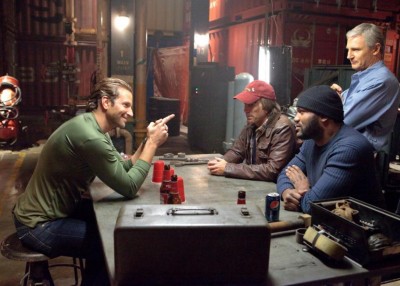
The old "A's" (Peppard, Benedict, T, and Schultz) were Viet-era grunts, but they've been re-boot-camped to the Persian Punch-Out (and Mr. Cheney says to leave the quagmire comparisons at the door, thanks, and he's got a gun). But they're still the zany merc's they always were, with their complicated strategems, the MacGyver'd weapons, "you-can't-do-that-in-this-vehicle" stunts, and the "pity the fool." The cast is shake-your-head-til-it-rattles good: Liam Neeson, haggard and stogified, makes a great Col. "Hannibal" Smith—it's nice to see Neeson in something a little lighter, the man needs a break. Bradley Cooper's "Face" has a perpetual shit-eating grin, and no dolby/no squelch for chatting people up (he's worked out and takes off his shirt a lot, ladies). As John Milius said about Arnold Schwarzenegger, if Mr. T didn't exist, they would have to construct one, and they've done that, shoe-horning "Rampage" Jackson into the role. Sadly, he doesn't have "T's" fire that smoulders during the drama scenes, but when required to turn it up to "11," Jackson comes through. But, the curdled cream-of-the-corps is Sharlto Copley as "Howling Mad" Murdock. Fans of the show loved the certified (and certifiable) pilot played by Dwight Schultz (bless 'im), but Copley (who played the harried Afrikanner middle-management hack in "District 9"—and you liked him in that), takes the role in his teeth and shakes it 'til it squeeks, flecks of mad-foam and scrambled accents flying in all directions. Let this be noted in the ledger—he is going to be big. He's that good. He's that funny. He's that creative, and this is him playing in the minors. There are at least two "Batman" villains with his name on them. Sharlto. Copley. Learn to pronounce it. You'll be using it a lot.
They could have put anybody else in this movie and it would be fine, but Patrick Wilson has a field-day with his ghost-in-the-CIA-machine, Agent Lynch. Gerald McRaney (one of those TV-elements I talked about earlier) manages to rise above the material, and Jessica Biel rocks her wardrobe, plays the straight man, and nails the movie's best line (the laughter went for 30 seconds, I clocked it).
High praise. Brownie points for that. And the writers weren't lazy,* the special effects crews sloppily crafty—8 of them, but they spent more time on details and in-jokes than they do on photo-realism and I can respect that. But the direction (by Joe Carnehan—remember when he was "the next big thing" with "Narc?") is a mess. At one point, there's a heated conversation in a photo-booth between two people and you'd swear there was three. There are odd shots during the mayhem that don't show much—and were obviously "C"-roll cameras—but are there, anyway. And more than that, the cutting scheme assumes we're morons, flashing back to scenes we might have missed adjusting our drool-cup in case we missed "the point."
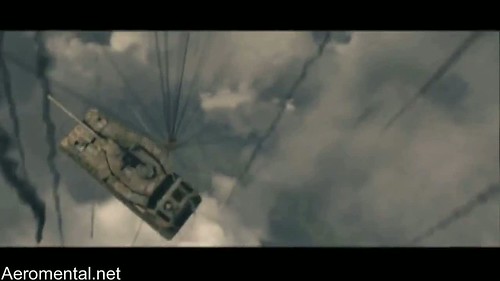
They needn't have bothered. "The point," such as it is, is to keep sharpening before it gets dull, which the movie threatens to do at several points. During the "drama," one gets the urge to get a Coke, hit the head, or text-message, until the next hyper-action sequence comes along, like the hysterical tank-bit, or the child's mayhem with a cargo-tanker, comes along.
It's entertaining. And that's a gift.
But, like a sugar-high, it doesn't last, and makes one antsy for the next supply of "rush."
Isn't there a big-budget "Magnum: P-I" scheduled?
"The A-Team" is a Rental.
* Although you will think they were. At one point, it will be obvious what is going on, and you will (I have faith in you) go "Wait a minute...that's..."—as every member of the audience I saw it with, did, and felt the need to say it aloud. I'm going to give the writers credit and say it's another one of the TV-tropes I alluded to earlier—the "obvious switcheroo" that Your Aunt Jessye could figure out.





Friday, March 6, 2009
Watchmen

 "Turning Air to Gold:
The Transmutation of 'Watchmen' from Graphic Novel to Silver Screen"
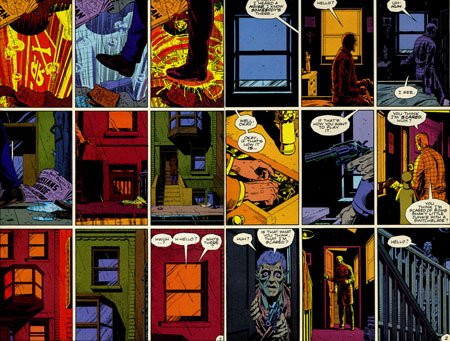
After years of failed attempts by various studios and directors, Alan Moore and Dave Gibbons' epic deconstruction of super-hero stereotypes in graphic-novel form has finally made it to the screen. Two studios financed it (with proceeds going to a third) and the director is Zack Snyder, who did an interesting re-make of "Dawn of the Dead," and the film adaptation of Frank Miller's "300." "300" was a somewhat mixed result due to the weakness of its source material, and Snyder's reliance on a bleached CG oppressiveness, but one could see him trying to find interesting ways to make Miller's panoramas and boxes translate to interesting moving images, if not a fully-realized film. "Structurally, There's No Difference" Snyder and his scriptwriters David Hayter and Alex Tse have compressed the story, eliminating some second and third-tier characters (although they appear in the movie if you're looking for them), completely eliminating the parallel stories (in comic form) of "Tales of the Black Freighter" and the super-hero memoir "Under the Hood" (which will appear on a separate DVD, apparently) and concentrating on the main thread of the story: "Somebody is killing the Great Retired Superheroes of America."** It follows the investigation of never-realized super-group The Watchmen into who might be killing their members, starting with The Comedian, a government-sanctioned vigilante. All the Watchmen are vigilantes and, to some degree, fascists breaking arms and legs in brutal fist-fights that are, in the film, probably the best realized comics-fights yet filmed—like cage-matches in the open air. They all dress in the spandex kicking heads for different reasons and their very differences in attitude, sense of justice and heritage are what make the characters interesting, not the justice dispensed. There's action aplenty,*** but where Snyder has excelled and made the film his own is to take Moore's example and kick it up a notch. Moore's super-America of 1985 has Nixon still in the White House for an unprecedented sixth term, the Viet Nam War having been won by Watchmen incursion. But Snyder doesn't stop there. There are all sorts of cultural references spread throughout the film mixing History with heroes. TV, political and business personalities are recognizable from their Real World counter-parts. Moore piled on the culture references but Snyder takes advantage of the audio-visual tools he has to provide a great soundtrack of hits from a diverse group of Bob Dylan, Simon and Garfunkle, Leonard Cohen, and Phillip Glass. Compositions and dialog are taken from other movies to sometimes hilarious effect, and although one doesn't want to give away too many of Snyder's surprises, to not acknowledge them would be giving this film's own strengths short-shrift. It is its own animal—a fully functional moving picture that takes the strengths of the comics medium source, but builds on it and takes the viewer between the panels without a sense of filler or extraneous material. "But my Eyes were stabbed by the flash of a neon light/ Just as Moore nested references throughout the series, Snyder takes visual cues and unites them throughout the film. Where Moore has his "Smiley Face" icon throughout (a device that seems a shade contrived in the film), Snyder's white-bright light flashes carry resonances throughout the film, especially in an ages spanning credit-sequence (which contains one of the best comics call-backs in the film). Those flashes will carry dramatic weight throughout the movie right up to the ending (which manages to logically improve on the novel's proposition-of course, that's how you solve "the problem," it's been staring us in the face all along). I was surprised and delighted by "Watchmen," the movie re-creating the same emotions I had reading the book all those years ago. But I wonder how much information one would get from the movie without having read the source. For me, there was recollected information bursting out of every frame, but to someone without the book in their banks those frames might seem over-crowded with useless knick-knacks...instead of pieces of the puzzle. Without that fore-knowledge, is the movie as compelling, or does one take a Manhattan-ish dis-interest? "Watchmen" is a Full-Price Ticket (Hrn).
When one heard that his next project was to film the unfilmable "Watchmen," there was some cautionary hope: Moore's works "From Hell," "V for Vendetta," and "The League of Extraordinary Gentlemen" were not the movies they should have been, mostly due to liberties taken to Moore's blue-print (and as a result, Moore has refused any interest, personal or financial, from filmed adaptations of his writing—his lack of credit yawns like a big black hole in the film's credits).
His "Watchmen" is another animal—a sprawling 12 issue serial based on an alternate Earth where masked vigilantes do exist, it crossed eras and locations in a blink, played on nesting cultural references and on-the-nose word-play, while having the look and feel of a movie story-board. It looked like it should be filmed, even though its nudity, ultra-violence and political satire made it somewhat over the heads of the casual movie-goer and beyond the scope of the MPAA. Given Moore's history, the expectations were another bastardization, or, given Snyder's, a by-the-numbers adaptation with nothing new to offer.
The result, though, is neither extreme.
It's a faithful adaptation that doesn't mind sharing in the fun of creation.
That split the night"
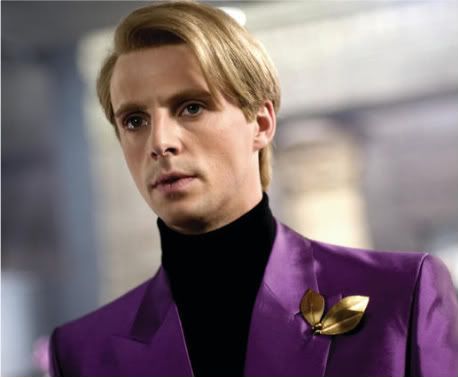
But, you can have all the CG wizardry in many worlds if the organic part ofthings, the actors, don't breathe life into the characters, and here "Watchmen" excells. Patrick Wilson has spent too much time being the handsomely bland blonde guy that it's a welcome relief to see him stand out appreciably as Dan Dreiberg, The Nite-Owl. Matthew Goode as Ozymandias has a lazy, lithe, slurry quality that shows how used he is to being The Smartest Man in the Room, always. Jeffrey Dean Morgan has the hardest role as The Comedian, but makes it work, as Malin Akerman does for The Silk Specter. But the big raves go to to guys who spend most of the time hidden: Billy Crudup, who manages to make a character of Dr. Manhattan despite the fact that it's all CGI imagery (can you believe they wanted Schwarzenegger for the role?), and Jackie Earle Haley, who does wonders as Rorshach. The stand-out character of the series needed a superb performance and Haley, who's made few mis-steps since re-igniting his peculiar acting career slams it home. One hopes that his talent is acknowledged soon.  * There have been some review complaints of "slavish" adherence to the source material. Whole sections have been lifted, but it's only once in awhile when those sections encompass a lot of material (usually from a God's eye perspective). "Slavish adherence" is simply not true. Even if it was, when was that ever a movie sin? Nobody complained when "Lonesome Dove" stuck so close to Larry McMurtry's novel. Why is it an issue now? Nothing else to write about?
** "Watchmen" grew out of Alan Moore proposing a 12 issue series based on characters acquired by DC Comics when it bought the Charlton Comics line. DC wanted to use those characters in the regular comic-line, but wanted Moore's story, too. So, Moore created new heroes based on those characters: Captain Atom became Dr. Manhattan; Blue Beetle became Nite-Owl; The Question became Rorschach; Pete Cannon-Thunderbolt inspired Ozymandias; The Peacemaker became The Comedian; Nightshade became The Silk Specter.
*** "Watchmen" is a hard "R" for moments of sexuality, nudity and stomach-churning violence, for instance, characters are meat-cleavered in the head, one criminal has his hands tied to prison bars and his arms sawed off, not to mention the near-occasion of brutal fights—The Silk Specter breaks an arm so hard the bone pierces the skin — and a prison fight ends when a prisoner is dowsed with boiling oil. The movie begins with a bone-crunching fight between The Comedian and an unknown assassin, leading to his being thrown through a plate-glass window a couple dozen stories high. The movie's lone super-powered hero, Dr. Manhattan, explodes people with a wave of his hand. The show I went to, a couple brought their five year old son. He's gonna be in therapy for months.




Tuesday, January 22, 2008
Little Children
"Little Children" (Todd Field, 2006) One I've been wanting to see but avoiding. Again, bad decision. Todd Field has the spirit of Kubrick in him
 (Field, as an actor, worked on "Eyes Wide Shut" and Kubrick subjected him to "the drill" about his first film, "In the Bedroom"--"Why do you want to make that? What can you bring to it? How can you tell your story more compellingly? Is it worth doing, though?")--but Fields, is a far looser director, and with a much more sure sense of humor, though it was missing in "Bedroom." That razor-like humor helps in this story of a neighborhood not coping well with a convicted sex offender in their midst (he's a flasher). Everyone is on the critical edge of everyday panic and with an aversion to complacency, so everyone seems determined to see how far they can push the envelope before things come crashing around their ears. There is an air of clinical observation to the film that is cruel and humorous, though, for the characters portrayed, everything is of deadly earnest and has complex consequences. And its use of Will Lyman is brilliant. Uniformly the cast is excellent with Kate Winslet, Patrick Wilson (he had the least showy role in HBO's "Angels in America" as the closeted conservative), Jennifer Connelly (restrained and never better), and particularly Jackie Earle Haley as the flasher. Absent from movies for years, Haley now has a cadaverous look like he's being consumed from the inside, and his beady-eyed pressurized work keeps you on pins and needles. He and Winslet received the lion's share of accolades at awards-time last year, but the film itself should have received more attention...certainly more than "The Departed" did. Todd Field is a guy to watch.