 Physician, Heal Thyself
or
"It's Hard, You Will Find, to be Narrow of Mind When You're Jung at Heart"
There's a lovely scene in Francis Coppola's Tucker: The Man and His Dream, in which Tucker's accountant (played by Martin Landau) talks about how his mother "in the old country" warned him not to get too close to people or he'd catch their "dreams." "Years later," he says "I realized I misunderstood her. 'Germs', she said, not dreams, you'll catch their germs."
David Cronenberg's film of A Dangerous Method (adapted by Christopher Hampton from his play), a fictionalization of the relationship between psychiatric pioneers Signmund Freud, Carl Jung and Sabina Spielrein, might well have "don't get too close to people or you'll catch their dreams" as its tagline. Starting out, Jung and Freud are two eminent theoretical psychiatrists, the former in Switzerland and the latter in Vienna. Spielrein is admitted to Jung's care, suffering from what appears to be schizophrenia, but he is convinced that Freud's "talking cure" (the name of Hampton's play) might lead to a break-through from her confusion and agitation.
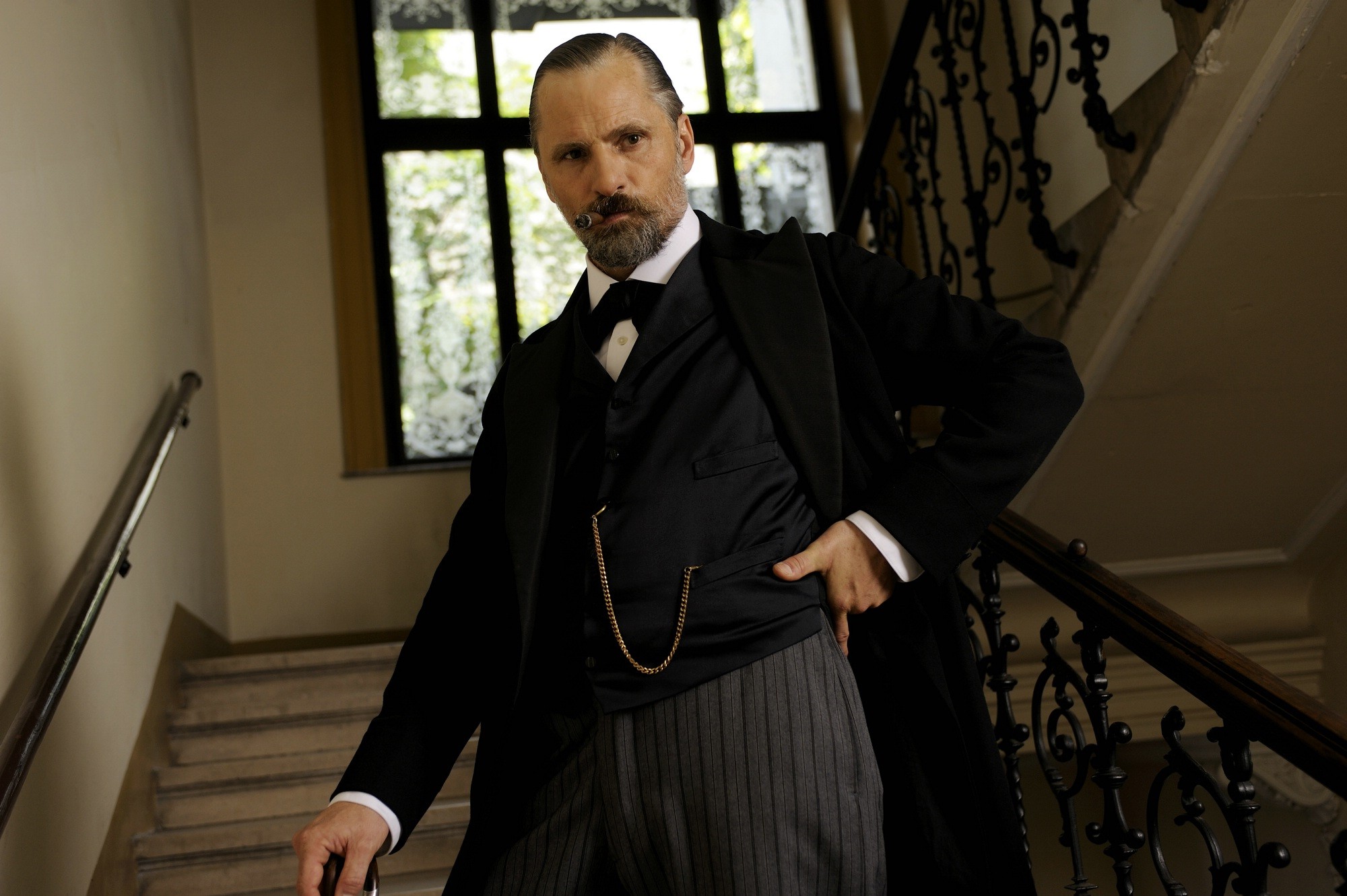
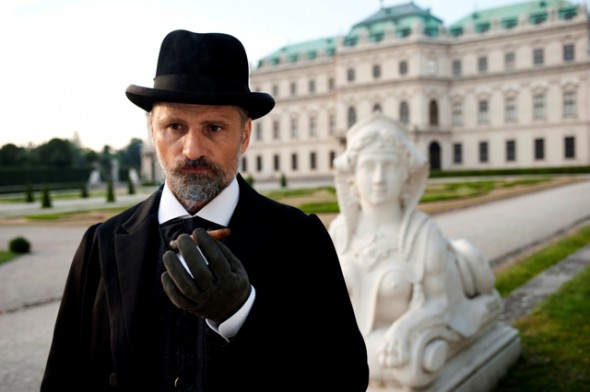
Jung (Michael Fassbender) has it all going for him—in marked contrast to his troubled patients and his contemporaries in his field—married to a rich heiress, he works because he wants to, not because he has to. Humorless, cool and entirely self-absorbed and -satisfied, the treatment of Spielrein gives him a very real sense of accomplishment, as the woman's obvious intelligence allows her to improve from the agitated state she arrives in.* His comradeship with Freud (Viggo Mortensen, his third film in a row with director Cronenberg) starts intellectually, evolves into an affectionate father-son mentorship, Freud sees him as an "heir" in the field of psychotherapy, and encourages his younger contemporary and his processes...up to a point—Freud cooly informs Jung, while he's is visiting the home of the elder, that, sure, he can espouse his sexual theories at the Freud family dinner table—after all, "they've heard worse." But the air of chastisement is never far from Freud's sphere, like the smoke that hangs around his cigar.
Jung is a confident, if clueless, intellectual and emotionally remote (although he would use the word "dispassionate"). Things start to go downhill when Freud sends him "a problem" professor, Otto Gross (a nearly unrecognizable Vincent Cassel), a libertine without conscience or consequences, who starts to influence Jung to his way of thinking. The pressures of Gross' philosophy (such as it is) and Spielrein's needy attempts at seduction, compels him to begin, eventually, a twisted affair with his patient, the result of which leads to whispers of impropriety in psychiatric circles and creates a rift between him and Freud. Jung reacts, not by questioning his own actions, but escalating his objections to Freud's obsession with sex as the root of human dysfunction,** and as good as he is at examining others, is incapable of realizing the deadening of his own emotions and darkening of his tone. His own self-analysis becomes paralyzed in the conflicts of his own mind, and he's left confused, disillusioned and impotent to know how to bring himself out of it. The patient improves and becomes a more rounded human being, but the doctor...he succumbs.
It recalls words the simple answer my brother used when I was contemplating psychotherapy: "But...psychiatrists are crazy!"
And why wouldn't they be? In tending to our needs, they are just as likely to catch our dream and ensnare our nightmares...and be ensnared by them. Everything is communicable.
And the stories of Spielrein, Jung and Freud, running parallel but opposite paths of mental health, exemplify the rising and falling fortunes, not of career and accomplishment, but of personal integrity. A Dangerous Method is a furthering of the film argument (which is found throughout the work of Kubrick and Welles, for instance) that intellect does not matter so much in a person's measure as character.
A Dangerous Method is a Matinee.
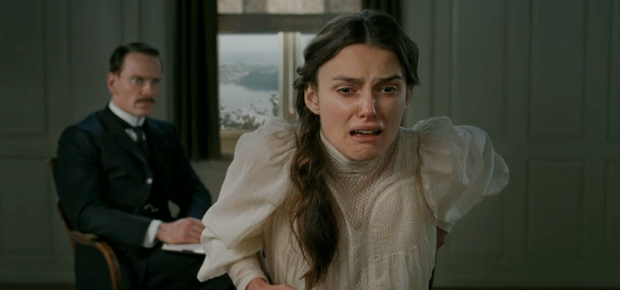
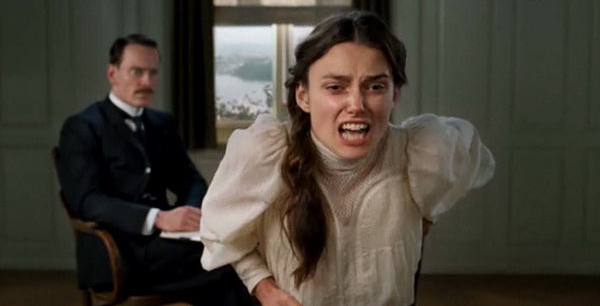
* A passing comment on Keira Knightley's performance, which is, initially, truly alarming, one of the great "crazy" acts since Helena Bonham Carter's Ophelia in Zefferelli's version of Hamlet, but then Knightley has never been afraid of a performance that will risk her beauty. Here, she is vigorously spastic, mercurial, contorting her face into ape-like grimaces and flashes of madness, the eyes pin-wheeling around the room in search of...anything that might pull her out of her own head. Yes, it's over-the-top, but compare it to the woman she becomes by the end—for the triad of performances and personalities in the film, her story is the focus, the linch-pin around which the film revolves—very properly, as those early years of the "talk treatment" are dominated, probably unfairly, but historically accurately, by the reputations of the father-figures in the field. Girls Not Allowed.
** This is certainly true in the portrayal of Freud here; if you ask Morgenson's Freud how many psychiatrists it would take to change a light-bulb (Answer: Just one, but it has to really want to change), he'd cooly appraise you, contemplate his cigar and ask aloud why you chose to not use the word "screw." Avoidance, maybe? Um...
Friday, February 3, 2012
A Dangerous Method






Friday, September 2, 2011
The Dead Zone
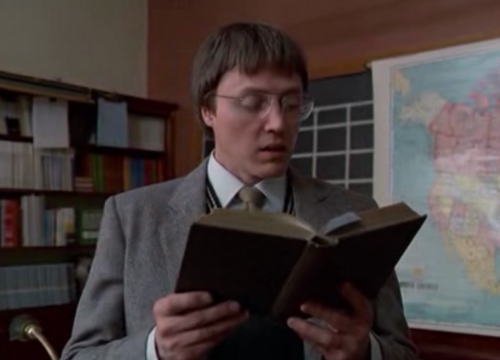
 The Dead Zone (David Cronenberg, 1983) Stephen King's "The Dead Zone" was written as a defense of assassination as a preventive measure for disaster (No, really...what if you could go back in time and kill Hitler as a child?*). What if you had the power of foreknowledge and did nothing to prevent something catastrophic? It may be a sin to kill, but the Catholic Curch also warns of sins of omission. The extraordinary circumstances of a psychic being able to see the future and acting to prevent it is the stuff of philosophy, morality and science-fiction.** But King, who took horror tropes and turned them on their pointed ears wasn't writing science-fiction. His brand of personal horror turned this cautionary tale into one of tragedy.
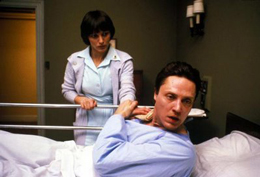
Up to that time, David Cronenberg was known for viscerally-filmed Grade-Z horror films with an emphasis on the squishy, but his film of The Dead Zone (one of the early King adaptations after DePalma's Carrie, Kubrick's version of The Shining, and the Tobe Hooper-directed TV version of 'Salem's Lot) was one of the strongest of the bunch. Cronenberg (and screenwriter Jeffrey Boam) took the larky good-nature out of the initial character of Johnny Smith (played in the film by Christopher Walken, but King thought it better suited for Bill Murray) and boiled the story down to essentials. Smith (as anonymous a name as you'd want) goes on a date with Sarah Bracknell (Brooke Adams) and things are going alright—he's fallen in love, in fact—when Fate raises its Huge Hand in the form of a near-fatal traffic accident that puts Johnny into a coma for five years (Cronenberg, perversely, has the collision occur with a milk tanker—as in "no use crying over..."***). Waking up, he finds that life is completely different—Mom's become unhinged, Sarah's up-and-married, he's semi-crippled, even after severe rehabilitation, and he can't find a job as a teacher of English Lit anywhere.
Oh, yes. Then there's "the power." By merely touching another human being, Johnny can see into that person's future, seeing their possible destiny and maybe death. He wants to live a "normal" life, a life of obscurity and happiness, but this "gift" is more of a curse, throwing him into the limelight, giving him responsibilities that he can't want or need. But, a man of conscience, Johnny can't keep his visions to himself—he has to warn people. He can't merely witness, an innocent by-channeller, he has to act to prevent the tragedies he sees and insert himself between those he touches and their Fates.
A social man, his gift makes him increasingly isolated, trying to hide his abilities, and avoiding people and touching them to keep from seeing those visions. But, as much as he tries to quash his ability to see the future, he is always confronted by it and must come out of his obscurity to prevent them from occurring.
Sounds like classic tragedy to me. With biblical, even apocalyptic echoes.
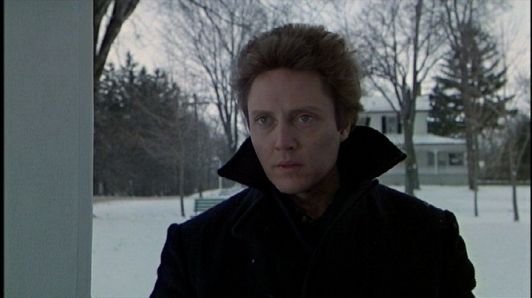
Cronenberg keeps the tone of the film oppressively heavy (Michael Kamen's score is particularly down-beat) and the Canadian locations have a dull, overcast, obliquely lit feel to them, like every moment is a late afternoon threatening to snow. Smith is a particularly sepulchral figure, Walken's tall frame shrouded by a long black overcoat, hobbling stiff-leggedly with a cane, like a harbinger of doom, his eyes haunted, but Walken's hooded eyes grow wide, when he touches someone or an object they possess, as if grabbing a live electrical wire as he goes into his vision. Before long, he is perpetually wearing black gloves.
But, on one of his rare excursions out he manages to take the hand of one Gregg Stillson (Martin Sheen), a Senator with eyes towards the presidency, and what he sees is Stillson launching a nuclear attack, ensuring Mutually Assured Destruction, and he becomes obsessed with stopping it.
Screenwriter Jeffrey Boam does some compression and simplification of the novel that emphasizes coincidence for the sake of a romantically resonant ending, but all in all, it is one of the best of the King screen adaptations (you've got to be careful with King—if you boil down his stories too much and take out too many of his incidents, you can sometimes see that the skeleton of his writing is calcium-deficient). The cast is amazing—Walken, Adams, Lom, but also Tom Skerritt, Anthony Zerbe (playing a strong character for once), Colleen Dewhurst, and the wonderful Jackie Burroughs—and keep things playing out naturally, with only Sheen veering into a kind of caricature.
It's one of Cronenberg's tamer, more straightforward early films (relatively, although there's some gut-churning violence), but it's one of his great ones.








 |
| Cronenberg gives Smith's visions a perverse power. |
* It's been years since I've read the book or seen the movie, and I'd forgotten that very question is asked by Smith in both: in the novel to a WWI veteran, and in the movie to his neurologist Dr. Weizack (Herbert Lom).
** King's next book "11-22-63" is about a man who travels back in time to prevent the Kennedy assassination. I'm going to write one called "The Well" about an author who goes back to one too many times. (Note: There was a "The Twilight Zone" episode called "Back There"—great score by Jerry Goldsmith, btw—about a man who goes back in time and—unsuccessfully—tries to prevent Lincoln's assassination. It starred Russell Johnson, who, whenever he came into the studio I worked at, I'd make sure that his reading copy had nice bold type on it. He appreciated it, and I had a standard exit line for his thanks: "Well, after all, you went back in time to save Lincoln...")
*** In the novel, the accident Johnny is in is caused by drag-racers.
Wednesday, November 14, 2007
Eastern Promises
 Every picture tells a story, don't it?
 "Eastern Promises" is the latest film by David Cronenberg, Master of the Uncomfortable, Enemy to the Squeamish. As with "A History of Violence" his star of choice is Viggo Mortenson, who after years of "body in a suit" roles where he barely registered, became a star with the "Lord of the Rings" trilogy. His post-"Ring" choices have been interesting, including two films by Cronenberg where he could use his inscrutable demeanor to maximum advantage. His Nikolai--ostensibly "The Driver," but to others, "The Undertaker"--is a lieutenant in the Russian mob in contemporary London. His boss is Kirill (Vincent Cassell), the unreliable son of Semyon (Armin Mueller-Stahl), owner of the Trans-Siberian supper club, and "King" of the mob. There are many facades in "Eastern Promises," whether they're legitimate businesses that front prostitution, or the quaint grandfatherly demeanor that Semyon presents. *
Into this world of death comes mid-wife Anna (Anna Ivanovna as Semyon, from the old country, calls her) who oversees the birth of a baby girl to a heroin addict who dies in childbirth. Trying to return the child to relatives, Anna takes the girl's diary to try and gleen any information from it. As it's written in Russian, she turns to the Russian community for help. Her timing couldn't be worse as warring factions are busy slitting the throats of their enemies and it's a world where innocence can be completely subsumed in everyone's search for "a better life."
Cronenberg doesn't make "feel-good" movies, and all of his films take you places you don't want to go. Fans of Viggo Mortenson will see this film and be nicely rewarded with a finely layered, laid-back performance using an accent that approaches parody. But be warned: It's a violent flick with two graphic throat-cuttings, a scene where a dead man's fingers are snipped off to prevent identification, and in the major set-piece of the film, Mortenson's Nikolai is attacked in a bathhouse by two toughs with box-cutters. Yes, ladies (and gentlemen), you get to see his package, but the price you pay is sitting through one of the crunchiest, gristleiest, gooiest fights in a long, long time.
But that's the price you pay.
"Eastern Promises" is a full price ticket
*The only truths are those tatooes into the bodies of the mobsters, from their days in the Russian work-camps--their lives, their stories are burned into their skin for all to see.