Showing posts with label 1983. Show all posts

Friday, September 2, 2011

The Dead Zone

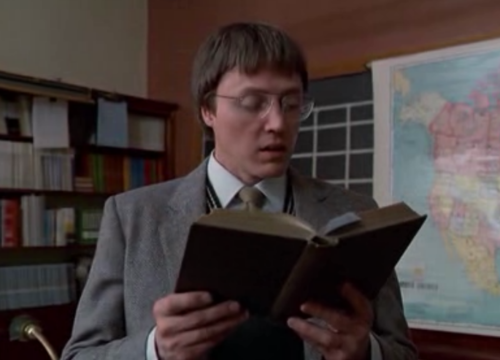
The Dead Zone (David Cronenberg, 1983)  Stephen King's "The Dead Zone" was written as a defense of assassination as a preventive measure for disaster (No, really...what if you could go back in time and kill Hitler as a child?*).  What if you had the power of foreknowledge and did nothing to prevent something catastrophic?  It may be a sin to kill, but the Catholic Curch also warns of sins of omission.  The extraordinary circumstances of a psychic being able to see the future and acting to prevent it is the stuff of philosophy, morality and science-fiction.**  But King, who took horror tropes and turned them on their pointed ears wasn't writing science-fiction.  His brand of personal horror turned this cautionary tale into one of tragedy.

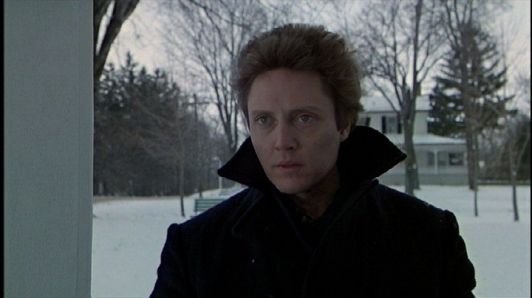
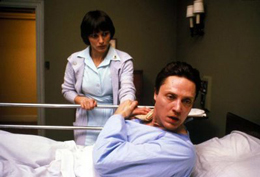
Up to that time, David Cronenberg was known for viscerally-filmed Grade-Z horror films with an emphasis on the squishy, but his film of The Dead Zone (one of the early King adaptations after DePalma's Carrie, Kubrick's version of The Shining, and the Tobe Hooper-directed TV version of 'Salem's Lot) was one of the strongest of the bunch.  Cronenberg (and screenwriter Jeffrey Boam) took the larky good-nature out of the initial character of Johnny Smith (played in the film by Christopher Walken, but King thought it better suited for Bill Murray) and boiled the story down to essentials.  Smith (as anonymous a name as you'd want) goes on a date with Sarah Bracknell (Brooke Adams) and things are going alright—he's fallen in love, in fact—when Fate raises its Huge Hand in the form of a near-fatal traffic accident that puts Johnny into a coma for five years (Cronenberg, perversely, has the collision occur with a milk tanker—as in "no use crying over..."***).  Waking up, he finds that life is completely different—Mom's become unhinged, Sarah's up-and-married, he's semi-crippled, even after severe rehabilitation, and he can't find a job as a teacher of English Lit anywhere.

Oh, yes.  Then there's "the power."  By merely touching another human being, Johnny can see into that person's future, seeing their possible destiny and maybe death.  He wants to live a "normal" life, a life of obscurity and happiness, but this "gift" is more of a curse, throwing him into the limelight, giving him responsibilities that he can't want or need.  But, a man of conscience, Johnny can't keep his visions to himself—he has to warn people.  He can't merely witness, an innocent by-channeller, he has to act to prevent the tragedies he sees and insert himself between those he touches and their Fates.

A social man, his gift makes him increasingly isolated, trying to hide his abilities, and avoiding people and touching them to keep from seeing those visions.  But, as much as he tries to quash his ability to see the future, he is always confronted by it and must come out of his obscurity to prevent them from occurring.

Sounds like classic tragedy to me.  With biblical, even apocalyptic echoes.

Cronenberg keeps the tone of the film oppressively heavy (Michael Kamen's score is particularly down-beat) and the Canadian locations have a dull, overcast, obliquely lit feel to them, like every moment is a late afternoon threatening to snow.  Smith is a particularly sepulchral figure, Walken's tall frame shrouded by a long black overcoat, hobbling stiff-leggedly with a cane, like a harbinger of doom, his eyes haunted, but Walken's hooded eyes grow wide, when he touches someone or an object they possess, as if grabbing a live electrical wire as he goes into his vision.  Before long, he is perpetually wearing black gloves.

But, on one of his rare excursions out he manages to take the hand of one Gregg Stillson (Martin Sheen), a Senator with eyes towards the presidency, and what he sees is Stillson launching a nuclear attack, ensuring Mutually Assured Destruction, and he becomes obsessed with stopping it. 

Screenwriter Jeffrey Boam does some compression and simplification of the novel that emphasizes coincidence for the sake of a romantically resonant ending, but all in all, it is one of the best of the King screen adaptations (you've got to be careful with King—if you boil down his stories too much and take out too many of his incidents, you can sometimes see that the skeleton of his writing is calcium-deficient).  The cast is amazing—Walken, Adams, Lom, but also Tom Skerritt, Anthony Zerbe (playing a strong character for once), Colleen Dewhurst, and the wonderful Jackie Burroughs—and keep things playing out naturally, with only Sheen veering into a kind of caricature. 

It's one of Cronenberg's tamer, more straightforward early films (relatively, although there's some gut-churning violence), but it's one of his great ones.

Cronenberg gives Smith's visions a perverse power.


* It's been years since I've read the book or seen the movie, and I'd forgotten that very question is asked by Smith in both: in the novel to a WWI veteran, and in the movie to his neurologist Dr. Weizack (Herbert Lom).

** King's next book "11-22-63" is about a man who travels back in time to prevent the Kennedy assassination.  I'm going to write one called "The Well" about an author who goes back to one too many times.  (Note: There was a "The Twilight Zone" episode called "Back There"—great score by Jerry Goldsmith, btw—about a man who goes back in time and—unsuccessfully—tries to prevent Lincoln's assassination.  It starred Russell Johnson, who, whenever he came into the studio I worked at, I'd make sure that his reading copy had nice bold type on it.  He appreciated it, and I had a standard exit line for his thanks: "Well, after all, you went back in time to save Lincoln...")

*** In the novel, the accident Johnny is in is caused by drag-racers.

Tuesday, November 9, 2010

Brainstorm

Brainstorm (Douglas Trumbull, 1983) Effects wizard Trumbull's second (and, to date, last) feature film had him experimenting with themes and film formats.   Usually films taking on that track, either have a case of the cutes (see More American Graffiti), or have all the charm of a demonstration disc.  But, in Brainstorm the jarring transitions seem necessary, dramatically proper, and perfectly suited to what's going on on-screen.


And that may be its trouble.  Brainstorm has always seemed  
snake-bit for one reason or another...unfairly, I think.  It is notorious for being Natalie Wood's last film, as she died in a midnight boating accident during the filming, an event that has always had an element of the unknowable about it.  No one knows why she rowed away from her boat in the middle of the night, making it the subject of gossipy speculation, and thus, irrelevant to the film.  Some scenes went unfilmed, but the majority of her work made it to the finished film, and there are no continuity bumps noticeable from her absence.  But the event did cast a pall over the film, probably to its detriment, as Death is already a major player in the film.


But there's another reason it's unlucky.  It premiered at the dawn of home-video, and if there was an film that needed to be seen full-screen in a roadshow presentation, it is Brainstorm.  I had the happy occasion to see it at a press preview where it was one of the attractions that would be demonstrating the wide screen glory of the new Grand Cinemas Alderwood, north of Seattle, which, bucking the trend of cracker-box multiplexes, were built large in scope and multi-channeled in sound to take advantage of the post-Star Wars spectaculars that were starting to flood theaters, after the timid response of the studios to large format fare.  The Grand was the perfect place to see it large enough to encompass the full-width of the big-screen sections, but intimate enough to keep you from feeling cheated when the smaller format drama scenes took precedence.


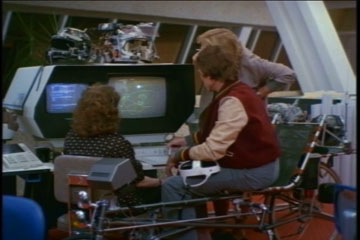
And that was something home-video and cable screenings never could duplicate—the awesome transitions from the scenes of scientists and technicians toiling over the wires and ramifications of their brainwave recorder to the hyper-dimensionality of the gizmo's playback in action.  For that is the crux around which the film and its unique formatting revolves.  Dr. Mike Brace (Christopher Walken) and his team of neuroscientists under the leadership of Dr. Lillian Reynolds (Louise Fletcher) are working on the ultimate video machine.  They plan to actually tap into the brain's higher functions to capture memories—initially, just sight and sound, but eventually, the other neuro-pathways, as well.  Thus, hardwired, they can experience another person's recorded memories, thoughts...even emotions...more real than real, with the exception that they're not yours.


The possibilities soon move beyond precipitous roller-coaster rides and flights over the Grand Canyon, as the scientists do their own beta-testing on themselves.  For Brace, it renews his memories of the first blush of romance with his ignored-for-science wife, Karen (Wood, whose character's job is to streamline the helmet for Fahrvergnügen), for another, it's straight to sex, suffering a breakdown when he splices an endless loop of "the good stuff" (Buddy, if it lasts more than four hours, call your doctor!), and in the ultimate trip, Reynolds turns on the machine and records her experiences while suffering a fatal heart attack.


That last tape becomes an obsession for Walken's Brace, risking everything to take that journey with the proviso that he has an "Off" switch for The White Light, a Cosmic Clapper if you will.  For Trumbull the tech, it's an opportunity to pull out all the FX stops with journeys through memory bubbles, a Boschian vision of Hell, and a slit-scan trip down Heaven's main thoroughfare, complete with angelic Hosts.


Quite the show.  But, in its attempts to present its Stairway to Heaven, the art design gets a little busy and too specific in its architecture, while disorienting the actual journey (was the trip through Hell necessary?).  It's a bit too high-tech for its own good, as beautiful as it is.  And, taken in context with the more teasing glimpse of the afterlife afforded by Hereafter, it might be too much of a God Thing.


Saturday, May 8, 2010

Chaplin

"Chaplin" (Richard Attenborough, 1983) Elephantine, lugubrious bio-pic of the man underneath "The Little Tramp," Charles Spencer Chaplin. If more bio-pics were this ill-serving, it would be good reason to avoid the limelight altogether. Years after sweeping the Oscar-race with his ever-so-respectful biography of "Gandhi"* (starring Ben Kingsley), director Attenborough took on his famous countryman's auto-biography and varnished it with the same extra coats of shellac (with broad strokes) that made a still-life out of his film of "A Chorus Line."

Charles Chaplin is a more-than-worthy subject for a sweeping biography that covers a huge amount of history in both the times of the U.S. and England, but also of the film industry. Chaplin was one of the rare few film-makers to make it out of the silent era alive and functioning, amassing a great fortune, becoming beloved world-wide—his Tramp character was recognized world-wide, with even more reach than Mickey Mouse—and treading the then-virgin territory of film star-dom with all its glamor, responsibilities...and pit-falls. Only thing, part of the problem was too many virgins. A clown-comedian who made his living, first by exposing the pomposity of authority, and then—as the Tramp—actively fighting it, he ran afoul of the authorities who didn't take too kindly to his irreverent side, little noting that the Tramp's triumphs were a balm for a restless public, sublimating dissatisfaction in a permanent trap on-screen, keeping it from spilling into reality. They should have thanked him. But instead, the authoritarians, be they Nazi's or J. Edgar Hoover, fought him. And Chaplin had enough hubris and pomposity himself, to think that the public would always rally to his side.

Now, that's a story. One that Chaplin would appreciate, if he wasn't living it. But, instead, Chaplin saw himself as he always saw himself—the hero. You could say of Chaplin what
Alice Roosevelt Longworth said of her President-father Theodore: "He wanted to be the bride at every wedding, and the corpse at every funeral." Chaplin loved being the Clown and the center of attention, but he also wanted to be taken very seriously, as he saw himself. Quite the dichotomy. That Chaplin couldn't embrace his own pretensiousness as part of the act was what turned his reel-comedy into real-tragedy.

But don't drop any tears for Chaplin. He lived an extraordinary life...of his own creation. Well, feel bad for him for this movie, perhaps.

The problems start with the screenplay. The timeline uses his films as the spine of it, set up by little incidents that inspired them. A more fitting strategy for a film-symposium than a movie, especially a movie about a comedian: Nothing kills a joke faster than having to explain it. The films are the high-lights; they are punctuated by explorations of Chaplin's relationships with the women in his life, starting with his Mother (eerily played by
Geraldine Chaplin, the person's real grand-daughter!), then his lost loves, whether by his own design or by his inability to maintain a love greater than his own. This is interrupted by the lamest of devices—going over the autobiography with his ghost-writer (Anthony Hopkins), in a kind of literary psychiatric session. They amount to repeated episodes of the aging Chaplin clinging to his fantasies and the writer calling "Bull-shit," once literally.

This may be a convenient way to film in the blanks, but it also splinters the narrative force. Are we to believe Charlie, the biographer, or what we see with our own eyes being represented? And as the subject is a film-maker, it's a bit like falling down a rabbit-hole of fun-house mirrors. Who do you trust? The end-result is taking none of it very seriously, as Attenborough can't resist speeding up some episodes in
a representation of silent film techniques. Nothing is real. A little contrary for a biography.

Then, the tone is so heavy. Starting with a title sequence of Chaplin taking off his "Tramp" make-up (exposing the real man, get it?) to a melancholy score by
John Barry, that would be more suited for a funeral, the film never gives up the tone of self-important tragedy that ultimately swamps the movie and any good feelings that one might have for Chaplin, the man, his work or the movie.

But, every dark cloud has a silver lining. In the case of "
Chaplin," it is its star, Robert Downey, Jr. Downey was a once-removed member of "The Brat Pack," the coterie of young actors who buzzed through Hollywood in the late 70's and 80's, appearing in ensemble pieces by John Hughes and other directors. Appearances in his father's films, a couple of featured roles and a disasterous stint on "Saturday Night Live" offer no hint of the disciplined, exemplary work he brings to the title role, eerily evoking the look—especially the smile of Chaplin—and, most amazingly, pulling off the physical comedy—Chaplin's particularly physical comedy—the role required. He was honored with his first Oscar nomination (losing to Al Pacino's first Oscar win for "Scent of a Woman."), but, after "Chaplin," Downey's performances would turn more physical, quick-silvered and nuanced, paving the way for a universal respect for his craft that even an errant personal life couldn't derail. Downey's evocation is the one reason to watch "Chaplin," rather than, say, reading about him...or better yet, watching the man's films.

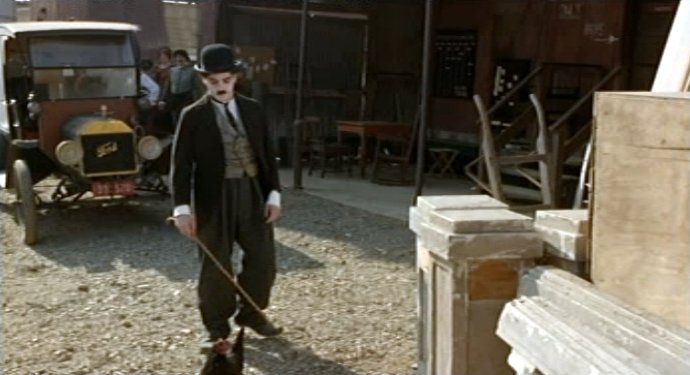
The immigrant looks upon the Promised Land: Robert Downey Jr. as Charlie Chaplin looks at a strip of this new medium, film, left on the cutting room floor. Of course, the footage is of him.


* "Gandhi" beat out "E.T., the Extra-Terrestrial" for Best Picture that year. I understand the Academy's hesitancy to give the statue for an alien combination of "Shane" and "Lassie," but no amount of prestige attached to a project can replace a film's status years after the fact. This one was a mistake. And short-sighted, replacing typical Awards reverence for "prestige," rather than popularity or endurance.

Friday, March 21, 2008

Zelig

"Zelig" (Woody Allen, 1983) One of The Woodman's most experimental films, playing not only with the story-telling form but the way film documentary can be distorted. "Zelig" was an early example of the "mock"-umentary, telling the tale of Leonard Zelig (Woody Allen), famed in the Roaring '20's as "The Human Chameleon" for his ability to "blend" with whoever he's with. Zelig is "the ultimate conformist" changing views, attitudes, dress and skin color in order to feel safe and accepted. Contemporary "interviews" are interspersed with amazingly integrated historical footage that places Zelig at Yankee Stadium, in a ticker-tape parade down Wall Street, at the Vatican with Pope Pius, and, hilariously, on the dais behind Hitler at the Munich rally. The interviews are fine with such folks as Saul Bellow, Susan Sontag and Dr. Bruno Bettelheim playing along, although there are some shifts in the folks playing older versions of the subjects of the "found" footage. There is a verbal disconnect between the actresses playing Dr. Eudora Fletcher (Ellen Garrison and Mia Farrow), and Farrow's portrayal is flat and mousey, though she serves the purpose of Allen's straight man, especially in a scene where she calls Zelig's bluff about posing as a fellow psychiatrist ("You've got problems, lady!"). The satire has depth, showing Zelig's "influence" on society with a wealth of tin-pan alley songs, including "Chameleon Days" sung by "Betty Boop" herself, Mae Questel. And one can't argue with the moral of the story: "It just goes to show what you can accomplish when you're a total psychotic!"