Brainstorm (Douglas Trumbull, 1983) Effects wizard Trumbull's second (and, to date, last) feature film had him experimenting with themes and film formats. Usually films taking on that track, either have a case of the cutes (see More American Graffiti), or have all the charm of a demonstration disc. But, in Brainstorm the jarring transitions seem necessary, dramatically proper, and perfectly suited to what's going on on-screen.
And that may be its trouble. Brainstorm has always seemed
snake-bit for one reason or another...unfairly, I think. It is notorious for being Natalie Wood's last film, as she died in a midnight boating accident during the filming, an event that has always had an element of the unknowable about it. No one knows why she rowed away from her boat in the middle of the night, making it the subject of gossipy speculation, and thus, irrelevant to the film. Some scenes went unfilmed, but the majority of her work made it to the finished film, and there are no continuity bumps noticeable from her absence. But the event did cast a pall over the film, probably to its detriment, as Death is already a major player in the film.
But there's another reason it's unlucky. It premiered at the dawn of home-video, and if there was an film that needed to be seen full-screen in a roadshow presentation, it is Brainstorm. I had the happy occasion to see it at a press preview where it was one of the attractions that would be demonstrating the wide screen glory of the new Grand Cinemas Alderwood, north of Seattle, which, bucking the trend of cracker-box multiplexes, were built large in scope and multi-channeled in sound to take advantage of the post-Star Wars spectaculars that were starting to flood theaters, after the timid response of the studios to large format fare. The Grand was the perfect place to see it large enough to encompass the full-width of the big-screen sections, but intimate enough to keep you from feeling cheated when the smaller format drama scenes took precedence.
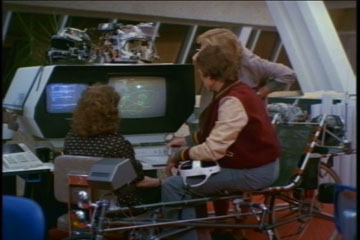
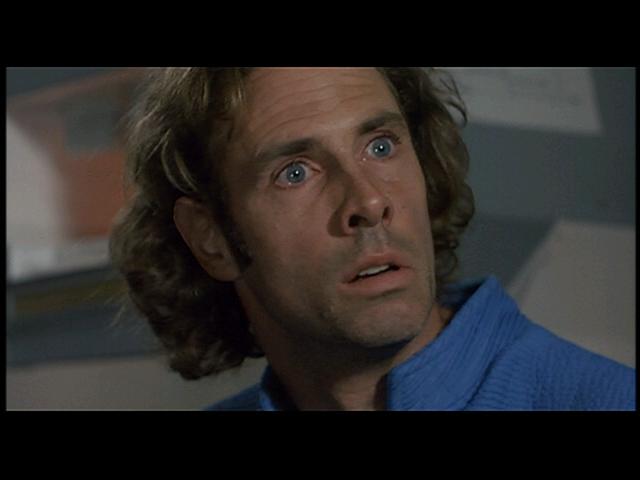
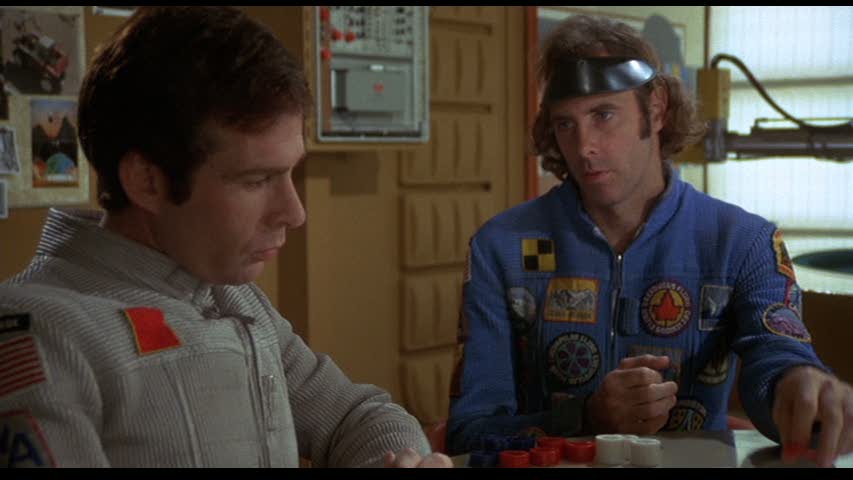
And that was something home-video and cable screenings never could duplicate—the awesome transitions from the scenes of scientists and technicians toiling over the wires and ramifications of their brainwave recorder to the hyper-dimensionality of the gizmo's playback in action. For that is the crux around which the film and its unique formatting revolves. Dr. Mike Brace (Christopher Walken) and his team of neuroscientists under the leadership of Dr. Lillian Reynolds (Louise Fletcher) are working on the ultimate video machine. They plan to actually tap into the brain's higher functions to capture memories—initially, just sight and sound, but eventually, the other neuro-pathways, as well. Thus, hardwired, they can experience another person's recorded memories, thoughts...even emotions...more real than real, with the exception that they're not yours.
The possibilities soon move beyond precipitous roller-coaster rides and flights over the Grand Canyon, as the scientists do their own beta-testing on themselves. For Brace, it renews his memories of the first blush of romance with his ignored-for-science wife, Karen (Wood, whose character's job is to streamline the helmet for Fahrvergnügen), for another, it's straight to sex, suffering a breakdown when he splices an endless loop of "the good stuff" (Buddy, if it lasts more than four hours, call your doctor!), and in the ultimate trip, Reynolds turns on the machine and records her experiences while suffering a fatal heart attack.
That last tape becomes an obsession for Walken's Brace, risking everything to take that journey with the proviso that he has an "Off" switch for The White Light, a Cosmic Clapper if you will. For Trumbull the tech, it's an opportunity to pull out all the FX stops with journeys through memory bubbles, a Boschian vision of Hell, and a slit-scan trip down Heaven's main thoroughfare, complete with angelic Hosts.
Quite the show. But, in its attempts to present its Stairway to Heaven, the art design gets a little busy and too specific in its architecture, while disorienting the actual journey (was the trip through Hell necessary?). It's a bit too high-tech for its own good, as beautiful as it is. And, taken in context with the more teasing glimpse of the afterlife afforded by Hereafter, it might be too much of a God Thing.