Showing posts with label Sean Penn. Show all posts

Friday, June 24, 2011

Thoughts on The Tree of Life

"Nature vs. Nurture"
or
"Where God Lives"

"The quality of mercy is not strain'd,
It droppeth as the gentle rain from heaven
Upon the place beneath: it is twice blest;
It blesseth him that gives and him that takes:"
The Merchant of Venice Act IV, Scene I


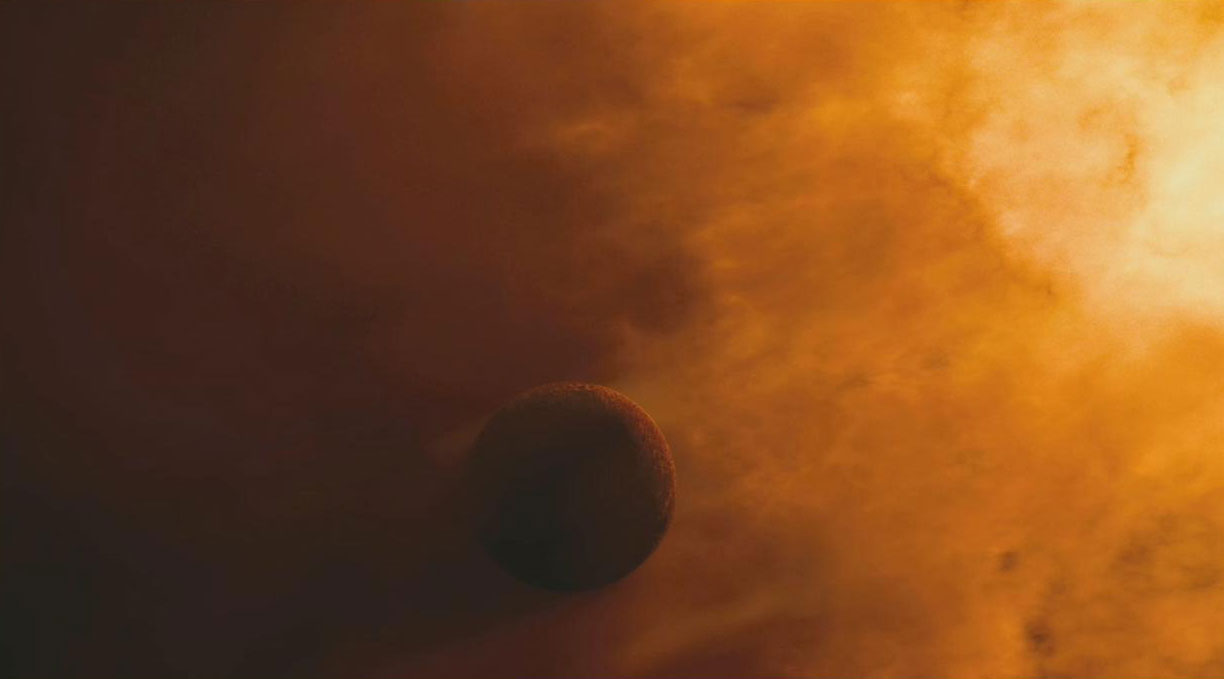
Federico Fellini telegrammed Stanley Kubrick (they were a mutual admiration society) after viewing 2001: A Space Odyssey: "You made me dream eyes open."  Terrence Malick's new film The Tree of Life is like a dream, composed of memory and emotion, originated in the very building blocks of life, and aspires to transcendence and Hope.  And like a dream, there's a very good chance you'll come out of it wondering what the heck that was all about. 

The film is polarizing, nontraditional in its aims and techniques of story-telling (but not outside the realm of human consciousness—it is not in any way random) with unquestionably beautiful images, but arranged in a way that might confuse those who expect a movie to be the standard filmed melodrama (oh, there is drama here, painful, raw drama) and nothing more.  But, The Tree of Life makes you dig deeper into the images and the way they collide and coalesce with each other to find meaning.  It's what any film demands, of course.  But, by relying on the experience of the film, rather than standard direct narration and dialog, it might leave some on the shore.

There's been a lot of ink spilled (or pixels pulsed) about linking the Kubrick and Malick films as far as reach and style, but it's a wrong analogy.*  If anything, The Tree of Life resembles the time-lapse documentary  Koyaanisquaatsi, but with a dramatic thread—a personal dramatic thread.  Sure, it's mostly done with images, with precious little dialog, substituting (as Malick tends to do) an inner monologue, frequently whispered, of the participants, devoid of the drama on-screen, but expressing the emotions, the doubts and the delirium of the process of living.  Kubrick's film had a dramatic structure in four acts, where The Tree of Life is like the scatter-shot approach of thinking—a "Blink" movie, if you will—that jumps from present day to 1950's Waco, Texas family life (where the majority of it settles), and (because it's all part of the process of "getting there") from the Origins of Life to The End of Time.**  Where it does compare to Kubrick's epic is the desire to find a satisfying middle ground on a basic, polarizing but far-reaching—even unanswerable—philosophical argument; just as Kubrick answered "Is Man risen from the Earth or dropped from heaven" with "a little bit of both," so Malick tackles the old "nature vs. nurture" question, and comes up with the same answer.


"The nuns taught us there were two ways through life - the way of nature and the way of grace. You have to choose which one you'll follow. 

Grace doesn't try to please itself. Accepts being slighted, forgotten, disliked. Accepts insults and injuries. 

Nature only wants to please itself. Get others to please it too. Likes to lord it over them. To have its own way. It finds reasons to be unhappy when all the world is shining around it. And love is smiling through all things."

So says Mrs. O'Brian (Jessica Chastain) early on in The Tree of Life and it sets up the warring dynamic—the dichotomy of each of us, who are composed of the same matter (the same way of breathing, the same way of carrying the oxygen we need to our hearts to be sent to our brains) can think so differently and individualistically, with our own precious memories, our own way of doing things, our own sense of right and wrong, our personalities, made up of the combination of male and female genes, unique to us and us only.  When we stop the process of being, we die, and are changed back into the basic chemicals from which we started.  The spark of life—the Soul—well, we all have our ideas about that.


"The fault, dear Brutus, is not in our stars,
But in ourselves, that we are underlings."


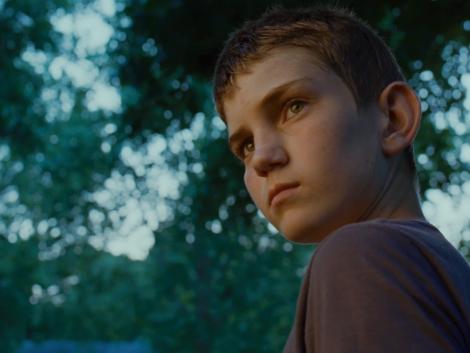
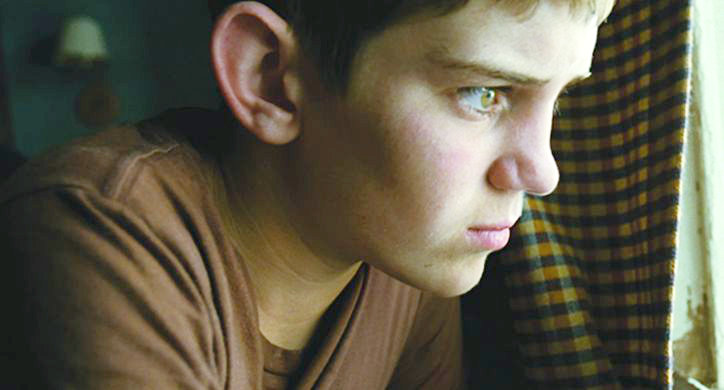
It's tough to say where The Tree of Life starts, but I suspect it starts as a dream, as Jack (Sean Penn), eldest son of the O'Brian clan, contemplates the death of his brother.  He is an architect, builder of great chrome and glass wonders, but as he contemplates the situation he operates in ("The world has gone to the dogs.  People are greedy.  Things are getting worse.") and ponders himself and his family ("How did I lose you?  Forgot you?"), his images move out of the cold constructions of the world, and into the more organic thoughts of his mind, represented by a beach-desert at ocean's edge, and we are made witness to his memories, contemplations, brief startling fantasies—his mother floating in front of a front-yard tree, himself escaping the door of a flooded house, Sleeping Beauty in a glass casket in the woods, and sequences contemplating the beginning and end of Life.  The adult Jack expresses his frustration with the process by avoiding his wife (Joanna Going)—a trait he picked up from his father.  His father, a frustrated musician and inventor, is ambitious and tough...sometimes abusive.  He's definitely Nature.  His mother is sweetness and light, caring, giving, but weak.  She's Grace.  And both parents, both aspects, "always...wrestle inside me.  Always you will."  And as he remembers in sharply, interruptively edited sequences his childhood, he wrestles with the Instinct and the Reason, as each dominate and recede in a confusion of needs and emotions.  Malick was given something of a miracle in young Hunter McCracken, who has a face the camera can read without him having to do more than think, as he goes through jealousy, shame, the temptations of power, the realization for humility and responsibility, the need for his parents attention, and the bitter realization of their flaws, as he grows older, a child fettered by rules and regulations that he rebels against.


And the LORD God made all kinds of trees grow out of the ground--trees that were pleasing to the eye and good for food. In the middle of the garden were the tree of life and the tree of the knowledge of good and evil.  Genesis 2:9

The Tree of Life begins with a quotation from Job (38: 4,7 "Where were you when I laid the foundations of the earth ... when the morning stars sang together?") of God's rebuke of Job's questioning his suffering.  This provides a context for the film, but no answers.  I don't know that there IS a definitive answer to what The Tree of Life is all about (I don't know what Life is about, either!).  In that way, we are all reviewers of Malick's film, and I don't think anybody's reading of it...or feeling of it...is better than anybody else's.***  Or could be, short of Malick coming out and explaining it and that won't happen. ****  It's an immersive work, and our viewing of it informs it.  Just as our views of religion inform our visions of God and of life.  This film couldn't be more personal in its impact and interpretation, but it is also challenging.  For me, the film flew...or maybe the better word is "flashed"...by, and it spoke to me, very personally and very specifically, about the process of "becoming," in both senses of the term—of the journey to the goal of fruition and the reflection (in a positive way) of something beyond us.  At the same time, I can also see a casual movie-goer throwing up their hands in frustration about "what it's all about."  It depends on whether you want answers or questions.  And one suspects the film, and film-maker, are asking the exact same question.

We're all on the same page, all a part of the audience, all seeking something of it...even if we are only moved by the images that we see.  That response is equally as valid as trying to write a term paper.

What's it all about?  My response was overwhelmingly positive to it's journey from grief ("Brother.  Mother.  It is they that led me to your door"—the film's first lines) to acceptance ("I give him, my son"—it's last), from Nature to Grace, and that journey and my response to it couldn't be any more personal or unique than yours. 

But, it did inspire a thought that came rushing to my head—something entirely new and appreciative: Maybe we humans pursued religion as a modern-day cosmologist pursues a Unified Theory—just because we needed Some One to thank.


It would be nice—really, really nice—if, come Oscar-time, this film, that dares to come to grips with such universal themes would be awarded Best Picture.  But, in the Grand Scheme of Things, it doesn't really matter.  Life goes on.

The Tree of Life is a Full-Price Ticket.


...and exactly who is watching Whom?


One of John Boswell's "Symphony of Science" videos that addresses the same themes, and even uses similar imagery as The Tree of Life.


* I've also seen The Tree of Life categorized as "Science Fiction," which couldn't be further from the truth.  If we wanted to stretch the envelope to something beyond "Drama," it would be "Religious Film."

** It's aspirations may be a little too far-reaching, like a James Michener novel.   Michener, who was given the nickname "Windy Blowhard" in this household, couldn't write a cook-book without starting it at The Big Bang.  (or maybe that was Carl Sagan, who famously said "To cook an omelette, you must first create the Universe").  Still, when was the last time you saw a film attempt something like this?

*** And I haven't felt that way about a film for a very, very long time.

**** And that might be a good thing.  Part of the charm of The Tree of Life is the mystery of it, as the line goes in A Serious Man, one must "embrace the mystery."   A Cliff's Notes explanation of it would diminish it, somehow.  And I haven't said THAT about a film in as long a time.

Wednesday, November 24, 2010

Fair Game


"Playing the Plame Game"
or
"The Problems of Two Little People Don't Amount to a Hill of Yellow-Cake in this Crazy World."

Those of us in the United States know the story: Ramp-up to the Iraq war; alleged yellow-cake uranium sales from Niger to Iraq; aluminum tubes thought to be nuclear weapons partsambassador Joe Wilson's editorial calling fraud on those suspicions; shock and awe tactics by the White House leaking information to the press, publicly exposing Wilson's wife as a CIA agent; the furor that created; the investigation; the prosecution and resignation of a key Bush administration official; the President's commuting of his fine and prison term.  That's the headlines.

But, the nice thing about Doug Liman's film about the case, Fair Game, is that he immediately makes it personal.  Using the same gritty techniques used in The Bourne Identity and Go (he is also the director of photography on this one, as he was making Go), he takes us to hot-spots of the world, the cold corridors of power, and the warm cozy homes of the participants, finding the nuances of life and feeling.  We watch as Plame (Naomi Watts), posing as a chemical consultant, travels to Kuala Lampur to talk business, effectively dodging a trap with hockey trivia, then, when things get dicey, turns the table on her contact.  Plame's cool friendly exterior turns icy when she looks her hostage in the eye and says calmly "If you help us, we can help you.  And I promise you one thing: you have no idea what we can do."

Truer words.  And she has no idea how true those words are.

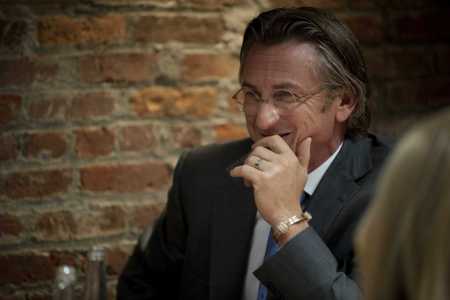
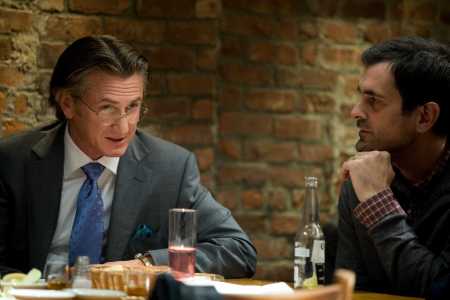
Plame knows stuff.  She knows a lot of stuff*.  A prized CIA investigator, she regularly travels to the Middle East coercing, cajoling and charming nuclear scientists and terrorist contacts, making promises, making contacts, hovering in the peripheries, returning home to domesticity with her husband, former ambassador Joe Wilson (a nicely rumpled Sean Penn), currently trying to turn his connections into a consulting business.  Because of his knowledge on Niger, the CIA asks him to investigate the yellow-cake sale for their investigation for the Vice-President's office...the logistics of which would have been impossible to pull off unseen.  Plame, on the other hand, has all the facts that the Bush operatives don't have (or won't acknowledge) about those aluminum tubes that, it turns out, are completely unsuitable for bomb-building.

But that doesn't stop the Administration from using both fraudulent claims as pretexts for invading Iraq to stop a non-existent nuclear program—selling the war is easier if the motivation is fear.  Both Plame and Wilson (and their colleagues) watch in horror as the invasion occurs under false pretenses (and Wilson, having met, and been threatened by Saddam Hussein, is no apologist calling him "a monster").  Wilson calls "bull-shit" on the White House, and, fearing "a trust issue," the President's advisers start to spin the story in the Press, starting by leaking that Plame is a CIA officer.  Suddenly, this spy, with enemies around the world and friends out of the loop at home, is besieged with questions and the protective bubble she has lived in is popped.  Considered toxic by her colleagues in the CIA, she loses her clearances and her job, the phone rings off the hook with confused friends and death-threats and just-plain crazies.  The stories start to spin out of control, with Wilson fighting back, but Plame trying to retreat back to an anonymity she will never have again, and a truth that has become irrelevant in the fire-fight at home.

The emphasis on the home situations of Wilson and Plame (and their two children) is what makes this personal political thriller so interesting**: he fights his battles out in the open, but she works in the shadows—when the couple must fight the same battle against their oppressors, the divergent styles splinter the two of them apart.  Watts and Penn have worked together before (21 Grams and The Assassination of Richard Nixon), so they're old hands at making a relationship look believable, both, in turn, have moments of weakness and vulnerability, alternating with a fierceness in strength which they share, but rarely at the same time.***  That internal squabble inside the larger fight makes up the heart and soul of Fair Game, Liman and his camera catching moments of temperament between two "inside" outsiders at war at home.

Fair Game is a Full-Price Ticket.


* One of the amusing things about Plame's book on the subject (that shares the same name as the movie) was the redacting of so much of it; Plame was still bound to pass her book's galley to the CIA for review to prevent the dissemination of sensitive state secrets.  So much of the book was blacked out that Plame published the censored document as is, and a relative not tied to the CIA explained the deleted segments—using completely public documents—in the Appendix.  The credits for the movie black out many of the names of the characters. Heh.  

** And somewhat akin to Liman's earlier fanciful, fictional spy film Mr. & Mrs. Smith... 

*** They're just the marquee names in a great cast, including Bruce McGill—always fine—as Plame's boss, Michael Kelly—who I've been watching since Eastwood's Changeling—as one of Plame's colleagues, a very subtle Polly Holliday (tremember "Flo?") as Plame's mother and Sam Shepard, who has a very short, but very significant, cameo as Plame's Air Force father.

Saturday, February 14, 2009

All the King's Men (2006)

"All The King's Men" (Steven Zaillian, 2006) The story goes that Robert Rossen, the director of the 1949 version of "All the King's Men" was not happy with his film. Too long, too talky, and too boring, Rossen was unsure of what to cut to get it down to length. A plan was drawn up: he told his editor to take 30 seconds from the beginnings of scenes and 30 seconds from the end. What was left came in under two hours of running time and moved at a jarring pace, but it won Oscars for its star Broderick Crawford, Best Supporting Actress Mercedes McCambridge...and Best Picture.

"
All the King's Men" was already a great film, but there were too many compromises to the Hays Code to get it to the screen. Steve Zaillian (a fine screenwriter, who directed a favorite film of mine "Searching for Bobby Fischer") decided to make a new film of Robert Penn Warren's Pulitzer Prize winning book, and sadly, wasted the opportunity in a film convinced of its own importance.*

From the crack of thunder that appears before the opening credits, to the thudding
James Horner score that telegraphs (with hammers) each imminent plot-point (Horner uses one dirge-like theme which, by its third appearance, I had assigned lyrics "This-is-a-sad-sto-ry/A-bout Lou-i-si-an-na"), to the subdued lighting and the art design in shades of "Godfather" mordant, everything about this movie promises great portent, but merely meanders through its story of how nothing born of corruption can come to any good, be it man, ideals or building materials.

It's a frustrating film to sit through, because the pieces are there given a less respectful (as in funeral respect) presentation. The cast is impressive.
Kate Winslet and Mark Ruffalo and Anthony Hopkins play the well-to-do Stanton clan. Kathy Baker and Jude Law are the blighted Burden clan, and Sean Penn, looking more and more like an young George C. Scott, plays the fictional surrogate of Huey Long, Willie Stark. As his flaks and flunkies, James Gandolfini, Patricia Clarkson and Jackie Earle Haley.

Good cast. But there are problems.
Penn, as he is wont to do, goes over-the-top in his speechifying, his arms waiving wildly in the air, his fingers doing filigreed dances. Where Penn got the inspiration to play it this way is a mystery, as footage of Long in speech-mode (below) shows him much more in control. Not even Adolph Hitler emotes this much. Jude Law, never the strongest of actors, falls into the dreariness of the film, staring at the other actors or nothing-in-particular with sad doe-like eyes.** One suspects editing problems with this film—Zaillian did spend an inordinate amount of time in post-production on it. Subjects are brought up and dropped, like Stark's football-playing son, who figures prominently in the '48 film, is mentioned here and then never heard from again.*** We never do find out how Burden's mother acquires facts to make an accusation against him. Mark Ruffalo's character is left as a dissatisfying enigma.

What we do get is ponderous, and pretentious. Zaillian spends a lot of screen-time trying to show (visually) that the only thing that could unite the "hicks" and gentry of Louisiana is death. Again, that same lesson had been told in better films.


* Given the awards-history of the cast and screenwriter it was assumed that "All The King's Men" would be a top contender come Oscar-season, but its poor box-office reception scuttled those hopes.
** K (who likes Law) kept yelling out "accent-drop!" whenever his "Lawsiana" draw-el moved to Market Street. Anthony Hopkins, the sly old dog, doesn't even try.

*** Sadly, Zaillian, in an attempt to simplify his film, gutted some crucial scenes from it including the sub-plot about Stark's son, and an extended ending that provides the best scenes for Jude Law and Jackie Earle Haley.

Wednesday, January 14, 2009

Milk

"The Plural of 'Us's' is 'I'"

I had all these cute little headlines to put at the top of this review, reflecting my disappointment with Gus Van Sant's bio-pic of slain San Francisco supervisor Harvey Milk—"Condensed Milk," "2% Milk"—but ultimately it comes down to this: you owe it to yourself to see "The Times of Harvey Milk" the Oscar-winning documentary on Milk and his efforts to fight discrimination. No hidden links: You can watch it on Hulu here: http://www.hulu.com/watch/49577/the-times-of-harvey-milk It'll cost you nothing but 90 minutes of your time with minimal interruptions. "Milk" acknowledges its debt to this film in its final credits. Indeed, you'll see a lot of archive footage shared by both films. And "Milk," a features recreations of footage from this film. The film ends with Sean Penn, as Milk, saying the words that you'll find in the video at the bottom of this review into his tape recorder for the prescient "In the Event of My Death by Assassination" tape he made. But that sentiment was not a private one. And the film does a disservice to Milk making it so.

It also inadvertently plays into stereotypes by suggesting that Milk's assassin Dan White was a closeted gay man instead of the mentally ill person he was. White's angry (and public) resignation during a meeting of the Board of Supervisors is also made private in the film. White's sneaking into the city hall with a loaded weapon to avoid metal detectors is alluded to, but not that White re-loaded his pistol after shooting Mayor Moscone and heading to the Supervisor offices to kill three other board members (Milk was the only one present). That the crimes were deliberate seems incontrovertible. But White was only convicted of manslaughter and released after serving five years in prison.

And one can quibble about Penn's performance as well, making Milk more fey in his mannerisms (Milk had hidden his sexuality in New York for years), and giving him a thick Bronx accent more Harvey Fierstein than Harvey Milk (ironically, Fierstein narrates the "Times" documentary).

Still, ya gotta do what ya gotta do. The original documentary is 25 years old and is probably past its shelf-life. A dramatic re-telling of the tale was probably due (a twin project "The Mayor of Castro Street" has been in the works, first by Oliver Stone and more recently by writer Christopher McQuarrie and Bryan Singer for years, and has for the time being been abandoned) if only to keep reminding people of the toll closeted life inflicted on the gay population. The battle continues to put a familiar face on homosexuality. And if a melodramatic re-telling of a pivotal story is required, so be it.

Van Sant does a fine job of mixed media cutting between vintage footage, newscasts, and recreations. And he gets great work out of his cast, particularly Penn, who's never seemed so relaxed in a role, James Franco (who gets better with each movie) as his first partner in San Francisco, and Emile Hirsch from Penn's "Into the Wild" as one of his youngest recruits.

"Milk" is a Matinee.


Wednesday, March 12, 2008

Into the Wild


I confess, I am usually one of those people who prefer the book to the movie. However, Sean Penn’s adaptation of Jon Krakauer’s Into the Wild is an exception to that ‘rule’. Following Krakauers book, Penn chooses to tell the story of Chris McCandless through his interactions with those who befriended him in the last two years of his life intercutting these episodes with the final weeks of his life when he finally reaches his goal of living out in the wilds of Alaska.

Penn’s direction gives a pace and balance to the story that the book seemed to lack. In addition, his use of a voice-over by Chris’s sister, Carine and the interspersing of close-ups and long-shots of the natural world give more of a sense of her brother’s rebellion against his parents and the reasons for his rejection of the trappings of modern life in favor of an idealized and romanticized view of a life in Nature.

Somehow, Penn gets his cast to become their parts so much that Into the Wild is one of those movies where I feel like I am watching the characters on the screen rather than the actors playing them. I even found myself appreciating the performance of Vince Vaughn.

Perhaps the movie makes McCandless’s life a little too glossily tragic. He was neither a modern-day Jack London nor just a spoiled little rich kid but something of both and something else too.

Sunday, February 3, 2008

The Interpreter

"The Interpreter" (Sydney Pollack, 2005) A lot of "firsts" in this movie: the intriguing pairing of Sean Penn and Nicole Kidman--she, in a role tailor-made for Charlize Theron, and he, basically making money for the production of "Into the Wild;"* it's the first time the United Nations has allowed filming on its premises (a wise move to dispel some of the recent "Secret Society" rantings about the U.N. among the Red States), showing the inner workings and the awe-inspiring chambers inside; it's Sydney Pollack's first film designed for wide-screen since his work in the 60's**--his compositions are far more elegant and complex than the kind of attention he paid to, say, "The Electric Horseman," or "Tootsie," or sadly, "Out of Africa." The wide-screen compositions give the impression that the film is more complex than it actually is. As it stands it follows the Pollack formula ("Person of Mystery investigated by another until all is revealed in a pro-forma setting," in this case, the general assembly of the U.N.) The Person of Mystery is Kidman's Sylvia Broome, an interpreter at the U.N. with a burning secret. The investigator is Penn's Tobin Keller with the Secret Service, charged with protecting the despotic President of an African nation--where Ms. Broome's dissident parents, sister, and most recently, brother were killed. Only he doesn't know that. Why wouldn't he know that, you may ask? So do I, as a background check might--just might--turn up that information. But, he's distracted because 1) you know how investigations involving information from third world countries go, 2) Broome is very good at not volunteering any information, 3) she's being stalked, so now he's involved in protecting the potentate and her for what she might know, and 4) oh yeah, his wife just died.

I guess 1-3 weren't dramatic enough reasons.

There are plots, counter-plots and even bogus plots falling all over each other, one particularly nasty explosion (that violates the "Hitchcock rule"***), and some such nonsense about Truth being better than Lying. It's a lot of drama built over one of those Messages that is so Simplistic, Nobody's going to be Offended. I guess you have to do that when you film at the U.N.

Seeing the magnificent cathedrals to world peace is the best reason to see this movie. Kidman and Penn are very good, but wasted (but not as "criminally" wasted as Catherine Keener is as Penn's partner-agent), and Pollack's eye for composition has never been better. If those particulars are of interest it's a movie to see. If things like story matter, best to give it a pass.


*More and more, Penn is looking like this generation's George C. Scott, in the literal and spiritual sense.

*** Pollack stopped doing wide-screen composition for films because the only other market for films was airings on television--full-screen, which would take wide-screen films and electronically shift them to the area of the screen where the center of attention was, a process perjoratively called "pan-and-scan." So, Pollack made movies where most of the "action" was going on in the middle of the screen in a barely elongated square, like your television screen. Now, that the technology has advanced with wide-screen TV, and DVD's eclipsing TV broadcasting (the "major" networks don't show movies anymore), and the cable channels mix wide-screen with "pan-and-scan." Movie channels devoted to films (like TCM) show films wide-screen. Movie channels that only SAY they're devoted to films like AMC) pan and scan--and insert interruptions, like commercials and promos. Stanley Kubrick composed for television, as well. that's why there's such a stink about his DVD's (except for the early films through "Clockwork Orange") not being wide-screen. They supposedly weren't intended to be.

*** Before you set off a bomb, tell people there is a bomb, and where it is, and when it will go off, to build suspense. That's why a lot of movie-bombs have superfluous LED screens.

Thursday, January 17, 2008

Into The Wild

Finding oneself and getting lost

There is a pleasure in the pathless wood,
There is a rapture on the lonely shore,
There is society, where none intrudes,
By the deep sea, and music in its roar:
I love not man the less, but Nature more,
From these our interviews, in which I steal
From all I may be, or have been before,
To mingle with the Universe, and feel
What I can ne'er express, yet cannot all conceal.

Lord Byron

The films of Sean Penn's directorial career have all carried the underlying theme of obsession. But until now, he has always shown the dark side of it-- "The Indian Runner," "The Crossing Guard," "The Pledge"--the latter two focussing on revenge, of sorts--the Need to get even, to balance the books, to set the world and Nature right. But with his Oscar-winning role in Clint Eastwood's "Mystic River," he seems to have cauterized that need from his system. His new film, "Into the Wild," is just as obsessive but presents more of a spiritual quest. Nature is already balanced. Now one must become a part of it. Based on Jon Krakauer's book (which is expanded from this article on "Outside Online"), it dogs the footsteps of Christopher McCandless, who upon graduating from college, disappeared on a journey across the country and eventually to Alaska, where he tried to live off the land, and his body was found by moose hunters in an abandoned bus. If he wanted to become one with Nature, he achieved it. But there's no great trick doing that. As so often happens, the destination isn't as important as the journey.

Penn (who also wrote the complex screenplay) presents McCandless' Odyssey as a rite of passage, literally divided into chapters, starting with his shedding of everything tying him to a middle-class life like his parents (played cold and shrill, by, respectively, Willian Hurt and Marcia Gay Harden), and simply disappearing, leaving no trace, and ensuring that he would have at least a couple months head-start before anyone knew he'd left. These chapters serve as flash-backs of a sort (given the opening of the film, the whole thing could be a flash-back) to McCandless' day-to-day life living in the abandoned bus/hunting drop that would unwittingly be his last stand. The narrative is punctuated by McCandless' writings in dreamy, floaty script, and a journal-like view from home from the perspective of his sister (played by Jena Malone). Each chapter begins with an extended montage played over songs by Eddie Vedder (which sounds like it could be horrendous, but Vedder's introspective lowing is the perfect counter-point to the images--one begins to look forward to the transitions). The results are never less than hopeful while never losing sight of the hardships along the way, the lessons learned and the experiences along the way.

Or the people. Along the way in the form of jobs worked, beds crashed, and meals shared, McCandless (who travels by the name of "Alexander Supertamp") encounters reflections of his parents and free spirits who push him to abandon his mental baggage, that, instead of establishing lasting ties, only steels his determination to complete his trek to Alaska. Here the movies shines with wonderful performances by Catherine Keener, Vince Vaughn (who's great), Hal Holbrook (who is heart-breakingly good-he should be recognized for this) and some folks that Penn just found on location (including a guy named Brian Dierker, who runs a ski shop in Flagstaff, Arizona--first movie--endearing performance). And its here that if the movie has a weakness, it is that Everybody Loves Chris, wanting him to settle, and by having that be the sole reaction, one's manipulation-shield is engaged, wondering if Penn is stacking the deck, making his McCandless not merely charismatic, but near-messianic. Counter that with the fact that these people are road-blocks to his purposes, while being necessary way-stops on the journey, and those quibbling mountains become mole-hills.* I suppose one could have done more to balance his character (for example, including the opinions of the native Alaskans who thought him merely "stupid"), but short of showing him rolling a drunk, I'm not sure that such a pruning would be all that worthwhile. His encounters are already showing the roads not taken, it is THIS path that is the subject of the film. Anything else would be a detour.

I didn't want this film to end, frankly. It's truly exciting to see a director use a kaleidoscope of techniques to tell a story that celebrates life.

"Into the Wild" is a full-price ticket.

* I wrote this entire review without mentioning the amazing work of Emile Hirsch as McCandless--the guy's in the ENTIRE movie, and if McCandless is too much of a good thing, it's because Hirsch's performance is so constantly winning, and focussed. You're compelled to keep watching this kid, and fear that his next step will be wrong. It's an involving, remarkable performance. While Penn's work is astonishing, he has the best co-conspirator in Emile Hirsch. His next role? He's playing "Speed" Racer. He looks just like him, but...I mean, c'mon AAAAUGH!