Showing posts with label Donald Crisp. Show all posts

Friday, October 11, 2013

The Sea Hawk (1940)

The Sea Hawk (Michael Curtiz, 1940) Thought I'd better get this one in before Captain Phillips dashes all our fantasies about pirates.  Or, in this case, "privateers."  

Captain Geoffrey Thorpe (Errol Flynn) is the captain of The Albatross, part of the Sea Hawks, a private fleet of Queen Elizabeth I (Flora Robson), taking "reparations" from the Spanish fleet of King Phillip II (Montagu Love—my new favorite actor name), who has plans to (dare I say it?) rule the World.


Well, not if Thorpe (rather loosely based on Sir Francis Drake in the Howard Koch-Seton I. Miller screenplay that has nothing to do with the Rafael Sabatini novel) can fire across their bow.  On a diplomatic mission to see the Queen, the ship carrying Don José Alvarez de Cordoba (Claude Rains) and his daughter Doña Maria (Brenda Marshall) is intercepted, fired upon and boarded by Thorpe and his all-too-eager crew.  Once there, they see that the oarsmen for the Spanish are former English sailors, who are freed and taken back to home and family.  Don José is allowed to keep his meeting with the Queen, but all puffed up and protesting about it, and he and the Queen's adviser, Lord Wolfingham (Henry Darnell) demand that Thorpe be arrested and thrown in the dungeon, or the brig, or the tower, or whatever gray-bar hotel they had in 16th century England.  The Queen puts on a stern public face, but is only too happy to let Thorpe command his ship to the isthmus of Panama to commandeer supplies from South America to the Spanish Armada.


But, the Queen's court has divided loyalties and Wolfingham is working with Don José to intercept Thorpe's plans, and the crew, once on land, and in a tinctured yellow setting, is trapped by Spanish forces and imprisoned as oarsmen on an enemy ship on its way back to Europe.  Can Thorpe and his men escape their fate and warn the Queen about the oncoming attack by the Spanish Armada?


What do you think?


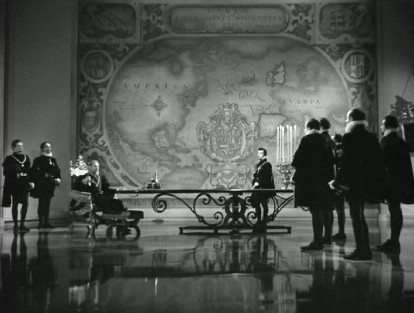
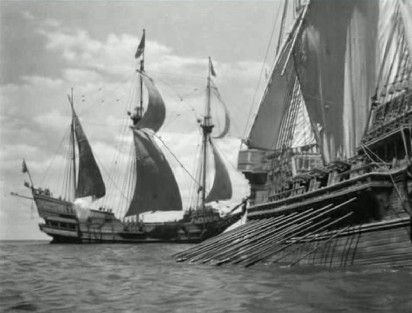
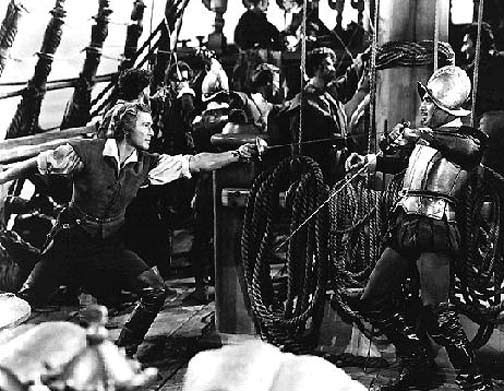
It's a grand epic, and director Curtiz, accustomed to filling the film-frame with detail has a lot of scenery to use.  The ships are big and impressive sets (especially when there are two next to each other), and the sea battles, some shots culled from Captain Blood (which is why this one is black and white and not Technicolor), are rousingly busy affairs starting with the chases, the cannon lobs, the swinging from ship to ship, then the sword-fights.  They're frenetic and fun, the stuff of our pre-Johnny Depp cultural memories, and blood-shed is kept to a minimum.  Curtiz and his designers also make the film feel a bit more gritty than one associates with a Hollywood studio film of the type (except of course in the Queen's court where everything is vast, spotless, and polished to the point of reflection).  But compare Curtiz's slave galley to the one Charlton Heston occupied in Ben-Hur, and although the effort displayed by the rowers in the latter seem more strenuous, the conditions in the former are far more depressing.  And Curtiz keeps it moving, no dawdling over the ironic dialogue or key sequences, as there's another just around the cut to get to.  The cherry on top is one of Erich Wolfgang Korngold's greatest film-scores, which in itself has an awful lot of swash-buckling just in the playing.  


Try to see the longer version, though.  For awhile, The Sea Hawk had its final scene plucked—The Queen's speech before the attack of the Spanish Armada, which may be the strangest speech a Queen has even been given: 


And now, my loyal subjects, a grave duty confronts us all: To prepare our nation for a war that none of us wants, least of all your queen. We have tried by all means in our power to avert this war. We have no quarrel with the people of Spain or of any other country; but when the ruthless ambition of a man threatens to engulf the world, it becomes the solemn obligation of all free men to affirm that the earth belongs not to any one man, but to all men, and that freedom is the deed and title to the soil on which we exist. Firm in this faith, we shall now make ready to meet the great armada that Philip sends against us. To this end, I pledge you ships - ships worthy of our seamen - a mighty fleet, hewn out of the forests of England; a navy foremost in the world - not only in our time, but for generations to come. 
"The earth belongs not to any one man, but to all men , and that freedom is the deed and title to the soil on which we exist."  What do mean "we," Queen E?  Fact is, Elizabeth didn't say this.*  But, as this film was released in 1940, it serves as its own little shot across the bow to another "one man" who wanted the map, not to be of Spain, but of the Third Reich—Herr Hitler.   The film, when first released, had that bit of rallying to it, in the days before The Blitz.  After the war, prints had that speech removed as unnecessary (and probably anachronistic, and not in a Queen's spirit.   


"...vast, spotless and polished to the point of reflection."


* She ACTUALLY said this: "My loving people, we have been persuaded by some that are careful of our safety, to take heed how we commit ourself to armed multitudes for fear of treachery; but I assure you, I do not desire to live to distrust my faithful and loving people ... I know I have the body but of a weak and feeble woman, but I have the heart and stomach of a king, and of a King of England too, and think foul scorn that Parma or Spain, or any Prince of Europe should dare to invade the borders of my realm."  "My" realm.  See that?  "My".

Tuesday, December 18, 2012

The Man from Laramie

The Man From Laramie (Anthony Mann, 1955) "Hate's not becoming on a man like you." Hmm.  Then, they shouldn't have put this star and director again, as hate, obsession and (sometimes) disfigurement were the order of the screenplay. The last of the James Stewart-Anthony Mann pairings (the others being Winchester 73, The Far Country, Bend of the River, and The Naked Spur, all superior disturbing Westerns) that pushed Stewart's psychological boundaries in the Old West by pushing the traditional physical boundaries in the Old West.*
Stewart's Will Lockhart rolls into the town of Coronado with his small transport business delivering merchandise to the general store.  Along the way, he stops from his day job to indulge in his hobby—seeking revenge for his younger brother whose cavalry unit was ambushed by Apaches who were brandishing repeating rifles, too many to be acquired on raids.  The Apaches are another story.  He's after the man who sold them those rifles.

Coronado, though, is hardly welcoming.  He can't take a few steps into the street without being warned to leave the town the same way he went in—under his own power.  That advice, with intentions good or bad, stems from the town's controlling interest, a cattle baron by the name of Alec Waggoman (Donald Crisp), one of those autocratically protective father-figures who like things the way they are, are suspicious of any changes, and is a bit blind to how others see it.  He's particularly near-sighted when it comes to his entitled son Dave (Alex Nicol, in a thankless performance, rather dimly performed), a bully who's next in line to run the ranch—probably into the ground given his business acumen—and (as John Wayne used to put it) "if he lives."  To prevent those eventualities Waggoman has installed the only picket-wire he might approve of, his chief ranch-hand Vic Hansbro (Arthur Kennedy, who often provides the counterbalance in the Mann-Stewart westerns) as a nanny to keep Dave under control.


But Vic, with so much responsibility to the Old Man, always seems to be a day late and a dollar short, unable to keep Dave from single-handedly destroying Lockhart's business, burning his wagons and killing his mules, a rather contrary manner of getting him to leave town, by destroying the means.  And, of course, it just inspires Lockhart to get all-cussed and motivates him to stick his nose in everybody's business and his fists in Dave's mid-section.  Things don't get any better when Lockhart decides to take a job ranching for Waggoman's rival Kate Canady (Aline McMahon), a crusty woman-rancher who won't give an inch on territory or principle, or one hoof of cattle to the larger concern.


From any angle Lockhart is caught in the middle, guaranteeing a rise in tensions and an escalation of grievances.  And if the elder Waggoman wanted peace and quiet, he should have looked for the anarchy running wild in his own midst.   So, there's that familial element running through it.  And Mann and Stewart, through their collaborations, were exploring psychological depths that weren't mentioned between the gun-shots in the standard shoot-'em-up. All of their westerns involved Stewart's character going through a trial by fire—he's actually dragged through a campfire in this one—facing humiliation and crippling at the hands of the Waggoman's, the confrontations with the clan making up the best part of the film, with only Stewart's rather half-hearted interplay with Waggoman's neice (Cathy O'Donnell) seeming like time wasted, although it provides one more conflict for Lockhart to be distracted by.  Mann's use of location shooting is always imaginative and compositionally interesting, and he uses the Vistavision format to get as much horizon into the frame as possible.  Certainly worth a look-see, just don't go expecting Shakespeare.**

Maurice Thomas' Stewart portrait for some of the film's poster art.


  * The two also worked on the non-westerns Strategic Air Command and The Glenn Miller Story.

** Curiously, Shakespeare is on a lot of people's mind when they see this film, comparing it to "King Lear."  Um, okay, not the "King Lear" I'm familiar with, although there's a thematic string in there (actually there's a Shakespearean string in just about everything, isn't there?).  Actually, there's more "King Lear" in "Bonanza" than here (except that everybody gets along).   And, of course,  the movie Legends of the Fall has more than a bit of both in it.

Wednesday, July 18, 2012

The Dawn Patrol (1938)

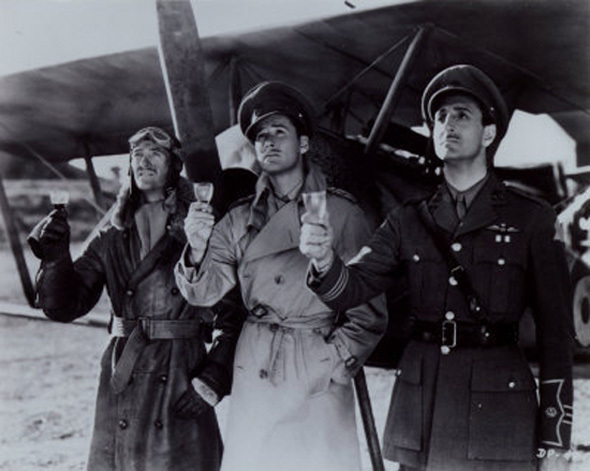
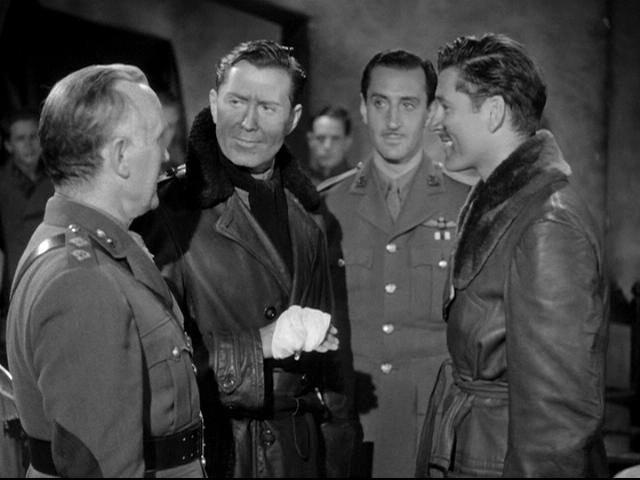
The Dawn Patrol (Edmund Goulding, 1938) Eight years after the silent Howard Hawks hit starring Richard Barthelmess and Douglas Fairbanks, Jr., the same studio released this remake, taking advantage of sound technology to enhance the story, not only in the roar of engines in combat (they even used the same planes from the Hawks version), but also the fellowship of song (a Hawks staple, by the way--I'm very curious to see how the first film got away without it, with no music and no use of the emblematic "Hurrah for the Next Man Who Dies.") This time, it's Errol Flynn as the pilot with the longest shelf-life, reporting to superior Basil Rathbone (who sits and waits, listening for the sound of each plane returning) aided and abetted by Donald Crisp, who does the paper-work, writing the letters home to bereaved families.

Headquarters is a slap-dash dormitory/strategy room with a 24 hour bar (tendered by Barry Fitzgerald)/rumpus room, done in late German atrophy and a blackboard containing the names of the squadron on duty and the chalk-dust that is left of the honored dead.  It's a rotating complement of young men dealing with the pressure cooker (with heavy seasoning) of combat and the existentialism of transitory bonhomie. Very quickly, rookies become veterans and the dreams of youth evaporate in the shots of whiskey and the oil grime that cakes their faces after every sortee.

They're all brothers in the air, dueling and jousting in the machines they pilot, and when they fall, there's enough honor to salute the plummeting.  These pilots are so joined that when a captured German pilot is brought to the barracks, he's welcomed to the party, even though he's just shot down one of their comrades (David Niven) and if someone holds a grudge, well, that's just bad manners, what?

A little odd for a war film,* but an example of Hawksian work ethics—do your job, be a professional, even in war-time.  It's just a grudge-match between nations, anyway, and once everyone's on equal footing—in this case, terra firma—you don't hold a grudge against professionals.  One has to prove oneself worthy, of course, but the general rule is to keep the war in the skies, keep your chin up and your upper lip stiff.

It's not a Hawks film, understand, just an interpretation of Hawks material.    And Edmund Goulding is quite adept at making the material soar, both in the skies and on the ground.  It's a British cast, so the bantering is quite formal with well-defined rules of engagement.  Goulding doesn't match Hawks' trademark at-the-shoulders camera compositions, choosing, instead, a more versatile shooting scheme, which are, at times, artful.  But, it is one odd war movie, removed from the geopolitics, insular and private.  You get the impression that these guys might be doing this, anyway, if it wasn't for the damned turnaround.  But, it is remarkably free of jingoism, glorification and other self-serving sentiments.  War is a hell of job, even in the first light of mourning.


* Odd, yes, but not without precedent, especially given the odd episode of the Christmas truce during WWI (a variation of which Steven Spielberg used for an episode in his War Horse film).  And, in these economic times, there are parallels: I have friends who work in a call center, who oft-times don't see the escorting off the premises of co-workers, while the "new recruits" keep revolving into the ranks to replace them.  I've suggested more than once the idea of a tontine for the "last man standing" from the many cliques that form in such situations.