Showing posts with label Black and White. Show all posts

Friday, December 6, 2013

Nebraska

Making Things Right
or
And Everything Looks Worse in Black and White

There's a story that Peter Bogdanovich got sick of telling during all the press junkets he did for The Last Picture Show about why he shot in black and white rather than color.  Truth was, that he started test-shots of the Archer City location (author Larry McMurtry's home town) in color, but the town always looked too good, and didn't have the sense of bleakness that he wanted.  The story goes that he went to Orson Welles (who was staying at his house) and mused maybe he should shoot the movie in black and white. "Of COURSE you'll shoot it in black and white!" Welles barked back.  After repeating the story over and over again at press interview after press interview, the last few times Bogdanovich simplified his answer: "Because Orson Welles told me to."

I don't think Alexander Payne shot Nebraska in black and white for that reason, or because it might recall the cover of the same-titled Bruce Springsteen album.  But, I think the bleakness is there, running as an under-current through the film as a view of life—not rosy and pink with vitality, green with verdancy, but shades of gray and the occasional extreme of black or white—the palette for a story of folks with limited choices in the nuances of life...and truth.  But, lest you think this one's about old folks with one foot in the grave, or Alzheimer's or something like that, it's not.  Not really.  It's about living life before you run out of it, and grabbing any kind of dignity out of that life, despite Nature's determination to take it away in any way it can.

And not to mention your relatives and acquaintances.


It's also a damned funny movie, in the same low-key, sometimes painful way that its writer, Bob Nelson, wrote sketches for the late, lamented "Almost Live!" show which seemed to focus more on human dysfunction, rather than Pacific Northwest eccentricities.  The old saw "familiarity breeds contempt" is apt here, as the extended Gates family, long separated (for good reason, apparently), is blandly caustic, bringing up family histories and past imperfections as grist for the family grinding mill.


The Gates clan watch a baseball game: Rance Howard (far left);
Bruce Dern (asleep in the back) and Will Forte (placating, far right)

"Wow, this feels too much like real life" said one of the patrons in Nebraska's audience.

The story's simple and seemingly uneventful, but mindful of David Lynch's The Straight Story.  Woodrow Gates (Bruce Dern) is picked up by the police walking the highway in Billings, Montana.  "Where ya goin'?" says the Sheriff. "Headed down the road there,' says Woody, none too helpfully.

O-kay, there's a little detour to the police station, where his son David (Will Forte) comes to pick him up. "So you told the Sheriff you were walking to Nebraska..."  Woody's wife (June Squibb) won't drive him, he doesn't have a car, and he won't be given money for the bus. The reason he wants to go to Nebraska (Lincoln, specifically) is because he got a certificate in the mail from a magazine promotion company saying that he could have won a million dollars. Woody doesn't "buy" that it's a way to get him to buy magazines; he thinks he's won it, so he's walking to Lincoln to get his million.  Why didn't he just mail it in? "I'm not going to trust the mail with a million dollars."  Makes perfect sense.  Walking, though, doesn't.


There's no sympathy at home.  Wife Kate won't entertain any of this "I didn't know the son-of-a-bitch wanted to be a millionaire!  Know what I'd do with a million dollars? I'd put him in a home!!"  Brother Ross (Bob Odenkirk) thinks Dad's senile and doesn't want to hear of it.  Only David will entertain the notion of driving Woody to Lincoln, if only for the chance to connect with the old man.  They set off with some hitches and fits along the way, eventually stopping at relatives' to get a breather from what would seem to be a continuing series of minor disasters.  But, his old stomping grounds bring no comfort, as word soon gets around that Woody's driving to Lincoln to get a million dollars—a sum that strikes everyone dumb...and a little bit stupid. Old debts are brought up, and quite a few people want a part of that million dollars whether they deserve it or not...and for some reason, nobody thinks twice about how Woody might have come into that money—the amount leaves them a little blinkered.  And envious.  And opportunistic.


For David, it's an opportunity to gain some perspective (just the ability to see Woody's past surroundings adds a little knowledge) and, as he's stuck in a pattern of "getting by," some insight into both Dad and himself.  By the time the two ride off into the last shot—one of the loveliest and most potent of the past year's movies, a black-and-white sunset—a nice, warming resolution has been reached.  But not too warming.  It is a sunset.  And it is in black-and-white, lest it betray any cheer or a rosy sensibility.  Payne, evidently, did make a color version of Nebraska to satisfy some niche contractual requirements for the studio (Paramount Vantage), but has expressed hope that it never sees the light of electronics.

OF COURSE, it won't.  It would be a completely different movie, and a less effective one.

Nebraska is a Full-Price Ticket.

Tuesday, November 19, 2013

Go West (1925)

Go West (Buster Keaton, 1925) There have been a couple features with the title, but this is the one written, directed and starring Keaton as a woe-begone dweller of a podunk town who sells everything he owns at the Fade From Black, only to find (after buying food and buying back the family photo he'd forgotten in a drawer) that he's a completely free man (freedom being just another word for nothing left to lose).  Deterred and detoured, he hoboes a freight train and accidentally (not exactly the right word as Keaton's "accidents" are always complicated) finds himself on a working ranch out west.  A discraded set of chaps is all the references he needs to start working on the ranch and working the herd, starting from the ground up.  Removing a stone from a heifer's hoof gains him a friend and a constant companion in the work-a-day world, as the un-broco'd Buster and bovine look out for the other.  

It's a classic fish-on-the-prairie story as Keaton's tenderfoot and his tender-footed cow-friend find ways to get things done while not doing things in the normal cowboy fashion, and any mentioning of the lessons learned in milking, lassoing and branding a cow will only spoil the surprise.  Let's just say that PETA would be proud.

The way most silent comedies work is with a long series of short bits and then an extended sequence in the final couple reels, and that was Keaton's standard blue-print, as well.  The final complication involves getting the herd to market so that the ranch can pay its bills, while at the same time, saving the one cow that Keaton has become the guardian cowboy to.  It involves a train-trip (a Keaton specialty) as well as one logistical movie-making nightmare—a cow stampede through the streets of roaring '20's Los Angeles, but done at a pace with a tangential series of complications that amaze.

As always seems to be the case with silent comedies, especially those of Keaton, the fewer words the better.  Just seek it out and enjoy.


The first "Mexican stand-off" in movies is instantly defused with a pinkie finger.


Wednesday, October 16, 2013

Jour de Fête

Jour de Fête (Jacques Tati, 1949) Tati's first feature length film, featuring the protagonist, François the rural postman (played by Tati), and many of the jokes re-bicycled from his 1947 short The School for Postmen.  Tati expands it with the story of a town's preparations for a big festival, and all the dangers for mayhem that accompany a feature of fun.  

Francois is on his daily rounds, done at their usual leisurely pace, but even more so for all the trouble the slightly officious fâcheux of a mailman can find to distract himself. But, the next day, inspired by an newsreel of how Americans are improving the speed of their mail delivery, he endeavors to increase the tempo of his route.

That's it in a nutshell, but the details, as with most silent comedies (although Jour de Fête isn't silent), are where the enjoyable bits are.  François is a more manic character than Tati's laid-back Mr. Hulot, and has a puppy-like fascination with just about everything and a cat-killing curiosity that gets him into both hot and cold water.  He is everybody's dork with a title, sure of himself and the only one in the room who is.  But his intentions are good.  His results are variable.

Tati filmed Jour de Fête twice, one version in black and white, and another using a color process called Thomson-color, a dicey system and lab that, unfortunately, went out of business before the film could be processed.  The black and white version was released to success, but Tati's dissatisfaction.  In 1962, he re-released it with a sub-plot about a sketch artist making pictures of the festival, and as the artist added colors to his black and white drawings, the colors would appear in the film, hand-tinted onto the film (this is the version of it I saw).  Increasingly, as the day wears on, more and more parts of the fair are tinted, sometimes surprising in what the choices are. 

Thirteen years after Tati's death, his daughter Sophie and French cinematographer Françoise Ede (who'd made a documentary about Tati's Playtime) managed to find the color elements and restore the Thomson-color version for the 1995 DVD release in France. 

It has yet to be released in the U.S.


The Three Lives of Jour de Fête


Black and White
Tinted

Color


Friday, October 11, 2013

The Sea Hawk (1940)

The Sea Hawk (Michael Curtiz, 1940) Thought I'd better get this one in before Captain Phillips dashes all our fantasies about pirates.  Or, in this case, "privateers."  

Captain Geoffrey Thorpe (Errol Flynn) is the captain of The Albatross, part of the Sea Hawks, a private fleet of Queen Elizabeth I (Flora Robson), taking "reparations" from the Spanish fleet of King Phillip II (Montagu Love—my new favorite actor name), who has plans to (dare I say it?) rule the World.


Well, not if Thorpe (rather loosely based on Sir Francis Drake in the Howard Koch-Seton I. Miller screenplay that has nothing to do with the Rafael Sabatini novel) can fire across their bow.  On a diplomatic mission to see the Queen, the ship carrying Don José Alvarez de Cordoba (Claude Rains) and his daughter Doña Maria (Brenda Marshall) is intercepted, fired upon and boarded by Thorpe and his all-too-eager crew.  Once there, they see that the oarsmen for the Spanish are former English sailors, who are freed and taken back to home and family.  Don José is allowed to keep his meeting with the Queen, but all puffed up and protesting about it, and he and the Queen's adviser, Lord Wolfingham (Henry Darnell) demand that Thorpe be arrested and thrown in the dungeon, or the brig, or the tower, or whatever gray-bar hotel they had in 16th century England.  The Queen puts on a stern public face, but is only too happy to let Thorpe command his ship to the isthmus of Panama to commandeer supplies from South America to the Spanish Armada.


But, the Queen's court has divided loyalties and Wolfingham is working with Don José to intercept Thorpe's plans, and the crew, once on land, and in a tinctured yellow setting, is trapped by Spanish forces and imprisoned as oarsmen on an enemy ship on its way back to Europe.  Can Thorpe and his men escape their fate and warn the Queen about the oncoming attack by the Spanish Armada?


What do you think?


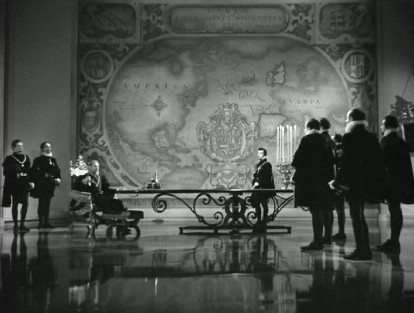
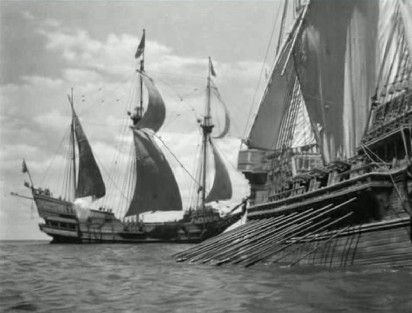
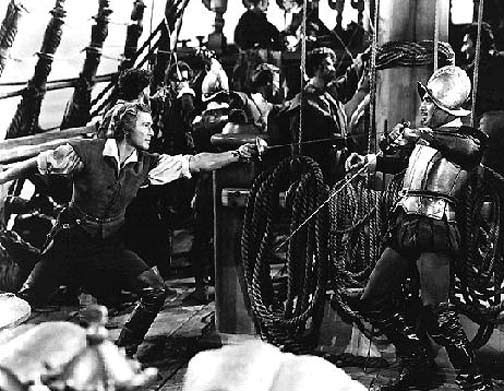
It's a grand epic, and director Curtiz, accustomed to filling the film-frame with detail has a lot of scenery to use.  The ships are big and impressive sets (especially when there are two next to each other), and the sea battles, some shots culled from Captain Blood (which is why this one is black and white and not Technicolor), are rousingly busy affairs starting with the chases, the cannon lobs, the swinging from ship to ship, then the sword-fights.  They're frenetic and fun, the stuff of our pre-Johnny Depp cultural memories, and blood-shed is kept to a minimum.  Curtiz and his designers also make the film feel a bit more gritty than one associates with a Hollywood studio film of the type (except of course in the Queen's court where everything is vast, spotless, and polished to the point of reflection).  But compare Curtiz's slave galley to the one Charlton Heston occupied in Ben-Hur, and although the effort displayed by the rowers in the latter seem more strenuous, the conditions in the former are far more depressing.  And Curtiz keeps it moving, no dawdling over the ironic dialogue or key sequences, as there's another just around the cut to get to.  The cherry on top is one of Erich Wolfgang Korngold's greatest film-scores, which in itself has an awful lot of swash-buckling just in the playing.  


Try to see the longer version, though.  For awhile, The Sea Hawk had its final scene plucked—The Queen's speech before the attack of the Spanish Armada, which may be the strangest speech a Queen has even been given: 


And now, my loyal subjects, a grave duty confronts us all: To prepare our nation for a war that none of us wants, least of all your queen. We have tried by all means in our power to avert this war. We have no quarrel with the people of Spain or of any other country; but when the ruthless ambition of a man threatens to engulf the world, it becomes the solemn obligation of all free men to affirm that the earth belongs not to any one man, but to all men, and that freedom is the deed and title to the soil on which we exist. Firm in this faith, we shall now make ready to meet the great armada that Philip sends against us. To this end, I pledge you ships - ships worthy of our seamen - a mighty fleet, hewn out of the forests of England; a navy foremost in the world - not only in our time, but for generations to come. 
"The earth belongs not to any one man, but to all men , and that freedom is the deed and title to the soil on which we exist."  What do mean "we," Queen E?  Fact is, Elizabeth didn't say this.*  But, as this film was released in 1940, it serves as its own little shot across the bow to another "one man" who wanted the map, not to be of Spain, but of the Third Reich—Herr Hitler.   The film, when first released, had that bit of rallying to it, in the days before The Blitz.  After the war, prints had that speech removed as unnecessary (and probably anachronistic, and not in a Queen's spirit.   


"...vast, spotless and polished to the point of reflection."


* She ACTUALLY said this: "My loving people, we have been persuaded by some that are careful of our safety, to take heed how we commit ourself to armed multitudes for fear of treachery; but I assure you, I do not desire to live to distrust my faithful and loving people ... I know I have the body but of a weak and feeble woman, but I have the heart and stomach of a king, and of a King of England too, and think foul scorn that Parma or Spain, or any Prince of Europe should dare to invade the borders of my realm."  "My" realm.  See that?  "My".

Friday, August 9, 2013

The Sin of Harold Diddlebock

The Sin of Harold Diddlebock (Preston Sturges, 1947) (aka Mad Wednesday, 1950) Sturges' first film out of his Paramount Studios contract, and with his film company California Films in partnership with millionaire polyglot Howard Hughes. Sturges adapted his script idea "The Sin of Hilda Diddlebock" (about a young girl's misadventures in Hollywood) for a favorite silent film star, Harold Lloyd—who was under the impression that he'd get to direct some sequences.  

It must have been "going around," as Sturges was under the impression he had free reign over the film.  But when it opened "soft," Hughes took over control of the film, re-editing it (in his painstaking way), finally releasing it in 1950 as "Mad Wednesday" (because a title with "sin" in it might not appeal to audiences throughout the nation—although it was probably that very enticing nature that led Sturges to title it that way in the first place).


The version we saw is the Sturges version, in desperate need of some sort of care and restoration—the black and white images are soft and dark looking, like it was shot in perpetual twilight, several splices mar the flow and interrupt a couple jokes here and there, and making one want to see the mangled version just to see if it's (ironically) in better shape.


It's hard to determine what "sin" Sturges is talking about. The film starts with a sequence from Lloyd's The Freshman (made in 1925) intercut with some recent scenes that act as bridging sequences as Lloyd's water boy manages to score a winning touchdown, impressing a business owner who (in new scenes filmed by Sturges) hires him on the spot.  Sturges keeps the sequence silent and primitive to mesh with the earlier filmed sequences and Lloyd looks young enough to pass for his younger self.


But, that's where the film starts.  Diddlebock's moment of glory results in his getting a job as an accountant for the man's firm.  Twenty years later, he's still there, passed by by other employees, including a series of sisters he admired and all moved on, leaving the youngest as Diddlebock's work colleague.  He's laid off, given a severance, and kicked out without prospects and no goal posts to run towards.


Already, the film is a commentary on American business, its spoiling of potential through pigeon-holing and compartmentalization, and the efficacy of "glory days."  But this is the first ten minutes.


Out on the street, Diddlebock gets way-laid by a racetrack tout (Jimmy Conlin) who sees him as a case of arrested development—one with a lot of disposable income—and after a two decades recess, Diddlebock goes back to school, as taught on the street.  First step: a bar, where he has his first adult beverage, an event that inspires the bartender (Edgar Kennedy)—"You arouse the artist in me"—to create a grand concoction of mixology, the sipping of which elicits a primal scream somewhere between the ubiquitously used red-tail hawk cry and a high-pitched ape roar.  A couple of toots of those and it's a trip to the barber's for a complete make-over, including a garishly nightmarish checkered suit, and the investment in short-term futures at the horse track, which pays off huge dividends, further inspiring high living, a blackout for an indeterminate length of time, and the investment in a defunct circus, including a menagerie of animals and one particularly cranky male lion that becomes Diddlebock's nearly constant companion and chief collateral throughout the rest of the movie.  Hilarity—and Sturges' unique brand of hysterical panic—ensues.


It's the maddest of screwball comedies with Diddlebock a cyclone of disruption wherever he goes, trying to unload the results of his bleary recent past and only finding himself with more problems, more prospects and an ever-growing number of acquaintances...the freak accidents of American success.

Even with Sturges' frenetic timing, the results are a bit off in tone and pace, as if somewhere along the way, the directorial edict became "faster..." (which, for Sturges, approaches the super-sonic).  Still, even though its uneven, it's still full of bizarre child-like invention and scrupulously drawn character types.

The dialogue is snappy and so is the lion—a couple of times making a lunge for LLoyd's hand, while the plucky silent star (probably to avoid further takes with the animal which he was terrified of) keeps going with the take, not missing a beat.  Amazing.

No, it wasn't successful; Sturges might have lost some of his homespun touch after so many frustrating years in Hollywood, despite his successes for Paramount.  Parallels can be found with Diddlebock, who hits the jackpot and keeps on hitting, despite being beset by day-to-day "small stuff" that he has to sweat.  But Sturges can still mine comedy gold out of his self-analysis, as he did with Sullivan's Travels.  He would continue to struggle, while still walking the thin line between message and entertainment.  He would only make three more films.


Tuesday, June 11, 2013

Oz the Great and Powerful

What a World, What a World;
or
There is no Baum in Gilead

Any movie attempting to resuscitate L. Frank Baum's "Oz" books has to deal with the series' own Wicked Witch of the West—that being M-G-M's musical version The Wizard of Oz, which had Judy Garland in it, and set the bar very high as far as expectations go (for quality that is, whereas for the box-office TWoO was not a box-office success at the time of its release and only became a classic after a couple decades worth of Thanksgiving showings on network TV).  Walter Murch's attempt to take an OZ story back to its roots, 1986's Disney's Return to Oz, was an abysmal failure, although artistically it was a terrific show--but probably butted heads with too many memories for its own goodness as, for instance, the Lion, Tin Man, and Scarecrow were not vaudevillians in theater-suits, as was the 1939 version, but looked more in line with the book's illustrations.

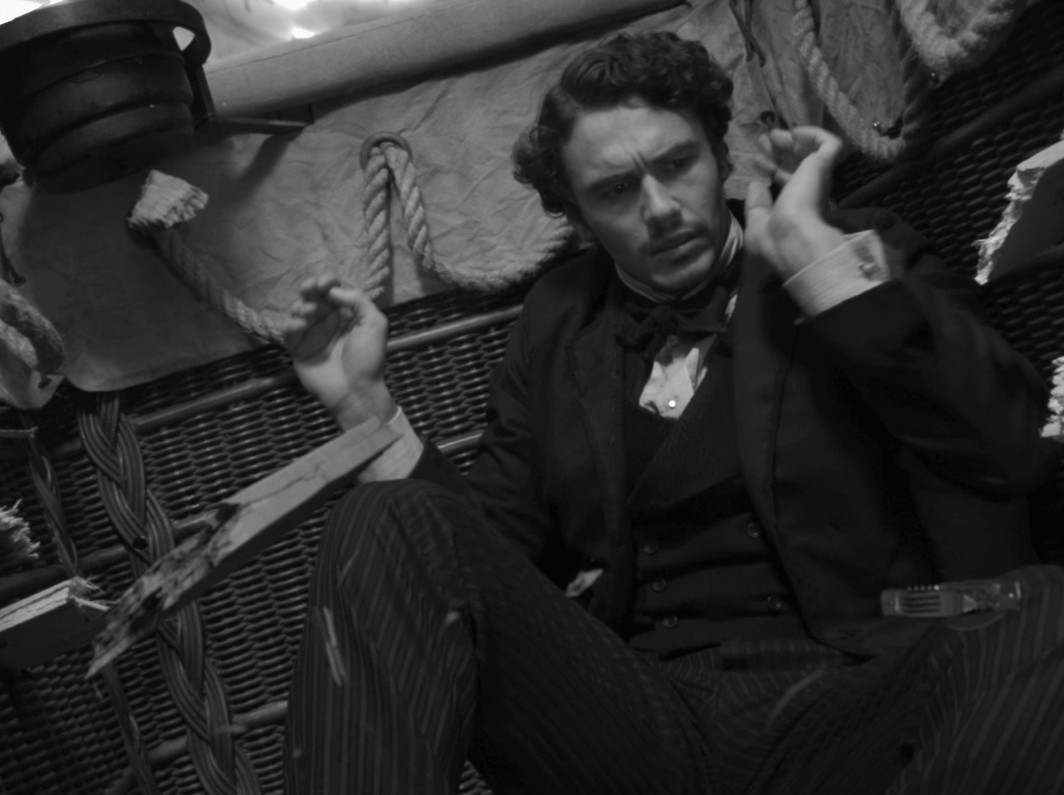
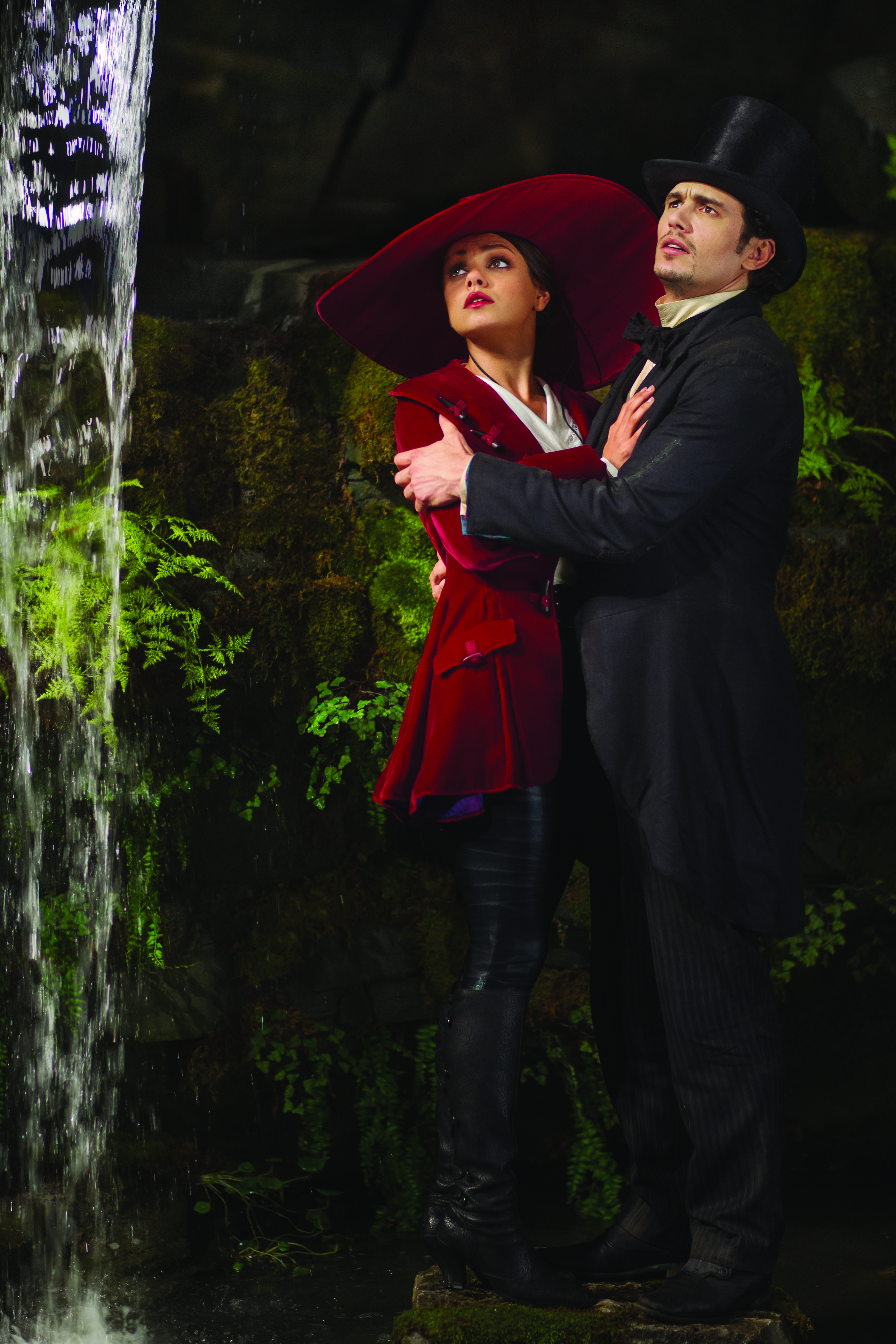
Sam Raimi, he of larkey horror films and the Tobey Maguire Spidermen, is probably a very good choice for doing an OZ film, as he has equal qualities of sweetness and sour, where Tim Burton (the next usual suspect*) would have made the film travel heavier to the morose.  Raimi's Disney's Oz the Great and Powerful (as convoluted and punctuationally challenged a title if ever, oh ever, there was one) manages to be its own thing while bowing and occasionally scraping to the previous' yellow brick road (which is revealed, as an aside, to have potholes, which nicely sums up the movie's respect, and lack thereof).  A prequel, kinda sorta to The Wizard of Oz, it starts out in a black and white box-square format (with a special effect detail amusingly violating it here and there) on a sound-staged Kansas that creepily recalls the musical version.  There scam-magician Oscar Diggs (James Franco) is conning rubes and comely assistants alike, and taking advantage of his stage-assistant, Frank (Zach Braff).  He's a jerk, only revealed to better purposes when a lost love (Michelle Williams) comes to visit to tell him she's going to marry farmer John Gale (father of Dorothy, making her mother of), and he takes the higher road, telling her she chose the better man.

But his past catches up with him...or tries to...and his road goes even higher, escaping a vengeful cuckolded circus strong-man in a helium balloon.  Kansas being Kansas, he is caught up in a tornado—one that presumably opens up a rip in the space-time continuum through some sort of meteorological consequence, and winds up in the storied land of Oz, where, true to movie-form, everything turns to color and the screen expands to wide-screen proportions.


The pattern is set—Diggs is an outsider, a stranger in a strange land, but enough of a roué that any sense of wonder he initially feels is soon replaced by annoyance (Franco is great at that).  Oh, it's nice to have a minor seduction with the first female he stumbles on, Theodora (Mila Kunis), but the flying monkeys (in the form of Finley, voiced by Braff), and the girl who comes from hummle beginnings, the fragile porcelain girl (who comes from the neighboring land of Chinatown and voiced by Joey King), but before long he's embroiled in Oz's matriarchal politics between witches Theodora and her evil sister Evanora (Rachel Weisz), who are lording it over the Emerald City, and the witch Glinda (Williams again), who is protecting the provinces from the influence of the Big Bad City.  This troika of females all think that Oscar will bring some sort of balance to Oz, and despite himself, he's got enough answers to help Finely and China, who become devotees.  Evanora is the first to see Oscar and think "there goes the neighborhood," and the plot and the make-up thickens in a battle royale between the various forces of magic, Evanora and Theodora in the Emerald City, and Glinda and Oscar and her army of tinkers, winkies and munchkins.  Tinkers and winkies and munchkins.  Oh my.


As Donald Rumsfeld said, you fight with the army you got.


And just to show this isn't Gramma's OZ (or Louis B. Mayer's) when we get welcomed to Munchkinland this time, and the town's welcome wagoneers start into a bouncey little song with high, tight voices (provided by composer Danny Elfman), Diggs just calls the whole thing off: "Stop!  Stop it!"  Musical numbers are not tolerated in this more cynical fantasyland.  Nor is anything approaching the good-heartedness of Baum or Fleming.  Even Glinda the Good Witch turns out to be something of a bad-ass here, far badder than in the '39 version.  And that's just a little backwards because the original has an empowered little girl who saves the day, while in this one it's a man, a messiah, who must sort things out in the messy rule of a matriarchy.  


This is progress?


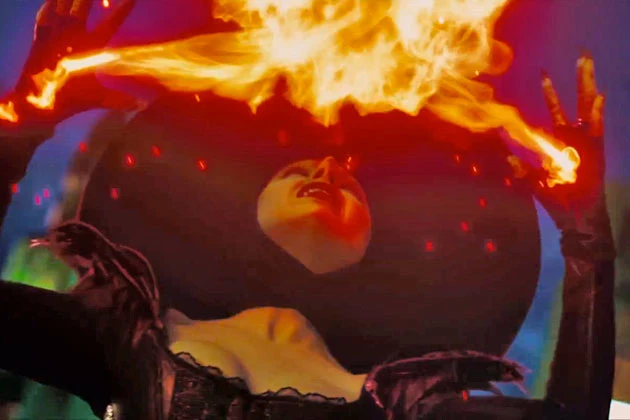
The movie ends with some fantasy-nastiness.  Glinda is captured, tortured, and made to grovel before the sisters, Oscar comes to the rescue with his own Earth-bound pyrotechnics, similar to what he's use in the future.  But the movie feels very much like a movie of today—things end not with a splash of water, but a lot of impressive fireworks.  You want something a little meatier, though, something that might last and impress longer, but given the Oz that will come post-prequel, there's really nothing much to do about it.  The great and powerful Oz is merely a humbug, the man behind the curtain.  The evil sisters will remain evil, although Evanora's fashion sense (especially regards hosiery) will take a serious hit.  And Oscar will become a patriarch based on big promises with nothing much to back it up.  Sounds like any politician, really.  This Oz is not so magical, not so great and not so powerful.  What it needs is more brains, more heart and more courage.


Disney's Oz the Great and Powerful is a Rental.


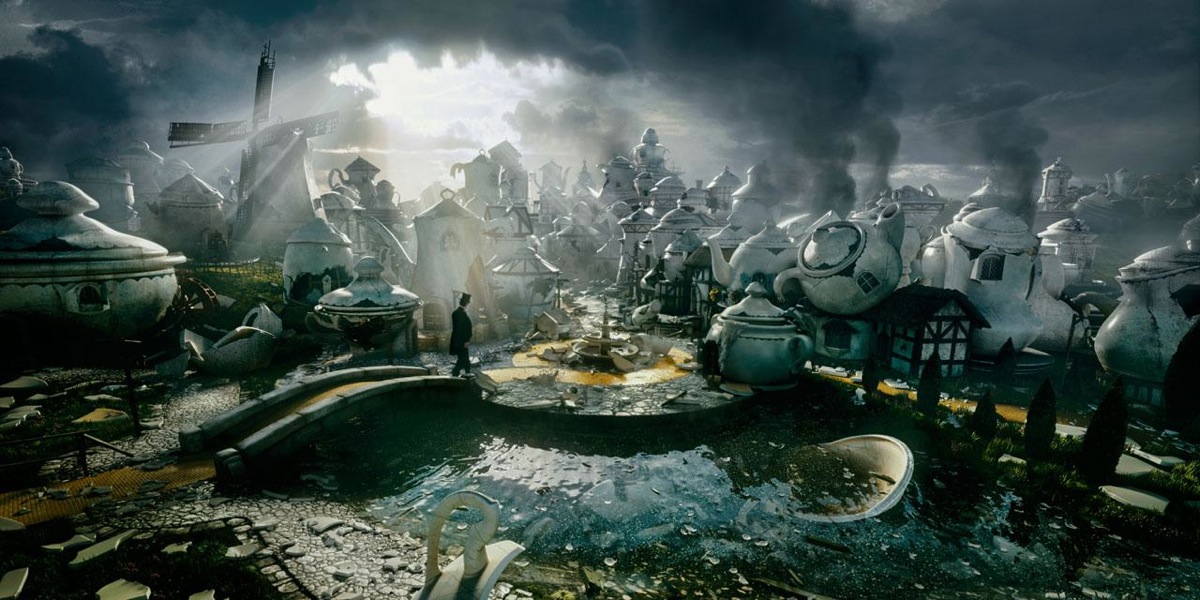
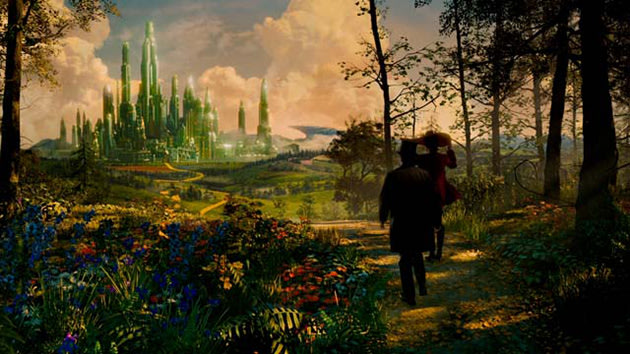
Yellow Brick Road?  Check.  Emerald City? Check.  Dark Forest?  Check.
Now we just needs brains, a heart and courage.


Oz, the Great and Powerful is available on DVD starting today.


And the original is forever.
 
* Frequently recalled as this film is scored by Burton co-conspirator Danny Elfman.

Saturday, October 20, 2012

Shadows and Fog

Shadows and Fog (Woody Allen, 1991) When Woody Allen makes a film in the style of Ingmar Bergman (Interiors), it's done in deadly earnest.  But, when he takes on German Expressionism, entering the angular world of Lang, Murnau, with a para-nod towards Kafka, it's a comedy.  Not quite sure why; maybe he has an affinity towards one stylization and the other he just finds phony, but the different approaches are like, well, day and night.  Allen explored that theme—taking the same story and interpreting it as either comedy or tragedy—in Melinda and Melinda, a bit of a mis-fire—but one suspects that the Nordic tradition he buys completely, and completely dismisses the German (God knows why).

Here, the visual is pure dread, but the subject matter is a mixed bag of precision and vagueness, comedy and darkness.  Allen plays Kleinman, a passive-aggressive bookkeeper, who is recruited in the middle of the night by a vigilante mob (including David Ogden Stiers and James Rebhorn) to roam the streets looking for a serial strangler.  Being a professional coward, and only dealing well with facts and figures in black-and-white, Kleinman is ill-suited for the activity and begs off, inviting suspicion from the group.  When there is speculation that maybe he won't do his duty as a citizen because he might be the strangler, Kleinman caves.

On his dark journey through the city streets (the largest set ever built in New York's Kaufman-Astoria Studios, making this Allen's most expensive film), he runs across an all-star cavalcade of slothful potential victims: a philosophy student (John Cusack) with a weakness for prostitutes (among them Lily Tomlin and Jodie Foster, madamed by Kathy Bates), a circus love-triangle tangentially related (with John Malkovich, Mia Farrow and Madonna) and the town coroner (Donald Pleasence), who has a purely scientific interest in the killer.*

Kleinman soon realizes that life simply doesn't add up, that a little slippage occurs, especially when it comes to illusion and reality (in the form of a very handy and practical magician named Armstead, played by Kenneth Mars).  The film struggles with the dichotomy throughout, as highly contrasted as the black and white photography, never truly meshing, and finally ends, as many of Allen's weaker films—and one of Allen's strongest ones (Hannah and Her Sisters)—do, with a Deus ex Machina** that buttons everything up inexplicably, leaving no questions but a lot of raised eyebrows.

Which is fine for the purposes of the film, but it's hardly what you'd find in an example of German Expressionism, where the punishment fits the crime...and where things really are in black and white.  


* Yes, the film is top-heavy with fine actors (and Madonna), but if you look in the darkened nooks and crannies of the film you'll also find Fred Gwynne, William H. Macy, John C. Reilly, Josef Sommer, Wallace Shawn, Kate Nelligan, Kurtwood Smith and Philip Bosco.  Was this film cast or filmed at a SAG convention?

** Here's a question:  It's a Woody Allen film; Can there be a Deus Ex Machina if there's no Deus?