Showing posts with label Alexander Payne. Show all posts

Friday, December 6, 2013

Nebraska

Making Things Right
or
And Everything Looks Worse in Black and White

There's a story that Peter Bogdanovich got sick of telling during all the press junkets he did for The Last Picture Show about why he shot in black and white rather than color.  Truth was, that he started test-shots of the Archer City location (author Larry McMurtry's home town) in color, but the town always looked too good, and didn't have the sense of bleakness that he wanted.  The story goes that he went to Orson Welles (who was staying at his house) and mused maybe he should shoot the movie in black and white. "Of COURSE you'll shoot it in black and white!" Welles barked back.  After repeating the story over and over again at press interview after press interview, the last few times Bogdanovich simplified his answer: "Because Orson Welles told me to."

I don't think Alexander Payne shot Nebraska in black and white for that reason, or because it might recall the cover of the same-titled Bruce Springsteen album.  But, I think the bleakness is there, running as an under-current through the film as a view of life—not rosy and pink with vitality, green with verdancy, but shades of gray and the occasional extreme of black or white—the palette for a story of folks with limited choices in the nuances of life...and truth.  But, lest you think this one's about old folks with one foot in the grave, or Alzheimer's or something like that, it's not.  Not really.  It's about living life before you run out of it, and grabbing any kind of dignity out of that life, despite Nature's determination to take it away in any way it can.

And not to mention your relatives and acquaintances.


It's also a damned funny movie, in the same low-key, sometimes painful way that its writer, Bob Nelson, wrote sketches for the late, lamented "Almost Live!" show which seemed to focus more on human dysfunction, rather than Pacific Northwest eccentricities.  The old saw "familiarity breeds contempt" is apt here, as the extended Gates family, long separated (for good reason, apparently), is blandly caustic, bringing up family histories and past imperfections as grist for the family grinding mill.


The Gates clan watch a baseball game: Rance Howard (far left);
Bruce Dern (asleep in the back) and Will Forte (placating, far right)

"Wow, this feels too much like real life" said one of the patrons in Nebraska's audience.

The story's simple and seemingly uneventful, but mindful of David Lynch's The Straight Story.  Woodrow Gates (Bruce Dern) is picked up by the police walking the highway in Billings, Montana.  "Where ya goin'?" says the Sheriff. "Headed down the road there,' says Woody, none too helpfully.

O-kay, there's a little detour to the police station, where his son David (Will Forte) comes to pick him up. "So you told the Sheriff you were walking to Nebraska..."  Woody's wife (June Squibb) won't drive him, he doesn't have a car, and he won't be given money for the bus. The reason he wants to go to Nebraska (Lincoln, specifically) is because he got a certificate in the mail from a magazine promotion company saying that he could have won a million dollars. Woody doesn't "buy" that it's a way to get him to buy magazines; he thinks he's won it, so he's walking to Lincoln to get his million.  Why didn't he just mail it in? "I'm not going to trust the mail with a million dollars."  Makes perfect sense.  Walking, though, doesn't.


There's no sympathy at home.  Wife Kate won't entertain any of this "I didn't know the son-of-a-bitch wanted to be a millionaire!  Know what I'd do with a million dollars? I'd put him in a home!!"  Brother Ross (Bob Odenkirk) thinks Dad's senile and doesn't want to hear of it.  Only David will entertain the notion of driving Woody to Lincoln, if only for the chance to connect with the old man.  They set off with some hitches and fits along the way, eventually stopping at relatives' to get a breather from what would seem to be a continuing series of minor disasters.  But, his old stomping grounds bring no comfort, as word soon gets around that Woody's driving to Lincoln to get a million dollars—a sum that strikes everyone dumb...and a little bit stupid. Old debts are brought up, and quite a few people want a part of that million dollars whether they deserve it or not...and for some reason, nobody thinks twice about how Woody might have come into that money—the amount leaves them a little blinkered.  And envious.  And opportunistic.


For David, it's an opportunity to gain some perspective (just the ability to see Woody's past surroundings adds a little knowledge) and, as he's stuck in a pattern of "getting by," some insight into both Dad and himself.  By the time the two ride off into the last shot—one of the loveliest and most potent of the past year's movies, a black-and-white sunset—a nice, warming resolution has been reached.  But not too warming.  It is a sunset.  And it is in black-and-white, lest it betray any cheer or a rosy sensibility.  Payne, evidently, did make a color version of Nebraska to satisfy some niche contractual requirements for the studio (Paramount Vantage), but has expressed hope that it never sees the light of electronics.

OF COURSE, it won't.  It would be a completely different movie, and a less effective one.

Nebraska is a Full-Price Ticket.

Tuesday, November 29, 2011

The Descendants

"Finding Grace in Paradise"
or
"Keeping the Kidneys and Other Vital Organs Working and Hoping for the Best"

There's a lot of water in Hawaii.  It's an island, after all, a string of volcanic mountains surrounded by water on all sides.  Plus, there are the myriad rivers that course through, invading the land, falling off the mountains combined with the torrential rains that sometimes beat down with such ferocity that they turn highways into flood corridors, making negotiating trails on the islands difficult.  All that water does have an advantage—it turns the volcanic soil green with lush verdant beauty.

And it also hides the tears.

Alexander Payne's adaptation of Kaui Hart Hemmings' novel The Descendants is something of a miracle, a nearly perfect adaptation, much like James L. Brooks' transformation of Larry McMurtry's Terms of Endearment (and if there's any justice...or taste...in Hollywood this awards season, Payne's film will be awarded as much gold as Brooks').  It retains Payne's way of nailing a particular culture, as he has with right-wing religion, high school politics, retirement wanderlust, and the pretentious pseudo-culture of Napa Valley.  In The Descendants, it's the extreme casualness of the privileged Howlies, who have invaded the island culture, overcoming it like a tsunami.

But, there's a difference here.  All of Payne's films have been a trifle dodgy, askew or off-kilter.  Not The Descendants. It is a fine distillation of the book, taking the best of the dialogue, a perfect cast of vets and unknowns and bringing it together with polish, exquisite comic timing and poignancy.

Attorney Matt King (George Clooney) is the last in a long line of Kings of Hawaii, who trace their roots back to King Kamehameha, a family history that has held in trust 25,000 acres of undeveloped, still natural Kauai'i coastline which will be out of trust in seven years.  Matt is the sole trustee, but is in negotiations with his family on how to deal with the land.  A decision is to be made soon.

But, that's the least of Matt's concerns.  His wife, Elizabeth, has been put in a coma from a boating accident.  He is left with her medical decisions and the caretaking of their two daughters—Scottie, 10 (Amara Miller), and Alexandra "Alex," 17 (Shailene Woodley, I hesitate to mention he performance as a standout, because everyone is great)—a difficult task as the aloof and professional Matt is, for all intents and purposes, "the back-up parent."  Scottie is starting to react to her mother's hospitalization in odd, destructive ways...and Alex?  She's already been shipped to another island to a strict boarding school for dabbling in drugs and older boyfriends.  "What is it with the women in my life that they want to destroy themselves?" Matt asks in one of the many narrations that dominate the film.

Good question.  And the answers to that one aren't even explored in depth here.  Let's just say that Matt is responsible, and must be more responsible if he is to save his family, nuclear or extended.  However diligent he might be as a man or a person, he cannot prep for the emergencies that life hands to him.  He cannot research what to say or argue before the court of his kids, and absolutely must find a way through the briarpatch of mercurial emotions that has nothing to do with reason or law.  There is no precedent to draw upon for what he is going through. This is life, not jurisprudence. There is no preparing for that. Life is off-the-cuff, on the wire, winging it because life is what happens (as John Lennon said) "while you're busy making other plans."  In the film, Clooney's character must deal with both death and life and find the personal grace to do both, simultaneously, letting go of the past and dealing with the essential unforeseeable future. 

There are two axioms that I hold dear in life as true, and recently they came up again, in my life, to steer me to a clearer, calmer path. The first is "actions speak louder than words." Words are fine, nice, even comforting. But they are useless, and can be even considered lies if not backed up by a concurring action.* The other is one of the few things I take as absolute truth from the Bible and that is that "love never dies." I realized that with the death of my parents, but it is only reinforced to me, day after day. Like energy in science, once it's generated, love never leaves the Universe. It can change, sometimes savagely, turning into hate (at least, temporarily, because the opposite of love is indifference), but it never goes away...never "vanishes." And The Descendants, in its funny, quirky way, eloquently speaks to those truths.

I love this movie.  There are choices that Payne and his co-writers have made in the presentation of Hemmings' novella that are oddly poetic, even beautiful, and with the clear-eyed collaboration of his actors, have made up some of the most memorable scenes in a film that have moved me this year.  It is certain that many of them will show up as "Moments" in the year-end wrap-up of the best of 2011.  This one might be the best film of the year.

But, the movie-year, despite being deep in its 11th month and on the cusp of the 12th, is still young.  Who knows what lies ahead? 

The Descendants is a Full-Price Ticket.
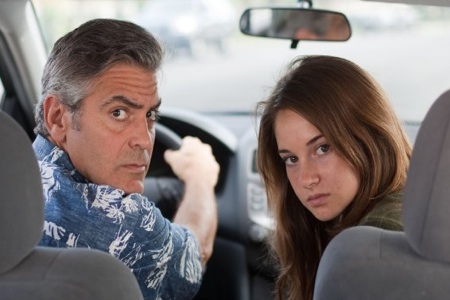

Matt looks over a hedge—one of the many quirky directorial choices
Payne makes that makes this film so enjoyable.


* It's especially true of politicians.  Think of that during the next political campaign.