Showing posts with label Jacques Tati. Show all posts

Wednesday, October 16, 2013

Jour de Fête

Jour de Fête (Jacques Tati, 1949) Tati's first feature length film, featuring the protagonist, François the rural postman (played by Tati), and many of the jokes re-bicycled from his 1947 short The School for Postmen.  Tati expands it with the story of a town's preparations for a big festival, and all the dangers for mayhem that accompany a feature of fun.  

Francois is on his daily rounds, done at their usual leisurely pace, but even more so for all the trouble the slightly officious fâcheux of a mailman can find to distract himself. But, the next day, inspired by an newsreel of how Americans are improving the speed of their mail delivery, he endeavors to increase the tempo of his route.

That's it in a nutshell, but the details, as with most silent comedies (although Jour de Fête isn't silent), are where the enjoyable bits are.  François is a more manic character than Tati's laid-back Mr. Hulot, and has a puppy-like fascination with just about everything and a cat-killing curiosity that gets him into both hot and cold water.  He is everybody's dork with a title, sure of himself and the only one in the room who is.  But his intentions are good.  His results are variable.

Tati filmed Jour de Fête twice, one version in black and white, and another using a color process called Thomson-color, a dicey system and lab that, unfortunately, went out of business before the film could be processed.  The black and white version was released to success, but Tati's dissatisfaction.  In 1962, he re-released it with a sub-plot about a sketch artist making pictures of the festival, and as the artist added colors to his black and white drawings, the colors would appear in the film, hand-tinted onto the film (this is the version of it I saw).  Increasingly, as the day wears on, more and more parts of the fair are tinted, sometimes surprising in what the choices are. 

Thirteen years after Tati's death, his daughter Sophie and French cinematographer Françoise Ede (who'd made a documentary about Tati's Playtime) managed to find the color elements and restore the Thomson-color version for the 1995 DVD release in France. 

It has yet to be released in the U.S.


The Three Lives of Jour de Fête


Black and White
Tinted

Color


Tuesday, March 15, 2011

The Illusionist (2010)


"The Disappearing Act"
or
"We Liked His Earlier, Funny Ones..."

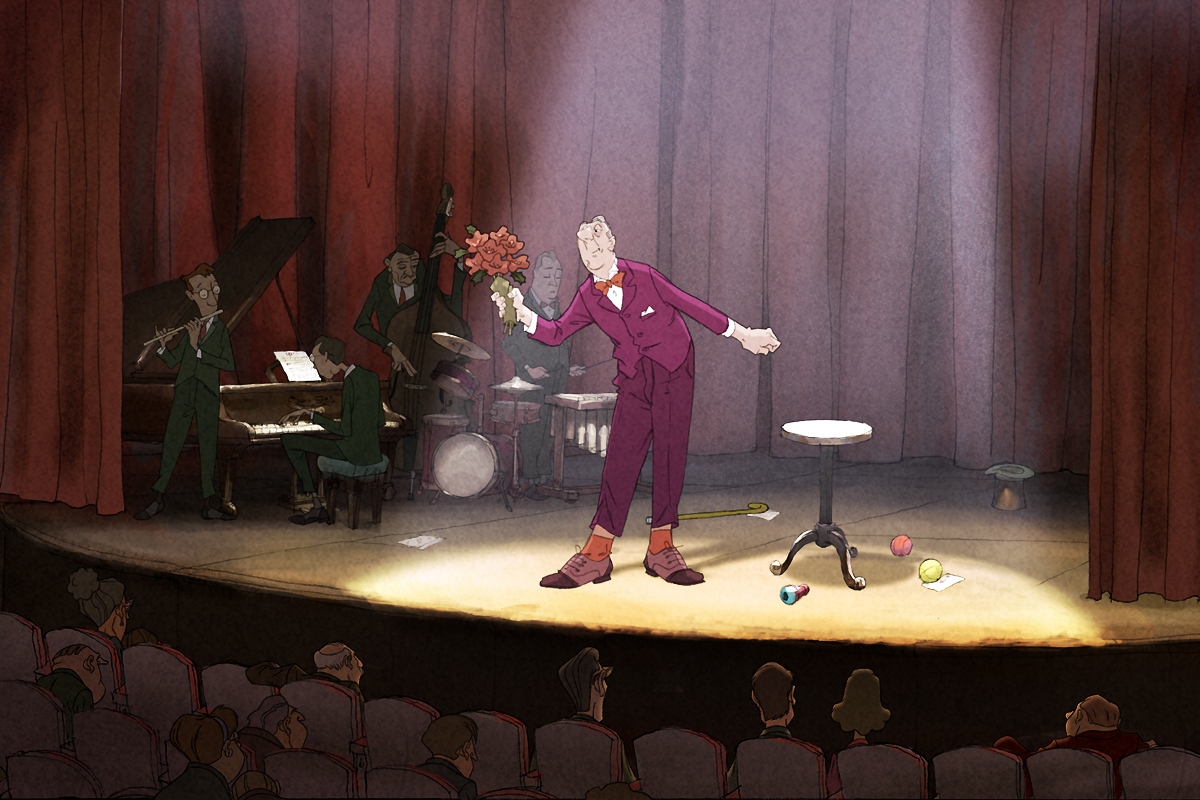
The French comic/film-maker Jacques Tati left one unproduced screenplay when he died in 1982.  That script, entitled "Film Tati Nº 4," is the basis for animator Sylvain Chomet's first feature after The Triplettes of Belleville, The Illusionist (or L'Illusionniste).  It is a lettre d'amour to Tati, with a main character resembling the French Master in size, style and manner (right down to the examination of the world with hands placed on the back of one's hips), directed in the same spare long-shot frame that allows disaster to occur from corner to corner.  It has the same errant mechanics (the sense that what could go wrong will go wrong), the ironic timing and "marking time" quality of Tati's films, in the elegantly focussed manner of silent films with sound effects.

But, it is a special case.  Tati wrote this after Mon Oncle and never made it, for whatever reason, coming down to mostly personal grief...but over whom is much in dispute.  Tati had two daughters, a child-out-of wedlock whom he abandoned, named Helga, and his legitimate daughter Sophie. Tati was going to make the film with Sophie in the 1960's, but never did.  His estrangement from his daughters weighed heavily on him, and the result—this melancholy little mea culpa—might have seemed as cheer-dousing as Charlie Chaplin playing McBeth. Or, it was simply too close to commit to.

A not-too-well-considered prestidigitater, Tatischeff (Tati's real name, by the way) is pulling a living out of his hat on a low-rent club circuit.  It is 1956, and rock n' roll is filling the theaters, and television is emptying the minds.  Tatischeff can't compete with his props and particularly ill-mannered rabbit (he bites!) and he plays empty halls to little applauseAn invitation to perform at a private party in Scotland turns out relatively well, and he stays, making the acquaintance of Alice, who works the tavern and sees Tatischeff as a genuine magician.  Noting the condition of her shoes, he buys her a nice pair of red ones, leaving her convinced her that actual magic can happen.

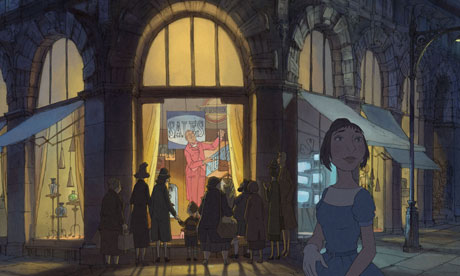
On a trip to Edinburgh,* he discovers that Alice has followed him without a ticket.  He buys her one, and the two travel the rest of the way together and settle in the city in a flop-house for performersWhile Tatischeff performs to the dwindling crowds at the Music Hall, Alice cooks, cleans, becomes the roving ambassador to the other performers and wanders the streets looking at the promises of a better life in Edinburgh shop-windows

The relationship between performer and waif is completely a father-daughter relationship.  He is a bit aloof, but tries to provide for her dreams by taking on a series of increasingly demeaning jobs, which he manages to pull off with uneasy aplombShe cares for him, but looks to the horizon.  At some point, his job is to let her go...to perform his own disappearing act in her life, if she is to have one.  Bittersweet, to be sure.

The Illusionist also has up is sleeve the constant thread that everything is an illusion: performers and artisans put their best face forward, we hide behind masks, we project elegance, we learn as we go becoming expert only after trial and error, and there is nothing so false as the entertainment industry with its sad clowns, facile crooners and feathered chorines.  There are no inner lives on stage, only the projection of illusion, a made-up false-front for reality.

Rich in detail and sub-text, it's the sort of quietly deep-thinking comedy that has mostly been absent since Tati passed, and though it has its laugh-out-loud moments, it is mostly a meditation on the transitory nature of life, how we dress it up, corral the chaos, change it, make it into reality only to see it fade and move on.  It is partially performance, partially illusion, but we are constantly changing, turning something into something else.  Life is what we make it and what it makes us.  

The Illusionist is a Full-Price Ticket.


* I've been to Edinburgh—it's where Chomet's studio, Django films was located—and the recreation of the city is amazing.  There were all the places I'd seen, but all in the wrong place, a scrambled Edinburgh that doesn't lose any of its charm.

Friday, August 7, 2009

Mon Oncle

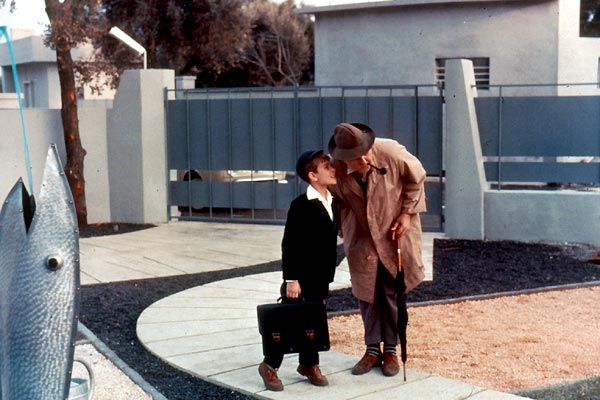
"Mon Oncle" (Jacques Tati, 1958) French comedy (the director's first in color) that won the Oscar for Best Foreign Film that year. Tati had been making comedy films for 20 years by this time, and he was startling to settle his silent anarchic character Mr. Hulot as something of a stick-in-the-mud in the French landscape, preferring the noisy, quaint ramshackle of city life to the encroachment of pre-fab, angular concrete and steel slab-homes.

You know whose side he's on immediately with the first three shots as the first two pan down from a construction crane to reveal the contractors (only in a neat wrinkle they're the film's credits,
with the title scrawled like graffiti on a stone wall in an alleyway that becomes the early morning run for a pack of dogs who pee on everything in sight and raid the garbage receptacles for food. Immediately the messy brick and mortar of old France is linked to the natural and everything just beyond its broken metal fence is restrictive, mechanical, and regimented. The "yard" is landscaped sand and pebbles, with paver stones as path-ways although what they're protecting other than orderliness is hard to fathom.

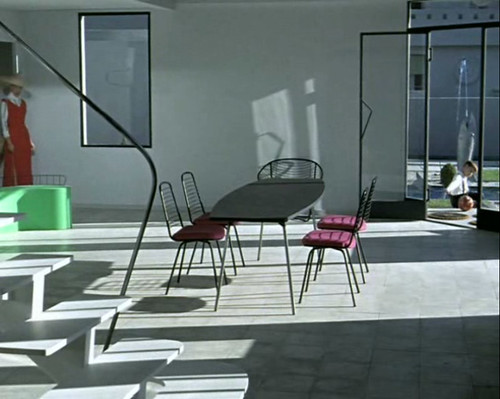
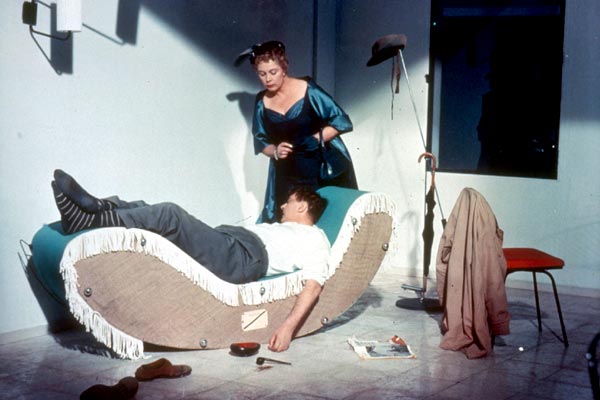
The house itself, the main set of the film, is a square monstrosity with bug-eyed windows on the second floor, which will be used to hilarious effect later in the film. And the interior is spartan with uncomfortable metal furniture that appears never to have been sat on. The kitchen has every sort of gadget you could imagine and some for comedy of the automated variety. It is here that Hulot's sister lives with her family, her husband working in "coal derivatives" (though the company's main function seems to be the manufacture of plastic hoses) and her son chaffing against the sterile environment.

He'd much rather be with his Uncle (
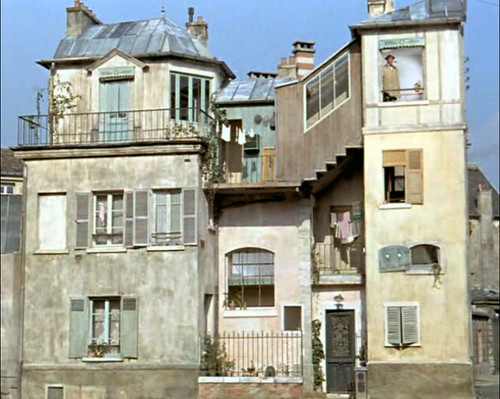
Tati), who by contrast lives in a rooftop apartment from which he can watch the city. To get there, he must make his way through a most circuitous 3-dimensional maze of stairs and hallways before reaching his front door. The life he lives is unorganized without the benefit of car or clock and the open neighborly village life suits him, rather than living behind the locked gates (remote controlled, naturally) of her sister's domicile.

By this time in his career, Tati could milk comedy out of every situation embracing chaos in a clickety-clack, buttoned-up synthetic world. "Mon Oncle," with its narrow focus has all the cover-the-comedic-bases charms of Chaplin, but especially the mechanical engineering of Keaton, while maintaining it all in a limited space. And with each film, Tati was becoming more adept at integrating sound into a silent world (Hulot is always silent but still manages to get his point across to the chattering populace anyway). The plastic offices have a perpetual hum, the factory is hermetically sealed by hydraulic doors and every gadget and goo-gah has its own personality and rhythm. Hulot's neighborhood is an uneven sprawl of city-sounds, dogs barking and kids playing. Tati is starting to become a welcome habit with me as he recalls the delights of the silent stars, but also the most disciplined of the "Looney Tunes" sensibility (Isn't that ironic?)

Thursday, October 16, 2008

M. Hulot's Holiday

"M. Hulot's Holiday" aka "Les Vacances de M. Hulot" (Jacques Tati, 1953) Ya know, it's a funny thing about comedy. So much of it depends on opposition, and the mechanics of opposition--not so much a study in contrasts as having contrasts bump into each other and fall down a man-hole (or, sorry, a sewer-hole).

I learned an interesting word the other day:
antimetabole. It's particularly noticeable in politics, speechifying and election years: it's simple turning of phrases is pleasing to the listener, and it's necessarily simple concepts seem to carry more depth than there is. During the Democratic Convention, Pres. Clinton used the phrase "People the world over have always been more impressed by the power of our example than by the example of our power."

Comedy is like that. The court and spark, the yin when you shoulda yanged of comedy is what makes us laugh.
Andrew Sarris in his encyclopedic "The American Cinema" mentioned (in his article on Richard Lester) that The Marx Brothers represented a free insanity in a rigid, sane world, whereas The Beatles represented freeing sanity in a rigid, insane world.

And so,
Jacques Tati. Tati's M. Hulot spends the movie being the square peg in a round hole. Tati has a great deal of fun presenting the rigid schedule of a vacation resort (Vacation? Rigid? Aren't they antithetical--oh, yeah, that's right...comedy) only to see Hulot wander about as the human monkey wrench sticking in the gears. He's Joe Btsfplk, with a silver lining. He's a "cooler"--to use the Vegas term, and movie title. He wanders about light as a straw, breaking every camel's back. Then suddenly, waiters who've done very well going in the right door into the kitchen and the left door out, are suddenly colliding in transit to the cacophony of falling plates and platters. Peace is preserved when his little black cloud of a car rattles off into the distance.

But he's not a walking example of anarchy. He's not bad luck. He's a perpetual "newbie," without the benefits of beginner's luck. And he's vaguely, very vaguely, aware of his effect on things. But he rolls on, regardless.

The lovely thing about
Tati is that he's basically making silent comedies with sound overlay. And the dependence on the visual for his effects puts emphasis on the mechanical, and the habitual which are ripe for disruption. Hilarity ensues, loudly or not. Tati's ambitions grew and grew, culminating in the mammoth "Playtime." I'll have to check that one out.

Supposedly, there's an unproduced Tati script,
The Illusionist, that is being produced as animation, and the director is Sylvain Chomet--who produced "The Triplettes of Belleville."

Now that is a match made among the spun cotton clouds of cinematic heaven.


* And the most famous one is "Ask not what your country can do for you, but what you can do for your country."

**Well, he kinda said it. I added a couple of words. And it's an antimetabole.