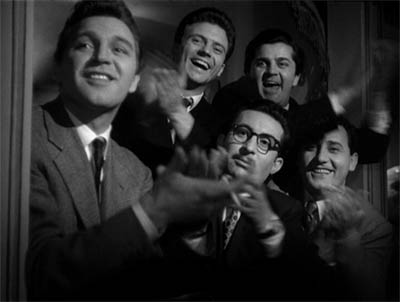
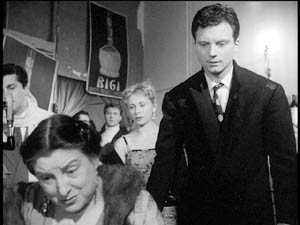
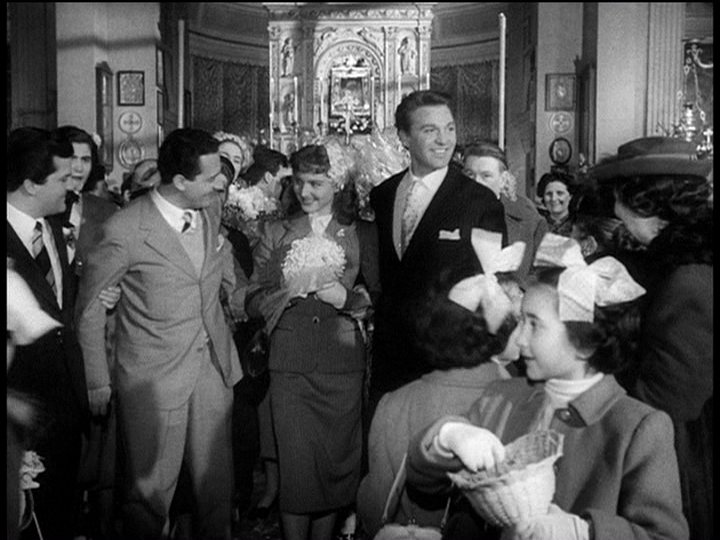
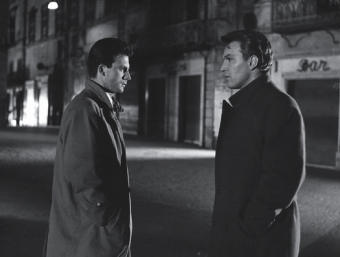
Il Bidone (aka "The Swindle") (Federico Fellini, 1955) The Italian maestro in his hey-dey. This 1955 film follows a trio of grifters—Augusto (Broderick Crawford), Picasso (Richard Basehart), and Roberto (Franco Fabrizi)—who are low-level con-artists in search of the Big Score—even a Ponzi scheme would do. They drive into a small village, all pomp and circumstance, with as much respectability as a disguise or a decent suit can buy, and with guile and a healthy disrespect for people's own need for "easy riches" or a "too-good-to-be-true" deal, bilk the citizenry out of as much cash as they can find lying around. As priests (using the respectability of the Church), they convince simple farm-folk of "buried treasure." On a grander scale, they're developers collecting down-payments on rooms to a vapor—hotel that will never materialize ("The economy's bad and we've suffered some set-backs").
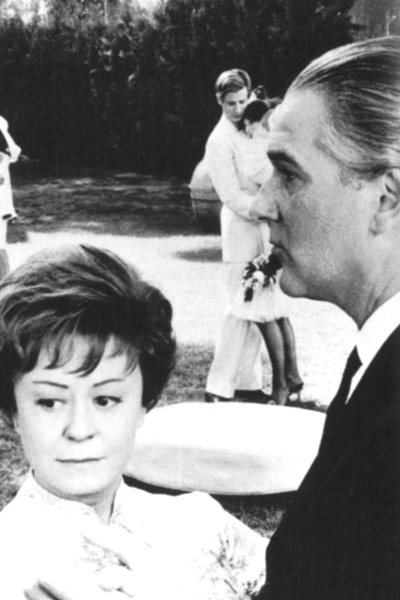
For Picasso, there are dreams of becoming a famous painter (but in the mean-time he can forge a few masterpieces to get by, much to the chagrin of his long-suffering wife, played by the wonderful Giulietta Masina). Roberto, their chauffeur/get-away driver, is young to the game and is always looking for new angles so he can set off on his own crime-spree, free of "the losers" he thinks might be holding him back.
But, the leader of the group, Augusto, is feeling the advance of age and getting a little desperate; he hasn't achieved any real fortune, just what can be piffled away on a falsley high lifestyle and an evening of prospecting at the clubs (he's not a high-roller, but he has to play one and that can get "spendy"). He is torn. He wants the respectability that a really big perpetual con (like the kind found in government circles and among the constabulary can provide) can bring. In essence, what he wants to do is be for real what he only play-acts as his work. A man of respect, a high roller...an adult, or his version—his imagining—of what that is, this overlarge, over-age boy in big pants. For Augusto, he hits "the brick-wall of Reality," in the presence of his very real daughter, for whom he wants most to be seen as a man of respect, a man of accomplishment, instead of the fraud he pretends to be.
I started out this review saying "the Italian maestro in his hey-dey" and have come to this point wondering if that is true. I've often dismissed his latter films as inferior if more complicated and less grounded in reality to his 1950's films, which are more asprirational in nature. They're about wishing and hoping for success which eludes their protagonists—the street-performers of La Strada, the drifting men of I Vitelloni...Cabiria. When Federico Fellini became "Fellini," international artist, he seemed to lose that touch of "becoming," to make observations of his new life of "having made it," and finding it difficult to maintain and empty, finding it wanting, and in a sense, was compiling an autobiography of his journey to success and beyond. Even his wife (Messina) complained that his Juliet of the Spirits wasn't about a woman's issues, but about his own. His movies about the glitzerati felt hollow and self-absorbed (appropriately).
But, the director still aspired, although he struggled for subject matter (see 8½) or funding, especially in his later years, despite his reputation. He retreated to fantasies and circuses, reality being not enough—and maybe not sure anymore about what reality was, surrounded as he was by reputation, the expectations of fame, and the glare of the spotlight. Simple virtues and humble origins cannot be found on the soundstages of Cinecitta, or the boardrooms of Titanus.
But, the aspirations continued. As if documenting Shakespeare's seven stages of life, Fellini's vision, aimed ever inward, began looking back, became nostalgic for those early times of "wanting" dreams, trying to reclaim them, make them real again. Not so much aprirational anymore, but seeking the times and memories of aspiration, when the world was full of possibilities, when wonder was more than klieg-lights and grease-piant, a fraud wanting to be real.
I've had a review of Amarcord in the drafting stage for almost a year. I think I can write that now.
Friday, September 9, 2011
Il Bidone
Thursday, July 7, 2011
I vitelloni
I Vitelloni (aka The Large Calves) (Federico Fellini, 1953) So many films have come down the strada since this one (American Graffiti, Diner) that bear a resemblance to this nicely melancholy collection of stories about the wasted lives of young men that fans of those later Americanized versions will find themselves in cozily familiar (if uncomfortable) terrain. It has become a staple of film makers who have become nostalgic, but just smart enough to see their pasts with the lenses of irony and affectionate smugness.
In a provincial town, there are five men who, post-education and living with their parents, are poised on the edge of putting away childish things and becoming men—and they're doing it as slowly as possible: Alberto (Alberto Sordi) a flamboyant life-of-the-partier, which is fine for him but he's bothered by sister's dalliances with a married man; Riccardo (Riccardo Fellini, the director's brother) is a fine baritone with never-realized dreams of being an entertainer; Leopoldo (Leopoldo Trieste), the intellectual, has the required "script-in-the-drawer," never published, never performed; the unofficial leader, Fausto (Franco Fabrizi), whom all the others look up to, is an unrepentant womanizer, good at seducing but bad at staying 'til morning; then, there's Moraldo (Franco Interlenghi), the youngest, who observes all the behavior, following in the others' footsteps if not down their paths.
See, there's a problem: Moraldo's sister (Leonora Ruffo), who's just been named "Miss Siren of 1953" at the end-of-Summer bash, is pregnant with Fausto's baby. When she faints after being crowned, the whole town becomes aware of the scandal and Fausto is forced to marry her, then take on a job as a clerk, which he despises. Already, Moraldo's loyalties are divided, between loyalty to family and friends, between fun and responsibility, and right and wrong, and it creates a new perspective from which he observes his friends as they listlessly make their way from Summer to Summer (their season to shine) free, but not care-free...and not entirely rootless. Time goes by, getting by, and all are shown lessons they don't want to learn—about compromise, about self-reliance and duty. But there's always another party to go to, another prank to pull, another alley to duck into when the going gets uncomfortable. There's no time to lose, as time can't be wasted, only spent.
It's all set to the sad swagger of Nino Rota's perfectly-in-tune score, and it is one of those rare Fellini films that ends with a resolution, rather than a wry shrug. There is hope, and an indelible last image that hangs in the memory (and not because it's freeze-framed) that shows how brilliant Fellini could be when he kept things simple (and he had to on this film, shot over six months, with different cinematographers). The last line is also curious, as it is dubbed, not by the actor, but by Fellini himself. He would insert himself more and more into his films, until they merged, the two indistinguishable for a time, the man and his work, his dreams made real.
| Sittin' on the dock of the bay...wastin' time |
.
Saturday, December 5, 2009
Juliet of the Spirits
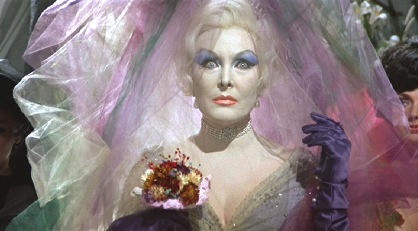
"Juliet of the Spirits" aka "Giulietta degli spiriti" (Federico Fellini, 1965) Any director's first forays into color from black and white are worthy of attention. John Ford filled his palette with startling reds. Stanley Kubrick set his first color film in the black and white world of space-travel and suffused interior spaces with hot red's, pale greens and cool blues. Fellini you'd expect to go somewhat crazy right off the bat.* But then, how colorful can priests and dirty beaches be? Oh, and the circuses. The circuses must be splendente with color.
But, the great Italian director starts conservatively with its dimension of other-worldliness and earthy matters with a natural palette and muted colors. But as the world of Giulietta (played by Fellini's wife and muse, Giulietta Masina) starts to crush inside and explode outwards, the colors within her reach become more vibrant and exotic, approaching the phantasmagorical as she explores the phantasmic.
On her fifteenth anniversary to roguish businessman Giorgio (Mario Pisu), Giulietta has a romantic dinner planned, only to have to share it with the clutch of hangers-on and sycophants he drags home with him. She begins to suspect that she's sharing him in other ways as well, and she seeks guidance from the spirit-world and evidence from a detective agency (of priests!) to get the goods on her no-good husband. At the same time, she begins...slowly, reluctantly to move on from her past life to a new one.
Fellini has famously said "All of my movies are really about me."** Of course. He's making them and writing them—creating them—so they'd naturally reflect his thoughts and obsessions. But the Fellini who earlier collaborated with his wife-star on empathetic films like "Nights of Cabiria" and "La Strada" was now an internationally known and renowned film-maker. His previous films—"La dolce vita" and "8½ "—were international hits, as well as being particularly autobiographical Pilgrim's progresses through the glitterati of a new Italian dynamic. He's still working in that mode in "Giulietta," but he's inserting Masina into the scenario as an outsider looking in on the decadent adventures of the journeying artist and exploiting the pain of the taken-for-granted wife in the story. One could be gossipy and say that Giorgio is Fellini and the entire movie is an invitation to Giulietta into his dream-life of passions, or a cinematic separation telling the world what a stick-in-the-mud his wife is, but given his past empathetic films with Masina, "Giulietta" is a bit dispassionate and curiously cold. And cruel; He's inserted his wife into his collection of grotesques and nubile concubines and finds her wanting.
Masina, too, is a little off-put in her performance. Where, in her previous roles with Fellini, she is passionate and eccentric, even effervescent, here she is withdrawn, and 1/4 into the film, after seeing the constant tight smile that she has on her face—pensive, patient (but only so far), repeated again and again in a medium close-up, you get the impression that she's holding back her frustration. One can hardly blame her; "Giulietta" is caught between two worlds, neither one to her comfort or liking. As she expressed the pain and hope of her characters in the past, one feels her pain with this film.
But you can't argue with a dream. The colors are eye-popping. The images are by turns, challenging and inviting. The film has the same fascination that a corner holds—what's coming up? What lies beyond? But somewhere, in turning the corner, the journey becomes all-important. The lead character becomes lost in the landscape; lost, or left behind.
** I've avoided using the exact quote as it comes in two different flavors, depending on which translation you use (and which bumbling entertainment "journalist" translated it): "If I were to make a film about the life of a soul, it would end up being about me," or "Even if I set out to make a film about a fillet of sole, it would be about me." Cosa?