Showing posts with label Anton Walbrook. Show all posts

Friday, December 13, 2013

49th Parallel

49th Parallel (aka The Invaders) (Michael Powell, 1941)
Interesting propaganda film to promote the war effort by the British government, made by "The Archers" (Emeric Pressburger and Michael Powell) before they became "The Archers" and combining the writer-director credits together. More than anything, it was designed to influence isolationist American minds about the threat of the Nazis, by presenting a story where they arrive on our shores.

It is 1941 and a German sub is prowling Canadian waters, sinking any transport they can.  Detected, they make a run for Hudson's Bay and the sub commander orders a landing party to capture an outpost in the area.  But, soon after leaving the sub, the men see it attacked and sunk by a bomber, sent by the Canadian air force, alerted to their presence.  The Commander, Hirth (Eric Portman) continues to land to complete the mission, hoping that they can make their way eventually to the United States which is (gulp!) famously neutral in order to get back to Germany.


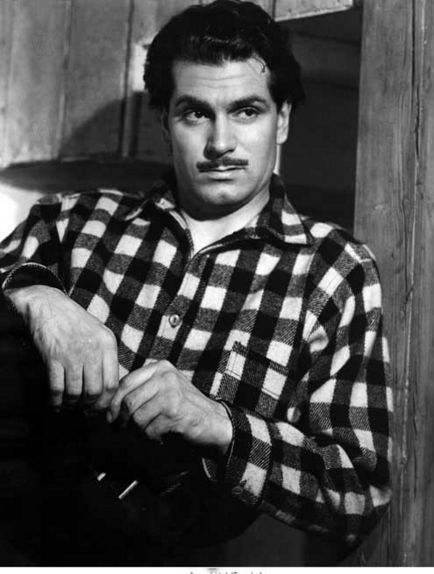
But, first they have to get through Canada.  First stop, a trading post, where Finley Currie and Eskimo guide Ley On are welcoming back French trapper Johnnie (Laurence Olivierwith the wildest accent you've ever heard, eh?) after being up north for eleven months.  The Nazi's take over the trading post, hoping to entice and hijack a plane to get them across the border.  But, it goes badly leading to a skirmish, which barely has the Nazis escaping with their lives.  They then make their way to a German Hutterite community led by Anton Walbrook, who first welcomes the visitors to their peaceful enclave, then when the Nazis' arrogance get the better of them and try to teach the community about their "better" way, Hirth and the community leader engage in a lively debate over the merits of each other's systems.  The Germans are kicked out, making their way to the wilderness where they are captured by the RCMP, but make their escape using an eccentric writer (Leslie Howard) as a hostage, but even that plan does not go as planned.  

Each encounter has reduced their numbers, and, at the last, only Hirth remains free and on the run.  He hops a freight to try and make it across the 49th parallel into the States, but riding the car with him is AWOL soldier Andy Brock (Raymond Massey), whose sympathies are still with Canada, despite being reluctant to fight, and he makes things very complicated.

It is a propaganda piece, after all, and if the various episodes seem a bit far-fetched and feel like a tortured demonstration on the length and breadth of Canadian diversity ("Meet the Canadians!  Even OUR Germans don't like THEIR Germans"), it is with the intent of contrasting that diversity with the sameness of the Aryan lineage and autocratic group-think of the sub crew.  If the thing gets a little pedantic, it was to educate reluctant Americans about Nazi philosophy in a dramatic fashion and inspire a feeling of "It CAN happen to YOU" to the "American Firster's."  It's a bit clumsy and the fisticuffs are a might ham-fisted, but it's positively sub-tle when you put it up against the thousand goose-stepping hosers of Triumph des Willens.  And Powell and Pressburger were just getting started.

Eric Portman's Commandant wants things a little
more orderly in 49th Parallel


Saturday, July 9, 2011

Lola Montès

Lola Montès (Max Ophüls, 1955) "The things we do to women"—one of the mantras of fictional President Jed Bartlett in "The West Wing," said several times over the course of the series in the presence of a male audience (but never as much as "What's next?"). 

The last film of master craftsman Max Ophüls (two years before his death) is a reverie, a cautionary tale of the course of the life of dancer/courtesan Lola Montez, who climbed socially through the world of prominent men until a dalliance with the King of Bavaria (who appointed her The Countess of Landsfeld) created such an uproar, it caused a revolution in 1848.  The real Lola lived quite well, though doing it so fast ultimately cost her.  She died from pnuemonia after suffering a stroke at age 40 in the United States.


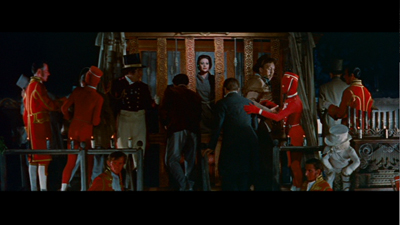
Ophüls' "reel" Lola (played by Martine Carol) lives out her foreshadowed final days as a featured performer of a circus (ring-led by Peter Ustinov), a public spectacle where she is forced to re-live and metaphorically re-enact her scandalous rise and precipitous fall before an audience of French rubes, who, like the rabble they are, shout questions from the dark (and Ustinov's Circus Master smarmily answers, egging them on). 


She is the star performer, but trappedby the schedule, by the spotlight, and finally caged, as a seemingly endless line of paying customers queue up to kiss her hand, paying homage and risking little.  She is a prisoner of her fame, her reputation and her life, that once represented a kind of freedom, where she felt she could challenge the limitations of polite society.


For Lola, it must seem a little like Hell, and for director Ophüls, it might have, too.  A long, complicated shoot, his first in color and wide-screen (at the producers' insistence), with a star he didn't want (at the producers' insistence), his film's complicated flashback structure, shifting back and forth from the circus' smarmy presentation of incidents to Lola's memories of the events—was re-edited into an uneasy chronological order to get to "the good parts" faster (at...well, you already know), after its premiere.  And that version of Lola—with one or two bits of lost footage tacked on over the years—was what the world knew of Ophüls' last film...until 2008.  Restored to the structure Ophüls intended, the film wheels between Lola's life in charge and manipulating events, to her being manipulated reliving the events, like a sideshow attraction.  And the presentation has an accusatory, sensationalist tone—a show-trial, literally.


It's a cunning look at fame (or infamy), of how one's actions can be sold as just about anything (the director's son in a supplemental interview says "Lola Montès is anti-advertising.")—and ironically the producers took the deception one step further, missing, or ignoring, or even sabotaging, the point.


Meanwhile, Ophüls managed to make the most of his star's lack of range, making her a stoic throughout the self-abasement.  Politically, it's an odd film: ostensibly, a "Comeuppance" film where an upstart (in this case, Lola) gets her "just desserts" (if one is thinking uncharitably), suffering humiliation and entrapment at the hands of men—once powerful and influential, she's now powerless.  But, that's a simplistic, even a foolish, reading.  Lola still holds fascination, draws a crowd, and those lines of men at the end are paying money to kiss her hand and pay their respects.  Even the Circus Master betrays his personal devotion to her.  Caged she may be, but she's still "got" it.

And Ophüls might have just told the flashback story, but the tragic scenes at the circus provoke empathy for Lola, reliving her lost past, generating understanding, or as Ophüls' son says, "in a spirit of penitence and mortification, benevolence." An audience might not be so sympathetic if Lola wenched her way around the world. getting her way and getting away with it, but the circus summaries exploit and promote her past victories, while placing her in marked contrast with her accomplishments. Like the circumstances of Barry Lyndon (Ophüls was a huge influence on Kubrick), the comedown goes a long way to evoking sympathy for the unfortunate forever caught in the frame.


Critic Andrew Sarris once called Lola Montès "the greatest film ever made."  One can see why.


Friday, January 16, 2009

The Life and Death of Colonel Blimp

"The Life and Death of Colonel Blimp" (The Archers, 1946) Controversial film for the majority of its life, although looking at it now, one wonders what all the fuss was about.

"Colonel Blimp" was a political cartoon created by cartoonist David Low as a blow against pomposity and complacency, but writer/director team of Michael Powell and Emeric Pressburger ("The Archers") took the name and reputation and turned it into another animal altogether—an epic about manners, regimentation and the Rules of Engagement, both intimate and grandiose.

After serving in the
Boer War, Clive Wynne-Candy (the criminally forgotten Roger Livesey) is embroiled in a sword-duel with a German officer, Theodor Kretschmar-Schuldorff (Anton Walbrook), which results in both men being wounded and a substantial recovery time in the same hospital. The two become friends, and while friendships may last, alliances do not, especially in the European history of the 20th Century. Times change, the borders of countries shift like Teutonic plates, but loyalties...what happens to them? It may seem an odd thing to focus on to American audiences (as we've always fought "dirty" in our wars, bending the rules of warfare to our advantage), but the British throughout that century struggled to maintain a decorum to war, which, if it were not so ingrained, must seem like a flight of fancy.*

"The criminally-forgotten Roger Livesey"

Flights of Fancy are what Powell and Pressburger do best. And despite mis-understanding by, primarily, Churchill (who must have thought it was about him), the film has been unfairly maligned, and expectations for it blown out of proportion. Satirical it is. But also a melancholy treatise on long life and outliving one's epoch. One walks in expecting brash and finds it sad and sweet. And cleverly inventive, in technique and story-line. Deborah Kerr (in a daunting screen debut) plays three women in Candy's life: the woman he gave away to a friend, the woman he married, and his driver during WWII—the arc of a love in three acts for women who resemble each other, if only in the mind of one man.

If nothing else, "The Life and Death of Colonel Blimp" is amazing in its look--a Technicolor confection that pops off the screen, a mark of "The Archers."


*However...given the film begins with The Boer War, one can't help but use the word "decorum" a bit sarcastically given the British use of "scorched Earth" policies and concentration camps during that conflict.