Showing posts with label Laurence Olivier. Show all posts

Friday, December 13, 2013

49th Parallel

49th Parallel (aka The Invaders) (Michael Powell, 1941)
Interesting propaganda film to promote the war effort by the British government, made by "The Archers" (Emeric Pressburger and Michael Powell) before they became "The Archers" and combining the writer-director credits together. More than anything, it was designed to influence isolationist American minds about the threat of the Nazis, by presenting a story where they arrive on our shores.

It is 1941 and a German sub is prowling Canadian waters, sinking any transport they can.  Detected, they make a run for Hudson's Bay and the sub commander orders a landing party to capture an outpost in the area.  But, soon after leaving the sub, the men see it attacked and sunk by a bomber, sent by the Canadian air force, alerted to their presence.  The Commander, Hirth (Eric Portman) continues to land to complete the mission, hoping that they can make their way eventually to the United States which is (gulp!) famously neutral in order to get back to Germany.


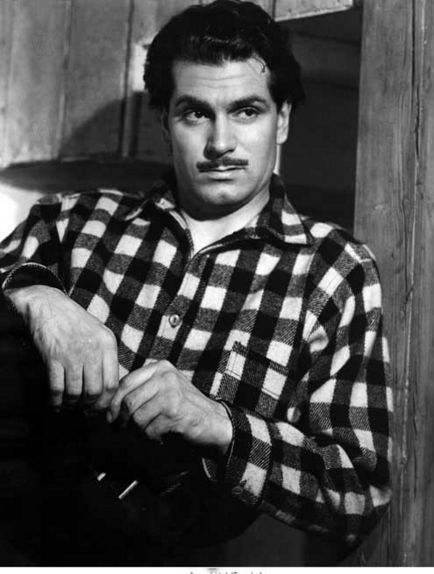
But, first they have to get through Canada.  First stop, a trading post, where Finley Currie and Eskimo guide Ley On are welcoming back French trapper Johnnie (Laurence Olivierwith the wildest accent you've ever heard, eh?) after being up north for eleven months.  The Nazi's take over the trading post, hoping to entice and hijack a plane to get them across the border.  But, it goes badly leading to a skirmish, which barely has the Nazis escaping with their lives.  They then make their way to a German Hutterite community led by Anton Walbrook, who first welcomes the visitors to their peaceful enclave, then when the Nazis' arrogance get the better of them and try to teach the community about their "better" way, Hirth and the community leader engage in a lively debate over the merits of each other's systems.  The Germans are kicked out, making their way to the wilderness where they are captured by the RCMP, but make their escape using an eccentric writer (Leslie Howard) as a hostage, but even that plan does not go as planned.  

Each encounter has reduced their numbers, and, at the last, only Hirth remains free and on the run.  He hops a freight to try and make it across the 49th parallel into the States, but riding the car with him is AWOL soldier Andy Brock (Raymond Massey), whose sympathies are still with Canada, despite being reluctant to fight, and he makes things very complicated.

It is a propaganda piece, after all, and if the various episodes seem a bit far-fetched and feel like a tortured demonstration on the length and breadth of Canadian diversity ("Meet the Canadians!  Even OUR Germans don't like THEIR Germans"), it is with the intent of contrasting that diversity with the sameness of the Aryan lineage and autocratic group-think of the sub crew.  If the thing gets a little pedantic, it was to educate reluctant Americans about Nazi philosophy in a dramatic fashion and inspire a feeling of "It CAN happen to YOU" to the "American Firster's."  It's a bit clumsy and the fisticuffs are a might ham-fisted, but it's positively sub-tle when you put it up against the thousand goose-stepping hosers of Triumph des Willens.  And Powell and Pressburger were just getting started.

Eric Portman's Commandant wants things a little
more orderly in 49th Parallel


Tuesday, September 25, 2012

The Entertainer (1960)

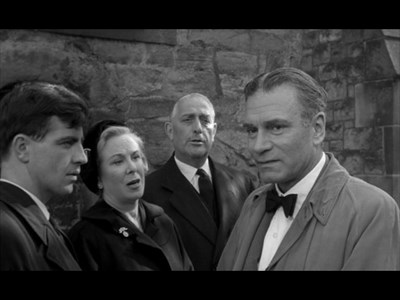
The Entertainer (Tony Richardson, 1960) One thing about Laurence Olivier, he was an actor for all genres.  Yes, he was primarily known as a stage and film Shakespearean, probably the greatest, but he also did light comedies, thrillers, period dramas, horror films, the occasional cheese-fest...everything...including the kitchen sink.  Kitchen sink dramas, that is. 

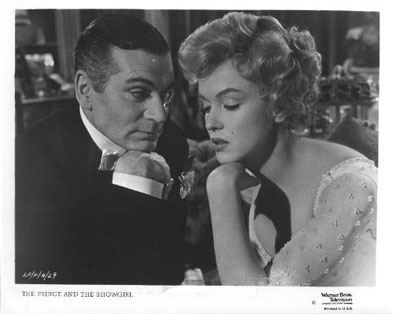
In My Week With Marilyn—the fictionalized telling of the filming of The Prince and the ShowgirlKenneth Branagh's Olivier announces he's done with directing (after his on-set tussles with Monroe and finding out she's incandescent on-screen, anyway, despite his direction) and is going back to the stage to do a John Osbourne piece.  That would be "The Entertainer," the play on which this film is based.  On stage, it vacillated between life on-stage for Archie Rice (Olivier), and at home, where...well, he's never really OFF-stage, a needy vaudevillian with an alcoholic second wife (Brenda De Banzie), three kids (Albert Finney, Alan Bates, and Joan Plowright—who would become the last Lady Olivier), and a slightly more talented, but no more wiser live-in Da (Roger Livesey).

For now, Archie is scraping by, as star/producer of a boardwalk diversion at a seaside holiday camp, in the perfect venue—an old, faded theater, where the air is as stale as his material.  His day is only vital in the afternoons and early evenings in the bustling chaos of on-stage and backstage.  The rest is the drummest of hums—wife in her cups, son off to war in the Suez, youngest son helping Dad in the dive, and daughter teaches art to a bunch of barely interested teddy-boys and girls.  She goes to the seaside, seeking out Father, looking for some form of stability before settling into a perfunctory marriage.

She should have gone somewhere else.  Archie is only accessible on-stage, and when off, he's trying to hustle another season, another venue, another donor, another prospective starlet.  Life just isn't good enough for him if a limelight isn't on him and the money's starting to run out to pay the electric bill. Much was made of the play as a comment for the fading empiricism of Great Britain, as personified by the propped-up jolly-good Archie, for whom the show must go on, despite not having any juice in it for years, surviving with a heavy layer of rouge and grease-paint to give the long-distance impression of vitality and youth, blithely ignoring the march of time and pasting it over with the false grin of performance, no matter how desperate it may come across.

Richardson's film opens the play up, puts instance on Archie's transgressions on-screen instead of just being talked about and blubbered over, and Olivier sticks out like a sore thumb—rightly so—apart from the rest of the cast.  Where Livesey is old-school formal and the kids are new-broom casual, Olivier sticks to his guns with a theatrical performance which feels appropriately, desperately false, which benefits the film while also making the character of Archie a complete outsider, a role he no doubt relishes.  There's only one star in this "revue," everybody else is a bit player.

For Olivier, it must have fulfilled some need—to slum, maybe, or to reach out to the new material being generated by Osbourne, Richardson and others in the new school of British rebellion.  Maybe, after his long string of kings, princes and noblemen, he wanted to explore the has-been's and ignoble men, to cultivate portraits of characters of a more stratified than rarefied stripe.  There's also an element that Olivier might have been familiar with—the performer's ennui, bordering on contempt for his audience.  At this stage in his career, Archie is performing for himself—the money's not great, the material stale, and any creative collaboration is non-existent—the most intimate relationship he has is with his make-up mirror and even that is betraying him.  Olivier is not above showing bitterness—he was particularly adept at tartly spitting out the ironic put-down in the guise of civility.  And he was acknowledging his age (he was a very old Hamlet in his film of it) and the potential for failure, by portraying it, challenging it, mocking it, waving a red cape at it, maybe exorcising it.  It was a brave interesting role for Britain's leading thespian.


Olivier as Archie Rice: "The Roar of the Greasepaint"


Monday, August 25, 2008

Hamlet (1948)

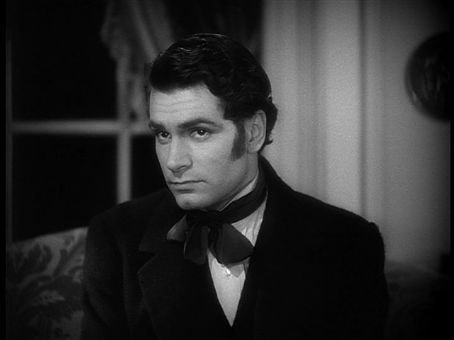
"Hamlet" (Laurence Olivier, 1948)

This is the story of a man who could not make up his mind" intones
Laurence Olivier at the beginning of his Production of "Hamlet" (L.O. gets the opening card over Wm. Shakespeare).

Well, yes, that's an easy way to look at it. And while it's essentially true, it negates the fact that Hamlet is struggling with the moral implications of killing, especially since the object of all the daggers he's throwing out with his eyes is, himself, a murderer, traitor, and is sleeping with his mother.* Hamlet tries every trick in the book to expose the treachery, even takes a stab at killing him himself (with collateral damage**) Hamlet is wrestling with his conscience the whole way--while depressed, grieving--and with not good reason: his quest is based on the flimsiest of evidence--the word of a ghost. A ghost that even his
Spock-like friend Horatio saw, to be sure (or not to be), but a ghost nonetheless. Such evidence would never stand up in the Court of Elsinore. The Dark Prince must also wrestle with the consequences of his actions--from his father he knows of the existence of Hell and the damnation murderous actions would lead to.

"Couldn't make up his mind." He wanted to slit the King's throat, not his own.

Every production of "Hamlet" must wrestle with the text
*** that ballooned with many versions, asides, and blind alleys. Olivier stripped it bare: No Rosencrantz, no Guildenstern, no Fortinbras, no battle on the plain in Denmark and so, no "Let my thoughts be bloody" speech. Hamlet does not compare his plight with the futility of war, and in 1948, considering his "rally-the-troops" version of "Henry V," an anti-war statement must have seemed in bad taste, after surviving the blitzkrieg.

And just as every Hamlet must pick and choose what sections to explore, every actor playing Hamlet must contend with ghosts;
**** not the play's, but the players of the past. Like baseball veterans chasing old records, each Hamlet is a reflection of the past, and a portent to other Princes. The current crop of actors taking on the role must have considered Olivier's take, or Richard Burton's, or Nicol Williamson's, just as Olivier must have thought about John's Gielgud and Barrymore. Olivier does take chances given the film medium. His "Frailty, the name is woman" speech is done in voice-over with some choice epithets that burst out of him on-set. That's a good choice for the scene, where Hamlet is in a public space following a celebration and could conceivably be overheard by some hanger's-on. He is much more verbal in his further monologues when he is thought to be crazy, or alone. The "To Be or Not To Be" speech is performed on a parapet overlooking the sea, with dagger in hand. It's a good concept to have the prince "on-edge" at that juncture.


The unique staging of that speech is one of those elements that absolutely separate the filmed Hamlets from each other.***** To me, there are three others: the presentation of the Ghost of the murdered Old Hamlet, the use of Polonius, and the approach to Ophelia. Here's how Olivier treats them.


The Ghost: Olivier wraps him in vapors of the real and optical variety, dressed in his battle armor, looking sepulchral, and emaciated, like a classic death figure, with a low-whispered voice--supplied by Olivier and played back slowly.

Polonius: As played by Felix Aylmer, and directed by Olivier, Polonius is a comic figure, whose verbosity is played for laughs, and most treat him with a feigned patience, and wish he'd get to the point.

Ophelia: As played by the 18-year old Jean Simmons, Ophelia is very much the traditional Ophelia as delicate flower. She goes crazy with the loss of Hamlet, the death of her father, and no Laertes to bolster her. She is an Ophelia too frail to stand on her own and crushed by the whirl of events, and her cracked sanity is portrayed by a far-away gaze and "fairy-princess" demeanor. How influenced she is by Hamlet's shifting moods is hard to say. But she is "ingenue-as-victim" in the Hollywood tradition.

The other thing I hear about Olivier's "Hamlet" is that it is somehow a "film noir" interpretation of the play. Except for some fine deep-focus black and white photography, I don't see it. No play of shadows--in fact, everyone is extremely well-lit. And the movie's very set-bound; nobody's walking down the "mean streets" of Elsinore.


Laurence Olivier's "Hamlet" won the Best Picture Oscar in 1948, with Olivier winning Best Performance by an Actor. He was the first person to ever direct himself to an Oscar-winning performance. Only one other actor has done it: Roberto Benigni.

* Gertrude. One of the interesting things to note about the various "Hamlet's" is the varying ages between mothers and sons. They're starting to get it right, but it wasn't always thus: In the 1990 Hamlet, Gertrude (Glenn Close) is only nine years older than Hamlet (Mel Gibson). In this one, Gertrude (Eileen Herlie) is fourteen years younger than Hamlet (Olivier)! I guess it's an improvement when your realize in the original stagings Gertrude was probably played by a man! And incidentally, Herlie also played Gertrude to Richard Burton's Hamlet--he was five years younger.

** I've always called "Polonius," the verbose father of Laertes and Ophelia, "Collateralous."

***Unless you're Kenneth Branagh, whose 1996 all-star "Hamlet" used the second Quatro version (1604) (with additions from the First Folio version), clocked in at 4 hrs., 2 mins., was filmed in 70mm, with 6 track Dolby sound, but at least had Rosencrantz, Guildensterm, Fortinbras, the "Let my thoughts be bloody" speech, and had a Gertrude who could have conceivably (heh) been Hamlet's mother!

**** There are other ghosts at Elsinore if one is to believe Olivier's camera-work. Elsinore is an enclosed castle with labyrinthine corridors and vast open emoting spaces. Between acts, we flit down corridors and up spiraling staircases as if the audition is, itself, an apparition, seeing everything in turn with an omniscient view-point. And in a reversal of stage tradition, we go to the actors, rather than them coming to us.

***** Most actors address the audience on-stage. Mel Gibson's Hamlet performs it in a burial catacombs, Kenneth Branagh, while looking in a mirror, and Ethan Hawke, at the video store.