Vantage Point (Pete Travis, 2008) An American news crew sits in their van in Salamanca, Spain, technically coordinating coverage of a Presidential visit. No sooner does POTUS (William Hurt) take the podium when two shots ring out, sending him flying, to the horror of the news-people, the Secret Service, the crowded throng and the millions who are (probably not) watching at home. For a split-second, there is reaction all around, and then the confusion starts: where did the shots come from, who's that running guy, get the president to the hospital, foot-chase. At the end of it, a lot of people are dead, and the ramifications are huge, while the news channels try to play catch up...and one suspects never will.
This one's just plain crazy. The same 15 minutes, played out, rewound, clock started again, and POV switched. Technically, it's a daunting challenge, with all the shots of things that have gone before shifted into the background, and having to match what went before in the same time-frame that it did before, although one later incident seems to be fudged a little longer to allow some exposition in one segment (all the better to build suspense). The director, Pete Travis, mostly known for his British television work) does one thing that always drives me nuts in pot-boiler novels—he takes you to one pop-eye inducing moment...and then...stops and goes back. Next chapter. We'll get back to that...
That would make it "a relentless page-turner" if it had a spine, but you're stuck watching the movie, wondering, "Yeah, but what about..." Annoying. But, not enough to make you hit the "Eject" button.
Source Code did this a little better this year, and had the decency to make all the populace in it more than innocent by-standers. Most of the characters are there to serve a function in the plot, rather then being motivated, save for Dennis Quaid's Secret Service agent, who has just come back to active duty after taking a bullet for this President six months earlier. The speculation is that he might be a little gun-shy (if so, he wouldn't be put on active duty, now would he?)
This is the problem with the film. Good concept (even if it is Akira Kurosawa's), but the deeper we go into the movie and the more we find out about this 15 minutes, the situation becomes less and less likely, and more and more contrived. It has the kinetic feel of an episode of "24" compressed and spread out over a ninety minute running time. And, it isn't even "The Rashomon Effect," where (when it's done well) the differing perspectives are colored by the person telling the story. Here, facts are facts—it just happens from different angles, how the person feels about it doesn't enter into things. In that regard, Vantage Point is just a standard detective thriller, more about information dissemination in an electronic 24 hour news cycle, rather than saying anything about the human condition—besides the obvious jumping to conclusions. The film begins and ends in that van and the broadcast of events, making the point that there's a photon-filter between truth and knowledge. At the end, the news audience does not know, and may never know exactly what went down. But, given what we already know about the efficacy of reporting "while it happens," the endless speculation and rumor-airing and other apocrypha and opinion that's offered as journalism, it is a bit of a hollow exercise, a "gimmick" movie without that much to offer.
Is it a good movie? I don't know.
Wednesday, July 20, 2011
Vantage Point


Wednesday, March 24, 2010
Repo Men
 "I Sold My Soul to the Company Store"
Who is Miguel Sapochnik and why haven't I heard of him before?
The reason is simple—he's been attached to a lot of projects that fell by the way-side for one reason or another, not the least of which is probably studio cold-feet at risking a lot of dollars on a director whose only previous credit has been a 15 minute short ("The Dreamer," 2000).
The release of "Repo Men" will, hopefully, change that. Sapochnik's sci-fi noir (based on the novel "The Repossession Mambo" by Eric Garcia, who co-wrote the screenplay with Garrett Lerner) posits a future corporatocracy (the credited "futurist" is Ben Bova) in which everything is for sale. You think unrestrained capitalism in health-care is bad now, you just wait. The scenario here is that rather than having diseased patients waiting for organ donors to supply replacement parts, manufactured items are used instead, manufactured by several bio-mechanics corporations. A franchise called "The Union" arranges the transplants and supplies the tickers and goo-gah's to be implanted, at a cost that is extremely prohibitive. But, that's okay, there's an easy payment plan to fit any budget (the APR is 19.6%, which elicited knowing whistles in the audience). But you'd better read the fine print. After 90 days your account goes into arrears, and The Union has the right to repossess your equipment. They hunt you down, taser you (at which point they read to you that you have a right to an ambulance or any emergency medical care if you can afford it, not that it'll do you any good while stunned) and then proceed to saw, scissor, scalpel their equipment out of you (and maybe it's just me, but I find this scenario very plausible).
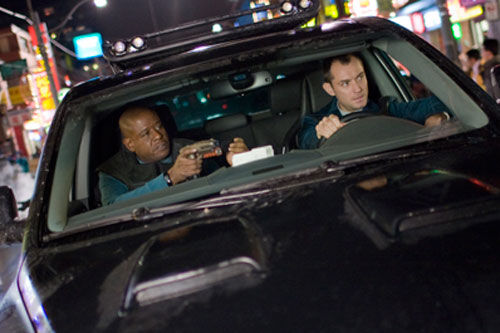
The best repo-man The Union has is Remy Stark (Jude Law, he's terrific in this, for once bringing a strong presence to a starring role), partnered odd-couple style with Jake (Forest Whitaker, clearly having fun), but Remy is getting pressure from home to get out of the repo biz and into sales, which has more regular hours and solves that nasty blood-stain problem with the laundry. The decision is made for him on one job recalling a heart, when his portable defibrillator used to stop the victim's heart back-fires and ends up stopping his.
In one of those ironies that they teach in Screenwriting 101, Remy winds up in the hospital possessed of his own ticking time-bomb in his chest, and, having a literal change-of-heart, suffers sympathetic pains with his victims and can no longer...operate. Complications pile up: his wife, because he's now stuck in the repo job kicks him out, his weakened condition makes work harder even if he can get the gumption to start cutting, and he soon runs out of money and, yes, time.
As if there would be any doubt.
"Repo Men" is "Logan's Run" cross-stitched with "Coma," and the Urban Legend of the guy in the bath-tub of ice, but it's in the telling of the tale that the movie sails through the material like a hot knife through butter. Sarcastic, caustic and beating to an eclectically quirky soundtrack (everything from Rosemary Clooney with Perez Prado to Mama Cass), the movie is rude, ironic and fiendishly funny, almost gleefully detailing the trap that Stark puts himself into, and not conceding to the squeamish in the cracking of chests, the popping of knees and the squirting of arteries (there's a protracted operation that plays almost like a love scene late in the film that had people fidgeting and crossing their legs throughout the theater). The action scenes become a bit unbelievable as the movie goes on, and steadily more blood-thirsty. Plus a third-act change of tone—the humor drops about 40% 'round about the time the fights start—hampers some of the nasty enjoyment of the thing. But Sapochnik (who started out in the art department) makes the movie go a long way on a limited budget, and his odd future hybrid—there are blimps, light-rail and overhead lines in the same shot—keeps things down to Earth. Whitaker and Law are helped by a wonderful dead-pan performance by Liev Schreiber, and Alice Braga's third sci-fi damsel role in as many years (after "I Am Legend" and "Blindness").
Definitely not for the squeamish, but "Repo Men" is a promising feature debut for the director. The only reason it doesn't get a (coveted) "Full-Price Ticket" is because of the derivative climax. It'd be nice if a science fiction movie ended with something other than a fight every once in a great while.
"Repo Men" is a Matinee.





Wednesday, February 25, 2009
The Crying Game
 "The Crying Game" (Neil Jordan, 1992) I contend this "character" study is one of "the" great love stories, as it rather scrupulously deals with "love" and doesn't stray into the sexual category.
Well, it does stray, but not too far from home.
Sure, the story surrounding the film is about "the secret," but that's just a device for setting up a story about the nature of love, and what this "crazy little thing" is, and why it holds such sway against our better judgements, even against our natures, better or otherwise. And it does so in one of the better traps a film-maker has devised for its protagonist, worthy of a Hitchcock or a Kubrick.
When first we meet Fergus (Stephen Rea), he's a flunkie of a foot-soldier in a radical IRA organization. He's not well-respected in the group, so he gets the job of guarding over the British soldier kidnapped for political concessions. Fergus doesn't have the spine, the bite, the drive, the Cause-fueled sociopathic energy of Maguire (Adrian Dunbar) or Jude (Miranda Richardson, as ferocious a femme fatale as has been created for the screen). And he's just not ass-hole enough to be a terrorist.
Three days of holding Jody (Forest Whitaker) in Thatcher's non-negotiating Britain makes Fergus and the soldier form a Stockholm-ish bond. So when it comes time for Fergus to dispose of the evidence—kill Jody—he can't do it. He's spent too much time with him, become too sympathetic. Too empathetic. Fate, however, isn't so discriminating. And Fergus is left with the pact he's made with the fallen soldier.
The vow is to break the news to Jody's true-love, Dil (Jaye Davidson), and as the rest of the group go underground, Fergus fulfills his pledge and, along the way, becomes smitten with the hair-dresser/chanteuse.
The rest of the movie details Fergus's struggle to stay underground and protect Dil from his vengeful mates. It gets complicated. Very complicated.
What's love got to do with it? Everything. Like "Vertigo," "The Crying Game" brings into the open the question of what "love" really is. Fergus, and Vertigo's protagonist both share a name fragment as well as a vision of love that is their own, one that may have nothing to do with reality. But, it's real in some way. It has to do with responsibility and commitment and loyalty and all the things that go along with love and the bond it ties you up in.
At two points in the screenplay, writer-director Neil Jordan uses the fable of the frog and the scorpion and the bond they form to cross a river. Orson Welles used it in his "Confidential Report" (aka "Mr. Arkadin") to explain the unexplainable. For Fergus, it's acknowledgement that he's learned something...if only about himself. "It's my Nature" is the last line of the fable.
Well, that's half-right. But, there are no absolutes. As with the old debate, one has to acknowledge that "Nurture" plays a hand as well.





"She's...She's On!" Dil (Jaye Davidson) performs—
a sequence seamlessly designed and directed by Neil Jordan,
realized only after you've seen it a second time.
Sunday, February 3, 2008
The Last King of Scotland
 for "The Queen," and the two leading actors of his screenplays won both Best Performance Awards: Helen Mirren for "The Queen," and Forrest Whitaker for this film. They both had great material to work with. Morgan's talents for breathing life and personality into history (catch his HBO film, "Longford," while you're at it) puts to shame the recent spate of "highlights-biographies" ("Ali," "Nixon," "Man on the Moon," "Chaplin," "Ray") that are like filmed Cliff Notes. And Whittaker is amazing in the film ("How'd they get him?" K. asked when he was first on screen. No, it's Forrest Whittaker), projecting the half-baked soul of Idi Amin Dada. It's a Supporting-sized role, but so large does Whittaker's portrayal loom over the movie that he dwarfs everyone else, even James McAvoy's starring performance as cocky Scotts physician Nicholas Garrigan, who goes looking for some selfish adventures and winds up being The Devil's Internist in Uganda. And what starts as lucky breaks for a kid out of medical school turns into a nightmare of bad choices as the wildly paranoid Amin sinks deeper into madness, torturing first his enemies, and then those in his circle of confidence. In a country run by a lunatic, its a short trip from adviser to being strung up from a meat-hook (lest you think, "Last King..." is as genteel as "The Queen," think again, the violence is bloody, and the torture is dwelled upon).
 The director is Kevin Macdonald, a former documentarian, and he seems to have a problem with pace. "Last King" feels drawn out, and in need of additional editing (as did his previous film, the interminable "Touching the Void," which managed to make an incredible story something of a drag). But the sense of place and time feels genuine--you might not believe afterwards that the story is actually fictitious.