 "The Rules of Dis-Engagement"
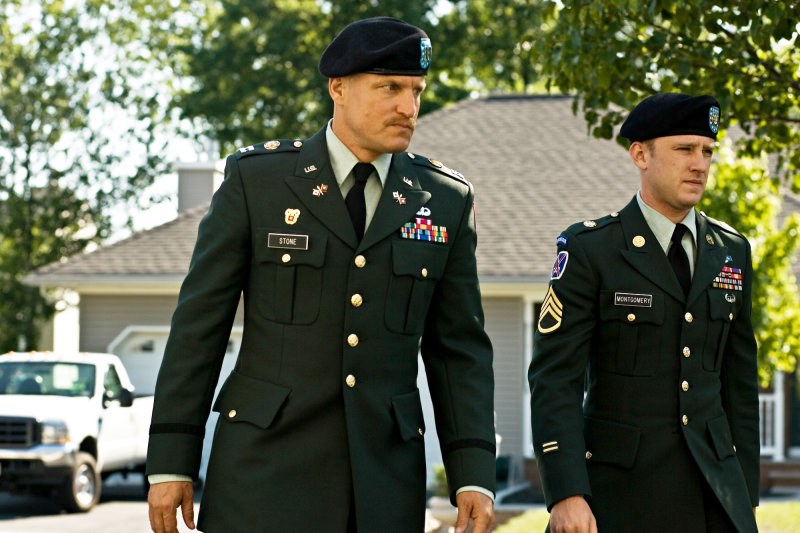
Staff Sergeant Will Montgomery (Ben Foster) has just rotated stateside from Iraq with shrapnel fragments from an IED explosion that have pierced his leg and screwed up his left eye. He comes home to find his girl-friend (Jena Malone) engaged to another man and very few options open, or as he puts it "the world is my f...ing oyster." He is then assigned to the "Casualty Notification Team" for New Jersey under the command of Captain Tony Stone (Woody Harrelson), as he is considered "a soldier of stature," and the job is a "zero defect mission."
"This mission is not just important," he is informed. "It is sacred."
No pressure.
He becomes part of the "Angels of Death" detail—informing the officially designated N.O.K.'s (Next of Kin) that their son, daughter, father, mother, sister or brother has been killed in Iraq, and there are specific rules: no contact, don't park close to the designated house, don't ask for directions ("besides, you're a man and men don't do that" says Stone), inform only the official N.O.K., knock on the door, rather than ring a cheery door-bell, "read the script, stick to the script," if the N.O.K. is not present—leave the premises, do not refer to the dead relative as "the deceased," inform the N.O.K. of the next steps in the process, say specifically that the relative has been identified and the circumstances of their death, do not leave room for hope. Most importantly, get out.
Like being a cop, it's one of those jobs where you mostly see people at their worst and the strain it imposes on the harbingers of death is considerable. Take Stone, for example. Married three times ("twice to the same woman"), alcoholic and wound pretty tight, Stone is a blustery veteran of the first "brief" Iraq War, and he keeps Montgomery on a very tight leash through his first details (including Steve Buscemi and Samantha Morton) with the inevitable clashes and SNAFU's. Pretty soon, they're depending on each other and Montgomery starts to go off-script.
"The Messenger" is one of those little miracles of a movie, with a good script (by director Oren Moverman and Allesandro Camon) that says a lot about the human condition and the pressures on the military in times of war and peace. the subject matter is depressing, but the movie has moments of gallows humor that emerge in times of grief, and the actors make the most of all the situations, prompting genuine laughs out of a tough situation. As the two park away from a house, they find themselves across the street from a park full of anxious mothers and children, all staring with a combination of expectancy and dread.
"Wall, it could be worse," drawls Stone. "It could be Christmas."
It's tempting to say that this is a good year for Woody Harrelson, but it usually is, as he makes the most of his assignments. He was one of the few joys in the nihilistic theme park attraction that was "2012," and his witty work in "Zombieland" was a star-making turn, one that sets a character into archetype. His work in "The Messenger" has won him a deserved Best Supporting Actor nomination, and were it not for Christoph Waltz's definitive work in "Inglourious Basterds" (or Christopher Plummer's one-two punch of being the oldest nominee as well as it being inexplicably his first nomination after a distinguished career), one would be tempted to say he deserves to win. He's matched by Foster, who can be the most iritatingly showy performer—as he was in "3:10 to Yuma"—but here does contained, simmering work that occassionally explodes into self-destruction. Moverman worked with Todd Haynes on the smart, witty script for the Bob Dylan homage "I'm Not There," and now I want to see "Married Life" (his last script) to see just how consistent his work is. His mature, unshowy direction and his ability to mine (and make the most of) entertaining possibilities out of promising material, makes him a name to remember...and seek out.
Wednesday, February 24, 2010
The Messenger (2009)





Thursday, December 4, 2008
Synecdoche New York
 "And the Truth Is..."
All the world's a stage,
And all the men and women merely players:
They have their exits and their entrances;
And one man in his time plays many parts,
His acts being seven ages. At first the infant,
Mewling and puking in the nurse's arms.
And then the whining school-boy, with his satchel
And shining morning face, creeping like snail
Unwillingly to school. And then the lover,
Sighing like furnace, with a woeful ballad
Made to his mistress' eyebrow. Then a soldier,
Full of strange oaths and bearded like the pard,
Jealous in honour, sudden and quick in quarrel,
Seeking the bubble reputation
Even in the cannon's mouth. And then the justice,
In fair round belly with good capon lined,
With eyes severe and beard of formal cut,
Full of wise saws and modern instances;
And so he plays his part. The sixth age shifts
Into the lean and slipper'd pantaloon,
With spectacles on nose and pouch on side,
His youthful hose, well saved, a world too wide
For his shrunk shank; and his big manly voice,
Turning again toward childish treble, pipes
And whistles in his sound. Last scene of all,
That ends this strange eventful history,
Is second childishness and mere oblivion,
Sans teeth, sans eyes, sans taste, sans everything.
William Shakespeare "As You Like It" 2/7
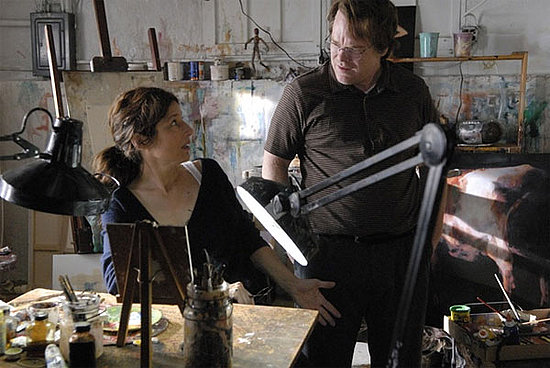
Director Caden Cotard (Philip Seymour Hoffman) wakes up every morning with a fresh pain to fuss about in the morning and a malady that he saves for the afternoon. He's a mess. So's his life, and the only time he feels comfortable is telling actors how to play their parts. But he frets about everything else. "I have 650 lighting changes! Why does it have to be so complicated?" "Because you make it complicated," says his wife Adele Lack (Catherine Keener), whose own art is to make paintings so small you need magnifying specs to look at them in the gallery. She's reductive. He likes to blow things out of proportion, which sometimes manifests itself, physically, as sycosis. "It's spelled differently," he tells his daughter Olive. "P-s-y 'psychosis' is when you're crazy, like Mommy is sometimes."
Welcome back to the World of Charlie Kaufman (and yes, after all the success you can still call him "Charlie"). Kaufman's screenplays are expanded "Twilight Zone" episodes where reality is warped and woofed through the gray matter of Kaufman's mind and some basic axiom of the human condition comes shining through like sunlight through cheese-cloth. "Synecdoche New York" is the same sort of Möbius-loop swirl like Kaufman's scripts for "Being John Malkovich," "Eternal Sunshine of the Spotless Mind," "Confessions of a Dangerous Mind," and "Adaptation.."* And as with those scripts, you not only get the story as it stands, but also a look into the soul of Kaufman, as well. "Malkovich" was the story of an street-artist who dreamed of being more than a puppeteer and ended up becoming a director of another man's life--a grander-scale puppet-master. "Eternal Sunshine" explored relationships and the hopeless act of putting one behind you. "Adaptation." was a look at obsession, disguised as Kaufman's own frustrations at trying to write a screenplay for an un-adaptable book. "Synecdoche New York" is another step altogether: Kaufman makes his directorial debut in this film about a director who can direct anything but his own life.
"And the Truth Is..."
"...well, like most directors, I suppose, what I really want to do is act."



Mel Gibson's Oscar speech, 1996
As life sometimes happens, when one part of your life is going great, another slides. Adele has taken Olive to Berlin for a showing of her work, and the weeks stretch into months, and Cadon can't hold his fragile state enough to have an affair with Hazel (Samantha Morton) the ticket-agent at his theater. The he gets a MacArthur grant. How's he going to spend his "genius" money? He rents a warehouse--like a monolithic Quonset hut in the middle of Schenectady, and begins a series of work-in-progress workshops, where the play will begin to take shape. But pretty soon, the play cannot be contained, and Cotard begins to wander through an increasing maze of scenarios intertwined with a phalanx of actors seeking direction and a cityscape forming inside the warehouse. He begins to lose track of his life and the play's purpose until he hires Sammy (the terrific Tom Noonan) to play himself. Sammy claims to have followed Cotard for years and says he knows the director better than he knows himself. At the time, that didn't seem like quite a stretch. For awhile the two are inseparable.
And then things start to get a little bit weird.
syn•ec•do•che (sĭ-něk'də-kē) Pronunciation Key n. A figure of speech in which a part is used for the whole (as hand for sailor), the whole for a part (as the law for police officer), the specific for the general (as cutthroat for assassin), the general for the specific (as thief for pickpocket), or the material for the thing made from it (as steel for sword).
To explain any more of the plot is to do two things: 1) Give away what's going on, and 2) explain what's going on; I can do the first, but not the second, which 1) is anathema to film criticism and 2) required of film criticism. The stew of "Synechdoche New York" is so rich that one can only pick a flavor or two, a passing impression, the overall emphasis, but I can't tell you what it tastes like, other than to say "I enjoyed it immensely, and I'd order this item on the menu again." I can understand why it would completely overwhelm a casual tasting or appear too rich to stomach, and I can certainly see the polarizing effect it has on those whose tastes don't run to such things.
But taste is an individual thing, and the structure of "Synecdoche New York," which, in itself, is its own false-front, is a deliberate shout-out that "Nothing is real," so if you're looking for explanations of some basic matters, it's just not going to happen, because the connective tissue that would provide the answers not only isn't there, it's considered irrelevant to the task at hand, and manipulated to actually confront, confuse, and consternate. And make a joke of it.
Which I find hilarious.
For instance, I love that Kaufman cast two actresses—Samantha Morton and Emily Watson—who I find, frankly, a bit indistinguishable, and cast them as an important woman in Cadon's life and the woman who's playing her in the play. That the two actually do become indistinguishable is a wonderful joke that I, alone, might get, but I still enjoy it. That the background score for a poignant telephone conversation seems to travel over the telephone line, as well (with the same tinny sound), is a great joke, but might frustrate someone else looking for logic or reason. That Adele coughs in a voice-over might make someone throw up their hands and question why someone would consider doing that only makes me giggle. That Hazel, when taking a tour with a real estate agent, makes a comment that she's really nervous about buying a house, but really wants to take the plunge, so much so that she'll ignore that the house is on fire, and, oh by the way, the agent's son is living in the basement, only reminds me of the compromises I've made and the flaws I've overlooked in similar decision-making processes. It also says something about the character...yes (*sigh*) in a lunatic way...but I found it funny.
"And the Truth Is..."
"I thought I was President of the United States. Then when my daughter was born, I realized I was just the Secret Service."
Seattle actor Ken Boynton, explaining Fatherhood
What's interesting to me is that I have my own ceiling of "guff" in movies: I'll "take" Kaufman because the spirit in which he creates is playful, the ideas he expresses I find, if not profound, worthy of consideration (such as the over-uttered point of "SNY") and the work, and the path taken to get there, entertain me; I appreciate the journey, even if the destination disappoints.
Yet, as a recent post on David Lynch's "Inland Empire" made abundantly unclear (my fault: I'm sorry, I was being illustrative of my frustration with the piece and its artist) there's only so much obfuscation I can take. There is a difference between an artist being deliberately "difficult" to understand, and an artist with a point to make. If you want to confound, go into the puzzle-making business. If you want to communicate—and that means taking the chance that your message may be received and judged—make sure that you're communicating. "Inland Empire" had no "Rosetta Stone," not even the orientation of humor, to guide the viewer, so whatever "TRUTH" Lynch was aiming for got lost in the scene-shuffle.** One can argue about the cruel economics of the film business, but every so often an indulgent artist has to give his Muse a bracing cuppa joe, black, (and amusingly, Lynch, of all artists, should know this!) and show it where the audience is sitting.***
Which brings up the philosophical question: If a theater-troupe makes a play in an empty theater, does it make a sound
And the answer is: "Who cares?"
"And the Truth Is..."
I know now that there is no one thing that is true - it is all true.
Ernest Hemingway, "For Whom the Bell Tolls"
"Synecdoche New York" is a full-price ticket.
* Although nobody ever brings up his writing for "Ned and Stacey" and "The Dana Carvey Show"
** I don't make a habit of beating up on Lynch. I love 80% of his out-put, especially "The Elephant Man," "Blue Velvet," "Mulholland Falls," and "The Straight Story." "Wild At Heart" and "Twin Peaks: Fire Walk With Me," pffft!
*** At the Guild 45th late show, a late-comer sat across the aisle from me, and throughout the movie we separately giggled and hooted throughout the film, laughing at the same parts. Only when the credits came up did we glance at each other and, in a perfectly synched move, raised our drink-cups in salute to the screen.
Friday, March 21, 2008
Elizabeth - The Golden Age

In Elizabeth - The Golden Age (I guess they realized they couldn't call it Elizabeth II), there was plenty of scope to explore this tension. Elizabeth is monarch of a divided country. She is the Virgin Queen, admired, we are told in the history books for her devotion to her country but under pressure too to marry, not just to produce an heir but also to make an alliance that will help protect England from its adversaries. This is the time of the Spanish Armada, a time when England was under threat from the most powerful country in Europe, when England was isolated and under the threat of invasion. Much like it would be 250 years later and again 400 years later. A time of conflict between two versions of the same religious faith with one determined to destroy the apostates because they have God on their side. Within the country, there are many who would support her overthrow. Well, you get the picture - there are plenty of themes here that would resonate with a modern audience.
But this Elizabeth is Good Queen Bess - Bette-Davis style. Though we see a little of her crisis of conscience over the death sentence for Mary Stuart, we see far more swash-buckling CGI as the filmmaker rewrites history for the convenience of the movie pitching Sir Walter Raleigh into the heat of the battle like an earlier Captain Jack Sparrow even though he actually spent the entire time firmly on dry land. Such distortions are to be expected and don't really interfere with the purpose of such a movie (this is not a History Channel documentary after all) but they are also symptomatic of why this movie was so disappointing.
It is as glossy and vibrant as its predecessor though it is a little disconcerting to see how clean this Elizabethan Age was. It was almost bearable to have the characters speak a strange mixture of modern English with a few archaisms thrown in for effect but in the end the movie was too over-blown and empty.
Where there could have been interesting contrasts between her public face and her private needs, between her sense of duty and her need for control, the movie sets up situation after situation and then shies away from them, preferring instead to go to the next great wide shot. Clive Owen starts out playing the foil to Elizabeth - theirs is not only a sexual but also an intellectual game they are playing with each other and he is willing to take great risks not just to advance his plans to open up the New World but also to entertain the thought of a relationship with her. Yet, the movie just meanders. It is not just that he becomes dull as she tells him, it is the movie. He dutifully straps on his high leather boots, dons his pirate shirt and does his best Erroll Flynn impersonation. Thank goodness, Samantha Morton is there to play Mary Stuart. Geoffrey Rush seems completely wasted as Walsingham and by the end, Cate looks like she can't wait to get back to playing real people like Jude Quinn.