The Spy Who Came In From the Cold (Martin Ritt, 1965) With the antcipation of the Christmas release of a film version of Tinker Tailor Soldier Spy, it would do well to revisit the world of George Smiley, "Control," and the duplicity of John le Carré's "kitchen-sink" version of spies. They're background characters in The Spy..., the focus being operative Alec Leamas (Richard Burton) former head of the West Berlin branch of "The Circus," who must go behind enemy lines—one of the toughest of them, the Berlin Wall—as a potential "mole"* to ferret out who might be a double agent for the Soviets, responsible for the death of one of Leamas' agents.
His identity is kept the same—The Circus wants Leamas and his background history out in the open—but he is demoted in rank and stature, and, depressed and drinking heavily, he becomes bait for Soviet recruitment to betray information. That's the mission, become a decoy on the "inside," another "double" feeding the Soviets false information, while trying to find out if there's a player on the other side in The Circus feeding information to the Russians.**
Oh, what a tangled web the Cold War weaves.
Taken to East Berlin, Leamas is interrogated by a suspicious Russian administrator named Fiedler (Oskar Werner) who (rightly) suspects Leamas of being a "plant." Fiedler suspects a British "mole" already underground in the Soviet service and so sweats Leamas for any information to discover who that might be. Ultimately, Leamas is undone by what so many of LeCarre's heroes or anti-heroes are susceptible to, the warmth of human contact—a failing that trips up a lot of the author's protagonists. Leamas "comes out of the cold," the world of spies, and his friends, relations or lovers—the thread of decency and honesty they provide—are used against him.
For the fact of the matter is the Spymasters of "The Circus" are cold-hearted bastards ("without sympathy" as "Control," played by Cyril Cusack, ponders)—they have to be to combat their enemies—and they're just as capable of betraying their own as those they fight.
Case in point: George Smiley (played here by Rupert Davies). He would become le Carré's most celebrated character, but here he's a bit of a functionary, and he's just as cold-hearted as the rest. In the "Tinker, Tailor..." timeline, "Control" was long since dead, having been driven out by "the new broom" from his station, which had left him suspicious and paranoid (ultimately with good reason) with Smiley his only trusted colleague. When the BBC made a television mini-series of the book, Smiley was famously played by Sir Alec Guinness and (as le Carré amusingly notes in his new forward to "Tinker, Tailor...," because of that he "lost control" of the character. But Smiley (however sympathetically Guinness played him) is also a "cold-hearted bastard"—if he wasn't, he wouldn't have lost the vital clue that was exploited by his enemies. He gives as bad as he gets, and, even at his most triumphant, takes little joy in what he does.
In such a world, Ritt's direction is entirely appropriate—low-key, almost documentary in feel on the streets of London—in drab black-and-white, not the high-contrast color of other spy films of the era. There is nothing glamorous about it, and plays out slowly and subtley—in fact, after a de-briefing by his boss, the shift in tone is so dreary one suspects one is watching a different film. It is part and parcel of the subterfuge—it works on us as it does for Leamas' Sov' recruiters (most prominently Michael Hordern).
And the script, now there's an interesting tale. A beginning draft was written by Hollywood veteran Guy Trosper, who died subsequently. Taking over was poet-playwright Paul Dehn. Dehn had written the final polish on the James Bond spy film Goldfinger (amusingly, as the two film could not be more polar opposite), and was the mainstay-writer for the "Planet of the Apes" sequels. But, Dehn knew the world of spies well—during the second World War, Major Paul Dehn was the "Political Warfare" officer at the BSC training headquarters "Camp X" (where among the trainees were Roald Dahl and Bond creator Ian Fleming).*** Dehn was well-versed in spycraft, deceit, and keeping secrets and his distillation of le Carré's novel brings the moral duplicity to the fore, while keeping the audience guessing on whose side is whom.
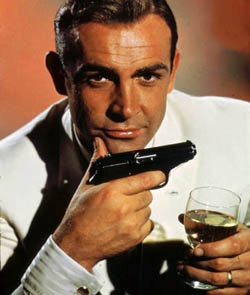
If the film has one flaw, it is the casting of Burton as Leamas. Burton was too good, too charismatic an actor/star to play a functionary like Leamas (it's about the same as "buying" Sean Connery as a spy (which was part of the joke of the Bond series)—he's someone you'd notice walking into a room, and thus, hardly spy material. But, Burton's presence, no doubt, got the film made, so the point is a bit moot. Still, if its ideas and mysteries of the State and the heart you want more than action and fireballs (shall we say if you want to be "stirred and not shaken?"), The Spy Who Came in From the Cold is a fine, bracing tonic.
 |
| Davies as George Smiley in The Spy... |
 |
| ...and Guinness in the BBC-TV Tinker, Tailor... |
 |
| Gary Oldman: "this year's" Smiley |
* The term "mole" is a le Carré invention—his spy-circles code-name for a double agent hiding in plain sight within one of the other spy agencies, Soviet or british, and relaying information to "the other side."
** There has been a rich history of double agents throughout the annals of spydom, the most significant of which were "The Cambridge Five"—Kim Philby, Donald Duart Maclean, Guy Burgess, Anthony Blunt, and a fifth (and possibly more)—who'd been recruited during their college years, passed information to the Russians during WWII, and subsequently during the post-War years through the early 1950's. "Tinker, Tailor, Soldier, Spy" (and the other two of the le Carré "Karla" novels) and le Carré's subsequent "A Perfect Spy" are inspired by "The Five" and their Russian puppet-master.
*** And, interestingly, one of the people who asked, and was briefly considered, to run Camp X...was Kim Philby!