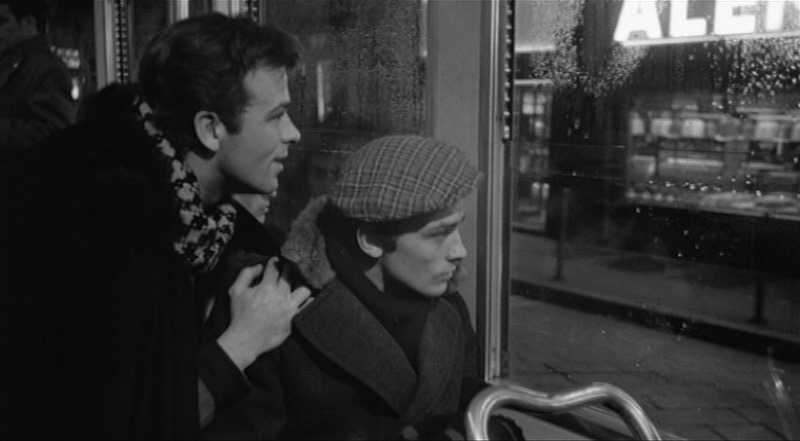
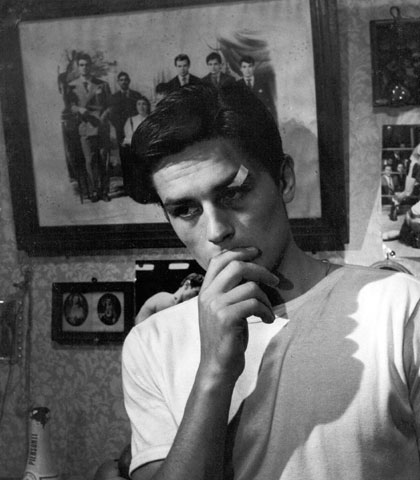
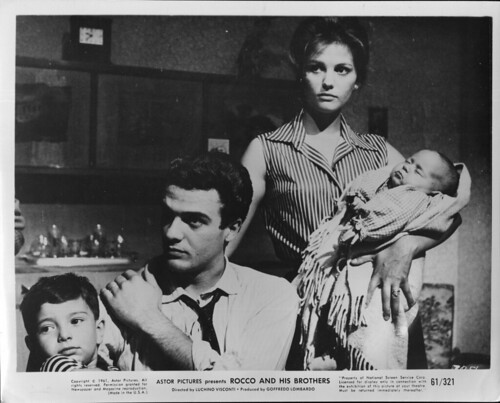
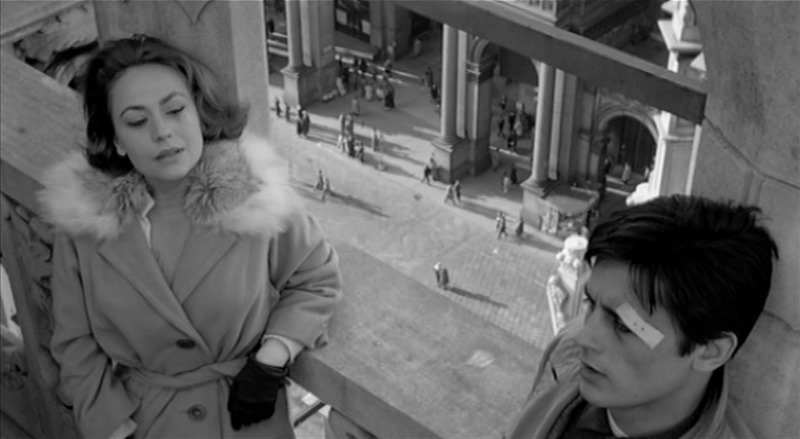
 "Rocco and His Brothers" aka "Rocco e i suo fratelli" (Luchino Visconti, 1960) The Parondi family moves up to Northern Italy from the country and they find simultaneous success and tragedy in the city. It's the immigrant's story: they move to make a better life and the choices they make are wholly determined by their conditions. The widow Parondi (Katina Paxinou) moves her brood to Milano, where eldest son Vincenzo (Spiros Focás) is guest of honor at an engagement party for his intended, Ginetta (Claudia Cardinale). The family swoops in and North/South prejudices erupt and break up the party. The worst news for Vincenzo is, as eldest, he has to provide for them and arranges a short term rental that he plans to break the lease on, so they can be kicked out and depend on government housing. From there, the brothers must find work and make a life for themselves.
But it's tough to be a saint in the city. The film is divided into chapters for each brother, starting with Vincenzo, then the mercurial Simone (Renato Salvatori), good-hearted Rocco (Alain Delon), practical Ciro (Max Cartier) and the innocent Luca (Rocco Vidolazzi) who looks up to them all. Simone and Rocco take the fast money way out, going into the traditional immigrant sport—boxing—and its underworld of shady characters, Ciro gets an auto-workers job, while Vince ignores his mother's objections, marries Ginetta and moves out. Each brother, in turn, finds their escape from family, even Rocco whose mission seems to be to keep the family intact. The brothers are wholly unprepared for the city and their separate ways of dealing leads to internal conflict and strife, with the women in their lives often being the ones chewed up in their machinations.
It's not just the 3-hour length and terrific Nino Rota score that suggest it, but you look at Visconti's direction of "Rocco and His Brothers" and you see the playbook Francis Ford Coppola used for "The Godfather:" the half-lit sets, the faces emerging from darkness, the "communal" shots where a lot happens in long takes of activity, the simultaneous staging of triumph and tragedy, and the bursts of violence communicated with a minute pre-echo of dread. That "Rocco" matches so many of "The Godfather's" themes—the passing of old traditions in modern times, the splintering of the family, the immigrant's plight, and the futility of good intentions—one can see how film-buff Coppola was inspired to make a silk purse out of Mario Puzo's best-selling sow's ear.
Wednesday, August 26, 2009
Rocco and His Brothers








Saturday, August 22, 2009
Olde Review: Purple Noon
This was part of a series of reviews of the ASUW Film series back in the '70's. Except for some punctuation, I haven't changed anything from the way it was presented, giving the snarky, clueless kid I was back then a break. Any stray thoughts and updates I've included with the inevitable asterisked post-scripts.
This Saturday's films in 130 Kane at 7:30 pm are thrillers: one sophisticated; the other unsophisticated, but God, it's neat, and they are Rene Clément's "Purple Noon" and Brian DePalma's "Sisters" "Purple Noon" or "Plein Soleil" (René Clément, 1960)Clément's "Purple Noon" was shown on TV Thursday night under a different title—"Lust for Evil"—and in a dubbed English version. Even if you saw it on Channel 9,* you should go see it Saturday night because, let's face it, movies always lose something on the television screen,** especially if they're dubbed in a sort of ill-fitting English as the televised version was.
"Purple Noon" is the story of two somewhat irresponsible young men. They tour the streets at night looking for trouble, rousting whoever they can. And in the course of the plot, one of them is murdered by the other. But how can Alain Delon, who plays the murderer, get away with it? Well, it happened out at sea, they were alone on the victim's boat (the victim's fiancé in a fit of pique had gone ashore), there were no witnesses.
But won't people, especially those close to the victim notice his disappearance? Delon has a plan for that: he is an excellent forger, he has the victim's belongings, his passport, and he can imitate his voice. And the fascination in this story is in the second portion. Will Delon be detected by those who knew the victim—especially the fiancé? Will he get out of all the close calls? How will he avoid it? It's a run through a maze and it culminates without a nice surprise ending.
And Clément's direction can sometimes come up with pleasant little touches that leave the viewer just a little bit amazed, as in the murder on the boat (that is over so quickly) only to be replaced by the problem of getting rid of the body, a task that is made more difficult by a sudden storm at sea that seems to rise up in moral vindictiveness over Delon's act. It's a nice touch, and "Purple Noon" is a nice, somewhat sedate little thriller.
Broadcast February 12, 1977
I didn't know from Patricia Highsmith in college. I discovered her quite later. Her delightfully dark amoral little tales filled a musty little hole in my heart for years. I did not know Highsmith when I saw "Purple Noon" in college, nor could I know that what I was seeing was the original, slimmed down and altogether superior French version of "The Talented Mr. Ripley."
It's bad form to speak ill of the dead (although Ripley would do it with his usual lack of conscience), but Anthony Minghella's 1999 version of the tale starring Matt Damon, Jude Law and Gwyneth Paltrow was too puffed up and proud of itself to make an effective thriller. It felt staged and lethargic (and that is the last thing a Ripley movie should be), whereas Clément is a witty, nimble director who will never let any cruel irony go unexploited.
Highsmith wrote five "Ripley's"—called "The Ripliad," only three of them have been made into films, two of them twice—and five men have played Ripley, besides Delon. Dennis Hopper played him in Wim Wenders' "The American Friend" (adapted from "Ripley's Game"), Matt Damon in the Minghella film, John Malkovich in the second "Ripley's Game" adaptation, and Barry Pepper in "Ripley Under Ground." Highsmith died in 1995 of leukemia (not foul play).
* Channel 9 was, and is, Seattle's main PBS affiliate—public television—and at the time of writing plays movies on Friday nights. The fare is some package of American movies that might have fallen off the populist radar—for every "Lone Star" there's a "Fiddler on the Roof"—that are old enough that they're not on standard rotation on the so-called "movie channels." I suspect they wouldn't be caught dead playing a foreign film—unless it involved cooking.
** Bear in mind this was the 70's—pre-HD, pre-plasma-screens, pre-home theater—when the ol' cathode-ray tubes didn't do justice to the pan-and-scanned images that were culled from the wide-screen prints—which was because they were 36" in diagonal.
Thursday, November 27, 2008
The Leopard
"The Leopard" aka "Il Gattopardo" (Luchino Visconti, 1963) I've seen "The Leopard" only once. Its beauties compel further viewings with which more of the complexities of the work will become apparent. One can't wait to get started. * Sydney Pollack supervised the dubbed version, and even he acknowledged it hurt the movie. One of the odd things about it is Lancaster's performance: He's actually better dubbed in Italian with a different, gruffer voice, rather than the soft, smokey baritone of his own voice. In fact, the combination of Lancaster's screen-work and substituted voice combine to make the greatest performance he never gave!
Epic.
Extraordinarily epic.
Exquisite three hour film (that is, if you watch the original Italian, rather than the edited, dubbed American version*) of the change-over from one generation of Italian artistocracy to one with fewer ties to the past, amidst a changing landscape that will ultimately change fortunes. Don Salina (Burt Lancaster) is a prince of the old lineage observing the change that will ultimately overthrow the government and his rights to power, even as he sees the old ways and traditions begin to erode in the rise of his nephew Tancredi Falconeri (Alain Delon) who chooses to marry below his station to the manipulative Angelica (Claudia Cardinale). In one of the many allusions to the animal kingdom, Don Salina fears that his generation of leopards is being handed over to jackals.
In its timeline and its scope, it could be labeled the Italian "Gone With the Wind." Certainly the care and attention to detail that director Visconti, Director of Photography Giuseppe Rotunno, and Production Designer Mario Garbuglia brought to bare can be compared to the extravagance of the American epic. But it's a smarter, richer film—a far better film—with layered subtleties that GWTW never aspired to.
Visconti had a special affinity for the material. Like the author of the original novel, Giuseppe Tomasi di Lampedusa, the director was born to the aristocracy. He knew its joys and pleasures and tastes, and he follows Lampedusa's celebration of that life in its recognition. But Visconti became a Marxist, so he looks at the excesses and hypocrises with less sentiment than Lampedusa does. But, he also acknowledges that change ultimately doesn't change much where fortunes are involved.
Contained here are some of the beautiful images that Visconti, Rotunno, and Garbuglia composed, rich in color and detail like fine paintings. But they're in motion and filled with life and portent and commentary.


Films like "The Leopard" are why one falls in love with the medium in the first place.


