This was part of a series of reviews of the ASUW Film series back in the '70's. Except for some punctuation, I haven't changed anything from the way it was presented, giving the snarky, clueless kid I was back then a break. Any stray thoughts and updates I've included with the inevitable asterisked post-scripts.
This Saturday's films in 130 Kane at 7:30 pm are thrillers: one sophisticated; the other unsophisticated, but God, it's neat, and they are Rene Clément's "Purple Noon" and Brian DePalma's "Sisters" "Purple Noon" or "Plein Soleil" (René Clément, 1960)Clément's "Purple Noon" was shown on TV Thursday night under a different title—"Lust for Evil"—and in a dubbed English version. Even if you saw it on Channel 9,* you should go see it Saturday night because, let's face it, movies always lose something on the television screen,** especially if they're dubbed in a sort of ill-fitting English as the televised version was.
"Purple Noon" is the story of two somewhat irresponsible young men. They tour the streets at night looking for trouble, rousting whoever they can. And in the course of the plot, one of them is murdered by the other. But how can Alain Delon, who plays the murderer, get away with it? Well, it happened out at sea, they were alone on the victim's boat (the victim's fiancé in a fit of pique had gone ashore), there were no witnesses.
But won't people, especially those close to the victim notice his disappearance? Delon has a plan for that: he is an excellent forger, he has the victim's belongings, his passport, and he can imitate his voice. And the fascination in this story is in the second portion. Will Delon be detected by those who knew the victim—especially the fiancé? Will he get out of all the close calls? How will he avoid it? It's a run through a maze and it culminates without a nice surprise ending.
And Clément's direction can sometimes come up with pleasant little touches that leave the viewer just a little bit amazed, as in the murder on the boat (that is over so quickly) only to be replaced by the problem of getting rid of the body, a task that is made more difficult by a sudden storm at sea that seems to rise up in moral vindictiveness over Delon's act. It's a nice touch, and "Purple Noon" is a nice, somewhat sedate little thriller.
Broadcast February 12, 1977
I didn't know from Patricia Highsmith in college. I discovered her quite later. Her delightfully dark amoral little tales filled a musty little hole in my heart for years. I did not know Highsmith when I saw "Purple Noon" in college, nor could I know that what I was seeing was the original, slimmed down and altogether superior French version of "The Talented Mr. Ripley."
It's bad form to speak ill of the dead (although Ripley would do it with his usual lack of conscience), but Anthony Minghella's 1999 version of the tale starring Matt Damon, Jude Law and Gwyneth Paltrow was too puffed up and proud of itself to make an effective thriller. It felt staged and lethargic (and that is the last thing a Ripley movie should be), whereas Clément is a witty, nimble director who will never let any cruel irony go unexploited.
Highsmith wrote five "Ripley's"—called "The Ripliad," only three of them have been made into films, two of them twice—and five men have played Ripley, besides Delon. Dennis Hopper played him in Wim Wenders' "The American Friend" (adapted from "Ripley's Game"), Matt Damon in the Minghella film, John Malkovich in the second "Ripley's Game" adaptation, and Barry Pepper in "Ripley Under Ground." Highsmith died in 1995 of leukemia (not foul play).
* Channel 9 was, and is, Seattle's main PBS affiliate—public television—and at the time of writing plays movies on Friday nights. The fare is some package of American movies that might have fallen off the populist radar—for every "Lone Star" there's a "Fiddler on the Roof"—that are old enough that they're not on standard rotation on the so-called "movie channels." I suspect they wouldn't be caught dead playing a foreign film—unless it involved cooking.
** Bear in mind this was the 70's—pre-HD, pre-plasma-screens, pre-home theater—when the ol' cathode-ray tubes didn't do justice to the pan-and-scanned images that were culled from the wide-screen prints—which was because they were 36" in diagonal.
Showing posts with label Rene Clement. Show all posts
Showing posts with label Rene Clement. Show all posts
Saturday, August 22, 2009
Olde Review: Purple Noon

Wednesday, December 10, 2008
Olde Review: Forbidden Games
This Saturday's ASUW films in 130 Kane at 7:30pm are the last of the Fall series, and they are Rene Clement's "Forbidden Games" and Kon Ichikawa's "Fires on the Plains." They look at the effects of war on children and men.
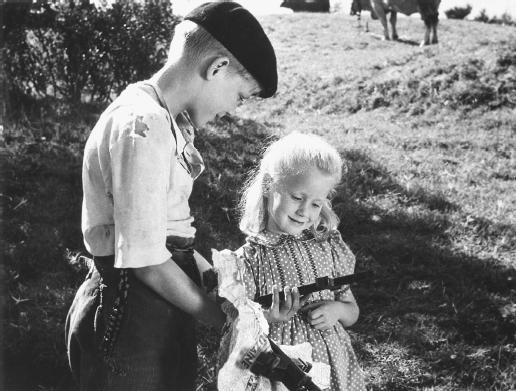
 "Forbidden Games" aka "Jeux Interdits" (René Clément, 1952) is a story of children in the midst of World War II. And for an anti-war film, there is very little war to be seen—at the beginning, a few strafing planes that rip through a line of fleeing Parisiennes, that leaves the young female protagonist an orphan. But the bloodshed is kept to a minimum, for the war is important only in a roundabout way; it's the two children in this story, and the family that surrounds them that are important. "Forbidden Games" is a film that is rich in allegory, but also rich in humor, and rich in a sort of melancholy attitude to the tarnished innocence of the children and the petty arguments of their elders. It's a film that, because of its nature, will lose something of its message, if you don't come across it yourself. So, suffice it to say that you will be left thinking about it, and thanking for it, for quite some time.
Broadcast on KCMU-FM on December 6th and 7th, 1976
Well, that's about as generic a review as one can write...and still have seen the film. That the saddest thing in the film is the kids' shortened childhood, and their melancholy embracing of the responsibilities of adulthood and attitude to death makes it that rare war film that deals exclusively with collateral damage and the effects of the anonymous warfare ripping apart the lives of others. The little girl, Brigitte Fossey, who was five when this was filmed, went on to have a long career in films--you probably saw her in "Cinema Paradiso."
 "Forbidden Games" aka "Jeux Interdits" (René Clément, 1952) is a story of children in the midst of World War II. And for an anti-war film, there is very little war to be seen—at the beginning, a few strafing planes that rip through a line of fleeing Parisiennes, that leaves the young female protagonist an orphan. But the bloodshed is kept to a minimum, for the war is important only in a roundabout way; it's the two children in this story, and the family that surrounds them that are important. "Forbidden Games" is a film that is rich in allegory, but also rich in humor, and rich in a sort of melancholy attitude to the tarnished innocence of the children and the petty arguments of their elders. It's a film that, because of its nature, will lose something of its message, if you don't come across it yourself. So, suffice it to say that you will be left thinking about it, and thanking for it, for quite some time.



Broadcast on KCMU-FM on December 6th and 7th, 1976
Well, that's about as generic a review as one can write...and still have seen the film. That the saddest thing in the film is the kids' shortened childhood, and their melancholy embracing of the responsibilities of adulthood and attitude to death makes it that rare war film that deals exclusively with collateral damage and the effects of the anonymous warfare ripping apart the lives of others. The little girl, Brigitte Fossey, who was five when this was filmed, went on to have a long career in films--you probably saw her in "Cinema Paradiso."
Subscribe to:
Posts (Atom)