Showing posts with label To Kill a Mockingbird. Show all posts

Sunday, June 21, 2009

Don't Make a Scene: To Kill a Mockingbird

The Story: Robert Mulligan begins this scene outside a bedroom window, and returns us outside when it is done, right before "outside" forces set foot on the Finch stoop and alter the Family dynamic.

Inside and outside are two different worlds in the film version of "To Kill a Mockingbird." Inside is familial and warm. Outside, people are eccentric, and nature seems threatening. In this child's eye view of the world the trees rustle with unseen danger, their moving shadows crossing over the children like threatening wraiths. Everything seems strange and scary, what with nasty neighbors (including the mythically haunted Radley household), mad dogs appearing on the street, and economic and racial tensions in the town transforming the town-folk.

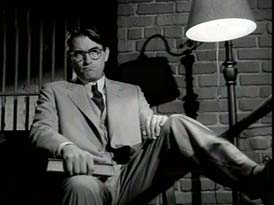
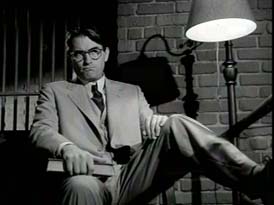
Inside, Atticus Finch is settling his children down for the night, spending quality time with them, one suspects, in a ritualistic way: the reading exercises, the presentation of familiar heirlooms, the taking of stock, and between the children the final sharing of history that mumbles down to sleep. We're in the child's world, looking in as they suspect "Boo" Radley does, moving outside to the father on the porch-swing hearing their talking of their late mother, and left alone with his own memories—the adult providing the warmth inside and the protection from the outside. One sees the toll taken. For that moment, Atticus Finch is not a paragon of virtue, but a mere human being doing the best that he can (although he might not know his son's age today), as he sits listening to his children talk themselves to sleep, an empty arm draped over the swing's back.

Happy Father's Day.*

The Set-Up: "Maycomb was a tired, old town, even in 1932 when I first knew it." It's the end of a day towards the end of Summer, typical in some ways, but not typical in others. Jem and Jean Louise—"Scout"—Finch (Phillip Alford,Mary Badham) have found a new playmate in Charles Baker—"Folks call me 'Dill'"—Harris (John Megna), and the kids have scoped out the scary Radley place down the road, and agitated the elderly Miss Dubose. Now, after a fine meal prepared by Calpurnia (Estelle Evans) (probably with hickory nuts from Mr. Cunningham provided for legal services rendered), the kids settle down for the night, which includes some reading time with lawyer-father Atticus (Gregory Peck). None of them knows that tonight will start a series of events that will change their lives forever.

Action!


Scout(reading): "I had two cats... which I brought ashore... on my first raft. And I had a dog."

Scout: Atticus, do you think Boo Radley ever really comes and looks in my window at night? Jem says he does. This afternoon when we were over by their house...

Atticus: Scout...I told you and Jem to leave those poor people alone. I want you to stay away from their house...and stop tormenting them.

Scout: Yes, sir.

Atticus: That's all the reading for tonight, honey. It's getting late.
Scout: What time is it?
Atticus: 8:30.

Scout: May I see your watch?

Scout: "To Atticus, my beloved husband." Atticus, Jem says this watch is gonna belong to him someday.
Atticus: That's right.

Scout: Why?

Atticus: Well... it's customary... for the boy to have his father's watch.

Scout: What are you gonna give me?

Atticus: I don't know that I have much else of value that belongs to me.

Atticus: But there's a pearl necklace, there's a ring that belonged to your mother. I put them away, and they're to be yours.

Atticus: Good night, Scout.

Scout: Good night.

Atticus: Good night, Jem.
Jem: Good night.

Scout: Jem?
Jem: Yes?

Scout: How old was I when Mama died?
Jem: Two.
Scout: How old were you?
Jem: Six.
Scout: Old as I am now?
Jem: Mm-hmm.

Scout: Was Mama pretty?
Jem: Mm-hmm.

Scout: Was Mama nice?
Jem: Mm-hmm.

Scout: Did you love her?
Jem: Yes.
Scout: Did I love her?
Jem: Mm-hmm.
Scout: Do you miss her?


"To Kill a Mockingbird"

Words by Harper Lee and Horton Foote

Pictures by Russell Harlan and Robert Mulligan

"To Kill a Mockingbird" is available on DVD from Universal Home Video.


While playing Atticus Finch, Gregory Peck bonded with the child-actors playing his children, especially Mary Badham—the youngest actor to be nominated for an Academy Award—and maintained that friendship until the day he died.


* It seems unfair of me to use a scene from the beastly "Psycho" for Mother's Day, and the angelic "To Kill a Mockingbird" for Father's Day but, really, I was considering using a famous "bad" Father's Day scene, if not for the reason I was going to use another scene from the same movie a couple weeks hence. Doesn't "do" to repeat yourself...at least that close together. Next year, a "Good" Mom and a "Dark" Father.

Thursday, May 14, 2009

Anytime Movies Reloaded: To Kill a Mockingbird

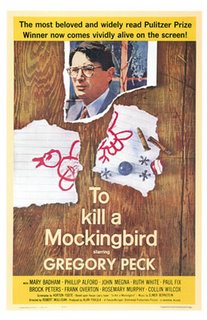
It's Spring-Break for me. Times are busy. The Summer Movie Season is already begun (and I'll be writing about the new ones) and the Film Festivals are grinding away like creaky mills separating wheat from chaff. It's as good a time as any to re-boot a feature I started years ago, when it was suggested I do a "Top Ten" List.

I don't like those: they're rather arbitrary; they pit films against each other, and there's always one or two that should be on the list that aren't because something better shoved it down the trash-bin.

So, I came up with this: "Anytime" Movies.

Anytime Movies are the movies I can watch anytime, anywhere. If I see a second of it, I can identify it. If it shows up on television, my attention is focused on it until the conclusion. Sometimes it’s the direction, sometimes it’s the writing, sometimes it’s the acting, sometimes it’s just the idea behind it, but these are the movies I can watch again and again (and again!) and never tire of them. There are ten (kinda). They're not in any particular order, but the #1 movie IS the #1 movie.

What is it about this film that puts it on so many favorites lists. Horton Foote’s masterful telescoping of Harper Lee’s frail, powerful novel? The fact that, as movie adaptations go, this is certainly one of the best? That it has an impeccably picked cast, directed to feel absolutely real, including three of the best child-performances in all of movies, by one of the best directors of actors, Robert Mulligan? The beautiful, fragile score by Elmer Bernstein, certainly contributes.

I remember seeing “
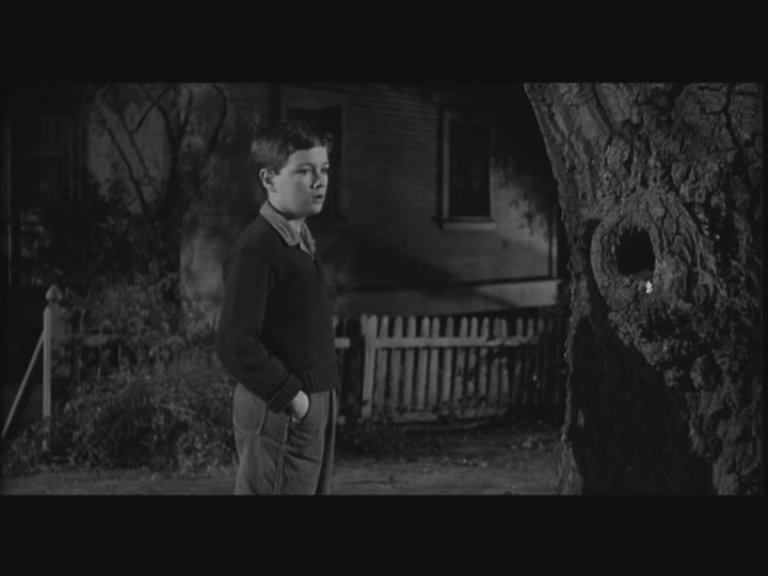
To Kill A Mockingbird” when I was seven years old, and not “getting it” much. I remember being annoyed with my Mom for trying to cover my eyes during the “scary” parts—although Robert Duvall as “Boo” Radley did genuinely creep me out back then (in fact, he still does, a bit). I didn’t “get” the dog-shooting (“He won’t kill a mockingbird, but he’ll sure-as-shootin' kill a dog!”) But I remember that it was a scary movie for a kid. In the film, the night was so dark, and any light cast spooky elongated shadows and trees moved and leaves rustled. The World seemed restless and alive when it should have been still and asleep. It was a world that, under the pretense of peace and calm, seethed with menace and dread just under the surface.

And that’s the key, I think. There seemed to be, in the movie, at least, a sense that the tremulous world was lurching and struggling to change—that the very earth was metamorphosing and demanding it, while the people entwined in that world, moved along, oblivious to the change, holding onto a complacent life that would inevitably end. At the same time, “Mockingbird” has the feel of nostalgia—the palpable sense that life flows through our fingers like sand, and that we’re always in danger of losing that life we hold precious.

But you don’t think of these things when you’re a child. Summers are endless. Life is eternal. If born into a nurturing, protecting household (and that is key) there is the illusion that the world is benign and all things are possible…under heaven.

Heaven is a concept easily grasped by a child. If you’ve been “good” in your life, as a reward after death, you go to a “good” place to spend Eternity. In the years of growth, a child struggles to understand its world and to assert itself in an environment it has no control over. In a world too complex to understand, the concept of Heaven is a comfort to a child. It’s simple. It’s uncomplicated. It’s black and white. Like Good and Bad.

Like integrity.


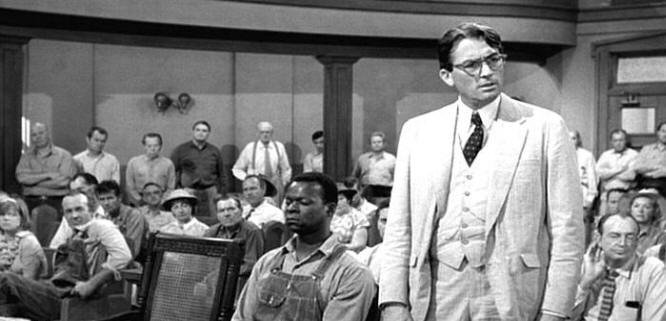
Atticus Finch (Gregory Peck) awaits a lynch-mob, that first to his initial dismay and then wonder is shamed and turned away by his own children. He shouldn't have wondered.

The children in “To Kill a Mockingbird” learn the world isn’t nearly as simple as they thought. That the Radley “kid” may not be the evil thing they whisper about in the dark before they go to sleep. That other peoples’ lives may not resemble their own. That their father is many things—but he is also fallible. Jem breaks down when Tom Robinson is convicted of raping a white woman, but I would doubt that he’s crying for Robinson. He’s crying for his father’s failure—a disappointment as palpable as his father being not willing to play football for the Methodists. Jem and Scout are too young to understand the idea of integrity. No, that's not quite accurate. They’re too young to understand the pressures of a world where integrity might be compromised. And they’re too young to understand that their father’s belief in right and good could actually cause them harm. But it is that integrity that makes their father dependable, despite the tragedies of the summer. It is that integrity in a fragile, changing world that will sustain and endure and remain a constant as sure as the north star in the void. And that echoes long in our minds at the end of the film with its last line of narration: “He would be in Jem’s room all night. An he would be there when Jem waked up in the morning.”

When the
American Film Institute held a vote for the cinema’s best hero, the honor did not go to the Sergent Yorks or the Skywalkers or the Bonds or any of the roles played by Eastwood, Willis or Schwarzenegger. It went to a character of gentle heroics who in the course of the movie only fires one shot, who does not raise a hand in anger, and with jaw set and quiet voice does what he knows to be right. It was a shock that Atticus Finch would be voted the greatest movie hero, but it was the best choice possible, and legitimized the idea of holding such a silly poll in the first place.


Stephen Frankfurt's evocative title sequence.
Music by Elmer Bernstein


Horton Foote died March 4th of this year. Robert Mulligan died right before Christmas last year. Brock Peters died in 2005. Peck, in 2003. My favorite actor in this and many things, Frank Overton, died in 1967. Survivors are William Windom (Prosecutor Gilmer), Robert Duvall (Arthur "Boo" Radley), Rosemary Murphy ("Miss" Maudie Atkinson), and the Finch kids.

And Harper.

Except for her one gentle novel that stood like a golden spike in the Civil Rights Era, Nelle Harper Lee has published no other novels, only a scattering of essays. Not a recluse, she merely avoids the public spotlight. She, in her shy ways, does no public speaking. She has said what she is going to say. And that should be enough.

Harper endures.

To Kill a Mockingbird
Goldfinger
Bonus: The Edge of Darkness

Tomorrow: Where were you?

Monday, January 14, 2008

To Kill a Mockingbird

What is it about this film that puts it on so many favorites lists. Horton Foote’s masterful telescoping of Harper Lee’s frail, powerful novel? The fact that, as movie adaptations go, this is certainly one of the best? That it has an impeccably picked cast, directed to feel absolutely real, including three of the best child-performances in all of movies, by one of the best directors of actors, Robert Mulligan? The beautiful, fragile score by Elmer Bernstein, certainly contributes.

I remember seeing “
To Kill A Mockingbird” when I was seven years old, and not “getting it” much. I remember being annoyed with my Mom for trying to cover my eyes during the “scary” parts—although Robert Duvall as “Boo” Radley did genuinely creep me out back then (in fact, he still does, a bit). I didn’t “get” the dog-shooting (“He won’t kill a mockingbird, but he’ll sure-as-shootin' kill a dog!”) But I remember that it was a scary movie for a kid. In the film, the night was so dark, and any light cast spooky elongated shadows and trees moved and leaves rustled. The World seemed restless and alive when it should have been still and asleep. It was a world that, under the pretense of peace and calm, seethed with menace and dread just under the surface.

And that’s the key, I think. There seemed to be, in the movie, at least, a sense that the tremulous world was lurching and struggling to change—that the very earth was metamorphosing and demanding it, while the people entwined in that world, moved along, oblivious to the change, holding onto a complacent life that would inevitably end. At the same time, “Mockingbird” has the feel of nostalgia—the palpable sense that life flows through our fingers like sand, and that we’re always in danger of losing that life we hold precious.

But you don’t think of these things when you’re a child. Summers are endless. Life is eternal. If born into a nurturing, protecting household (and that is key) there is the illusion that the world is benign and all things are possible…under heaven.

Heaven is a concept easily grasped by a child. If you’ve been “good” in your life, as a reward after death, you go to a “good” place to spend Eternity. In the years of growth, a child struggles to understand its world and to assert itself in an environment it has no control over. In a world too complex to understand, the concept of Heaven is a comfort to a child. It’s simple. It’s uncomplicated. It’s black and white. Like Good and Bad.

Like integrity.

Atticus Finch (Gregory Peck) awaits a lynch-mob, that to his initial dismay and then wonder is shamed and turned away by his own children

The children in “To Kill a Mockingbird” learn the world isn’t nearly as simple as they thought. That the Radley “kid” may not be the evil thing they whisper about in the dark before they go to sleep. That other peoples’ lives may not resemble their own. That their father is many things—but he is also fallible. Jem breaks down when Tom Robinson is convicted of raping a white woman, but I would doubt that he’s crying for Robinson. He’s crying for his father’s failure—a disappointment as palpable as his father being not willing to play football for the Methodists. Jem and Scout are too young to understand the idea of integrity. No, that's not quite accurate. They’re too young to understand the pressures of a world where integrity might be compromised. And they’re too young to understand that their father’s belief in right and good could actually cause them harm. But it is that integrity that makes their father dependable, despite the tragedies of the summer. It is that integrity in a fragile, changing world that will sustain and endure and remain a constant as sure as the north star in the void. And that echoes long in our minds at the end of the film with its last line of narration: “He would be in Jem’s room all night. An he would be there when Jem waked up in the morning.”

When the American Film Institute held a vote for the cinema’s best hero, the honor did not go to the Sergent Yorks or the Skywalkers or the Bonds or any of the roles played by Eastwood, Willis or Schwarzenegger. It went to a character of gentle heroics who in the course of the movie only fires one shot, who does not raise a hand in anger, and with jaw set and quiet voice does what he knows to be right. It was a shock that Atticus Finch would be voted the greatest movie hero, but it was the best choice possible, and legitimized the idea of holding such a silly poll in the first place.


Stephen Frankfurt's evocative title sequence.
Music by Elmer Bernstein


Anytime Movies are movies I can watch anytime, anywhere. If I see a second of it, I can identify it. If it shows up on television, my attention is focused on it until the conclusion. Sometimes it's the direction, sometimes it's the writing, sometimes it's the acting, sometimes it's just the idea behind it, but these are the movies I can watch again and again and never tire of them. There are ten. This is Number 9.

2. Citizen Kane
3. Once Upon a Time in the West
4. -Only Angels Have Wings
5.
The Searchers
6.
Mr. Smith Goes to Washington
7.
Chinatown
8.
American Graffiti
9. To Kill a Mockingbird
10.
Goldfinger