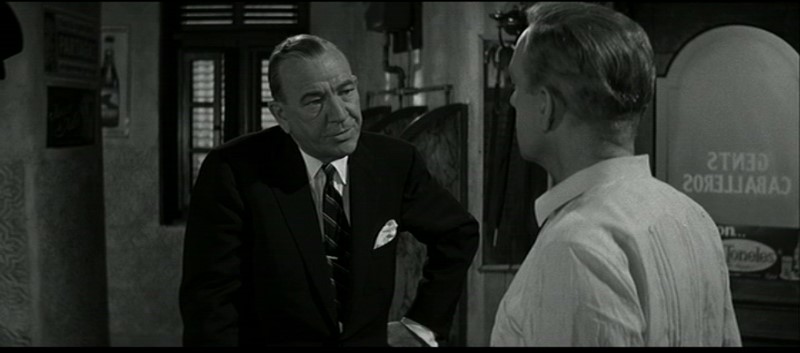
Our Man in Havana (Carol Reed, 1959) A fascinating serio-comic counter-point to author Graham Greene and Reed's post-war classic (made a decade previously) The Third Man. Reed's camera still swoops (courtesy of d.p. Oswald Morris), making sure that the Cinemascope frame is filled to the corners with detail, and the dark streets of Havana (filmed after the revolution and with the permission of Castro) at night, could be mistaken for post-war Vienna. The sun shines brighter, though, and so the internecine work of spies is done in the relative low-light of bars and brothels.
Greene's book was a cynical look at how Intelligence forces can show a distinct lack of intelligence when confronted with mis-information, but it is Reed's nifty idea to cast it with comedic actors, though not always playing for laughs. With such as Burl Ives, Noel Coward, Ralph Richardson, Ernie Kovacs (he plays a corrupt Cuban police official straight, but it is still funny) and Alec Guinness, it seems more a comedy of errors: British ex-pat Jim Wormold (Guinness) is scraping by a living selling vacuum cleaners in Havana, while his daughter (Jo Morrow) is developing a taste for the expensive horsey set—something that could be provided by Captain Segura (Kovacks), who has an eye for the blonde girl. Wormold has other plans for her, like an expensive Swiss boarding school. But where to get the money?
He is approached one day by Hawthorne (Coward, out of place in his dark suit and bowler hat in the mid-day sun of Havana) of the British secret service—or, as he is known, Agent 29500—to set up a bureau station for the service. For Wormold, it is extra cash, an all-expenses paid membership to the exclusive country club, and a more lavish life-style, all for keeping his daughter close. All the Service wants is results, which Wormold has trouble setting up—he is, after all, only a vaccuum cleaner salesman. Soon, he starts filing bogus reports, recruiting strangers as fellow agents (without their knowledge), building his station in importance to the delight of Hawthorne and his superior 'C' (Ralph Richardson).
However, becoming an important secret agent draws attention. He is soon assigned a secretary (Maureen O'Hara) by his superiors, wanting to build him up, and targeted for assassination by his enemies, wanting to shut him up. Doesn't matter if the information he's sending is all wrong; with so many resources at his command, he's sure to dig up something sooner or later. Scrutinized from both sides, the spy-game stops being so rewarding, and turns downright dangerous.
It's all played with a bit of a wink, with great comic actors under tight rein to let the material be funny without goosing it. Definitely worth seeing for the literate script, Reed's classic direction and the fine performances. John le Carré would later use the basic subject matter for his book (and subsequent John Boorman film) The Tailor of Panama.
Showing posts with label Alec Guinness. Show all posts
Thursday, January 27, 2011
Our Man in Havana
Labels:
1959,
Alec Guinness,
Burl Ives,
Carol Reed,
Comedy,
Ernie Kovacks,
Maureen O'Hara,
Noel Coward,
O,
Ralph Richardson,
Spy
Thursday, December 18, 2008
The Lavender Hill Mob
"The Lavender Hill Mob" (Charles Crichton, 1951)
Light-hearted Ealing Studios "caper" film starring Alec Guinness and Stanley Holloway as two renters in a Lavender Hill brownstone, one a bored bank auditor, the other a sculptor with dreams of greater things. The two men have enough in common that a shared light-bulb goes off: why not pool their common knowledge and carry-out the perfect crime?
Why not, indeed? The time was right for it. Crichton, whose directing career would go on and on, diverting to television and cap with the absurdist "A Fish Called Wanda"--these films share many similarities, actually--had a knack for nailing down frothy comedies with the slightest acid-wit without seemingly like a spoil-sport. Crichton is a director whose influence is less on the comedy, which is serviceable until he wants to make a real point—more on that in a tick—but on the dry way he presents comedy, and that donnish attitude to absurdism is equally evident from the nearly forty years that spanned "The Lavender Hill Mob" and "A Fish Called Wanda." Everything is perfectly cordial, until at some point the closk strikes four and suddenly it turns into a mad tea party, cracking the British reserve.
In "The Lavender Hill Mob," that moment comes when the two ring-leaders escape with their ill-gotten gains to Paris, and in a moment of aptness take a turn around the top of the Eiffel Tower—all 360 degrees of it—in one shot (I suspect it's a process shot done in the studio as there are no other tourists up there at the time, but I could be wrong). And then, in a moment of high urgency, scamper down the Eiffel's circular stairwell in a chase to beat the tower's elevator to the ground. The result is a dizzying sequence of hand-held shots watching the men go from despearation to scampering, hooting little boys, finally reaching the ground, their world spinning. It's a freeing moment, filmically and emotionally, the circular patterns cork-screwing an indelible moment into the film's structure.
It's a fine entertainment, and although Guiness and Crichton would never work together again, "The Lavender Hill Mob" shows the promise of two wily co-conspirators collaborating—right up to the seamless reveal of the film's final gambit.
And speaking of promising futures, look for future film icon's: Robert Shaw can be seen in the background of the police exhibition, Desmond Llewelyn ("Q" of the Bond films)is in the Customs scene, and at the beginning of the film the very small part of "Chiquita" is played by a young ingenue named Audrey Hepburn.
Audrey Hepburn's first screen appearance reaching the U.S.: "The Lavender Hill Mob"
Light-hearted Ealing Studios "caper" film starring Alec Guinness and Stanley Holloway as two renters in a Lavender Hill brownstone, one a bored bank auditor, the other a sculptor with dreams of greater things. The two men have enough in common that a shared light-bulb goes off: why not pool their common knowledge and carry-out the perfect crime?Why not, indeed? The time was right for it. Crichton, whose directing career would go on and on, diverting to television and cap with the absurdist "A Fish Called Wanda"--these films share many similarities, actually--had a knack for nailing down frothy comedies with the slightest acid-wit without seemingly like a spoil-sport. Crichton is a director whose influence is less on the comedy, which is serviceable until he wants to make a real point—more on that in a tick—but on the dry way he presents comedy, and that donnish attitude to absurdism is equally evident from the nearly forty years that spanned "The Lavender Hill Mob" and "A Fish Called Wanda." Everything is perfectly cordial, until at some point the closk strikes four and suddenly it turns into a mad tea party, cracking the British reserve.
In "The Lavender Hill Mob," that moment comes when the two ring-leaders escape with their ill-gotten gains to Paris, and in a moment of aptness take a turn around the top of the Eiffel Tower—all 360 degrees of it—in one shot (I suspect it's a process shot done in the studio as there are no other tourists up there at the time, but I could be wrong). And then, in a moment of high urgency, scamper down the Eiffel's circular stairwell in a chase to beat the tower's elevator to the ground. The result is a dizzying sequence of hand-held shots watching the men go from despearation to scampering, hooting little boys, finally reaching the ground, their world spinning. It's a freeing moment, filmically and emotionally, the circular patterns cork-screwing an indelible moment into the film's structure.
It's a fine entertainment, and although Guiness and Crichton would never work together again, "The Lavender Hill Mob" shows the promise of two wily co-conspirators collaborating—right up to the seamless reveal of the film's final gambit.
And speaking of promising futures, look for future film icon's: Robert Shaw can be seen in the background of the police exhibition, Desmond Llewelyn ("Q" of the Bond films)is in the Customs scene, and at the beginning of the film the very small part of "Chiquita" is played by a young ingenue named Audrey Hepburn.
Audrey Hepburn's first screen appearance reaching the U.S.: "The Lavender Hill Mob"
Labels:
1951,
Alec Guinness,
British,
Charles Chrichton,
Comedy,
L,
Stanley Holloway,
The Lavender Hill Mob
Subscribe to:
Posts (Atom)