Showing posts with label Only Angels Have Wings. Show all posts

Sunday, August 26, 2012

Don't Make a Scene: - Only Angels Have Wings

The Story: Howard Hawks swore that he saw this scene from - Only Angels have Wings played out in real life--a young pilot dying, asking to die alone. "A good death," said Hawks. An unsentimental death, certainly, on the surface, but Hawks never did anything very simply. The conversation between Geoff and the Kid (who is, typically for Hawks, older than him) is played out conversationally with emotions held in check. But Nature has a way of betraying us, and the rain that falls from Carter's hat stands as a substitute for the tears he won't shed in front of his friend. And the trademark Hawks cigarette is there, too, that symbol for charity, for need, for friendship, for bonds, serves a dual purpose: the smoke escaping from the Kid's last puff might be a representation of a soul (other directors have used it, like Sergio Leone in The Good, The Bad and The Ugly); and, that last cigarette goes from the Kid's lips to Carter's bestowing a once-removed kiss, (Hawks never shied away from a gay sub-text), or you can see it as Geoff continuing something the Kid can't finish. Geoff Carter and the Kid "go solo" their separate ways, Geoff finishing the Kid's last cigarette, walking out into a down-pour. 

A good death, indeed.  And a great film.

The Set-Up: Tragedy has struck the flight-service run by Geoff Carter (Cary Grant)out of the banana-port of Baranca. On this rainy, wind-swept night, a flight over the Andes has been thrown into jeopardy when condors, spooked by the sound of the its engines, crashed into the plane and through the wind-screen, disabling the navigator Kid Dabb (Thomas Mitchell), and causing a fire in one of the engines that severely burns the pilot, Bat MacPherson (Richard Barthlemess). MacPherson, years earlier, had disgraced himself, jumping from a damaged plane that crashed, killing his mechanic. As Fate would have it, that mechanic was Dabb's younger brother, and "The Kid" has never been able to forget, or forgive MacPherson. Now, MacPherson, fighting fire and severe weather has brought the plane in for a crash-landing--both men injured, but Kid Dabb, critically. A doctor tries to make him comfortable on this rainy night, the entire crew of the service hovering near their older colleague. 

Action!

Kid Dabb: [Wounded and laid out on a table after the crash, he gets annoyed at the doctor attending to him] Okay, doc, that's fine, that's fine. Cut it out, come one. Geoff, tell this guy to quit fussing with me, willya? I'm all right.

Geoff Carter: Let him alone. doc. [The doctor backs away and stands with the other pilots, who are watching behind Carter]
Dabb: Cigarette, papa?

Carter: Sure [He holds the cigarette to the Kid's mouth] Here.
Dabb: How's the other guy?
Carter: Hands burned and one side of his face.
Dabb: He's all right, Geoff. He could have jumped, but he didn't. He just sat there and took it like it was an ice cream soda. Buy him a drink for me, will ya?
Carter: Sure I will.
Dabb: Hadn't been for those birds, we'd have made it.
Carter: Sure you would.
Dabb: I'd make a windshield at an angle. Then they'd bounce off.

Carter: Not a bad idea.

Dabb: I'll make a present of it, papa. When I get on my feet, we'll work it out. Or will we?

Carter: Your neck's broken, Kid.

Dabb: Funny. Wondered why I couldn't feel anything.

Dabb: Well I guess this is it, then.

Dabb: Bad sport. Gee. [He suddenly tenses up]

Carter: What is it, fella?
Dabb: Get that bunch outta here, quick.

Carter: [To the others in the room] Get out of here. Hurry up. You, too, doc. Use both feet. [They leave. Carter turns back to the Kid]

Carter: What is it, fella? Come on, you can tell me.
Dabb: I didn't want them to see me.
Carter: Sure, sure.
Dabb: I'm not scared, Geoff.
Carter: Of course you're not.


Dabb: It's just that--it's like doing something new. Like when I made my first solo--I didn't want anybody watching then either.

Carter: Yeah.
Dabb: I don't know how good I'm gonna be at this.


Carter: Do you want me to go too?

Dabb: I'd hate to pull a boner in front of you, Geoff.

Carter: Sure, sure I know.

Carter: Here y'are, boy. [He gives him a last puff on his cigarette] So long, Kid.

Dabb: So long, Geoff. [Carter, with the cigarette in his mouth, walks out into the night rain]


- Only Angels Have Wings

Words by Howard Hawks and
Jules Furthman

Pictures by
Joseph Walker and Howard Hawks

- Only Angels Have Wings is available on DVD from Sony Home Video


Sunday, January 9, 2011

Don't Make a Scene (Sing-Along Month Edition): — Only Angels Have Wings

The Story: Harmony (noun): 1.  agreement; accord; harmonious relations. 2. the simultaneous combination of tones, esp. when blended into chords pleasing to the ear; chordal structure, as distinguished from melody and rhythm.

One of the things missing in most modern movies these days (possibly because audiences might find it "corny") is "the sing-along," where a group of characters participate in a collective musical performance that shows they can work together as a group to a common purpose.  Corny?  Maybe.  But it's a great audio-visual short-hand for communicating a dramatic idea—the resolving of differences.  Just as an orchestra can combine rhythm, brass, and strings to a unified whole, so, too, can disparate personalities and talents come together to create a sum greater than the parts.  We see this work in music groups  all the time, and there's no more obvious example in the movies than the Beatles documentary Let It Be, where the four writer-musicians bicker and back-bite, but manage to put it all together in their final concert on the Apple Studio roof-top, a meshing performance that shows just how good they could be.

Over the next four weeks in our "Don't Make a Scene" section, we'll present four sing-alongs from movies that display dramatically, through music, the putting-aside of differences in the creation of a unified effort—harmony.
And as music is the important element here, and really doesn't work one note at a time, we will temporarily dispense with the usual frame-by-frame breakdowns, and present the scenes in their full 24 frames per second vitality.

Howard Hawks was the master of this musical sub-text (he was a master of sub-text, period).  He used music, not only for its intrinsic entertainment value, but also to infer dramatic points that moved the story along.

Take this scene from his terrific —Only Angels Have Wings.  In it, a group of pilots, charged with delivering mail and supplies by the only means possible—by air—battle the elements, all of them—Earth, Wind, Fire and Water—and the existential situation they have undertaken.  The work is dangerous and competitive, and, as in war, if they lose one of their colleagues, little time is spent mourning the dead.  The work goes on, and though the danger remains—those deaths emblematic of it—one doesn't falter, best to keep on going.  Death happens every day; there's no use slowing the living because of it.

Into this environment lands Bonnie Lee (Jean Arthur), who finds this attitude cruel, uncivilized and brutal.  To the pilots, it is what it is—survival.  And her sentimentality risks everything.  So, she's put through the gauntlet, and emerges a little beat-up, slapped around metaphorically (in a quid pro quo for the physical one delivered to group leader Jeff (Cary Grant).  And rather than state the obvious ("Yeah, you were right, I was wrong, I see the error of my ways and I'm sorry"), she inserts herself back into the group, and participates in a group-effort.  It's subtle, unpretentious, and it gets the story-telling heavy lifting done, even if audiences don't recognize it.  That the song is an up-beat version of "One of These Days" (the next line is "you're gonna miss me, Daddy") is just the slightly ironic-tasting cherry on top.

And for that, she gets the highest compliment that can be bestowed in a Hawks film.  She is newly greeted...as "a professional."

Action!


Thursday, May 21, 2009

Anytime Movies Reloaded: - Only Angels Have Wings

It's Spring-Break for me. Times are busy. The Summer Movie Season is already begun (and I'll be writing about the new ones) and the Film Festivals are grinding away like creaky mills separating wheat from chaff. It's as good a time as any to re-boot a feature I started years ago, when it was suggested I do a "Top Ten" List.

I don't like those: they're rather arbitrary; they pit films against each other, and there's always one or two that should be on the list that aren't because something better shoved it down the trash-bin.

So, I came up with this: "Anytime" Movies.

Anytime Movies are the movies I can watch anytime, anywhere. If I see a second of it, I can identify it. If it shows up on television, my attention is focused on it until the conclusion. Sometimes it’s the direction, sometimes it’s the writing, sometimes it’s the acting, sometimes it’s just the idea behind it, but these are the movies I can watch again and again (and again!) and never tire of them. There are ten (kinda). They're not in any particular order, but the #1 movie IS the #1 movie.

While in college, I worked as a movie projectionist, and had an opportunity to show many great films for the various film courses being taught. But one film left a distinct impression—over the course of five days I had to show it eight times. I got to know it pretty well. Its name is “-Only Angels Have Wings” and it was directed by one of the great director-producers, Howard Hawks.

Hawks directed all types of movies, many of them classics of their genre: westerns (
Rio Bravo, Red River); mystery/noir (The Big Sleep); adventure (To Have and Have Not, Hatari!) and comedy (Bringing Up Baby, His Girl Friday). He even produced one of the first truly classic science fiction films (The Thing! [From Another World]), and an iconic musical (Gentlemen Prefer Blondes). Despite the genre, and despite the decade in which it was produced each film is unmistakably a Hawks film – a group of men (and women, but usually men) of diverse talents must come together to achieve a singular goal, be it to drive a huge herd of cattle to Missouri, or contain the alien threat, or capture a live rhinoceros, or get the bad guy to the Marshall (alive if possible) or ferry the refugees to safety, or find the dinosaur clavicle, or land a millionaire.

Conflict is achieved by introducing a newcomer to the mix who doesn’t understand the synergy of the group and who must learn “the code” to belong, and that keeps the group in cohesion. And so much the better if they do it without talking about it much.

That’s the Hawks formula, and he was able to create enough variations in the design that his films all seem different, even though they’re always telling the same basic story—a story that’s a metaphor for movie-making.
*

“Hello, professional”

Why “-Only Angels Have Wings” out of all those classics? It is the ultimate Hawks movie. Watch any of those others and you’ll hear similar lines and see similar situations, but in “Angels,” everything is distilled to the basic essence of the tale to become the best Hemingway story Hemingway never wrote. Distilled? The majority of the film takes place in one set! For this band of professionals, the goal is to fly the mail from the port city of Barancca through a narrow passage in the Andes utilizing one of a number of prop aircraft, all in need of repair. The men realize they’re merely links in a chain getting the mail…or a doctor…or a shipment of nitro-glycerin…to its destination with the threat of death flying right alongside. So hazardous is the job for these civilian-pilots that their base is a revolving door for the new blood who have to prove themselves. It’s "The Right Stuff” twenty years before Tom Wolfe popularized the phrase.

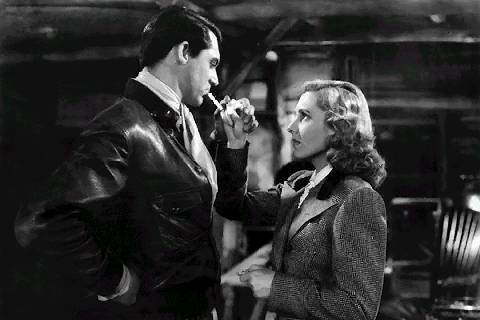
And it’s prime Hawks. For instance, watch the cigarettes. In a Hawks film, they’re visual short-hand for relationships—who’s in need and who can provide, who’s giving, who’s dependable, giving, taking, reading other's thoughts, . More than any other Hawks film, except perhaps “Rio Bravo,” the flame that’s there when you need it is a gambit that crams twice the information into the film, and reveals more about the characters than their deliberately circumspect dialog—what
Frank Capra called Hawks’s “three-corner dialog”—was allowed. To come right out and say things point-blank, well, not only would it be corny and unbelieveable…it just wasn’t done in Hawks's circles.

Hawks also liked to use music to convey mood. But it usually isn’t a Hollywood background score it's indigenous music—in this case, the bar band at Dutchy’s bar/mercantile and air terminal (this is a couple of years before “
Casablanca”). They set the mood, provide a little extra entertainment value, some local color for a set-bound movie and when the time is right and there’s a meeting of minds it’s reflected in a musical number in which everyone
participates. Again, no one has to come out and say ”We’re all thinking the same way.” They’re all singing the same song, so it’s understood.

"Boy, things happen fast around here, don't they?"

There’s also the unspoken ethos of the professional—you do your job to the best of your ability and you don’t talk about it. You don’t brag. You don’t cut corners and you don’t dwell on it. You do your job, you move on. You do your job right and people will notice. Do your job wrong and everyone suffers. In this way the group can depend on each other while staying out of their debt. In this movie-atmosphere, bit-players are allowed to shine. Yeah, the movie revolves around
Cary Grant (and the only role where he would be more stoic than he is here would be playing the icy spy Devlin in Hitchcock’s “Notorious”) and the delightful Jean Arthur—she could turn on a dime from tragedy to comedy and not miss a step— but even the lowliest of character-actors get great moments of screen-time. Also of note are a very young Rita Hayworth at the start of her career and Richard Barthlemess—a former silent screen star who didn’t make the transition to “talkies.” He plays a pilot who must prove himself to the others and that he can “cut” it in their world. Art imitates life.

And then there’s
Thomas Mitchell, who might well be the greatest character actor to never achieve name-above-the-title status. A veteran of many a Frank Capra comedy—and whose most prominent role would be as Scarlett O’Hara’s father in “Gone with the Wind”—here he plays a character with the title “The Kid,” even though he’s the oldest of the pilots. So much of the movie centers on him that his one character fulfills every plot device except love interest, although with Hawks one could never be too sure of that, either. **

Ultimately it’s Mitchell’s Kid who provides the means for Grant’s character to express his feelings, which, typically, he does without really having to, and in a way that makes it obvious to everybody involved. And as if anybody missed the point how dependent everyone is on each other, most of the pilots wind up injured, “winged” so that by the end of the movie, two pilots have to perform the job of one to fly each mail-run. Perhaps the better title may have been “-Only Angels Have Two Wings.”

It’s all done so economically, so breezily and with so little in the way of “action” that one may get through the entire movie before realizing that mostly everybody just talked…without really coming out and saying what they mean. Everything is shot at eye-level. There’s nothing fancy in the camera-work. The story is the King, and everyone is working towards making it work…like professionals.


Cary Grant needs a match. Jean Arthur carries a torch.

* Hawks was well-known for taking different stories and turning them into the Hawks formula, sometimes rewiting the entire film on a day to day basis to get there. The most extreme example of this is “El Dorado,” which after ten minutes of one story suddenly veers into becoming a remake of the earlier Hawks-John Wayne western “Rio Bravo.” When Hawks called John Wayne to ask if he’d star in yet another western, “Rio Lobo,” Wayne knew exactly what he was getting into. “Do I get to play the drunk this time?” he drawled.

** Someday, someone far more intelligent than I is going to go through the Hawks filmography with an eye towards sexual politics—whether it’s the leering banter between
Montgomery Clift and John Ireland in “Red River,” or Cray Grant in drag in “Bringing Up Baby” (“I went GAY all of a sudden!!”) and “I Was a Male War Bride,” or some of the more bizarre stagings of musical numbers in “Gentlemen Prefer Blondes.” And then there’s the long line of husky-voiced women in his movies who are one of “the boys,” from Rosalind Russell to Lauren Bacall all the way up to future Paramount Studios exec Sherry Lansing. For all the macho posturing exhibited in his movies, there are hints that Hawks never completely “bought” into it and is enjoying winking at it. He may well be second only to James Whale in sneaking so much gay subtext into his movies.


-Only Angels Have Wings
Chinatown
Mr. Smith Goes to Washington
American Graffiti
To Kill a Mockingbird
Goldfinger
Bonus: Edge of Darkness

Sunday, May 18, 2008

Don't Make a Scene: Only Angels Have Wings

The Story: Howard Hawks swore that he saw this scene played out in real life--a young pilot dying, asking to die alone. "A good death," said Hawks. An unsentimental death, certainly, on the surface, but Hawks never did anything very simply. The conversation between Geoff and the Kid (who is, typically for Hawks, older than him) is played out conversationally with emotions held in check. But Nature has a way of betraying us, and the rain that falls from Carter's hat stands as a substitute for the tears he won't shed in front of his friend. And the trademark Hawks cigarette is there, too, that symbol for charity, for need, for friendship, for bonds, serves a dual purpose: the smoke escaping from the Kid's last puff might be a representation of a soul (other directors have used it, like Sergio Leone in "The Good, The Bad and The Ugly"); and, that last cigarette goes from the Kid's lips to Carter's bestowing a once-removed kiss, (Hawks never shied away from a gay sub-text), or you can see it as Geoff continuing something the Kid can't finish. Geoff Carter and the Kid "go solo" their separate ways, Geoff finishing the Kid's last cigarette, walking out into a down-pour. A good death, indeed.

The Set-Up: Tragedy has struck the flight-service run by Geoff Carter (Cary Grant)out of the banana-port of Baranca. On this rainy, wind-swept night, a flight over the Andes has been thrown into jeopardy when condors, spooked by the sound of the its engines, crashed into the plane and through the wind-screen, disabling the navigator Kid Dabb (Thomas Mitchell), and causing a fire in one of the engines that severely burns the pilot, Bat MacPherson (Richard Barthlemess). MacPherson, years earlier, had disgraced himself, jumping from a damaged plane that crashed, killing his mechanic. As Fate would have it, that mechanic was Dabb's younger brother, and "The Kid" has never been able to forget, or forgive MacPherson. Now, MacPherson, fighting fire and severe weather has brought the plane in for a crash-landing--both men injured, but Kid Dabb, critically. A doctor tries to make him comfortable on this rainy night, the entire crew of the service hovering near their older colleague. Action!
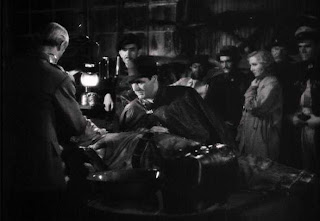
Kid Dabb: [Wounded and laid out on a table after the crash, he gets annoyed at the doctor attending to him] Okay, doc, that's fine, that's fine. Cut it out, come one. Geoff, tell this guy to quit fussing with me, willya? I'm all right.


Geoff Carter: Let him alone. doc. [The doctor backs away and stands with the other pilots, who are watching behind Carter]
Dabb: Cigarette, papa?

Carter: Sure [He holds the cigarette to the Kid's mouth] Here.
Dabb: How's the other guy?
Carter: Hands burned and one side of his face.
Dabb: He's all right, Geoff. He could have jumped, but he didn't. He just sat there and took it like it was an ice cream soda. Buy him a drink for me, will ya?
Carter: Sure I will.
Dabb: Hadn't been for those birds, we'd have made it.
Carter: Sure you would.
Dabb: I'd make a windshield at an angle. Then they'd bounce off.


Carter: Not a bad idea.


Dabb: I'll make a present of it, papa. When I get on my feet, we'll work it out. Or will we?


Carter: Your neck's broken, Kid.

Dabb: Funny. Wondered why I couldn't feel anything.


Dabb: Well I guess this is it, then.


Dabb: Bad sport. Gee. [He suddenly tenses up]


Carter: What is it, fella?
Dabb: Get that bunch outta here, quick.

Carter: [To the others in the room] Get out of here. Hurry up. You, too, doc. Use both feet. [They leave. Carter turns back to the Kid]


Carter: What is it, fella? Come on, you can tell me.
Dabb: I didn't want them to see me.
Carter: Sure, sure.
Dabb: I'm not scared, Geoff.
Carter: Of course you're not.


Dabb: It's just that--it's like doing something new. Like when I made my first solo--I didn't want anybody watching then either.


Carter: Yeah.
Dabb: I don't know how good I'm gonna be at this.


Carter: Do you want me to go too?

Dabb: I'd hate to pull a boner in front of you, Geoff.

Carter: Sure, sure I know.


Carter: Here y'are, boy. [He gives him a last puff on his cigarette] So long, Kid.


Dabb: So long, Geoff. [Carter, with the cigarette in his mouth, walks out into the night rain]


"Only Angels Have Wings"

Words by Howard Hawks and
Jules Furthman

Pictures by
Joseph Walker and Howard Hawks

Only Angels Have Wings is available on DVD from Sony Home Video


Monday, January 14, 2008

- Only Angels Have Wings

While in college, I worked as a movie projectionist, and had an opportunity to show many great films for the various film courses being taught. But one film left a distinct impression—over the course of five days I had to show it eight times. I got to know it pretty well. Its name is “-Only Angels Have Wings” and it was directed by one of the great director-producers, Howard Hawks.

Hawks directed all types of movies, many of them classics of their genre: westerns (
Rio Bravo, Red River); mystery/noir (The Big Sleep); adventure (To Have and Have Not, Hatari!) and comedy (Bringing Up Baby, His Girl Friday). He even produced one of the first truly classic science fiction films (The Thing! [From Another World]), and an iconic musical (Gentlemen Prefer Blondes). Despite the genre, and despite the decade in which it was produced each film is unmistakably a Hawks film – a group of men (and women, but usually men) of diverse talents must come together to achieve a singular goal, be it to drive a huge herd of cattle to Missouri, or contain the alien threat, or capture a live rhinoceros, or get the bad guy to the Marshall (alive if possible) or ferry the refugees to safety, or find the dinosaur clavicle, or land a millionaire.

Conflict is achieved by introducing a newcomer to the mix who doesn’t understand the synergy of the group and who must learn “the code” to belong, and to keep the group in cohesion. And so much the better if they do it without talking about it much.

That’s the Hawks formula, and he was able to create enough variations in the design that his films all seem different, even though they’re always telling the same basic story—a story that’s a metaphor for movie-making.*

“Hello, professional”


Why “-Only Angels Have Wings” out of all those classics? It’s the ultimate Hawks movie. Watch any of those others and you’ll hear similar lines and see similar situations, but in “Angels,” everything is distilled to the basic essence of the tale to become the best Hemingway story Hemingway never wrote. Distilled? The majority of the film takes place in one set! For this band of professionals, the goal is to fly the mail from the port city of Barancca through a narrow passage in the Andes utilizing one of a number of prop aircraft in need of repair. All the men realize they’re merely links in a chain getting the mail…or a doctor…or a shipment of nitro-glycerin…to its destination with the threat of death flying right alongside. So hazardous is the job for these civilian-pilots that their base is a revolving door for the new blood who have to prove themselves. It’s "The Right Stuff” twenty years before Tom Wolfe popularized the phrase.

And it’s prime Hawks. For instance, watch the cigarettes. In a Hawks film, they’re visual short-hand for relationships—who’s in need, who can provide, who’s giving, who’s dependable. More than any other Hawks film, except perhaps “Rio Bravo,” the flame that’s there when you need it is a gambit that crams twice the information into the film, and reveals more about the characters than their deliberately circumspect dialog—what
Frank Capra called Hawks’ “three-corner dialog”—was allowed. To come right out and say things point-blank, well, not only would it be corny and unbelieveable…it just wasn’t done.

Hawks also liked to use music to convey mood. But it usually isn’t a Hollywood background score but indigenous music—in this case, the bar band at Dutchy’s bar/mercantile and air terminal (this is a couple of years before “
Casablanca”). They set the mood, provide a little extra entertainment value, some local color for a set-bound movie and when the time is right and there’s a meeting of minds it’s reflected in a musical number in which everyone
participates. Again, no one has to come out and say ”We’re all thinking the same way.” They’re all singing the same song, so it’s understood.

"Boy, things happen fast around here, don't they?"


There’s also the unspoken ethos of the professional—you do your job to the best of your ability and you don’t talk about it. You don’t brag. You don’t cut corners and you don’t dwell on it. You do your job, you move on. You do your job right and people will notice. Do your job wrong and everyone suffers. In this way the group can depend on each other while staying out of their debt. In this movie-atmosphere, bit-players are allowed to shine. Yeah, the movie revolves around Cary Grant (the only role where he’s more stoic than he is here would be playing the icy spy Devlin in Hitchcock’s “Notorious”) and the delightful Jean Arthur--she could turn on a dime from tragedy to comedy and not miss a step, but even the lowliest of character-actors get great moments of screen-time. Also of note are a very young Rita Hayworth at the start of her career and Richard Barthlemess—a former silent screen star who didn’t make the transition to “talkies.” He plays a pilot who must prove himself to the others and that he can “cut” it in their world. Art imitates life.

And then there’s
Thomas Mitchell, who might well be the greatest character actor to never achieve name-above-the-title status. A veteran of many a Frank Capra comedy—and whose most prominent role would be as Scarlett O’Hara’s father in “Gone with the Wind”—here he plays a character with the title “The Kid,” even though he’s the oldest of the pilots. So much of the movie centers on him that his one character fulfills every plot device except love interest, although with Hawks one could never be too sure of that, either. **

Ultimately it’s Mitchell’s Kid who provides the means for Grant’s character to express his feelings, which, typically, he does without really having to, and in a way that makes it obvious to everybody involved. And as if anybody missed the point how dependent everyone is on each other, most of the pilots wind up injured, “winged” so that by the end of the movie, two pilots have to perform the job of one to fly each mail-run. Perhaps the better title may have been “-Only Angels Have Two Wings.”

It’s all done so economically, so breezily and with so little in the way of “action” that one may get through the entire movie before realizing that mostly everybody just talked…without really coming out and saying what they mean. Everything is shot at eye-level. There’s nothing fancy in the camera-work. The story is the King, and everyone is working towards making it work…like professionals.


*Hawks was well-known for taking different stories and turning them into the Hawks formula, sometimes rewiting the entire film on a day to day basis to get there. The most extreme example of this is “El Dorado,” which after ten minutes of one story suddenly veers into becoming a remake of the earlier Hawks-Wayne western “Rio Bravo.” When Hawks called John Wayne to ask if he’d star in yet another western, “Rio Lobo,” Wayne knew exactly what he was getting into. “Do I get to play the drunk this time?” he drawled.

** Someday, someone far more intelligent than I is going to go through the Hawks filmography with an eye towards sexual politics—whether it’s the leering banter between
Montgomery Clift and John Ireland in “Red River,” or Cray Grant in drag in “Bringing Up Baby” (“I went GAY all of a sudden!!”) and “I Was a Male War Bride,” or some of the more bizarre stagings of musical numbers in “Gentlemen Prefer Blondes.” And then there’s the long line of husky-voiced women in his movies who are one of “the boys,” from Rosalind Russell to Lauren Bacall all the way up to future Paramount Studios exec. Sherry Lansing. For all the macho posturing exhibited in his movies, there are hints that Hawks never completely “bought” into it and is enjoying winking at it. He may well be second only to James Whale in sneaking so much gay subtext into his movies.


Cary Grant needs a match. Jean Arthur carries a torch.


Anytime Movies are movies I can watch anytime, anywhere. If I see a second of it, I can identify it. If it shows up on television, my attention is focused on it until the conclusion. Sometimes it’s the direction, sometimes it’s the writing, sometimes it’s the acting, sometimes it’s just the idea behind it, but these are the movies I can watch again and again and never tire of them. There are ten. This is Number 4.


IV: -Only Angels Have Wings


V: The Searchers


X: Goldfinger