Showing posts with label James Mangold. Show all posts

Saturday, August 24, 2013

The Wolverine

Ronin on Empty
or
The SNIKT Hits the Japanese Fan

The last Wolverine movie—which was also the only entry in the "X-Men: Origins" series—was not very good (I gave a "Cable-Watcher" rating).  But, like Wolverine healing from his wounds and coming back whole, hope springs eternal like adamantium claws, and there were enough interesting aspects to The Wolverine that one wondered if this time they might have got it right. They were basing it on the Chris Claremont/Frank Miller mini-series from way, way back, and the director is James Mangold, who did Cop Land and Walk the Line. I mean he's no Darren Aronofsky (who he replaced on the project), but maybe, just maybe...

It tries very hard.


The script went through the hands of many writers, some of them quite accomplished—Christopher McQuarrie, Scott Frank—and Mark Bomback, who wrote Unstoppable and Live Free or Die Hard.  It retains some of the Claremont-Miller story, like the beginning with a self-exiled Wolverine living in the mountains, and his dealings with a bear and its careless hunter, but abandons most of it, causing it to suffer from serious story-bloat.  There are echoes of the original throughout—a mention of a bullet-train from the story turns into a full-fledged battle on the top of one in this—but instead of echoes, we have the roar of something almost wholly new, adding other elements and characters from other stories in the canon (thankfully limited to this world).  For example, it gives us a back-story of how Logan (Hugh Jackman) first met the man he will be dealing with in the movie—Yashida (Ken Yamamura in these scenes, then aging to Hal Yamanouchi). It's World War II, and he's in a Japanese prisoner of war camp, conveniently close to the city of Nagasaki, just when the second atomic bomb is dropped.  Logan shields the POW guard from the effects of the blast that crisps Logan, but, no worries, he heals from the effects in five minutes, although very painfully.

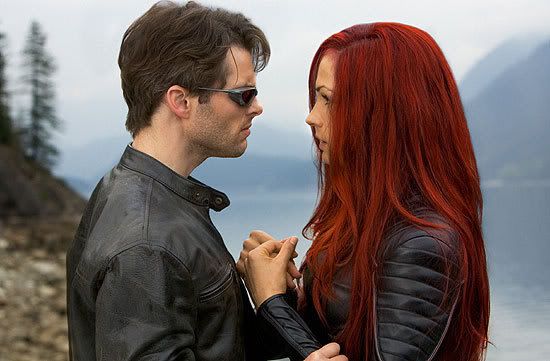
Fast forward.  When we find Logan in the present, he is haunted by nightmares of his dead love Jean Grey (Famke Janssen).  As she died in the egregiously terrible X-Men: The Last Stand, I know exactly how he feels—I'm still bitter about how they atomized the Scott Summers/Jean Grey relationship in that movie. While he's attending to the bear hunter in the bar, he's confronted with the pint-sized assassin Yukio (Rila Fukusima), who, in her stealth ninja style has electric red hair.  Fascinating.  She is in the employ of Yashida, who requests the man who saved his life at Nagasaki to do him a service before his death.* That would be in the form of relinquishing his mutant-powers to him.  Makes sense—he's dying and wants to live forever, while Logan is living forever and hates it.  Nobody's happy, so why don't we switch each other's green grass.  Well, despite his oft-professed existential pain, the mutant either has a change of heart or he just knows how to position it and says that he would never curse someone with his everlasting powers, so, thanks but no thanks.  

Easy for him to say, he's living forever.


Yeah, I know Frank Miller likes it, but I never "bought" the
"Claws-stops-samurai sword" variation of Rock/Scissors/Paper.


Yashida dies (thanks, Wolverine!), distressing his family, including daughter Mariko (Tao Okamoto) who is attacked and threatened with kidnapping at her father's very public funeral.  So much for stealth.  At this point, it becomes a chase between the forces trying to kidnap Mariko (but who?) and some mysterious forces behind it all.  Oh.  And fights.  And chases.  And Logan gets hurt.  And fixes himself, because that's what he does, even if it undermines any sort of tension that he actually might get killed.

To give it some exotic Japanese flavor, part of a chase takes place in...an arcade?

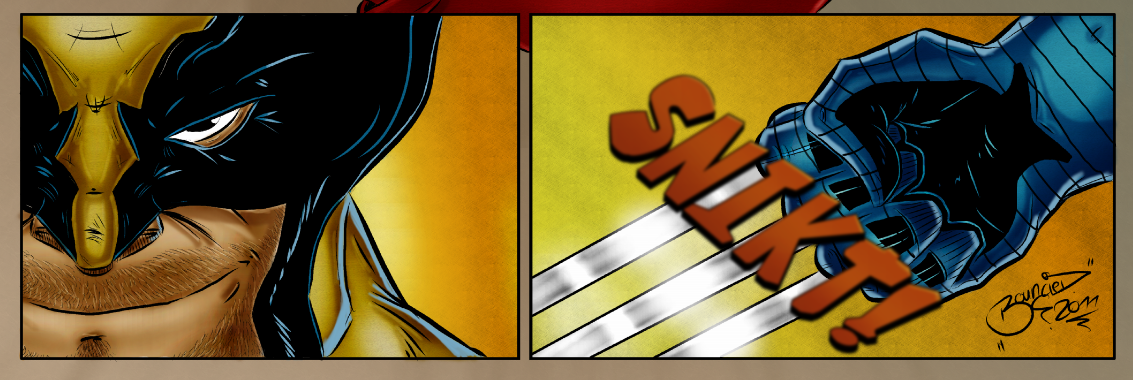
What Claremont and Miller cooked up in their mini-series was okay, if slightly uneventful.  But without the Mariko-Logan back-story of the original tale, what Mangold and his writers have done is complicate things...a lot, drag in a standard Marvel villain, Viper (played by Svetlana Khodchenkova) (or Madame Hydra, as she was occasionally known and they dress her up in the customary cut-away latex thing the character always seemed to wear) and basically start from scratch, occasionally waving at the original story.  The whole thing feels convoluted and clunky and only brings some surprises if you've actually read the comic books—standard movie-goers just get the usual twists and turns that they can see coming a mile away.  Mangold does try and bring something to the fights, but, with a PG-13 rating expected for the thing, there's only so much slashing that can be done in anything more than a suggestive fashion. As with the other X-men/Wolverine movies, you aren't shown the cleavage that happens when the SNIKT! hits the fan. For all the talk of the character's bad-assery, the violence that his powers implies and the fan-boys want to see will always be ham-strung by the movie ratings system.

Despite Jackman's performance (and he'll always be associated with this role no matter how many musicals he'll do) this one doesn't feel fresh or fun, recycling a lot of material, but more so.  That centerpiece fight on top of a bullet-train is the same sort of thing we've seen before—and recently in James Bond, Spider-man and The Lone Ranger—but the same stuff is being done, just faster and less impactful.  Despite the constant threat of falling off or de-capitation (for Wolverine, everything will just heal), how can you make a fight  on a bullet-train dull?

Stick around as the credits roll out, though, for a couple of essential appearances—one of which is very surprising—that will lead into X-Men: Days of Future Past, which will attempt to unite the original X-men films with the "First Class" ret-conning to smooth out some of the two series continuity issues.  

Really, does it matter? How about just concentrating on making a better movie, like the First Class formula-blaster was?

The Wolverine (2013) is a Cable-Watcher.

Okay, I REALLY don't buy the claws stopping the Silver Samurai's sword.
("The Silver Samurai??")


* Wait a second here.  Wolverine saves HIS life at Nagasaki, and pulls him all the way to Japan to do this?  I know he's an international crime-lord and all, but that's really against any "pay-back" principle or criminal code of conduct I've ever heard of.  "You saved my life, so to repay you, I'm going to ask you to save it again."  Oh.  Well!  When you put it THAT way!


Thursday, June 24, 2010

Knight and Day


"Planes, Trains and Automobiles on Cruise-Control"
or
"Every Man His 007 (And Every Woman, Too)"

June Havens (Cameron Diaz) is going through a life-transition and doesn't even know it.  She's getting on a plane to Boston to be a brides-maid (never a bride) at her little sister's wedding, and letting go of the past by putting the finishing touches on her father's dream-project, restoring a pre-70's GTO, and giving it to her sister as a wedding present.


But, she's keeps running into this "guy," literally—the last time at the airport before she boards her plane, and finds that...sorry, the flight is full-up.  The "guy," Roy Miller (Tom Cruise) enigmatically says, "Some times things happen for a reason" and boards the plane.

Truer words.  Before you can say "Non-res" she's on the plane and chatting up Miller, who's personable, quiet, and (when she's not looking) scoping out the plane.  It's the first instance of her not registering what's happening to her, but it won't be the last.  Don't be too hard on her.  She's a "newbie" at counter-espionage.

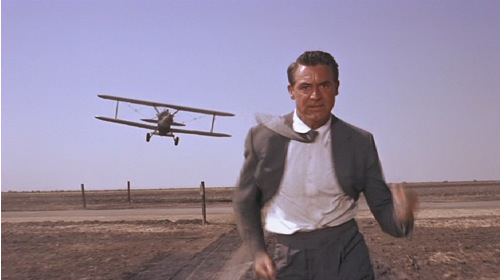
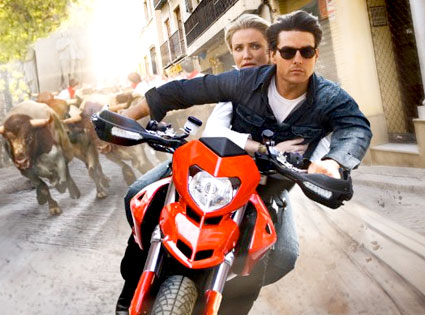
It starts tracking like a Hitchcock film—the "innocent" caught up in the intrigue—but it ends up morphing into Hitchcock's bastard love-child, the James Bond series.  Cruise has always wanted to play Bond (incorrigibly American and too short, despite Daniel Craig's height issues—and some of the sets are low-ceilinged to disguise Cruise's short stature), hence the "Mission: Impossible" series that turned a team-effort into a one-man show.  But, this is as close as he'll come, and he and the film do well by it, with the typical derring-do, a lot of homages to Bonds of the past, and doing one thing that the Bond's have never done:  this is a "Bond" film for women.

With all the variations on the theme the Bond producers have explored over the years, there's one thing they haven't done: looked at the adventure from the woman's perspective.  As Kim Basinger said about "Never Say Never Again," her part didn't amount to much because "it's all about Bond, anyway."  Deft analysis.  It is always from Bond's perspective, and the women dragged into the scenarios, with or against their wills, are just chaff blown about in the fire-storm (or the "Thunderball"), accoutrements like his cuff-links and his wristwatch, though usually less functional.  Bond walks into their world, blows it up, and the best they can do is end up in the boat with him, ahead of the shock-wave.  Even the most important and dynamic of the Bond-girls, Natalya Simonova from "Goldeneye"—she's the one who saves the world at the end—is along for the ride in all of the instantly disposable vehicles.  Appropriate, as they're instantly disposable, too, the inevitable break-up happening between films never to be seen again in the series.  Even the original books' author, Ian Fleming, tinkered with the idea, making "The Spy Who Loved Me," entirely from "the girl's" perspective.

And that's what this is, too.  We're focussed more on June and her "learning the ropes," frequently knocked out and dragged from one exotic location to another, by good guys and bad guys alike, a pawn in this battle of knights, Alice in "Thunderland." 

The great thing about "Knight and Day" is that it doesn't have the "Bond cache" where he's always in charge, and stretches the formula to resolve a lot of the women's issues about control and taking charge in a satisfying, and complete, manner.

Of course, the "big" issue with a Tom Cruise movie is...how is Cruise?  He's always been the eager-beaver, and sometimes (as we'll show in this Sunday's "Don't Make a Scene"), most times, in an effort to fill the void of the camera-frame, he'll take things so far as to be ludicrously over-the-top, practically mugging in an effort to create a character that registers.  He's learning.  He's antic and funny in this, especially in the action scenes ("Alright, nobody move, or I shoot myself, and then the girl!"), sure, and sometimes frustratingly practical when the bullets are flying ("promiscuously" as they say in "The Wind and The Lion") at him on the roof of car.  But, in the quieter moments, he's relaxed and subtle, and emitting a mega-wattage star-power—somewhat less than Cary Grant, but certainly in the Christopher Reeve/Pierce Brosnan range, where he knows less is more.  The camera loves him, and he accepts that love, without having to push it.  He's GOOD in this, and Diaz, as ditzy as she can be, manages to make her "every-girl" sympathetic and identifiable.

This is the Bond movie that the wife/girl-friend won't sit in frustration during, as it's been nicely laser-etched with a "chick flick" by James Mangold, (and a bevy of screen-writers, starting with Patrick O'Neill and also passing though the PC of the great Scott Frank) with a cast rounded out by good actors like Paul Dano, Peter Saarsgaard, and Oscar nominee Viola Davis (Good to see HER again!).  "Knight and Day," you are the one.

"Knight and Day" is a Matinee.

Wednesday, November 14, 2007

The "3:10 to Yuma" Shoot-Out

"Thar' Ain't Room in this Genre for Both of Us"

It's a truly fascinating experience to revisit Delmer Daves' strange little 1957 "oater" "3:10 to Yuma," and look at what James Mangold ("Walk The Line") has done with it 50 years later. The original was a tight little psychological western based on an Elmore Leonard short story, but, as with his latter urban capers, character informs action. And it provided Van Heflin and Glenn Ford two of the finest roles of their careers. Ford, never the most inspired of actors, does wonders with the role of rogue-bandit Ben Wade, who's just as handy with his words as a gun, and is just as dangerous hand-cuffed and guarded as he is on the loose. No one is safe in his sphere and he rules a band of outlaws on sheer force of personality. And Ford ekes out every subtlety, every nuance of his clever dialog and makes it look easy as taking a nap. His is a villain that never admits he's not in control of the situation. He's evenly matched by Van Heflin, looking haggard and down-trodden as a desert-farmer, who takes on a prisoner-transfer to save his farm, and maybe a touch of glory. Such a man is constantly in threat of temptation from the devil, and it's only his cussed stubborness that makes him see through a job when other men give up. Heflin has the less fun role, but gives it his all, and is rewarded by a Divine Intervention that is announced by a choir of angels (who are backing Frankie Laine singing the inevitable Title Song).

So, 50 years on, what can Mangold bring to the material? Well, not much really. It's puffed up with some more action and the dialogue is retained (at least in spirit) a surprising amount of the time (original screenplay writer Hallstead Welles gets the lead screenplay credit). What new things are added are informed by earlier instances in the original and made explicit, some times thuddingly, and everything is tamped down in a nihilistic amoral rasp as is expected of a western post-Leone/Eastwood (but with none of the wit or stylism). More explosions (Two, instead of the none in the first), one in an unnecessary story-detour through a railroad camp. The one opportunity the modern makers had--that of fleshing out the denouement in terms of character, they manage to make even more false, by pumping up the action and circumstances, straining credibility to the snapping point. Crowe's Ben Wade has the same dialogue, but none of the swagger, and enough skills that one wonders just what he's doing staying around the whole movie. Christian Bale's Dan Evans has the same motivations as the original, but his circumstances are worse, and to make his family connection explicit and situations more dire, his son sneaks along on the expedition. Still, its pretty obvious how much Mangold loves the original, seeing how much is retained, but the expansion of the story works against it, and we are left with what's good in the new one...being the old one.

But there are things missing, too. Besides the more colorful straight-ahead performances of Ford and Heflin, there is a marvelous one by the fine character-actor Richard Jaeckel, who makes Wade's lieutenant, Charlie Prince, a craftily-goofy rooster of a character. Ben Foster's performance has some of the characteristics, but is a stone-cold psycho (no doubt written that way) and pales by comparson.

And then there's that Frankie Laine song...

Decision: "3:10 to Yuma" (1957)
"3:10 to Yuma" (2007) is a rental.