Showing posts with label Hugh Jackman. Show all posts

Saturday, August 24, 2013

The Wolverine

Ronin on Empty
or
The SNIKT Hits the Japanese Fan

The last Wolverine movie—which was also the only entry in the "X-Men: Origins" series—was not very good (I gave a "Cable-Watcher" rating).  But, like Wolverine healing from his wounds and coming back whole, hope springs eternal like adamantium claws, and there were enough interesting aspects to The Wolverine that one wondered if this time they might have got it right. They were basing it on the Chris Claremont/Frank Miller mini-series from way, way back, and the director is James Mangold, who did Cop Land and Walk the Line. I mean he's no Darren Aronofsky (who he replaced on the project), but maybe, just maybe...

It tries very hard.


The script went through the hands of many writers, some of them quite accomplished—Christopher McQuarrie, Scott Frank—and Mark Bomback, who wrote Unstoppable and Live Free or Die Hard.  It retains some of the Claremont-Miller story, like the beginning with a self-exiled Wolverine living in the mountains, and his dealings with a bear and its careless hunter, but abandons most of it, causing it to suffer from serious story-bloat.  There are echoes of the original throughout—a mention of a bullet-train from the story turns into a full-fledged battle on the top of one in this—but instead of echoes, we have the roar of something almost wholly new, adding other elements and characters from other stories in the canon (thankfully limited to this world).  For example, it gives us a back-story of how Logan (Hugh Jackman) first met the man he will be dealing with in the movie—Yashida (Ken Yamamura in these scenes, then aging to Hal Yamanouchi). It's World War II, and he's in a Japanese prisoner of war camp, conveniently close to the city of Nagasaki, just when the second atomic bomb is dropped.  Logan shields the POW guard from the effects of the blast that crisps Logan, but, no worries, he heals from the effects in five minutes, although very painfully.

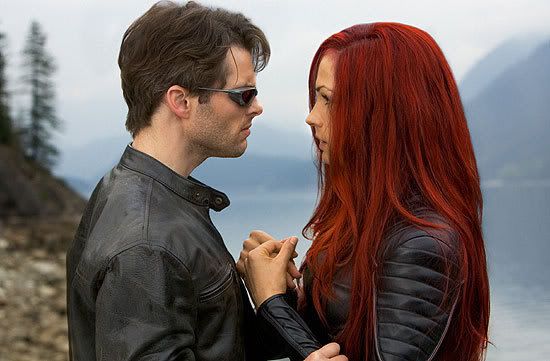
Fast forward.  When we find Logan in the present, he is haunted by nightmares of his dead love Jean Grey (Famke Janssen).  As she died in the egregiously terrible X-Men: The Last Stand, I know exactly how he feels—I'm still bitter about how they atomized the Scott Summers/Jean Grey relationship in that movie. While he's attending to the bear hunter in the bar, he's confronted with the pint-sized assassin Yukio (Rila Fukusima), who, in her stealth ninja style has electric red hair.  Fascinating.  She is in the employ of Yashida, who requests the man who saved his life at Nagasaki to do him a service before his death.* That would be in the form of relinquishing his mutant-powers to him.  Makes sense—he's dying and wants to live forever, while Logan is living forever and hates it.  Nobody's happy, so why don't we switch each other's green grass.  Well, despite his oft-professed existential pain, the mutant either has a change of heart or he just knows how to position it and says that he would never curse someone with his everlasting powers, so, thanks but no thanks.  

Easy for him to say, he's living forever.


Yeah, I know Frank Miller likes it, but I never "bought" the
"Claws-stops-samurai sword" variation of Rock/Scissors/Paper.


Yashida dies (thanks, Wolverine!), distressing his family, including daughter Mariko (Tao Okamoto) who is attacked and threatened with kidnapping at her father's very public funeral.  So much for stealth.  At this point, it becomes a chase between the forces trying to kidnap Mariko (but who?) and some mysterious forces behind it all.  Oh.  And fights.  And chases.  And Logan gets hurt.  And fixes himself, because that's what he does, even if it undermines any sort of tension that he actually might get killed.

To give it some exotic Japanese flavor, part of a chase takes place in...an arcade?

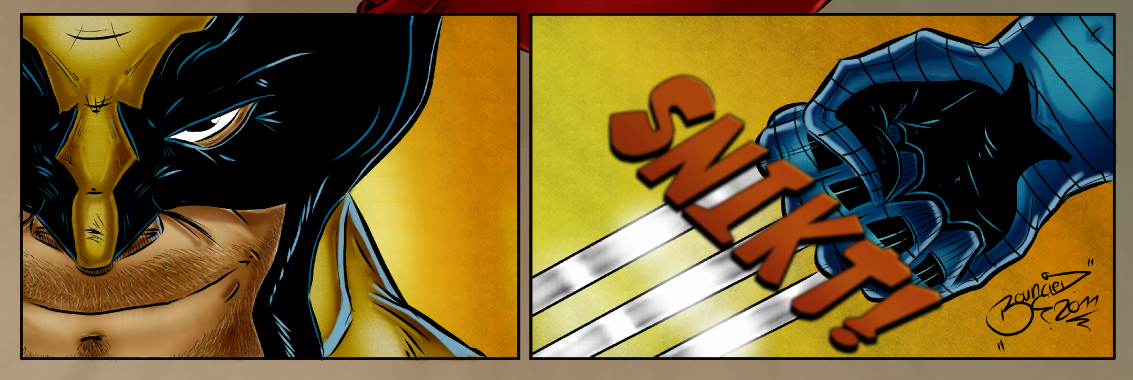
What Claremont and Miller cooked up in their mini-series was okay, if slightly uneventful.  But without the Mariko-Logan back-story of the original tale, what Mangold and his writers have done is complicate things...a lot, drag in a standard Marvel villain, Viper (played by Svetlana Khodchenkova) (or Madame Hydra, as she was occasionally known and they dress her up in the customary cut-away latex thing the character always seemed to wear) and basically start from scratch, occasionally waving at the original story.  The whole thing feels convoluted and clunky and only brings some surprises if you've actually read the comic books—standard movie-goers just get the usual twists and turns that they can see coming a mile away.  Mangold does try and bring something to the fights, but, with a PG-13 rating expected for the thing, there's only so much slashing that can be done in anything more than a suggestive fashion. As with the other X-men/Wolverine movies, you aren't shown the cleavage that happens when the SNIKT! hits the fan. For all the talk of the character's bad-assery, the violence that his powers implies and the fan-boys want to see will always be ham-strung by the movie ratings system.

Despite Jackman's performance (and he'll always be associated with this role no matter how many musicals he'll do) this one doesn't feel fresh or fun, recycling a lot of material, but more so.  That centerpiece fight on top of a bullet-train is the same sort of thing we've seen before—and recently in James Bond, Spider-man and The Lone Ranger—but the same stuff is being done, just faster and less impactful.  Despite the constant threat of falling off or de-capitation (for Wolverine, everything will just heal), how can you make a fight  on a bullet-train dull?

Stick around as the credits roll out, though, for a couple of essential appearances—one of which is very surprising—that will lead into X-Men: Days of Future Past, which will attempt to unite the original X-men films with the "First Class" ret-conning to smooth out some of the two series continuity issues.  

Really, does it matter? How about just concentrating on making a better movie, like the First Class formula-blaster was?

The Wolverine (2013) is a Cable-Watcher.

Okay, I REALLY don't buy the claws stopping the Silver Samurai's sword.
("The Silver Samurai??")


* Wait a second here.  Wolverine saves HIS life at Nagasaki, and pulls him all the way to Japan to do this?  I know he's an international crime-lord and all, but that's really against any "pay-back" principle or criminal code of conduct I've ever heard of.  "You saved my life, so to repay you, I'm going to ask you to save it again."  Oh.  Well!  When you put it THAT way!


Wednesday, January 16, 2013

Les Misérables (Musical; 2012)

The Song of Angry Men
or
 "To the Barricades!"


I realize I am not the man to do a critical analysis of Les Misérables, the filmed version of the long running staged presentation of the concept album produced by Claud Michel Schönberg, Alain Boublil and Jean Marc Natel, (from the novel by Victor Hugo) for many reasons: 1) I'm not terribly fond of musicals, finding the form unnatural and artificial—the inclination to burst into song having the requirement of being necessitated by the surge of emotion, which, if you do it too much, is a bit unsufferable—but, if the words and music are clever, born out of character and need, my prejudices can be batted away in the sweep of sheer admiration; 2) I’ve never seen “Les Miz” on stage, so this is my first exposure to the material, which I found musically strong, with nice linking strains between songs, but the lyrics, for the majority of it, trite and of the “Moon-June” variety, and the propensity to insert (with a guillotine) moments of light-heartedness in the midst of the most dramatic moments; 3) I have never liked the direction of Tom Hooper (who directed the mini-series “John Adams” with a heavy emphasis on unnecessary dutch angles, tortured compositions, and camera movement “baggage” for its own sake, and then directed The King’s Speech with a somewhat less gaudy eye, but a penchant for “gilding the lily” of competent performances with camera and lens tricks. So, Les Misérables is almost a “perfect storm” of things I don’t like in movies, making me feel a bit uncomfortable about even attempting to discuss it without the need to eviscerate it like an after-meal chicken.  Oh, there are things I thought were marvelous—the grittiness of it, the general down-troddeness of the whole thing, the brio of the effort in dragging it, naturalistically, to the screen, when everything cries out to leave it on the stage where it seems the presentation would be at its optimum.

So, kids, let’s get started.  I’ll leave out the show itself, which has more than silenced its original critical drubbing by becoming the wildly popular “people’s choice” at the box office, entirely appropriate given its liberté/fraternité themes.  Vive “Les Miz” and all that.  But the stage presentation was already an odd ying-yang of performers belting out their inner emotions to the cheap seats, confessing their shame at the top of their lungs.  To then bring it back down to intimacy, forcing powerful song material to be played out with naturalistic emotions—crying, snuffling, doubt—then compounds the confusion by compromising the musical material from its original intentions.
Then, director Hooper further piles on the emotional dissonance by shooting everything in very tight close-up, so we have intimate emotions couched in thundering expressiveness delivered at a timid range right in our faces.  Hooper did no service to his actors here, threatening to expose every mis-step of their performances (which, by the way, was sung and recorded on set in real time) so close that the audience can’t miss it.


How’d they do?  Admirably well, considering.  Anne Hathaway will surely win an Oscar for the “I Dreamed a Dream” sequence alone, finding the right balance of giving the song its due, while also expressing the grief, humiliation and moments of rage in her character.*  Towards the end of the film, Eddie Redmayne pulls off a similar gift with “Empty Chairs at Empty Tables” and, surprisingly, Amanda Seyfried makes the most of her moments with a high, feathery voice that doesn’t betray fragility.  Hugh Jackman and Russell Crowe are other matters.  Both great performers with musical pasts (the former on Broadway, the latter with his vanity band), both are very capable, but the material, production and presentation get the better of both of them, exposing Jackman’s reedy voice (somewhere between Anthony Newley and David Bowie) and Crowe’s pop sensibility to pitch to the note he’s seeking. The unlikeliest successes are Sascha Baron Cohen and Helena Bonham Carter, as the unscrupulous Thénadier couple, because their song is a knockabout one with lots of stage business letting them lose from the trap of Hooper’s tight framing, and because Cohen is allowed to throw in a couple of ad-libs (in beat, mind you) between lyrics, allowing a little bit of fresh air into the proceedings.**
For me, it was a train-wreck that seemed to go on forever, with only a couple of bright spots to give me hope.  But, given the production’s history, I’m sure the people will rise above it all, despite the tyranny of the direction on display.
Les Misérables is a Cable-Watcher…in any language.


* One of the best lines at the Golden Globes was Amy Poehler’s about Hathaway’s performance: “I have not seen someone so totally alone and abandoned like that since you were on stage with James Franco at the Oscars."  
**  The creators of the stage version must have realized this, too, as they keep turning up and their capering has a tendency to undercut the heavy drama.  Entertaining, yes, but at the expense of the rest of the play.
 

Wednesday, May 6, 2009

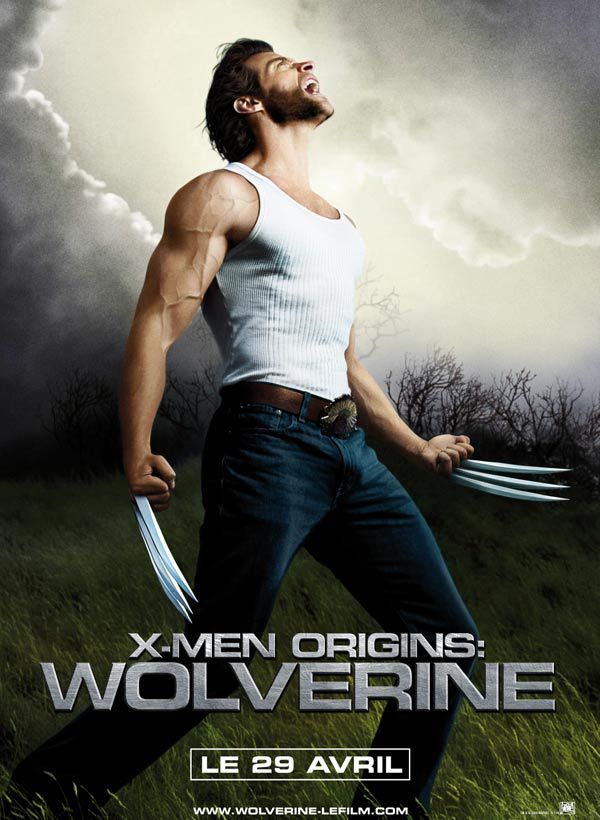
X-Men Origins: Wolverine

Shmukt!: Claws for Alarm

When the X-men movies lost its chief stylist Bryan Singer to do "Superman Returns" it was a double disappointment. "X-Men III: The Last Stand" was the most expensive movie ever made, and looked terrible. Top-heavy with stars that not only bloated the budget but capsized the script to fulfill their demands, it brought the X-series to a sad ending, x-hausted, x-cessive, and x-cremental (while "Superman Returns" felt like going to The Church of Kal-El and Klan).

Time to re-boot, so here we have, rising as he always does from his own ashes, "Wolverine Begins" with
Hugh Jackman reprising his break-out role. It's a smart move. Jackman was "the" star of the "X-men" movies and after the first, they were tailored for him, like his strategically ripped wife-beaters. One is hard-pressed to think of another movie where he is used so effectively (and succeeded at the box-office).

But this is a curious re-boot. At a time when most super-hero movies are dusting off the cliches,
"X-Men Origins: Wolverine" (the title says it all) coats itself in the dust and the muck and the mire and revels in it. For instance: there is not one, but two scenes where Jim Logan (Jackman) looks up at a conveniently omniscient overhead camera and yells his frustration to the skies and his x-communicating God.

Are you kidding me? Hasn't that shot been decommissioned after all the easy laughs it's garnered on "The Daily Show?"

It has. But nobody told director
Gavin Hood ("Rendition"). He seems unconcerned about cliches or recycled material (or "sell-past" dates), as the movie lurches like lead villain Sabretooth (Liev Schreiber, but it was Tyler Mane in the original where they didn't know each other) bounding from one bad idea to the next, linked as they are by the most mainstream of transitions—the one-to-one dissolve. We get a lot of them in the Main Title. After the Bruce-Wayne-Meets-Oedipus childhood trauma opening Hood shows the brothers Logan fighting in war after war, guns fading into guns and helmets into helmets. It's quite "artily" if unimaginatively done,* but Hood keeps using it until you start looking for the detail he might use in the transitions. Flames? Ocean waves? How about a dusk to dawn transition? That hasn't been done since...well, since I started writing this.

A lot of the problem is that
Marvel—"The House of Ideas," as it likes to trumpet—has culled so much from other stories that the whole Wolverine opus reads like a Reader's Digest Omnibus of Comic Literature. Logan gets recruited to join a Dirty X-Dozen black-ops unit, then declares himself "Wolverine no more" and becomes a lumberjack (and that's okay) until his school-teacher gal-pal is killed, and he swears revenge (cue the overhead camera and the underhanded cliche). He then submits to a "Frankenstein" experiment under the control of his former superior Stryker (Danny Huston, prequeling for Brian Cox), that coats his skeleton with indestructible adamantium. He escapes Stryker, and hides out with an old farm couple, the Kent's...er, no, the Hudson's, before being attacked—again—and hooking up with Gambit (Taylor Kitsch) for a full assault on the villain's headquarters, where like Spartacus, he leads a "mutie" revolt, that includes a young Scott Summers (Tim Pocock, looking like Ben Stiller rather than James Marsden).

There are lots of Marvel folk appearing (briefly):
Bolt, Deadpool, The Blob, Agent Zero, and Kestrel. The inconsistency with their comic-book counter-parts will drive some fan-boys nuts (not to mention Wolverine's brylcreemed pompadour from the first two films is gone, too). This fan-boy had trouble with the fights, all based on other movies: the war action from "Saving Private Ryan" (by way of "Crank"), another based on John Woo's hyper-dramatics and aerodynamics, and another, straight out of the "Star Wars" prequels.

So much recycled material to so little effect. Using the character's own
onomatopoeia, it's ten pounds of snikt!TM in a five pound bag.

"X-Men Origins: Wolverine" is a Cable-Watcher. Aaaaaaaaaaaaaahhh!

"C'mere, Kid. Got a lousy movie to show ya!"

* If you ever want to see it done to death, check out Danny DeVito's direction of "Hoffa."

** Spoiler Alert: Good place to put spoilers, isn't it? In case you think you're missing something, you're not. There's a cameo by Professor X (Patrick Stewart reprising his role), although why is Scott (Cyclops) the only guy X was reaching out to?—seems he could have contacted all the escaping mutants (because it would have killed the suspense is why), and the by-now standard "Marvel Tag" at the end of the credits is no big deal—Wolverine at a bar: "Drinking to forget?" "No. Drinking to remember." Supposedly, there are three others. If they're all that "good," don't bother collecting them all.

Wednesday, December 31, 2008

Australia

".....Crikey...."

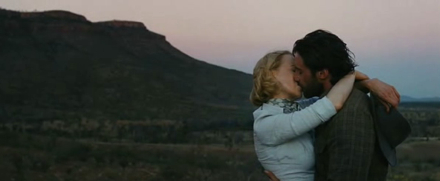
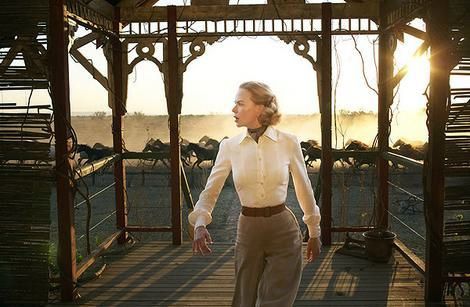
The long-in-the-planning Baz Luhrmann epic "Australia" tries to cram enough movie as it can into its nearly three hour length, combining elements of "Gone with the Wind," "Red River," "Pearl Harbor," and "Out of Africa" in a mess of a story that is big, grand, camp and as dumb as a mulga stump.

It doesn't help that
Luhrmann also cribs his style from other movies in a kind of short-hand attempt to stuff as much meaning into the thing as possible. For instance, in the most problematic section of the film—its beginning—"The Drover" (Hugh Jackman) is introduced in a series of shots cribbed from Eastwood intro's directed by Sergio Leone. Nicole Kidman's entrance is a bit like a screwball-comedy version of "Out of Africa," which is the cinematic equivalent of oil and water. In fact, rather than reminding one of the Pollack film it is more in line with the unsubtle comedy stylings of Spielberg's "1941"— which is to say, faces fill the screen with mouths agape in horror, comedy-lines are buried in the cacophany, and the main comedic engine is not surprise, but shock. The first half-hour is so full of schticky slap-stick and a frenetic cut-around style that circum-navigates what's going on screen, that it feels like you're watching the vicinity of the movie rather than the movie itself.

After Kidman's Lady Ashley arrives at the estate of "Faraway Downs," things calm down a bit, stylistically—in fact, they never go back to that early, dizzying pace. Luhrmann lets one shot stand in for the five he could have scissored together before and so the movie gains a certain amount of coherence for the rest of its run.

That's not too good a thing, as it quickly becomes a series of "Can You Top This" crises that has everything (as the
Thelma Ritter line goes) "but the bloodhounds snapping at her rear end." Pageantry stands in for plot, the villainy snears and twirls its mustache in obviousness, and the technical wizardry is of a kind that has the falseness of portraiture heavy on the air-brushed rouge. For all the cooing about the beauty of Australia, it's gussied up like a tart in church. One also gets the impression that a lot of work has gone on behind the scenes to hide imperfections. The shots of the stars galloping to stop a cattle stampede before they throw themselves off a cliff, taking an aboriginal child with them (yes, I'm not joking) are done in claustrophobic close-up, not to show the drama on their faces, but to hide the mechanical horses they seem to be riding and the computer generated back-drop that doesn't quite work.

And this is the essential problem: Baz Luhrmann is not the director for this kind of movie—he might have thought he was, since he wrote the turgid thing, but the direction is quite beyond him. Luhrmann is not a maker of epics, he takes small projects and blows them up to their maximum potential. In "Australia," he just seems lost as to which movie he's making: historical, romantic, adversarial, western, advocacy--it's all there, but trotted out one at a time as if he suddenly realizing, "Crikey, forgot the romance...
we'll do romance for a bit" Luhrmann is a man best suited on a sound-stage, not a location: under a proscenium arch, not the big sky. He's a man of the theater, and he makes everything theatrical. Under his watch, the natural doesn't stand a chance.

One is left thinking how impractical it all seems, like the entire movie is a propped-up false-front.
The costuming is designed tight to show off Kidman's shoulder blades and Jackman's pectorals but not to be in any way practical.

The one joy gleaned from the film is of Aussie film-actors from the past who shine in this:
Jack Thompson from "'Breaker' Morant," Bryan Brown who knows instinctively how to perform in a Baz Luhrmann film, big and grand, Bruce Spence, the indispensable thin-faced character actor and David Gulpilil, who has been the acting face for Australia's aboriginal people for thirty years. Seeing them is like visiting old friends.

You just wish you could have met somewhere else.

"Australia" is a cable-watcher, despite the scope and attempted grandeur.

Monday, January 14, 2008

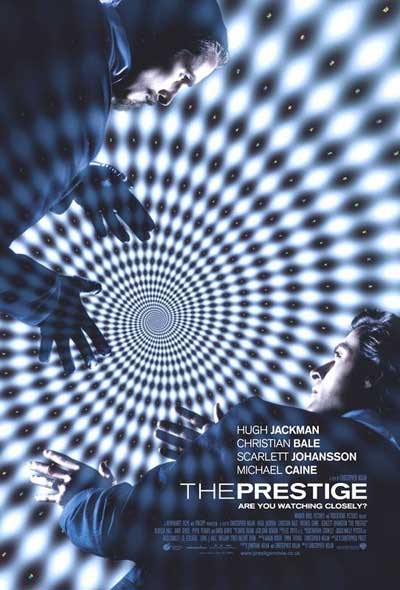
The Prestige

"Are you watching closely?" someone asks at the beginning of "The Prestige" (it would be interesting to know who whispers that at the beginning, but it's so soft and indeterminate of voice that you can't tell).

And then, while
Michael Caine explains the parts of a magic trick (The "Present," the "Turn," and "The Prestige") you're shown images, then a simple magic trick performed for a child, then, another elaborate magic trick gone awry with the murder of one main character, for which the other main character is arrested and sentenced to death.

That is the "Present" of the film, and while everything you see is absolutely true and occurs in the film, it is not what you think it to be (the "Turn") and when all is revealed (which will occur anywhere between the end of the film and a few hours after it ends) it is then it will occur to you that it is "The Prestige" that leaves you a little disappointed.

Oh, it does everything well. The period details. The terrific cast. The conceits. But, like most of
Christopher Nolan's films ("Memento," "Insomnia," "Batman Begins"), you leave not entirely satisfied, while acknowledging that it was all a terrific idea for a movie, and it sure started well...but Nolan seems to be a director who puts more care into the beginning of his films, then just sort of lets his last act "happen." He manages to tie everything up well enough, but never with any real style or a fluorish enough to enervate any audience. "Well, there it is," he seems to say at the end. C'mon, Chris. Sell it a bit more. Or give us an added context. A final ironic jab. Nope. You're left to think about it, and when you've thought it through, sing "Is That All There Is?"

I went with my sister, who's a huge
Hugh Jackman fan, and Jackman doesn't disappoint. He can be bland ("Swordfish," anyone?) or he can command (The "X-men" series) and here, he's terrific. Christian Bale, after making the star-making turn of his career with Nolan ("Batman Begins") sinks into "character actor" mode, and mumbles through a credible cockney accent that can be understood 1/2 the time (*cough*), while Michael Caine does another quietly supporting role that makes you appreciate him all the more. There's is a terrific example of stunt casting of David Bowie as Nicola Tesla that makes doesn't seem like a stunt at all, but a canny use of Bowie's exotic persona (Scarlett Johanssen's role seems more like the stunt, frankly--a 100 watt star in a 40-watt role), and Andy Serkis reminds you again how versatile he is even when actually seen.

Based on
Christopher Priest's novel (no, he's not the comic-book writer), it's a worthy project to separate Nolan's "Batman" movies.

Rating: a matinee ticket (all the better for dinner discussion).

The Fountain

Tapping a Dry Well

First off, this is the best-sounding film I've heard from 2006, with a subtle, supple sound design that makes great use of the stereo field to direct your attention. Secondly, it's one of the most beautiful--a truly different looking set-bound "green-screen" film that doesn't go for vast (and busy) pixilated papier-mache-feeling vistas ala "Sky Captain" or "The Lord of the Rings." There is a perpetually claustrophobic feel to it, despite the exotic locales that extend from an ancient Mayan temple to "the vast reaches of space."

And yet....one expects great things of a Darren Aronofsky film--not just in the images, but also in the ideas. Both "Pi" and "Requiem for a Dream" were visually and thoughtfully stunning, so one wanders into "The Fountain" expecting to be transported to new places, not only visually and aurally, but within the mind as well.


That's why I found "The Fountain" very disappointing. Though trying to say something profound, it offers up an idea so obvious that it occurs to me only every time I sit down for a meal, and that is: Out of Death comes Life. To make its point, there are three time-lines in the film--the first takes place in the present day as a researcher named Tom studies treatments of brain tumors in a frenzied race to save his wife Izzy's life. He is so bent on finding a cure that he loses all the precious moments he could be sharing with her. She is writing a fanciful book of a Spanish explorer named Tomas (wait, wait...don't get too far ahead yet. I mean, you're right. it's that obvious, but bear with me for a couple more sentences) who invades a Mayan tribe trying to find a fountain of youth (which is actually the sap of a specific tree) for his doomed queen Isobel--the story's a sort of parallel-o-gram to the researcher to wake up and see what he's missing. The next time-line features an older Tom, beneficiary of his research that has found the secret of long life (which involves the bark of a certain South American tree), in space-transit to restore his wife...from a tree... by means of the energy of a star (Xibulba) that figured in the Mayan legend of the explorer...well, everything relates--all the elements fall back on themselves in a self-referential heap.* All the Tom's of the film (portrayed by Hugh Jackman) are after Eternal Life in some form or another for their Queens...but mostly for themselves, while the Isabel/Isobel's (played by Rachel Weisz) know they will never achieve it. It takes him a near-eternity to learn that life is an eternal process (only not individually!) and that death is a necessary ingredient for it. The only original idea in the film is to state that to aspire to immortality is, rather than overcoming death, to deny the process of life and renewal. The idea should be profound, but it comes across as simplistic...and obvious. And dramatically inert. The tag-line for the film is "What If You Could Live Forever?" and the answer appears to be "Then You'd be a Selfish Bastard!"


Still, there is a sense of relief in, for once, seeing a film where death is the inevitable conclusion and you don't start whispering "So DIE already!" underneath your breath (curiously, part of the gorgeous sound-design has the film saying it for you...though not those exact words...frequently through the movie), but it did plant the seed of Elton John's "The Circle of Life" in my head for days for which it must be held accountable. And needless to say, "The Fountain" won't be at the top of the NetFlix list for the Schindler household.


The Fountain" will lose any visual splendor on the small-screen. Make it the cheapest of matinee's.

*"The Fountain" had a troubled production history. Millions of dollars were wasted in the first attempt at it (when it starred *shudder* Brad Pitt and Cate Blanchett...hmmm, now, they're in "Babel"). One can only wonder if, when re-started with half its original budget, whole sections of the screen-story that might have given it depth, were ash-canned (I haven't read Aronofsky's graphic novel, which ala Neil Gaiman's "Signal to Noise" might be closer to his original vision) which is a pity. But I don't know. Aronofsky was supposedly inspired to attempt this film by "The Matrix," which is just one more thing that overrated geek-flick needs to answer for.