Showing posts with label Raquel Welch. Show all posts

Saturday, August 10, 2013

Fantastic Voyage

Fantastic Voyage (Richard Fleischer, 1966) There has been a lot of talk recently of re-making 1966's Fantastic Voyage, a fairly interesting (if preposterous) science fiction movie of the 20th Century Fox strain, that did its damnedest to dumb down physiology and biology and make it a race against time with what were cool 60's scientific touchstones like lasers, computer typography, and Raquel Welch in a tight wet-suit (more than she apparently wore in one of the posters for the movie—oh, those mad marketing boys). 

The film is set (naturally) in the middle of the Cold War where Russian and American scientists are battling each other to develop a sustainable miniaturization process, presumably because they know small cars are in coming in the future.  Seems they can only keep things shrunk for a limited amount of time and both sides want the secret! And, as there always is, there's ONE MAN in the world who HAS THE SECRET and BOTH SIDES WANT IT!* 

<Aside> Am I just perverse or whenever one of these kinds of plots comes along, and both sides fight to get Dr. MacGuffin, wouldn't it be fun if it turns out that the guys a charlatan...or just simply wrong?** Maybe he just wanted to visit Chicago (in which case, the joke's on him)...or maybe the Russians just really wanted to get rid of him—"Here, this guy's single-handedly destroying our economy, let's give him to the Americans!!" Actually, I think some of that was in The Living Daylights</Aside>

Anyway, Dr. Benes has the secret, is defecting to the Americans and a botched Russian assassination attempt leaves him with a blood clot in his brain, and so, rather than giving him a shot of heparin (which would cost $70 in our time), our Best and Brightest Budget-Busters decide to inject a miniaturized submarine, The Proteus (designed by the Italian engineer Arturio Schlerosis), crewed by a team of experts to laser the blood clot, and book out of there before they de-miniaturize and give the guy a migraine the size of the military disbursement.

You read that and go "oh, that sounds so easy" but as with any operation, complications arise, even more than in your average Cialis commercial, and the crew must fight time, tides, detours (The Proteus didn't have Tom Tom), lack of oxygen, VERY LOUD NOISES, and a saboteur among them who's wrecked the laser-thingy—let's see, it could be Dr. Arthur Kennedy (except he was creepy in the 50's, scholarly in the 60's) or pilot William Redfield (who would be creepy in the 70's), "Rocky" couldn't play evil even if you gave her a dueling scar and a moustache to twirl, leaving only Donald Pleasence, who if agent Steve Boyd knew anything about pop culture, was every other bad guy and crackpot in movies during the 60's...when Steven Boyd wasn't playing them.


The crew has a few hang-ups removing PINK insulation whilst in an artery.
Or is that plaque?

They all get shrunk down to one micron, and are then injected into Benes' blood stream via hypodermic, and try and make their way up to the brain and its offending clot.  Arthur O'Connell and Edmond O'Brien monitor the problems of the crew in their control rooms with the obtuse monitors of blinking lights that go spitzin'/sparkin' if something goes wrong.  Sailin' along the old blood-stream, the crew wax philosophic and squabble and brainstorm and Fleischer and his actors all play this with straight faces, no matter how cheesy the sets—the ones involving full-sets look like a particularly tacky wall-paper pattern rather than a cell-wall, while the miniature travelling shots fare considerably better.  And there are red blood cells and nasty white ones, and in a Perils of Pauline moment, Raquel Welch is attacked by...either anti-bodies or cellulite, I forget which.

It's crazy stuff, and I remember reading the Isaac Asimov novel tie-in, and admiring how he worked herculean magic to make all the stuff plausible in a practical sense—for example, he wanted to make sure that every last bit of the Proteus gets out of Benes in order to prevent his head blowing up (in the movie they leave the laser rifle, the ship, all sorts of stuff), conjecturing a time differential between the shrinkees and the shrinkers, and making the issue of getting more oxygen from the lungs a LOT more complicated than the movie ever thought to do (the Proteus crew CANNOT breathe normal air, it has to be miniaturized along with them, as explained by Asimov).  It's goofy, but it was different from your typical space movie (while maintaining the tropes of sci-fi films).  I still remember it somewhat fondly, while also not taking it at all seriously.


A Fantastic Voyage poster promoting
its subject of biology


*Excuse me, I went into copywriting mode there...

** Actually, a variation of this "downer" ending was filmed—the Proteus crew did so much damage bumping into the defecting doctor's inner workings that he survives the process...but has forgotten his secret.  Insert Nelson Muntz "Ha-ha!" here.


Friday, August 8, 2008

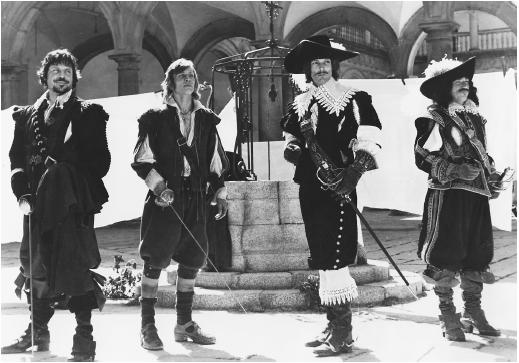
The Three Musketeers/The Four Musketeers

"The Three Musketeers: The Queen's Diamonds"/
"The Four Musketeers: Milady's Revenge"(Richard Lester, 1974/1975)
These rollicking films, originally planned as a two and a half hour epic (no matter what the Producers say!) may just be one of the best adventure films (and adaptations of a classic) ever filmed, balancing the demands of the story, the tenor of the times in which it was made and the idiosyncrasies of its director.

When approached, Lester (who hadn't made a film since "
The Bed Sitting Room" in 1969) wasn't enthused. Then he read the story, and did some research...and heartily agreed. One can see why. For "The Three Musketeers," as Lester and his screen-writer George MacDonald Fraser envisioned it is a story of intrigue in high places carried out by the lackeys and foot-soldiers who live to serve. Forget that the palace-dwellers are either snakes or dullards--they provide an opportunity for income and adventure--two qualities lacking amongst the citizens of France and England, who, at the time are at war. The opportunities for thrills, humor and pointed satire are rich and mined well by the film-makers.


Lester's direction is masterful--simple set-ups and multiple cameras used during the swash-buckling to make sure there's a glimpse of every buckled swash. And those scenes are choreographed as a group participation so that every Musketeer has "business." Lester also worked to makes sure that the fights were inelegant affairs--not balletic, but more like street-fights, with few rules and the use of landscape and surroundings as equal strategies to the sword technique (and every part of the sword is used, as opponents are sometimes conked with ornate handles).

Lester surrounds the royalty with games and idle amusements that have a slight tint of mindless cruelty to them, and that extends to the villains, whose machinations involving the Royals are merely extensions of those games, with regime-toppling consequences.

And the cast! As the musketeers, Oliver Reed as the surly Athos, Richard Chamberlain as the effete Aramis, Frank Finlay as the clownish Porthos, and Michael York as the young and naive D'Artagnan. As the Royals, Jean-Pierre Cassel as the foppish King Louis XIII, Geraldine Chaplin as the frail Queen Anna of Austria, and Simon Ward as the rakish Duke of Buckingham. As the villains, Faye Dunaway as Lady De Winter, Christopher Lee as the villainous Rochefort, and Charlton Heston in one of his best performances as the Machiavellian Cardinal Richelieu. Rounding out the cast are Raquel Welch as the Queen's seamstress, the accident-prone Constance de Bonacieux,* Spike Milligan as her randy husband, and Lester regular, the great Roy Kinnear as D'Artagnan's man-servant, Planchet. A superb cast, rarely equalled.

It's long been contended that the film was supposed to be one movie, but that the Salkind's split it into two to maximize profits. That's the rumor--there is a natural split of the film at the half-way point that feature almost all the actors for a sort-of bow, but it could have been used for an intermission. Certainly, there is less movie in "The Four Musketeers," it being padded with an "up-to-that-point" narrated prologue.

But there are two distinct stories of different tones, the first being the intrigue-filled, but relatively light-hearted "The Queen's Diamonds" story (in which Athos, Aramis and Porthos are wounded, but not killed), and the darker "Milady's Revenge" with its beheadings, extended back-story and several prominent deaths. Where Part 1 is rollicking fun with minimal consequences, the stakes in Part 2 are very high, passions flare, and the sword-play becomes deadly. The humor is darker than the first, too. Despite the same cast and crew,** the two are very different in tone.

Taken together, they have a moralist's sensibility of the costs of frivolity and duplicity; adventure can be fun, but in a poisonous political atmosphere, one adventure's at one's own risk. You can have a good time watching "The Three Musketeers," but the story is incomplete without the paid dues in "The Four Musketeers." Together, they make one of the finest adaptations of a classic novel ever put to film.

* Welch, not the most versatile of actresses, won the Golden Globe for her hilarious performance in "The Three Musketeers" and tearfully told the crowd "I've been waiting for this since "One Million Years B.C.!"

** except for the score composers--Michel Legrand for "The Three Musketeers" and Lalo Schifrin for "The Four Musketeers."