Showing posts with label James Bond. Show all posts

Tuesday, November 13, 2012

Skyfall

Once More into the Security Breach, Dear Friends...
or
"Old Dog.  New Tricks."

Bond is back, as promised, a longer wait than usual.  But with the Bond series (this is the 23rd "official" film from EON), that's usually a good thing.  After 50 years, there have been enough of the slap-dash ones that have been sub-par in order to get "product" into the theaters every biennium.  The Bond films have always been best when Cubby Broccoli's kids take a couple years to plan, take a breath and then throw themselves pell-mell into a fury of film-making that lasts less than a year, but creates something above and beyond what has been done in the past, both within the series and by its competitors.  Those interruptions usually occur with a change-over of studio or lead actor.  In this case, M-G-M's past financial cliff (if we want to be current) gave a couple more years distance between this one and its predecessor, Quantum of Solace—which entered production with an unfinished script, an overcompensation of chase scenes, and a misguided editorial effort to make the Bond series re-Bourne.  It was a decided stumble, after the brilliant series re-boot in Casino Royale, which tossed aside the easy laughs that were purloined for the "Austin Powers" movies and went back to Fleming's book (written in 1954) and found ways to make it work in a 21st Century without jet-packs.

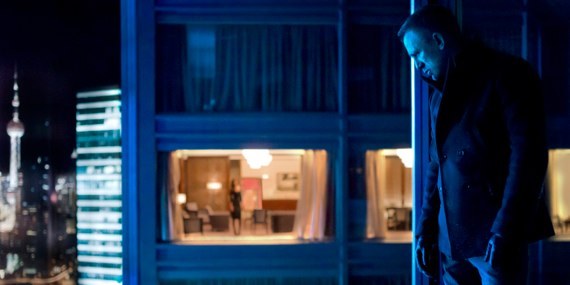
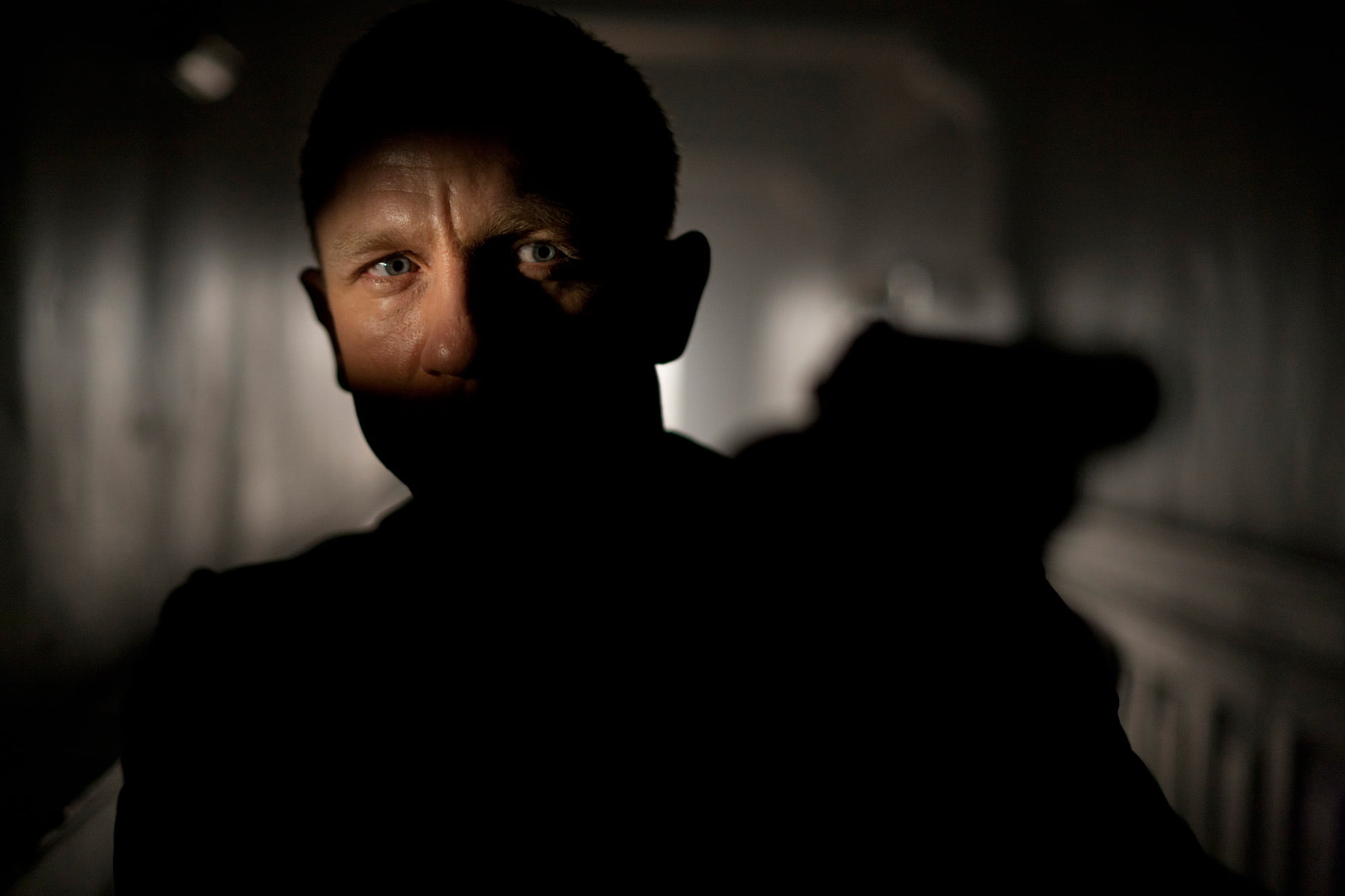
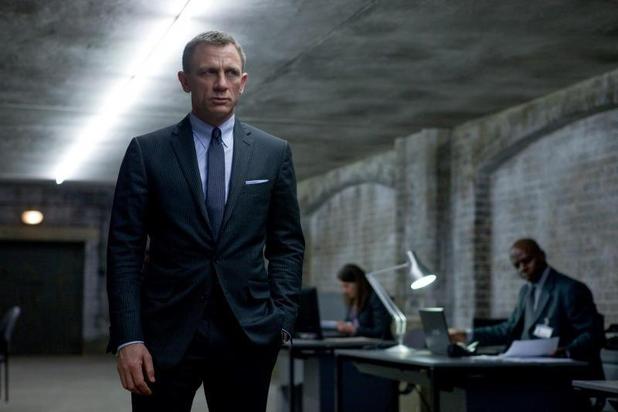
EON should take all the time it wants if something like Skyfall is the result.  Based on a story outline by Peter Morgan (The Queen), then fleshed out and re-tinkered by series regulars Purvis and Wade, and polished by John Logan, the script is a fine thriller in the odd "out-there" Bond tradition, while also making comments about the series and its relevance in the world.  And as directed by Craig-pick Sam Mendes (they'd worked together on Road to Perdition), photographed by Roger Deakins, and edited by Stuart Baird, it takes the Bond series to stylish heights it hasn't achieved in years.  This one is sumptuous, looks great, has great dialogue, and isn't one long chase from start to finish.  This one is decidedly old-school, God save the Queen.

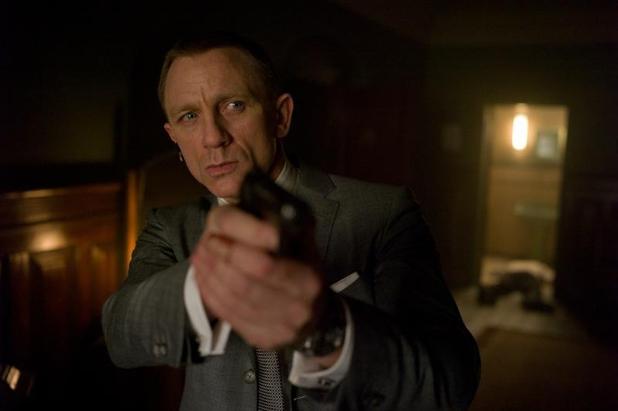
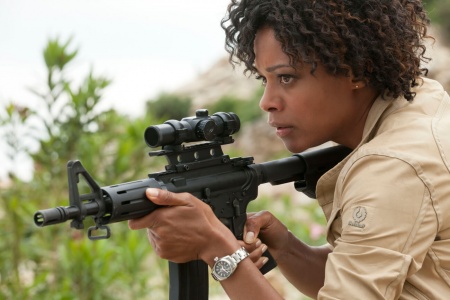
Somebody had better save her, and if Her Majesty isn't directly in danger, her stand-in, head of the Her Majesty's Secret Service, will serve.  An assassin has swiped a hard-drive with the names of embedded agents in terrorist organizations.  Two agents are dead.  One's dying, and Bond (Daniel Craig) tries to staunch his bleeding, but is rebuffed by his boss "M" (Dame Judi Dench, again) over his head-set: "Leave him."  And with a curt "Yes, mum"  Bond abandons the dying agent, miffed, but in pursuit, throughout the bazaars, streets and railways of Istanbul, with the aid of a female operative named Eve (Naomie Harris, a fine addition to the cast). It's a rough-and-tumble, messy fight with a lot of improvisation, a lot of destruction to property, old and new, and a last minute attempt by Eve to try to take out the assassin (Ola Rapace) before the train disappears into a tunnel.  But she hesitates, fearing she'll hit Bond.  "Take the bloody shot!" barks "M" and she fires, and Bond is hit, knocked off the train and falls hundreds of feet into a river, where his body is swept away.  The assassin and hard drive are gone, and so is Bond, sinking into a particularly macabre title sequence by Daniel Kleinman to Adele's defiantly melancholy title song

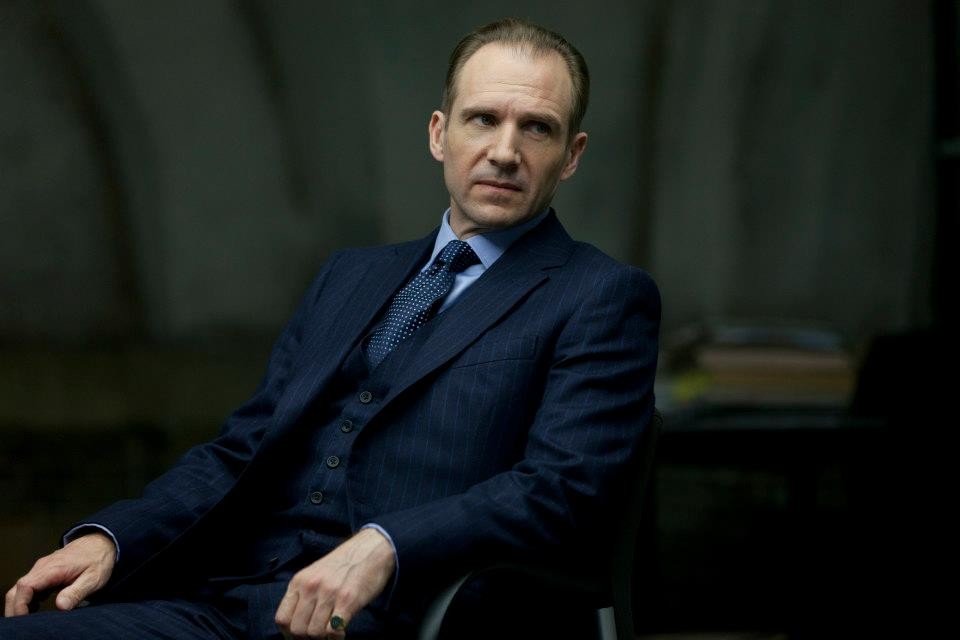
Wow.  But, we've seen this before.  Bond died (surreptitiously) in You Only Live Twice, and Fleming's novel of the same name had Bond lost in a mission,* only to have him return in the next novel "The Man with the Golden Gun," brainwashed by Soviet agents to attack MI6 headquarters and kill his boss.  That doesn't happen here, but the outcome—"M" sending 007 on a mission somewhat ill-prepared to either prove himself or die in battle—does.   As far as "M" is concerned, she's on the way out anyway, a victim of the botched operation and its ramifications in what the Minister of Intelligence (Ralph Fiennes) euphemistically calls "retirement planning."

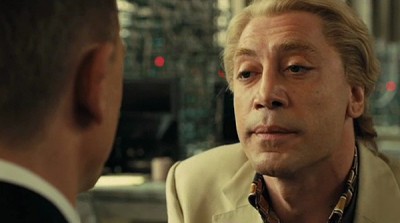
Seems that hard-drive has fallen into the wrong hands, a particularly misguided hacker named Silva (Javier Bardem), with a score to settle with MI6, exposing its agents and doing as much damage to the organization and Lady "M" as possible.  Britain's spy network is in retreat, ironically having to go to ground and reorganize with means both high-tech and historical to gain the upper hand.


Roger Deakins' cinematography is, at times, breath-taking.

That's the first 15 minutes or so of Skyfall, and one is loathe to reveal much else, even though, for a series that has depended on formula story-telling for so long, there is much that is surprising and different about this chapter.  For instance, despite the film being (as it always is) about Bond, there is much more supporting cast here with more to do than previous films in the series, more humor than previous Craig films (and not the kind of low-pun stuff that passed as humor—and writing—during the Moore and Brosnan years) with nice jabbing dialogue that doesn't just reveal plot, but attitude and character.  For instance, an MI6 analyst doing a perfunctory word-analysis on Bond (we've seen a bit of it in trailers) is a fine examination of 007's sophistication, wit and grit.  And when, later he's grilled by Silva about his hobbies, Bond says one word: "Resurrection."

Apt answer, that, but one can apply it to the entire series, as well.  Whenever the movies push the envelope on outlandishness (You Only Live Twice, Moonraker, Die Another Day) the production team steps back, takes a breather, and takes Bond back to his roots creating better than average entries (On Her Majesty's Secret Service, For Your Eyes Only, Casino Royale) and reinvigorates the possibilities of where the character and the movies can go, usually falling back on Fleming for a guide.


But the Fleming titles are gone (except for three odd ones), the stories (mostly) filmed, so Skyfall only takes inspiration from the author, specifically the novel version of "Golden Gun," and instead of the film having Bond "go rogue," this time, he does just the opposite, coming back to the fold in a time of crisis, tossed out on his mission by "M" to prove himself and the viability of the secret service and its methods.

The results are extraordinarily good, making this the best of the original movie stories not directly linked to Fleming and depending less on protracted action scenes, but emphasizing suspense and crackling good dialogue.  As "M" speechifies in her competency hearing, the targets are smaller, more dangerous, less predictable, and no longer tied to nation-states that can be manipulated by politics.  Now, it's individuals with access to disrupting vulnerable infrastructures that hold societies together and who will cause damage just to make a point.  One can draw parallels to Julian Assange (Silva uses YouTube to identify agents) and his unquestioning devotion to exposing anything and anyone—as long as it's not himself.

The cast, as it has been for awhile, is uniformly excellent.  Craig's Bond is just as steely, just as obstinate, but the actor enjoys playing him as a bit of a wreck, physically and mentally.  His Bond, after a time away, is not the man he was, and he goes through the film slightly hampered, his eyes hooded and bleary, his appearance often haggard and mussed, his demeanor prickly and defiant.  Dench has far more to do than any "M," and any past tremulousness is gone, and she's excellent in every way.  Ralph Fiennes plays his role quietly and competently with a heavy gravitas—he's a fine addition to the cast.  The Bond women, this time out, are very interesting and not just decorative: field operative Eve is cheeky and gives as good as she gets (that'll become important later), and as the femme fatale of the piece, Bérèniece Marlohe has a brief, but well-played expertise—her Severine has a dragon lady's cool, with a sex-worker's high-contrast too-bright smile that droops with a crash, revealing a trapped animal.  Ben Whishaw's "Q" is a contrast to what has gone before, far younger, far more tart than Desmond Llewelyn's court-jester toy-maker, but a whipper-snapper computer whiz.  Albert Finney has a small, pertinent role (that could have easily gone to Sean Connery, but it was thought he'd be too 'distracting," according to Mendes).  And Bardem makes his villain creepy-scary in the best tradition of the series, jolly in his evil, but believably so, cracked from his past and with an atypical physical deformity (as Fleming was wont to endow) that feels right given the context and is the stuff of nightmares.

After a high-powered finale—yes, things blow up as they do in Bond films, but not the way one expects—and by the end, Bond truly has gone back to his roots, as anyone who's looked at  the early Bonds will be able to tell, with ghosts left behind, family in place, and tradition—the old ways—firmly established.  Bond is back, and will be back.  With pleasure.

Can't wait.


Skyfall is a Full-Price Ticket.


"...the things we do for England..."


* Fleming killed Bond off twice...at least left readers on the edge of their last pages—in "From Russia With Love" and "You Only Live Twice," and one suspects he had the same love/hate relationship with his character as Arthur Conan Doyle did with Sherlock Holmes, killing him off over the Reichenberg Falls, then returning him years later, at readers' request.

Thursday, October 11, 2012

Now I've Seen Everything Dept.: (Update) James Bond

Dossier: The James Bond Series

No one knew—nobody, not the stars, not the producers—that when Dr. No hit theater screens in 1962, there would still be an audience for James Bond films fifty years later—and that they would be making more money than ever. Producers Harry Saltzman and Albert R. Broccoli were in it for the short term windfall—they were in the movie business, after all—and never expected the series to last more than ten years.

But the series endured, outlasting the stars, the producers (and distributing movie studios!), the Cold War around which they were based, and every journalist-naysayer who thought it was long since time for the series to cash in its chips and retire for the evening. The only thing that's stayed the same—The Queen and Country.
James Bond must be doing something right.

So did the series creators. They took Fleming's sado-mysoginist bulldog and wrapped him in mink and precious metals. Initial director
Terence Young brought the style, and first "official" Bond, Sean Connery, and he conspired to give Bond his flip humor, something the whole team began utilizing in the second film, From Russia With Love. By the third film, they were trading buzz-saws for lazer-beams and the films left the novels' grit behind for immaculate stainless steel villainy. Fleming's "blunt instrument" was all but forgotten in the stunts and vast expanses of chrome.

It only took forty years but somehow the producers and the audience have come together to bring Fleming's Bond to the silver-screen and see it succeed. Dr. No changed Fleming to increase the laughs and entertainment quotient and as long as the movies were in the Swingin' 60's it seemed to work. But once the '60's and the series' Rosetta Stone--Connery--passed, the movies and Fleming parted company to provide audiences with bread, circuses and gadgets-up-the-tailpipe jalopies. When attempts were made to take Bond back to his graying roots--with OHMSS and Licence To Kill--the poor box-office had the producers fleeing back to their bullet-proof tuxedos. But, finally, with an official adaptation of the very first novel, everyone seems to be on the same page...and fortunately it's one written by Ian Fleming.

We look back (in a terse writing short-hand and colorful titles) at the series, it's forebearers, pretenders and cousins, and rate just how many zeroes each has earned. They are grouped by who's in the barrell at the time.
*


Casino Royale (Brown, 1954) This one-hour adaptation for live-television's "Climax!" series starred Barry Nelson as "card-sharp" "Jimmy" Bond (American) taking on LeChiffre played by Peter Lorre. Primitive, a bit ill-timed in execution, it is a fairly faithful adaptation of Fleming's story although some liberties had to be taken (Bond's torture: tied up in a bathtub, his toes crushed by pliers (Ah, The Golden Age of Television), Bond never questions his assignment, Vesper lives). A not bad first attempt, but not great, either.
00


Dr. No (Terence Young, 1962) Sean Connery plays James Bond, Joseph Wiseman is Dr. No, Ursula Andress is...impressive. Armed with a $1 million budget, Bond comes to the big-screen with a heavy injection of humor, a lot more implied sexual activity than in the novel, and a genuinely nasty streak in violence. Bernard Lee plays Bond boss "M" with a heavy layer of crust. Bond gets his Walther PPK and ends up in a boat with the girl at the end. Connery's rough around the edges with a soft purr to his voice. Director Terence Young has put a lot of grit into the movie, and Peter Hunt's slash-and-burn editing keeps things moving faster than your normal adventure flick. It's also a bit of a send-up of your normal adventure flick--Ken Adam's flamboyant sets being the most obvious evidence of so many tongues in cheeks. The music is laughable except for John Barry's arrangement of "The James Bond Theme" which is used so much it nearly out-wears its welcome. Introduces S.P.E.C.T.R.E., a world-wide terrorism outfit as a stand-in for the Soviet Union (the producers wanted to court it as a market).
0000000


From Russia With Love (Young, 1963) What is Fleming's best novel is given a couple extra surprises mostly in Soviet spies working as double-agents for SPECTRE-chief Blofeld (whose face is not revealed). Casting is top-notch: Lotte Lenya as spy-chief Rosa Klebb, Pedro Armedariz as Our Man in Instanbul, but best of all is Robert Shaw as Grant, assigned to assassinate Bond and discredit him. The Shaw/Connery scenes are genuinely tense culminating in a no-holds-barred fight in the close-quarters of a railroad car. Some spectacular stunt work--and a scene where Bond is pursued amidst hill-tops by a grenade-launching helicopter becomes iconic, which is a nod and a wink to Hitchcock. "Q" is introduced. Bond ends up with girl in boat.
0000000


Goldfinger (Guy Hamilton, 1964) There are still thrills, but an extra coat of polish and humor is given this one, which also improves on Fleming, ditching his caper for one that's a bit more practical and scarier. Connery throws in more comic bits of business and plays it a bit more detached, probably because his Bond is a bit passive in the detecting department. Lots more gadgets. That car. That laser. Oddjob and his lethal derby. That little old lady with the machine-gun. Pussy Galore starts the trend towards eye-rolling names. Extended battle sequence at Fort Knox is the first extended battle sequence to climax the movie.
0000000


Thunderball (Young, 1965) Gadgets and locales start to crowd out Connery and for the first time, the movie seems like a let-down from Fleming. Starts with a jet-pack escape and ends with an underwater battle sequence that seems to go on forever--underwater ballet with spear-guns. So does the central atom-bomb hijacking that sets the plot...well, one is attempted to say "in motion" but it stops the movie cold. SPECTRE and the man with the cat is back. Connery appears iritated at times. But it is the all-time Bond box-office camp (adjusted for inflation). Bond ends up with girl in boat (until they're whisked away by air-sea rescue, see what I mean about the gadgets?)
00000


Casino Royale (Hughes, et al., 1967) Tiresome spoof with an all-star cast (David Niven, Peter Sellers, Orson Welles, Ursula Andress, Woody Allen...Woody Allen?) "Hellzapoppin'" Bond. If only it were funnier. Everyone ends up in Hell (deservedly, I thought) Audience only feels like it.
0


You Only Live Twice (Lewis Gilbert, 1967) Bond goes to Japan to stop hi-jacked space capsules. SPECTRE's secret HQ is in a big hollowed-out volcano that regularly launches rockets and helicopters. Right, no one'll notice. Finally see Blofeld and it's Donald Pleasance with one nasty scar and the voice of a braying chihuahua. Script logic and any resemblance to the Fleming story go down the ol' lava-tube. Connery hits his marks professionally, but that's about it. Big ninja attack in the volcano!! Goes...on...forever. Bond ends up with girl in a raft.
0000


On Her Majesty's Secret Service (Peter Hunt, 1969) Connery's gone, but not for good. George Lazenby is Bond...only semi-good. He looks fine in stunts but so does a 2x4 when used right. Editor Peter Hunt directs with an eye toward more color and a pell-mell style. Bond undercover to track down Blofeld who's now Telly Savalas. Bond falls in love with Diana Rigg who's groovy, baby. Lots of good skiing action. One bad love-montage with music. No gadgets to be seen. Nice crisp attack on mountain-top HQ, then a big wedding. Bond ends up with dead wife in his car.
000000


Diamonds Are Forever (Hamilton, 1971) Connery's back, jowlier and with a grayer toupee. Camp abounds. Effete Blofeld. Gay hoodlums. Big diamond laser thingy in sky. Played for laffs (what else can you do with Jill St. John as the Bond-girl), but some good jokey dialog still manages to surface. A none-too-impressive final battle on an offshore oil rig. Bond ends up on ocean liner with girl.
0000


Live and Let Die (Hamilton, 1973) Roger Moore is Bond, and kinda mannequins his way through it. Racist little plot, but a bit more hip than racist little book. Yaphet Kotto is not sure what movie he's in, can't maintain an attitude. Jane Seymour's not sure what movie she's in, feels she has to act. More chases, less material stringing movie together. Looking a little threadbare. Bond ends up with girl on train.
0000


The Man with the Golden Gun (Hamilton, 1974) Moore's back and is a little meaner which is hard to believe. Cristopher Lee would have been a terrific Scaramanga in another movie--here he's a bit too cheery. Britt Ekland is the bottom of the barrel for Bond-girls. But is better than Herve Vellechaize as hench-thing. Exotic locales. Energy "crisis" plot (in 1975!) Highpoint is barrell-rolling car stunt across river. Still looks amazing. Bond ends up with girl in junk. Precisely!
000


The Spy Who Loved Me (Gilbert, 1977) Moore at his best, but Bond-by-formula. Lazy writing. Too-easy seductions. Bond has it too easy all the way. Jaws--"Nuff said." Chase after chase with a plot spray-painted from the "You Only Live Twice" stencil. Marvin Hamlisch score feels like "James Bond! The Musical!" Barbara Bach plastic-pretty. But that's a great stunt in the open. Good will of that can't sustain the movie. Bond ends up with girl in bath-o-sub-escape-thing.
000


Moonraker (Gilbert, 1979) Moore is less. Very lazy writing. Venice sequence with hover-craft gondola and double-taking pigeons. Space movie with ray-gun shoot-out. Jaws falls in love with Pippi Longstocking. Bond-girl's name is Holly Goodhead (and she's supposed to be taken seriously?). Bond ends up with girl in orbit. Shoulda stayed there.
00

For Your Eyes Only (John Glen, 1981) More plot. Less stunts. Moore's starting to show age. Great climbing sequence. Borrowed bit from Fleming's "Live and Let Die" works well. Major ick factor as under-age gymnast Lynn-Holly Johnson hits on grand-dad Moore. Topol makes a good ally though he chews a lot of scenery. Bond ends up with girl on boat.
0000


Octopussy (Glen, 1983) A lot of plot partly written by George MacDonald Fraser. Some good moments, especially those involving a radical Russian General (Steven Berkoff). Moore dressed as clown disarming nuclear bomb feels...natural. Maud Adams, a bit stiff. Louis Jordan, a bit ripe. Fight outside a plane in flight a bit preposterous. Bond ends up with girl on boat.
000


Never Say Never Again (Irvin Kershner, 1983) Connery back. Writer Lorenzo Semple (Batman television series) briefly uses the "age" thing but then returns to Bond as elder stuntsman. Great cast with Kim Basinger, Klaus Maria Brandauer (superb!), Max Von Sydow, Edward Fox and an over the top Barbara Carrera (never better). Borrowed "Thunderball" plot with some 80's relics (Bond and villain "duel" over a video game?) . Last third of the movie is slipshod and rushed. Time to say "Never Again." Bond ends up with girl in a therapeutic hot-tub. Good choice.
000


A View to a Kill (Glen, 1985) Speaking of not coming back. Roger Moore's last outing and its irritating. It's fun to have Christopher Walken (as the villain) and Patrick MacNee (as a disposable field operative), but not to have Grace Jones and Tanya Roberts (who's particularly grating). Oddly unexciting film about a plot to cause The Big California Earthquake. Villain's a genius who produces computer chips, but doesn't seem to realize he's trying to kill a sizable chunk of his customer base. Hmmm. Starts with a chase at the Eiffel Tower. Ends with a fight at the Golden Gate Bridge. After all that, Bond ends up with girl in a shower. Moore leaves, all washed up.
00


The Living Daylights (Glen, 1987) Timothy Dalton is Bond and a good one. Harkening back to Fleming, this 007 taking the job VERY seriously and not liking it much. Though Dalton is king of romantic mini-series, he tones it down here. Bit of a cad, in fact. And sometimes barely in control. Great pre-credit sequence on Gibraltar. Possibly best fight in series and Bond's not in it. Good cast with Jeroen Crabbe as The Villain, and Joe Don Baker as the literal heavy (subsisting on scenery, I think) Bond ends up with girl...in dressing room.
000000

Licence To Kill (Glen, 1989) Borrowed bits from Fleming in a story about a drug king-pin who maims Felix Leiter, Bond's pal in the CIA. Bond quits MI6 and goes rogue for revenge. Feels like Fleming, but doesn't feel like Bond. Bond-girls are a bit token-tough. Villain has best lines. A very young Benecio DelToro shows up as villain's creepy, weasley assistant. Sub-plot of a televangelist as a drug marketer is mean-spirited/funny, but ruined by the casting of Wayne Newton. A guy gets exploded in a pressure chamber but Newton is ickier. Extended action sequence with 18-wheelers goes on far too long. Bond ends up with girl in a swimming pool.
00000


Goldeneye (Martin Campbell, 1995) After a seven year hiatus where most of the old Bond-team die, Bond returns. Pierce Brosnan makes a dapper, very crisp Bond and his introduction in the pre-credits in terrific. Casting of unfamiliar names (except for Sean Bean and Famke Janssen as the villains) with fine acting chops helps push Brosnan to the forefront. Bond-girl can ACT!! And she's the one who saves the day! Dame Judi Dench is the female "M" (she's squinty-eyed/prickly), Allan Cumming is a Russian computer-nerd, Joe Don Baker is back as an ally, Michael Kitchen as M's Chief of Staff and Robbie Coltrane and Minnie Driver show up in cameos. Another too-long finale. Great CGI credit sequence. Horrible score by Eric Serra that electronically pulses with sampled clanking between "oohs" and "aahs." Bond ends up with girl...in a military helicopter.
00000


Tomorrow Never Dies (Roger Spottiswoode, 1997) Brosnan again, but a slightly devalued Bond. Plot's about a media mogul who makes his own conflict-headlines. A bit over-written in places. Too many worthless chases. Jonathan Pryce makes an ineffectual villain. Teri Hatcher shows up briefly and is killed. Michelle Yeoh kicks things up as Chinese agent. Odd little sequence with Vincent Schiavelli as assassination specialist Dr. Kaufmann. As soon as garage-chase ends, it all goes downhill. Final battle on "stealth-boat" in interminable. Bond ends up with girl...on pieces of a boat.
000


The World is Not Enough (Michael Apted, 1999) Longest pre-credits sequence in Bond history makes a slight kerfluffle of the story, but Bond has to protect an oil heiress from an international terrorist who had previously kidnapped her. Robert Carlyle is largely wasted but Sophie Marceau makes the best of a confusedly-written part. Denise Richards is a nuclear physicist named "Christmas" (oh, the possibilities are endless) Old "Q" leaves, and new "Q" is John Cleese and hardly a "harrumph" is skipped. Dramatically a bit inert. Bond ends up with girl in Turkey... after exiting a too-long submarine sequence. Brosnan-Richards romance feels a bit icky.
0000


Die Another Day (Lee Tamahori, 2002) Starts out promisingly: Bond is captured by North Korea and held prisoner and tortured while 9-11 happens. Traded and discredited but escapes own services' captivity to start an investigation in Cuba. Then Halle Berry shows up and it all goes horribly...horribly wrong. Bond's Greatest Hits Done Poorly. Laser satellite. Car chase on ice. The thing is like a steroid-pumped video game (which probably was the idea). Snarky villain. Madonna title-song and..urk..cameo. Awful. Bond ends up with girl in Korean prayer temple. Protests ensue. Wanted to grab a sign and join them.
00


Casino Royale (Campbell, 2005) Full review here. Brosnan out/Daniel Craig in. Great script. Great action. Out-Flemings Fleming. Somehow makes Bond work for post-9-11 world in the same way he worked for the Cold War. Terrific cast. Eva Green shines as love-interest. No gadgets. Bond ends up with-OUT girl...on a boat.
0000000


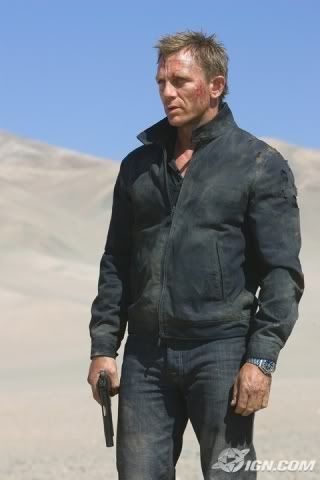
Quantum of Solace (Marc Forster, 2008) Settles into the same formula, though there are bright spots, good cast of actors who all try to do their best with the material. However, the emotions are dictated in short-hand, the script scrimps on the dialogue, and the plot pin-balls from action sequence to action sequence, ala the tepid "Live and Let Die." While those action sequences are spectacularly conceived, they're filmed obliquely and edited horribly—almost incompetently, without a sense of context. Blink and you'll miss three shots. More Fleming, and less frenzy, please.  Bond ends up alone. 0000

As the Bond series hits its fiftieth year, there is a new film opening next month, entitled Skyfall (maybe you've heard of it): Daniel Craig is still Bond, Sam Mendes (American Beauty, Road to PerditionRevolutionary Road) directs and the story idea is by Peter Morgan (The QueenThe Last King of Scotland, Frost/Nixon, The Damned United), scripted by regulars Purvis and Wade and John Logan (Gladiator, Star Trek: Nemesis, Rango, Hugo). Joining Craig and Judi Dench are Javier Bardem, Ralph Fiennes, and Albert Finney.  Pretty high pedigree for a pulp series. The only sure thing? As every official film has promised: "James Bond Will Return..."


* The gunbarrel-walk has been a consistent part of the Bond series, usually introducing the films (although the Daniel Craig films have mixed it up a bit). All the actors now do it, although the man firing in the first three "official" films is stunt-man Robert Simmons. Sean Connery did his first gunbarrel with Thunderball. Roger Moore did two—he wore a suit in his first two movies, then a bell-bottomed tuxedo (it was the fashioned-challenged 70's, after all, poor Roger). George Lazenby, as he was the Bond who got married in his one Bond film, goes down on one knee to fire—and disappears in the blood-wash. 


Wednesday, October 10, 2012

Quantum of Solace Revisited

Cutting to the Chase
or
"Once More into the Cuisinart, Dear Friends"


When last we left James Bond, newly double-0'd agent On Her Majesty's Secret Service, he was nursing a broken heart and the betrayal by his lover, by the one way that he knew to ease the pain--shooting someone in the leg with an assault rifle.

After the success of
Casino Royale, the last complete James Bond novel not to be given an "official" film version, and the revival of the franchise with the casting of Daniel Craig, one had to wonder what the producers would do for an encore.


Or a sequel.
Quantum of Solace* takes place 30 minutes after the ending of Casino Royale, (in mid-car-chase) with Bond going "rogue" and seeking revenge.**
It's the first "true" sequel in the Bond series--all of them previously being stand-alone stories, where for budgetary or scheduling reasons, the secondary characters --like CIA agent Felix Leiter--would be played by different people from movie to movie.

Here, things are consistent: Jeffrey Wright again plays Leiter, Giancarlo Giannini returns as Rene Mathis as does Judi Dench as "M." And the mysterious Mr. White (Jesper Christensen), behind so much of Bond's troubles last film is in the rather bumpy custody of MI6, where he drops the news that there's a world-wide criminal organization that the Brits aren't even aware of, presumably the one financing the bombing of the Skyway jet, the funding of "freedom fighters," and high stakes poker games from the last film. Apparently these activities are so "under the radar" that the world's network of spies--and in this film even Bolivia has a Secret Service--hasn't noticed. But that is just a wild goose chase to Bond achieving that quantum of solace about the events of Casino Royale.

One could go on and on with the trivial aspects of QOS, but in broad strokes, one can answer the entreaties of those who couldn't wait for the next installment last time. No, it isn't as good as the last one;  Casino Royale was one of the best film in the series (this is No. 22 of the "official" Bond films), even after the perspective of a couple years.

Does Bond find out the answers to the questions he's seeking? Yeah, for all the good it does us. We spend 95% going down a blind alley--at 90 miles an hour, with a shaking camera pointed aimlessly and an average edit length of half a second. More on that in a moment.


Does Daniel Craig take off his shirt? Yes, all too briefly for some, I'm sure.

The dialog is crisp and also very, very brief. The acting is uniformly good, with particular mention of Craig,
Dench, and Giannini. Even the "Bond girls," traditionally where the Bond films fall down in the presentation category, can act: former model Olga Kurylenko is quite good, using a cat-walk scowl as the basis of her performance; and Gemma Arterton is pert, spunky...and sadly disposable. Mathieu Amalric--so good in The Diving Bell and the Butterfly--makes the most of his reptilian looks, as a sort of bug-eyed Roman Polanski.***


All well and good. The film feels like a less goofy version of the Roger Moore Bonds where outlandishness is the order of the day, but without the obvious winking. There are some lighter moments (and Craig makes the most of them) but most of it is played with deadly earnest. One expects to get lost in some details along the way by the orange light of the explosions. Indeed, two of the major players in this film are brought up and never mentioned again.****

But there is a major problem with Quantum... which dims the viewing experience, that being the slap-dash way that director Marc Forster and his second unit director Dan Bradley (who stunt coordinated the "Bourne" and last couple "Spiderman" movies) have staged and assembled the action sequences--and there are a lot of them--on land, sea, air, and fire, by foot and all manner of motorized vehicles. These sequences are nearly incomprehensible, with a rapid pace that does not allow the distinguishing of any participant or the context in which they're being done. A good action director allows the time to register surroundings and environment, and provides the context of relationship--who's doing what to whom and where. It's that information that provides suspense. Without that information, it's just fleeting images that don't add up—in other words, a trailer. What Forster and Bradley may be trying to do is put the audience in the same dizzying, disoriented position as Bond, but even then, there are times when there isn't enough context to inspire alarm. At one point, in one of the hand to hand fights it becomes apparent that, suddenly, one of the combatants has acquired an axe. There was just enough time for me to register that perhaps the film would be better if it were edited with that. The shame is that a lot of work went into these sequences--QOS is the most expensive Bond film while simultaneously being the shortest--and a couple of marvelous shots that literally tumble along with Bond merely disorient, rather than thrill, as you're not allowed to see the original position from where these shots start. At the end of it all, you're left with a battered Bond but absolutely no idea how he got that way.

This is a major mis-step. These are suspense films, after all. But in pushing the envelope of how fast to take these action sequences, post-Bourne, the film-makers have reached the point where they are no longer telling a story, no longer communicating with the audience, at which point they've failed in their own mission.

I'm not even sure what is to be gained by seeing Quantum of Solace in a theater, even in the back row. The best way to get anything out of the action is to watch it at a slower speed on DVD.


Hence, "Quantum of Solace" is a Rental.


Two of examples of the subliminal editing style of Quantum of Solace.


* The name is taken from a Fleming Bond short story in which Bond merely sits and listens to a tale of a marriage turned ruinous, and a "quantum of solace" is the smallest particle of comfort one can derive to keep it going. The only Bond titles left to be used are "Risico," "The Property of a Lady," "The Hildebrand Rarity," and "James Bond in New York," none of which is a "grabber" of a title, or would make a good song. But then, who thought you could do anything with Thunderball? Passing a reader-board for another theater en route to the Cinerama, it read simply "007."

** "What, he's gone 'rogue' again?" is what a friend said after seeing the trailer. Bond had already done something similar in the Timothy Dalton-starring Licence To Kill, which combined equal parts "Miami Vice," Yojimbo, and elements of the Fleming novel, "Live and Let Die."'


*** Director Marc Forster used directors Guillermo del Toro and Robert Rodriguez as voice-actors on this film, and the "director" connection applies to a henchman called "Elvis" who reminds one of Quentin Tarentino. What with the "colorful" names of the villains, ala Resevoir Dogs and the producers' history with QT--he famously announced that he wanted to make "Casino Royale" with Pierce Brosnan and griped about not getting the chance--it wouldn't be too far afield to think he was being tweaked.


**** I've since been told by one of the "Opening Night Regulars" I see the Bond's with, that a sequence resolving their stories (all one minute of it) was left on the cutting room floor, giving the producers a chance to start afresh next film, rather than continue with yet another sequel
.